




Could a coronavirus vaccine be approved by Thanksgiving?
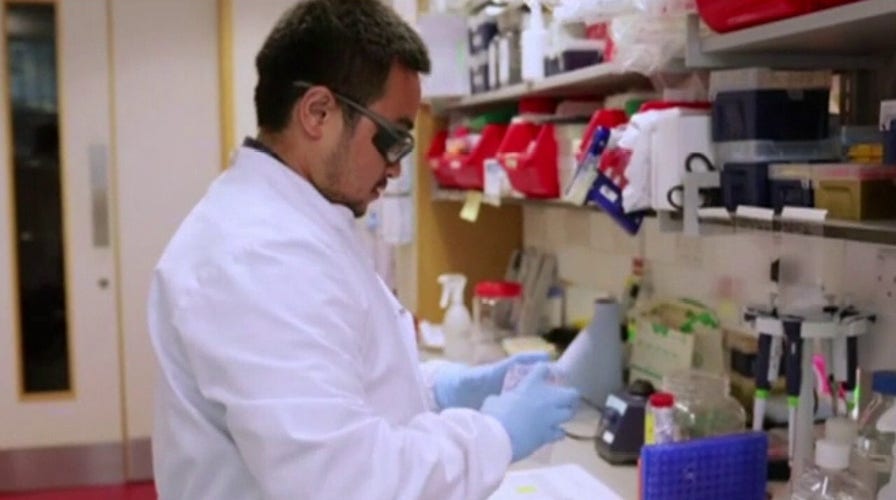
Operation Warp Speed scientific head Moncef Slaoui lays out the timeline on 'The Story'
Oct. 13, 2020 – This is a rush transcript from “The Story with Martha MacCallum” October 13, 2020. This copy may not be in its final form and may be updated.
SEN. KAMALA HARRIS (D-CA), VICE PRESIDENTIAL NOMINEE: Companies refusing to cover mental health care, insurance companies refusing to cover maternity camp, no free mammograms, cancer screenings or birth control. Insurance companies reinstating annual and lifetime camps and more than 20 million Americans losing insurance at the worst possible time, again in the midst of a pandemic, including nearly two million Texans, 607,000 North Carolinians, 288,000 South Carolinians, 227,000 Iowans and 4.2 million Californians.
And the pain of losing these protections would disproportionately be felt among the 9 million African American, Latino, Asian and Native Americans who gained coverage under the Affordable Care Act. But this isn't about statistics. This is about millions of real people living real lives who deserve their government and its institutions to see them and to heed their call.
And I know a Republican member of this committee said earlier today that the people who will lose health care are somehow not relevant to this hearing. I disagree. Helping these people is supposed to be why we are all here, why we all ran for office in the first place. And I'm here to fight for people like Felicia Perez. And this is her.
Felicia is a writer, a public speaker and former high school teacher from Southern California who now teaches at the University of Nevada, Reno. She has multiple pre-existing conditions including arthritis, asthma and a rare autoimmune disorder that caused tumors that have wrapped around her optic nerve and part of her brain. Her life depends on periodic cancer fighting infusions that cost $160,000 a year.
Felicia is terrified. She knows that without the Affordable Care Act, she could not afford ongoing treatment, the treatment she needs to stay alive.
And here's exactly what she said, and I will quote. My life is in the hands of people I do not know, who do not know me, who are essentially telling me I don't matter, that my life doesn't matter, that my health doesn't matter, that the day-to-day quality of my life doesn't matter. And that's really hard.
Tragically, Felicia's story is not unique. Her fears are shared by millions of Americans, the Affordable Care Act and its protections hinge on this Supreme Court and the outcome of this hearing.
Before being elected, President Trump promised that every justice he put forward will do the right thing unlike Bush's appointee John Roberts on Obamacare. Judge Barrett, 18 months later, you criticized the chief justice for upholding the Affordable Care Act when you concluded, Chief Justice Roberts pushed the Affordable Care Act beyond its plausible meaning to save the statute.
My question is, how many months after you published that article, did President Trump nominate you to be a judge on the Court of Appeals?
JUDGE AMY CONEY BARRETT, SUPREME COURT JUSTICE NOMINEE: Senator Harris, I apologize, I don't remember the timing of that article. I was nominated. I believe my nomination to the Court of Appeals was announced in May of 2017.
HARRIS: That's correct.
BARRETT: But I don't remember when the article came out.
BARRETT: The article was published in January of 2017, so that would have been five months later. Justice Ginsburg, whose seat you are seeking to fill, provided the critical fifth vote in a five-four decision that upheld the Affordable Care Act. So, let's lay this out for everyone who's watching.
As I have discussed previously, one, Republicans have spent a decade trying to destroy the Affordable Care Act. Two, Donald Trump promised to name a Supreme Court justice and Supreme Court justices who would tear down the Affordable Care Act. Three, President Trump is before the Supreme Court right now arguing that it'd be struck in its entirety. Four, the Supreme Court could be just one vote away from overturning the Affordable Care Act and all of its protections, including for everyone who has a pre-existing condition or may have a pre-existing condition.
In other words, the Affordable Care Act and all its protections hinge on this seat and the outcome of this hearing, and I believe it's very important that the American people understand the issues at stake and what's at play.
Judge Barrett, the day after President Trump announced your nomination to the Supreme Court. He tweeted, Obamacare will be replaced with a much better and far cheaper alternative if it is terminated in the Supreme Court. But in reality, there is no alternative that protects the millions of Americans who depend on the Affordable Care Act every day.
The horrifying truth is that President Trump and the Republicans and Congress are fighting to take health care away from the American people in the middle of a pandemic, as I have said, President Trump has said that he wants to protect the American people's health care. But the reality is right now he is asking the Supreme Court to take it away.
Senator Klobuchar, Judge Barrett asked you earlier today, but did not receive an answer. Prior to your nomination, were you aware of President Trump's statements committing to nominate judges who will strike down the Affordable Care Act? And I appreciate a yes or no answer, please.
BARRETT: Well, Senator Harris, wouldn't it be very, very careful, I'm under oath. As I'm sitting here, I don't recall seeing those statements. But if - let's see, I don't recall seeing or hearing those statements, but I don't really know what context they were in. So, I guess I can't really definitively give you a yes or no answer. What I would like to say is, I don't recall hearing about or seeing such statements.
HARRIS: Well, I imagine you were surrounded by a team of folks that helped prepare you for this nomination hearing.
BARRETT: I have had - yes.
HARRIS: Let me finish if you don't mind.
BARRETT: I'm so sorry.
HARRIS: Did they inform you of the president's statements and that this might be a question that was presented to during the course of this hearing?
BARRETT: When I had my calls with senators, it came up many of the Democratic senators wanted to know about the Affordable Care Act and to satisfy themselves that I had not made any pre-commitments to the president about it.
HARRIS: And so, you then became aware of the president's statement, is that correct?
BARRETT: Let's say, Senator Harris, in the context of these conversations, I honestly can't remember whether senators framed the questions in the context of President Trump's comments. Perhaps so. I think from my perspective, the most important thing is to say that I have never made a commitment. I've never been asked to make a commitment. And I hope that the committee would trust in my integrity not to even entertain such an idea.
And then I wouldn't violate my oath if I were confirmed and heard that case.
HARRIS: So, just so I'm clear and then we can move on. Are you saying that you are now before I said it, aware or not aware that President Trump made these comments about who he would nominate to the United States Supreme Court?
BARRETT: Senator Harris, what I was saying, I thought you initially framed the question as whether I was aware before this nomination process began.
And my answer to that--
HARRIS: If you are aware, were you aware before this hearing began?
BARRETT: So, you're changing - you're asking me now whether I was aware before the hearing began?
HARRIS: As a follow-up question, I am. Yes.
BARRETT: And what I said was that when I had my calls with Democratic senators, this question came up and I don't recall, but it may well have been that they referenced those comments in the course of those calls. Even if so, that wasn't something that I heard or saw directly by reading it myself.
HARRIS: Senator Leahy asked you earlier today, but I think it bears repeating, do you think it is important for the American people to believe that Supreme Court justices are independent and fair and impartial and that is a yes or no answer, please?
BARRETT: Yes, Senator Harris.
HARRIS: A number of my colleagues have asked you today whether you would recuse yourself from cases on the Affordable Care Act. You did not directly answer their questions, and instead you described a process by which that would work or happen. And so, my question is, isn't it true that at the end of that process, regardless of that process, that it would be you who ultimately would make the decision about whether or not you would recuse yourself?
BARRETT: That is true. And I can't have you elicit a commitment from me about how I would make that decision in advance. That would be wrong.
HARRIS: Right. And what I've asked you is that is it not correct that that is the process, but ultimately it would be you and you alone that would make the decision about whether you would be recused. You've already opined on the constitutionality of the Affordable Care Act. And that position satisfied the president's promise to only nominate judges who would tear down the Affordable Care Act and that position satisfied the president's promise to only nominate judges who would tear down the Affordable Care Act.
And Senate Republicans rushed this process so that you could rule on this very case. The reasonable question about your impartiality will undoubtedly hang over this court's ultimate decision in the Affordable Care Act case if you refuse to recuse yourself. I strongly believe that.
Supreme Court justices routinely consider the consequences of their decisions on people's lives. Earlier this year, the Supreme Court ruled against President Trump in his effort to repeal DACA protections for Dreamers. Children, of course, who have arrived in the United States many before they could talk or walk.
Chief Justice Roberts wrote the opinion for five-four majority that included the crucial vote of Justice Ruth Bader Ginsburg. The court rejected the Trump administration's attempt to end protections for Dreamers. Chief Justice Roberts said the administration had not taken into consideration the fact that many Dreamers rely on those protections when they started their careers and businesses, when they served in the military of the United States, when they bought homes and when they started families.
Senator Hirono asked you whether it is appropriate for a Supreme Court justice to consider real world impacts, but you're a sitting judge now. So, my question is in deciding whether to uphold government action, do you currently consider the consequences of your rulings on people's lives?
BARRETT: Well, Senator Harris, that's part of the decision of every case.
HARRIS: And so, you do?
BARRETT: Every case has consequences on people's lives. So, of course I do in every case, that's part of the judicial decision-making process.
HARRIS: And would you do that as if you are actually voted on the United States Supreme Court? Would you do that there as well?
BARRETT: Senator, considering how the resolution of a dispute will affect parties, will affect people as part of the judicial decision-making process? And I will continue engaging in that process to the best of my ability.
HARRIS: So, if the Affordable Care Act is struck down, more than 100 million Americans with pre-existing conditions like heart disease, diabetes and cancer would pay more for insurance or be denied coverage entirely.
More than 20 million Americans could lose their health coverage entirely, including nearly 3 million black Americans. And over 5 million Latino Americans received access to health insurance because of the Affordable Care Act.
Insurers will once again be able to discriminate against that more than 50 percent of African Americans and nearly 40 percent of Latinos with pre- existing conditions. Insurers will be able to deny coverage to more than one quarter of Native Americans with conditions like diabetes, heart disease and cancer. All of this in the midst of a pandemic that is not going away any time soon.
A pandemic that when age is taken into account, has been three times as deadly for black, Latino, Pacific Islander and Native Americans. A pandemic that has killed approximately one in 1000 black Americans, one in 1200 Native Americans and one in 1500 Latino Americans. Judge Barrett, would you consider the 135 million people who gained protections under the Affordable Care Act when deciding a case that challenges that law?
BARRETT: Senator Harris, if I were to be confirmed and conclude that I was not - that I was able to sit on the case pursuant to the recusal statute, and then if I heard the case and decided the case, I would consider all the protections that Congress put in place. And as I said earlier, earlier during this hearing, the question would be figuring out whether Congress, assuming that the mandate is unconstitutional now, whether that consistent with your intent, this is Congress's law, would permit this act to stand or whether the flawed portion of it could just be excised out.
And that is a question not of what judges want. It's not a question of the Supreme Court. It's a question of what Congress wanted in the statute. And that is the statute that you enacted and extended this health care coverage to millions of Americans.
HARRIS: What weight would you give the fact that 135 million Americans with pre-existing conditions are now depending on the protections of the Affordable Care Act? What weight would you give that?
BARRETT: Well, Senator Harris, as I mentioned to Senator Hirono, stare decisis takes reliance interests into account, because as I've said before, stare decisis is about keeping stability in the law. So, the law often takes into account reliance interests. I can't really say sitting here how they would play in a way in this case, because that's part of the legal calculus of the case. So, I can't really give you the kind of commitment or pre-commitment that you're asking for me of how I would weigh factors or how I would structure my decision-making process.
HARRIS: I would ask you to consider, if you are confirmed on the court, incredible benefit of the Affordable Care Act and that a destruction of its protections will have a devastating impact on millions, hundreds of millions of Americans.
Judge Barrett, you testified yesterday that Justice Ruth Bader Ginsburg opened the door for many women in law. And I certainly believe and know that to be true as a personal matter. She was a trailblazer for women's equality and gender equity. As a law student, as a teacher, as a civil rights lawyer, and as a second woman ever to sit on the United States Supreme Court, Justice Ginsburg broke many barriers for women across the country.
We, I believe, are fondly remember her as a person who had patience. She had the will and the vision to make our country a more equal place and a more just place. And one of the things she fought for was a woman's right to control her own body and to make decisions about her own body and health care and reproductive choices. The Constitution of the United States protects a woman's right to choose whether or when to become a parent. And it protects a woman's right to choose abortion.
Women of color, immigrant women, women with low incomes and women in rural areas face significant barriers when attempting to access birth control, cancer screenings and comprehensive reproductive health care. Moreover, anti-choice activists and politicians have been working for decades to pass laws and file lawsuits designed to overturn Roe and the precedents that followed. The threat to choice is real.
Just last year, the court heard a case that gave it an opportunity to revisit and overturn its abortion precedent. In a case called June Medical Services. The Supreme Court struck down a medically unnecessary restriction that would have closed all but one abortion clinic in Louisiana.
Chief Justice Roberts agreed with the court's four liberal members that the court was bound by its own precedent to strike down the Louisiana law because it was virtually identical to a Texas law that the court ruled unconstitutional in 2016. As a result, women in the state were able to receive the full range of reproductive care.
But Chief Justice Roberts wrote his own separate opinion in the case to make clear that in the future he could not be counted on to oppose a woman's right to choose. Justice Ginsburg provided the critical fifth vote to strike down the unconstitutional abortion restriction in June Medical Services. So, we must be honest about the impact of her passing and the impact it will have on the court's decisions in cases regarding women's access to reproductive health care.
Now, my Republican colleagues have said that there is a minimal chance that the Supreme Court will overturn Roe. But back in January, 39 Republican senators, including 10 members of this very committee, signed their names to a Supreme Court brief that asked the court to take up the issue of whether Roe should be reconsidered and, if appropriate, overruled.
So, let's not make any mistake about it, allowing President Trump to determine who fills the seat of Ruth Bader Ginsburg, a champion for women's rights and a critical vote in so many decisions that have sustained the right to choose poses a threat to safe and legal abortion in our country.
After all, President Trump said that overturning Roe v. Wade will happen automatically, in my opinion, because I am putting pro-life justices on the court.
Judge Barrett, several times today, you have quoted Justice Ginsburg's testimony about not making predictions in future cases. However, she was far more forthcoming at her confirmation hearing about the essential rights of women.
In 1993, Justice Ginsburg's confirmation hearing shows that she testified that the decision whether or not to bear a child is central to a woman's life, to her well-being and dignity. It is a decision she must make for herself when government controls that decision for her. She is being treated as less than a fully adult human responsible for her own choices.
Then Judge Ginsburg went on to say, it is essential to women's equality with man that she be the decision maker, that her choice be controlled. If you impose restraints that impede her choice, you are disadvantaging her because of her sex. Now, Justice Ginsburg did not tell the committee how she would vote in any particular case, but she did freely discuss how she viewed a woman's right to choose. But Judge Barrett, your record clearly shows you hold a different view.
In 2006, you signed her name to an advertisement published in the South Bend Tribune. It described Roe v. Wade as an exercise of raw judicial power and called for putting an end to the barbaric legacy of Roe v. Wade. You signed a similar ad in 2013 that described Roe as infamous and expressed opposition to abortion.
Also in 2013, you wrote an article about Supreme Court precedent in which you excluded Roe from a list of well settled cases that you said, no justice would overrule, even if she disagrees, suggesting of course that you believe Roe is susceptible to being overturned.
On the 40th anniversary of Roe, you delivered a speech in which you said that the court's recognition of the right to choose was created through judicial fiat, rather than grounded in the Constitution. And during your tenure on the Seventh Circuit Court of Appeals, you have been willing to reconsider abortion restrictions that other Republican appointed judges found unconstitutional.
As the Senate considers filling the seat of Justice Ruth Bader Ginsburg, who was straightforward enough in her confirmation hearing to say that the right to choose is essential to woman's equality. I would suggest that we not pretend that we don't know how this nominee views a woman's right to choose to make her own health care decisions.
Mr. Chairman, I ask unanimous consent that the following three documents be entered into the record. A letter opposing Judge Barrett's nomination from the NAACP, a statement opposing Judge Barrett's nomination from the Planned Parenthood Federation of America and Planned Parenthood Action Fund, and a report opposing Judge Barrett's nomination from the NAACP Legal Defense and Educational Fund.
SEN. LINDSEY GRAHAM (R-SC): Without objection.
HARRIS: Thank you, Mr. Chairman.
GRAHAM: Thank you. Thank you very much, Senator Harris. Senator Kennedy.
SEN. JOHN KENNEDY (R-LA): Mr. Chairman, I have--
MARTHA MACCALLUM, FOX NEWS HOST: Not a lot of question and answer back and forth between Senator Harris and Judge Barrett. I want to bring in Marc Thiessen, American Enterprise Institute Scholar and Fox News Contributor, and Harold Ford Jr., a former Democratic congressman and chairman of Rx Saver. Good to have both of you with us. Let me let me just get sort of a brief take from both of you. Marc, you first.
MARC THIESSEN, AMERICAN ENTERPRISE INSTITUTE: Well, I mean, it's pretty clear that they're not going to be able to stop Barrett's nomination. They know that going after her religion, the way they went after Brett Kavanaugh for with false charges of sexual assault would backfire. They could cost them their chances for the Senate in 2018.
So, they're trying to make this about health care and they're trying to make this about all these rulings and alleging that she's going to overturn all these laws. And the reality is they have no idea what she's going to do because they're exposing their flawed judicial philosophy. What Democrats do, they appoint activist judges who start with their predetermined result that they want to have and then find a legal reasoning to justify it and legislate from the bench.
Conservatives don't do that much to the conservative movement's frustration. Conservative judges apply the law even when it doesn't result in their preferred outcome. And if you want proof of that, the judge who cast - the justice who cast the deciding vote to uphold Obamacare was John Roberts, which is a Republican nominee. So, we have no idea how Amy Coney Barrett is going to vote on any on Roe v. Wade, on Obamacare or on any of these cases. And so, this assault is just nothing but political theater.
MACCALLUM: There was a suggestion, Harold Ford Jr., that Amy Coney Barrett was chosen because of a statement that she made when she was talking about ACA and the Roberts' decision. There were other judges who agreed, basically with her minority position on his approach to that decision. But she basically sorts of one of the dates to say, well, you wrote this, and then five months later, President Trump picked you. So, this must be why, is that fair?
HAROLD FORD JR., FORMER TENNESSEE REPRESENTATIVE: Well, first off, thanks for having me on. Good to be with you. I think all of it is fair. I think we shouldn't forget it and Marc raises great point. And there's no doubt, she's very likely to be confirmed. She's an impressive, smart, capable candidate. But I would add so was Merrick Garland. And it's almost as if as you watch these things, watch this hearing that some of my Republican friends in the Senate who I served with in the Congress believe that maybe President Trump won't be re-elected and they've got to rush this thing through.
I think Democrats will continue to question her very directly. She is answering questions. I'm impressed with the way she's answering the fact that she has no notes and seems to be taking no notes on one level is highly remarkably impressive.
But I think all of the questioning is fair. I thought Cory Booker this evening did an exceptional job of walking through with Judge Barrett, some of her thinking around what deserves consideration by the full court, what her thinking was around, some employment and racial law matters. And I thought that the vice-presidential nominee for the Democrats did a good job there. I thought during the day, during the early part of the day, Chris Coons and Dick Durbin, I thought were probably two of the more effective Democrats to lay out some of the questioning. But I would agree with Marc largely, this is probably - Judge Barrett will probably make it through, but not before, fairly, and rightly, a tough set of questioning for a lifetime appointment to the Supreme Court of the United States.
MACCALLUM: I mean, it is a very important process. And I think that every time we go through this, Americans learn a lot about the difference between judicial appointments and legislative work. We heard some quotes from the Federalist Papers on the difference between the judicial branch and the legislative branch in terms of judgment and how that works.
We do have several I think it's eight members of this committee, Marc, who are up for re-election. It felt a little like a campaign speech at the beginning of Kamala Harris' statement here, she talked quite a bit about COVID. The same could be said of Lindsey Graham, who definitely got in some of the points that he wanted to make. He's in a very tough race in South Carolina, and it sounded like part of his opening statements, which were very solid. We're also speaking to that audience as well.
THIESSEN: And I'm shocked, shocked there's politics going on here. I mean, everybody is trying to make the argument for that because the outcome is predetermined that everybody's making the argument that will be to their political advantage. And look, as I agree, a 100 percent with Harold that they have a right to ask these questions. They have a right. And they're - I just look at this and you just compare how dignified this day has been, even with the tough questioning to the fiasco that was the Kavanaugh hearing.
And it's so much more pleasant and much more of a credit to our democracy.
Yes, she's going to have to take tough questions and she should. And she's answering them very well. But one point, one-point Martha, on the Obamacare point, what people are forgetting, this whole idea that she was put on, she's been nominated in order to just arrive in time to strike down Obamacare.
The lower court ruling strikes down Obamacare. And so, if there's a split court, four-four, the lower court ruling stands. So, her presence on the court could possibly not make any difference, even if she did vote against Obamacare. And we don't know that she would because the severability thing is not an ideological breakdown. It's a legal rationale. And some conservatives would probably say that it's severable.
MACCALLUM: Well, she doesn't strike me as someone who is going to be influenced by what anyone else wants her to decide. And I'm sure that this will be used as a political point if she does decide in that regard. But we'll watch that as it all moves forward. Harold Ford, Jr., thank you very much. Good to have you here tonight. Marc Thiessen always good to have you here, too, as well. Thank you.
THIESSEN: Thank you.
MACCALLUM: So, coming up next, one of the most important people in the development of the COVID-19 vaccine joins me exclusively tonight with an update on Operation Warp Speed and when we can expect this COVID vaccine.
Lots of questions for this very important scientist right after this.
(COMMERCIAL BREAK)
MACCALLUM: So, election days almost here and Fox News polling shows that when Americans vote, these are the biggest issues on their mind. COVID-19 and the economy tied at 44 percent. A short time ago Joe Biden slammed the president for politicizing a COVID vaccine as the president says that he believes that that vaccine will be ready very soon. Watch.
(BEGIN VIDEO CLIP)
JOE BIDEN (D), PRESIDENTIAL CANDIDATE: We have to have to get vaccines, not politicize it and we have to plan for its safe and (Inaudible) distribution.
DONALD TRUMP, PRESIDENT OF THE UNITED STATES OF AMERICA: Operation Warp Speed we're in track to have 100 million vaccine doses before the end of this year and they will be delivered by the military and they're all set to go. They are waiting for it, waiting for final approval.
(END VIDEO CLIP)
MACCALLUM: So, one of my next guests is one of the most prominent forces behind this whole project, his name is Dr. Moncef Slaoui, he is the chief scientific advisor for the administration's Operation Warp Speed initiative. Doctor, thank you very much for being here. I think it's important that everyone --
MONCEF SLAOUI, CHIEF ADVISER, OPERATION WARP SPEED: Hi, Martha.
MACCALLUM: -- know that you have dedicated your whole life to working on vaccines and you've been one of the driving forces between the vaccine that so many of our family members have received for meningitis, for rotavirus, for HPV and that you were part of the GlaxoSmithKline effort for the malaria vaccine which took over 25 years and an amazing accomplishments, because malaria affects so many millions of people across the developing world.
So, it's good to have you here tonight.
SLAOUI: Thank you for having me.
MACCALLUM: So, the big question on everyone's mind is how, tell us how has this process, because four years is the shortest process ever for a vaccine, so how have we gotten this close in such a short period of time.
SLAOUI: Well, it's been -- it's been exceptionally fast for a number of reasons. One is we have learned over the last 10, 15 years, a lot about what's called platform technologies, which is the basic of a number of vaccines whereby 80, 90 percent of how you make a vaccine is already predefined.
So, we used platform technologies that we knew could be fast, could be safe, could be manufactured at scale, at investors scale, and that was one reason we went very fast.
The second reason is we did things in parallel. We prepared, we took financial risk, we didn't take any safety risk and we were able to prepare for phase one trial, phase three two trial, phase three trial, even before being into large animals.
We were manufacturing the vaccines even before starting the phase three trials, so we got all of the blanks, if you will, and less than 10 months after discovering this virus, we have six programs in the clinics, of which four are in phase three trials.
MACCALLUM: I mean, it's an incredible story and I think it's a story that we don't hear enough about. Of course, it won't be a success story until it is actually being administered to people. How far away are we from that?
I've heard you say Thanksgiving. What is your estimate?
SLAOUI: Yes. So, two of the vaccines are completing their phase three trials and I expect them to read their efficacy end point somewhere between the end of this month and next month.
Now reading the efficacy is the beginning of a process that will take probably three to four weeks before the companies are able to file for an emergency use authorization and the FDA to review it and approve it. So, yes, Thanksgiving, shortly before or shortly after will be my best estimate but this is of course only an estimate.
MACCALLUM: Yes. Everyone has heard the Johnson & Johnson story, that they have paused their vaccine trial. How serious is that? Is that unusual? Tell us.
SLAOUI: It's not unusual at all. There are serious adverse events in all clinical trials almost always. Of course, they don't happen in the limelight, you know, with all the countries looking into it. The key here is that every vaccine has its safety monitored very, very carefully, and at the slightest signal trials are put on hold, we try to understand what's going on.
If the vaccine is deemed to still be safe and can progress because the event was not really associated with vaccination, it will go on. If it is deemed to be a problem, the trial will be stopped.
MACCALLUM: I was reading a piece in the Wall Street Journal today that talked about polio vaccine and how hesitant people were initially to take it. And there is a hesitancy at least in the polls, but it talked about how quickly that faded away once people were able to get their hands on it.
They wanted it. They wanted it for their family members. Do you think that will happen in this case as well, doctor?
SLAOUI: I sincerely hope it will. I read that article and I was optimistic after reading it because I'm extremely worried about how politicized this situation is around the vaccine and how people are reacting to it.
We will be fully transparent. People will understand exactly the performance of the vaccines, their safety, and their benefit and I hope people will realize that the only way really to allow us to move away and control this pandemic will be through mass vaccination.
MACCALLUM: I want to ask you one thing about these monoclonal antibodies.
There was also a question that it could be given as a preventative that might protect people from getting the virus for a month or two while we wait for the vaccine. Is that plausible, in your mind?
SLAOUI: Yes, it is. Actually, we are supporting clinical trials from a manufacturer but also where the two other manufacturers are. As we speak, running clinical trials in very frail populations like elderly people, for instance, in senior homes or chemotherapy cancer patients who are unable to mount a strong immune response for their own and they are given the antibodies.
And if they encounter the virus while they have the antibody into them, which usually lasts between a month and six months, they will be protected.
MACCALLUM: I have 10 more questions but I only have time for one really quick one. The Nevada person who got it again, that is also not surprising.
As I understand it, people there are very rare cases where people get chicken pox twice, right?
SLAOUI: Yes, there are. And you know, exceptions exist always. I don't know the specific conditions, health conditions of that person but the exception isn't the rule here. The rule is most people will be protected after being exposed or being vaccinated.
MACCALLUM: Good to hear. Dr. Slaoui, I hope you'll come back. Great to have you with us.
SLAOUI: Thank you.
MACCALLUM: Thank you so much.
SLAOUI: Pleasure. Thank you.
MACCALLUM: So, moments ago, President Trump continuing his very active campaign this week. He took the stage in Pennsylvania. Really important state for both sides here. We are going to take you there to hear from him right after this.
TRUMP: -- low and we are independent. You know, we are now energy independent. First time ever.
(CROWD CHEERING)
TRUMP: So, I don't always play by the rules of the --
(COMMERCIAL BREAK)
MACCALLUM: It will pretty much be a different state every day for President Trump. Right now, he is in Johnstown, Pennsylvania tonight. A county that he carried by almost 23,000 votes over Hillary Clinton in 2016, significant considering that he won that state by 44,000 votes. So, this was a big one for him and he's working the crowd there. Let's listen in for a bit.
TRUMP: -- the whole world is going to empty out into our country. They are going to come for healthcare, they're going come for college, free college.
I say sometimes jokingly, sarcastically, everybody gets a free Rolls-Royce to which CNN says, they don't get a free Rolls-Royce, he has misrepresented. You know, these people are sick.
(CROWD CHANTING)
TRUMP: Everybody gets a free Rolls-Royce. They don't get a free Rolls- Royce. The president has misrepresented. They are sick people. But think of it.
So, remember when Joe he said raise your hand if everybody is in favor of free everything. Right? Free everything, but free healthcare for illegal aliens and Joe goes, like. He had no idea what the hell he was doing, folks. He has no clue. And he's not a nice guy just so you understand. Not a nice guy.
If he was a nice guy, I wouldn't hit him like this. But he's not a nice guy. He's a bad guy. He's always been a dummy. He's always been -- he's never been -- no, no. In his best of years, he was considered a dumb guy.
When asked about fracking, Biden said he would sure, absolutely make it, we will eliminate it. That's what he said, those are the exact words and then he said it 19 different times. Then one day he said, I never said that.
It's incredible. And they don't question him.
I couldn't get away with it for a minute. Not a minute. Did you see the town hall he had with NBC? That was a town hall for a child, a young child.
Barron Trump -- actually, Barron is far too advanced for that town hall.
That was a town hall --
(APPLAUSE)
TRUMP: Lester Holt. Lester Holt, that was a beauty, right? That was some town hall. That was -- and they said yes, we have a random sampling of people. Yes, all Trump-haters. Right? What a group of people. But he raised his hand, he said illegal immigrants will get healthcare. Now people don't realize what that means.
(CROWD BOOING)
TRUMP: That means your social security goes down the tubes, your country goes bankrupt, you know, the whole thing is a disaster. But he raised his hand, now he's trying to say he didn't do it and they don't call him out because they're fake. His radical left running mate, who I just watched on television, she is so pathetic, is a cosponsor of the socialist Green New Deal, which eliminates all fossil fuels.
(CROWD BOOING)
TRUMP: She's having a hard time getting out of that one. Did you hear the other day? She actually came out in favor of fracking and was like, yes, I think so. She is further left than Bernie. Did you see Bernie? I thought was the farthest left in the Senate. Because you don't get too much worse, right?
Then you go instead of socialist you go to the c word. She is further left.
She is considered further left than Bernie. This is -- and you know, they're looking. When Nancy Pelosi does the 25th Amendment she's doing it for Biden, you do know that, right?
Because they want to get Biden out and that won't be hard but at this very moment, Biden's web site includes a pledge to mandate net zero carbon emissions which fossil fuels, coal, everything is gone and it's gone soon.
OK?
(CROWD BOOING)
TRUMP: And with that goes our economy and with that goes our country. The Democrat Party hates fracking, they hate coal. They hate clean, beautiful coal. I see what they do with coal now. They hate domestic energy production and Biden will shut you down. He wants to shut you down just like your governor has got you shut down right now.
(CROWD BOOING)
TRUMP: They better open up your state. Did you see the World Health Organization yesterday? They said Trump was right.
(CROWD CHEERING)
TRUMP: They said you can't make the cure worse than the problem itself.
I've been saying that for a long time. And we did the right thing. We saved two million lives. They said 2.2 million people. We said two million lives, and you know we get nothing. And I'll tell you what. We have the vaccines are coming soon, the therapeutics and frankly, the cure.
All I know I took something. Whatever the hell it was I felt good very quickly. I don't know what it was, antibodies.
(APPLAUSE)
TRUMP: Antibodies. I don't know, I took it and I said I felt like superman. You know, I said, let me add them. No. And I could've been here four or five days ago. It's great. We have great doctors.
I want to thank the doctors at Walter Reed and Johns Hopkins.
(APPLAUSE)
TRUMP: One great thing about being president, if you are not feeling 100 percent, you have more doctors than you thought existed in the world. I was surrounded by like 14 of them. Where you from? I'm from this one. Where are you from? I'm from Johns Hopkins. I'm from Walter Reed.
But what great talented people, they did a wonderful job. And thank you.
(APPLAUSE)
TRUMP: And while I'm president, America will remain the world's number one energy producer with Pennsylvania workers leading the way and that's what's happening. You're leading the way.
(CROWD CHEERING)
TRUMP: You know you had the best year in the history of your place, it's a history -- if you look at the commonwealth of Pennsylvania -- you never want to say state. Don't ever say state. Actually, nobody cares but them, but you know. I'm just saying, let's say Pennsylvania, you got two of them, right? The commonwealth, the great commonwealth of Pennsylvania. I went to school here, probably spent more time here than sleepy Joe in all fairness.
I went to school here. But we're putting our great coal miners back to work. Joe Biden and the Democrat socialists will kill your jobs, dismantle your police departments, you see that happening. And we've got -- did you see in the debate the other night? I said to him, name one law enforcement agency. Just one in the whole country that supports you. He couldn't do it.
Then Chris Wallace bailed him out. Then I say, how come you got the $3.5 million from Russia? And they bailed him out again. He was joking like a dog. They bailed him out. But they want to dissolve your borders, they don't want borders. They want to have open borders. Release criminal aliens, raise your taxes, confiscate your guns, get rid of your Second Amendment.
(CROWD BOOING)
TRUMP: I mean, heres' one that incredible. Destroy yourself, OK. So, they talk about the suburban women, and somebody said --
MACCALLUM: All right. I want to bring you some breaking news tonight involving Attorney General Bill Barr's probe of Obama era unmasking, that is up next after this.
(COMMERCIAL BREAK)
MACCALLUM: So, reports coming in tonight that the unmasking probe commissioned by Attorney General William Barr has come to an end and that it has resulted in no criminal charges. Barr had appointed a federal prosecutor to review whether Obama era officials improperly requested the identities of people whose names were redacted in the intelligence documents but the prosecutor found no substantive wrongdoing.
Correspondent Gillian Turner has this breaking story for us tonight.
Gillian, good evening.
GILLIAN TURNER, FOX NEWS CORRESPONDENT: Martha, good evening to you, too.
The story is still developing as we speak at this moment. The federal prosecutor tapped by Attorney General William Barr to look into this probe has reportedly closed up shop. He is no longer working on the investigation. What he had been looking at was the Obama administration's intelligence committee and what is known as the process of unmasking.
Now, Attorney John Bash departed the Justice Department last and with him goes the prospect of any type of explosive report or criminal prosecution of Obama-era officials. Senior Trump officials including the president himself have claimed that the Obama team mismanaged the process of unmasking also known as requesting the identities of individuals whose names and identities are redacted in intelligence documents.
Now I'm going to read you the list of officials who made these requests.
They include Vice President Joe Biden, FBI director James Comey, Treasury Secretary Jacob Lew, CIA director John Brennan, DNI James Clapper, Chief of Staff Denis McDonough, and U.N. Ambassador Samantha Power.
Now, unmasking itself fairly standard operating procedure. Top national security officials who look at intelligence documents as part of their job are allowed to request that individuals become unmasked if they think that that individual poses a direct threat to national security.
Now, also breaking tonight, Martha, there are new developments in a separate DOJ investigation, a probe led by U.S. attorney John Durham. Fox News has obtained a 94-page document used by the FBI to keep track of information provided by Christopher Steele at the start of the 2016 Russia probe. Among the revelations, as we continue to comb through this document, the FBI believed Russians were trying to exploit Trump as quote, "personal obsessions by gathering compromising material on him." Listen to the president.
(BEGIN VOICE CLIP)
TRUMP: Documents are being released at a level now that nobody has ever seen before. Things that nobody thought were going to get released have been released.
(END VOICE CLIP)
TURNER: Martha, I'm learning from sources in the intelligence community that this probe from John Durham is not going to wrap up prior to the election on November 3rd as the Trump administration had hoped. We're also learning it's looking less and less likely he's going to produce any kind of a report coming out of this.
We'll keep you updated.
MACCALLUM: A lot of people will be disappointed to hear that. Thank you very much, Gillian Turner reporting tonight.
So, that is The Story of Tuesday, October 13, 2020. We'll be back with coverage of the hearing for Judge Amy Coney Barrett tomorrow morning and then we'll be back here tomorrow night with Senator Grassley who will join us as The Story continues. Have a great night, everybody. We'll see you back here tomorrow night at seven. Thanks for being here.
Content and Programming Copyright 2020 Fox News Network, LLC. ALL RIGHTS RESERVED. Copyright 2020 ASC Services II Media, LLC. All materials herein are protected by United States copyright law and may not be reproduced, distributed, transmitted, displayed, published or broadcast without the prior written permission of ASC Services II Media, LLC. You may not alter or remove any trademark, copyright or other notice from copies of the content.
