


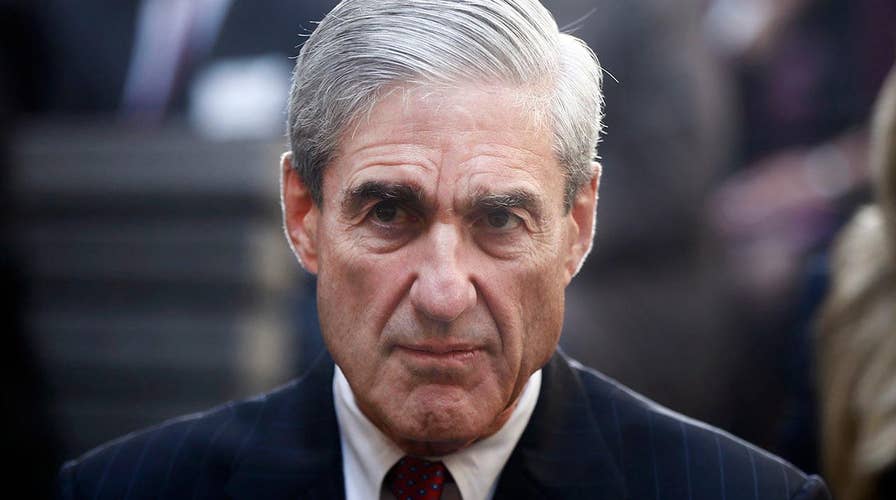
Comey calls for transparency in Mueller probe
Fox News contributor Trey Gowdy reacts to the former FBI director's comments and the state of the Russia investigation.
This is a rush transcript from "The Story," March 5, 2019. This copy may not be in its final form and may be updated.
MARTHA MACCALLUM, HOST: I am Martha MacCallum. And tonight, this is “The Story.” We are joined by three powerful senators at the center of the biggest stories on the Hill today.
Senator Lindsey Graham, says the president will win in court on the national emergency and he has brand-new data about what's going on in the border. And he will says, it will prove it. He's coming up.
Also, Senator Mark Warner, the top Democrat on the Senate Intel Committee, investigating the president, says there is enormous amounts of evidence. We will ask him about that.
And Senator Rand Paul who has been challenging the president's stance on the border and on Afghanistan. But first up, Democrat Senator Mark Warner and Republican Senator Richard Burr, have been investigating the president Russian collusion as, you know, for two years.
As we anticipate the imminent maybe possibly release of the separate Mueller report, Senator Warner says there is plenty of evidence despite this from his Republican chairman.
(BEGIN VIDEO CLIP)
SEN. RICHARD BURR, R-N.C.: We have no factual evidence of collusion between the Trump campaign and Russia.
(END VIDEO CLIP)
MACCALLUM: Here now, vice chair of the Senate Intelligence Committee Senator Mark Warner. Senator, great to have you with us this evening.
SEN. MARK WARNER, D-VA: Thank you, Martha.
MACCALLUM: I noted that you say that you and Chairman Burr agree on a lot. You agree on the fact that there was Russian interference in the election. Attempt to interfere on behalf of President Trump more so than Hillary Clinton. But with regard to what you just heard the Senator say there in terms of no evidence of collusion, is that a point of disagreement between you and your colleague?
WARNER: Well, I think if we just look at what is already in the public domain, and then, people can draw their own conclusions. We know based upon Michael Cohen's testimony last week that President Trump knew about and was negotiating with the Russians well past when he announced his campaign, well into the primary season in 2016.
We know that there was, at least, some indication that he, Trump knew about the potential leakage of all the DNC materials from WikiLeaks, literally days before it was released.
We know that Paul Manafort, the president's campaign manager turned over information to the Russia -- a Russian agent in terms of campaign data. We know that potentially, Donald Trump knew about the famous Trump Tower meeting with a Russian agent. So. I'm just saying --
(CROSSTALK)
MACCALLUM: All right. Well, let me -- let me jump in. Let's take a look at some of -- because I want to get -- you have said that -- you know, you believe you could prove collaboration or communications.
You know, I mean, the argument could be made in a lot of different administrations and campaigns that people had communications with people in Russia. Well, the things that you just went through.
(CROSSTALK)
WARNER: Martha.
MACCALLUM: No, I just want to ask you, you know, because for instance, the hotel. And I'm just playing devil's advocate here.
WARNER: Sure.
MACCALLUM: You look at the hotel for a second. If the -- if you're running for president, and you have a real estate operation that is ongoing. And you know, you think as Michael Cohen pointed out in the hearing that you mentioned that you might not win. And that if you don't win, you might want to leave some of those business avenues open. Is that in and of itself?
WARNER: No.
MACCALLUM: Is that -- is there something wrong or illegal about that?
WARNER: Martha, if there was nothing wrong with that, if that wasn't something, why did been Mr. Trump want to hide that information? Why was Cohen and all of the Trump organization denying these ongoing conversations?
I think most primary voters would actually think it's relevant that a candidate for president is still trying to do business with Russia. I'm not saying that in itself is illegal, but I think it is a relevant factor most voters would want to have.
MACCALLUM: So, let me ask you this thing. You know, of the things that you mentioned -- that you just mentioned, when you -- when you look at each one individually, what is it that you think that the president was trying to accomplish? You know, what do you think he was up to?
WARNER: Martha, I've been around politics a long time, I've never seen this many contacts between a campaign and the candidates business organization and a foreign power. I would say, particularly, when the foreign power is Russia that I've at least, grown up with most of my life thinking as, as an adversary.
I mean, I remember Ronald Reagan, you know, issuing the decree to Gorbachev to tear down the law.
MACCALLUM: Yes, but that was a long time ago. I mean, Hillary Clinton was very anxious to talk to Russia. In fact, she had lots of communications with Russia. So, it's very hard to understand -- you know, and President Obama said, you know, that Mitt Romney should take his 1980s foreign policy back.
We were not in a moment where there was a -- and you know, as we now know, in terms of election interference, we should have been smarter about all of that. But in terms of the actual what you call collaboration or communication, that seems like a far cry from you know, conspiracy to get together with the administration and the Russian government to try to throw the election.
WARNER: Well, here is what we know, we know the Russians did intervene in the election on behalf of Trump against Clinton. We know that there were these series of communications about business deals, about Russians offering dirt on Hillary Clinton. Julian Assange and WikiLeaks offering information that was then dump and release. We do know -- Martha, wait, OK.
(CROSSTALK)
MACCALLUM: But you don't know if there's any connection between the administration and those things, as far as I can tell?
WARNER: But we also know the president -- the president's campaign manager. Why would the president's campaign manager give secret campaign documents to a Russian agent?
Again, Martha, I'm reserving judgment. What I'm -- what I've said throughout this -- throughout this whole investigation --
(CROSSTALK)
MACCALLUM: We are. Yes.
WARNER: I said, I'm going to reserve judgment until every all the truth and all the facts come out. But in terms of just what is factually out there, we can -- you could potentially reach a different conclusion on their reach. My conclusion when all the facts come out, but these facts are fairly indisputable.
MACCALLUM: Now, but you say, you know, and you're going to continue and finish your investigation. How much longer and how many more people -- are you -- you've spoken to 200 people, I think. How much longer do you think the Senate investigation is going to go? And what impact will the Mueller report have on whether or not you're done?
WARNER: Listen, I want this to be finished, but I want us to make sure that we get the whole truth out there. And a number of the key individuals like Manafort, like some of the president's family, and others. More Manafort, for example, tied up with the judicial proceedings and the legal consequences out of Mueller. You know, we've not been able to have the full time that could get them in for questioning, because they've got the go through the legal process because they're -- they pled guilty to a variety of charges.
Those proceedings have to finish before we get access to some of the key witnesses.
MACCALLUM: But I mean, you can't put anyone in jail anyway. So, doesn't - - isn't that enough when you want -- you know, when that's done, you're going to want to pull them back in front of your committee and also family members, is that what you're saying?
WARNER: Well, what we want is we've got questions that still need to get answered. And we have a counterintelligence investigation. It's been done in a bipartisan fashion. We need to find out --
(CROSSTALK)
MACCALLUM: Do you think the president is a Russian agent?
WARNER: Listen, I'm reserving all judgment until we finish the investigation. The charge of this investigation was to look at, was there a level of collaboration or collusion between either campaign and the Russians during the 2016 election. And we're still seeking --
(CROSSTALK)
MACCALLUM: Right. No, I think everyone wants to know the answer to that. You know, and I'm just -- last question. Do you have a timeframe? You know, when you, you say you want it to be over. How much longer do you think you're going to be?
WARNER: In a lot of ways, that will depend on when Mueller finishes the legal proceedings against some of the key witnesses that need to see. I want this to be done. I want the American people to know. Well, what our conclusions are, and I want to make sure that no foreign power ever intervenes in our elections again.
MACCALLUM: Yes, the foreign -- one of the president's former attorneys, Ty Cobb, said he thinks this going to go on forever. He said even if -- he gets elected, it's going to go on another four years. Because that they will never stop investigating the president even if he gets reelected. What do you say to that?
WARNER: That what I want to say is what the House is doing in others, that's the House.
MACCALLUM: Yes.
WARNER: What I'm looking at is -- you know, I've given up guessing when Mueller's going to finish because I think frankly all of us have been consistently wrong every time we make a guess.
MACCALLUM: You're not alone. All right, there you good. Senator Warner, thank you very much for coming here to answer the questions. We appreciate it.
WARNER: Thank you, Martha.
MACCALLUM: Good see you tonight.
WARNER: Thank you.
MACCALLUM: Here to respond, Senator Lindsey Graham. Fresh off of a meeting with President Trump at the White House. Senator, good evening to you.
SEN. LINDSEY GRAHAM, R-S.C.: Good, that was clear as mud. Yes, I think.
MACCALLUM: Well, what do you make of that?
GRAHAM: I don't know.
MACCALLUM: What's your reaction to that discussion with Senator Warner about where this whole thing is going?
GRAHAM: I have seen no evidence of collusion. I'm on the Judiciary Committee. Burr, says he hadn't seen any. We'll see. Mueller give us the report hopefully in my lifetime. But this idea of just destroying President Trump and his family it's not going to play well with the American people.
And when Mueller issues his report, I don't think he's going to find any collusion between the Trump campaign and the Russians. I can tell you this. President Trump has a hard time colluding with his own government. So, I don't think he's colluded with the Russians.
MACCALLUM: What did -- the last night I talked to Joe diGenova, the attorney, and he said that he thought all 81 people who received those subpoenas should all refuse to show up.
GRAHAM: Yes.
MACCALLUM: What do you think about -- he said, you know, that would be the biggest boldest statement they could make. What do you think about that?
GRAHAM: I just think the House is off the rails. And they're going to spend all their time trying to tear Trump down instead of build up the country. And President Trump is going to challenge them to work with him on Immigration reform, on infrastructure that would help the American people. And if they keep playing this game but trying to destroy him and his family, in refusing to work with the president try to improve the lives of American families, Trump is going to win going away in 2020.
MACCALLUM: You get an interview with the New York Times and the Daily podcast, you know, quote, raise the question. "What happened to Lindsey Graham?" And when I listen to you talk about the president that way. And you know, what do you think he wants to accomplish -- you know, this is a long piece that drills down on the things that you said about the president in the past, coup crazy, all of that.
GRAHAM: Yes. Yes.
MACCALLUM: So, you know, in a -- in a sentence or two, what did happen to Lindsey Graham? What changed your mind so dramatically about the president?
GRAHAM: He beat me, he's president of the United States. I want him to be successful, I wanted Obama to be successful. I wanted Bush to be successful. The people in South Carolina want me to work with the president when it makes sense.
I like what he's doing, he's rebuilding the military, he cut our taxes, he destroyed the caliphate, he got out of the Iran nuclear deal, he's got rocket man at the table, he's -- he regulating the country, you put Gorsuch and Kavanaugh on the bench.
From my point of view, he's exceeded every expectation I had. And ashamedly want him to be successful. When I disagree with him, I'll tell him so but nothing's happened to me.
The only time you can be seen as a good Republican by liberal side of the equation is when you attack in a Republican. I had my shot at President Trump, the American people chose him. I want him to be successful. I'm all into the extent that can help this president, I will.
MACCALLUM: So, you know, you do disagree on things from time to time.
GRAHAM: Sure.
MACCALLUM: He's come out with a statement basically saying, 100 percent agree that we need to leave some forces in Syria.
GRAHAM: Yes.
MACCALLUM: And I would imagine that you were persuasive on that.
GRAHAM: Well, I think he took some military advice. He's right to want to reduce our commitment. He's right to have other people do more of the fighting and pay more of the bills. But by having a small footprint behind of Americans will get more Europeans, ISIS won't come back, Turkey and the Kurds won't go to war with each other, and Iran and Russia won't benefit from the hasty withdrawal.
I think this was a smart decision. And President Trump did something Obama would never do. Listen to people in a just strategy. If Obama had listened to people in Iraq, there would be no ISIS. So, I want to applaud -- I want to applaud the president.
(CROSSTALK)
MACCALLUM: You have a hearing -- all right. You have a hearing on the border.
GRAHAM: Yes. Right.
MACCALLUM: Coming up tomorrow on the Judiciary Committee. Thoughts on what you learned there.
GRAHAM: I was blown away. So, compared to last year, the number of families apprehended at the border has gone up 335 percent. The number of unaccompanied minors in our custody is going up by 54 percent. The average cost of housing an unaccompanied minor for the American taxpayer is $375 a day.
We're on track to spend $1.6 billion of housing unaccompanied minors in U.S. custody. If this is not a crisis, what the hell would be? We're being flooded, the numbers are just through the roof, and our laws --
(CROSSTALK)
MACCALLUM: Let me ask you this, you know, there is some -- just looking through your Twitter just moments ago, there is some complaints about the fact that Senator McConnell took up a vote on this, and allowed Republicans, which he knew, we're going to vote against the president on this.
Do you disagree with taking that vote in the Senate, wouldn't there have been so many times when there was never a vote taken in the Senate?
GRAHAM: Right. It's a privilege motion, I don't think he can stop it. But here is what the president, and I talked about for an hour and a half today that he's disappointed that he's not able to convince Republicans that this is an emergency.
Again, I've been dealing with this issue for a decade. If families get to America, they're released within 20 days, if an unaccompanied minor makes it into our custody, only two percent are returned to the country where they came from.
We're sending a signal to all over Central America, if you can make it to America, you're going to stay. We're being overwhelmed, we're on track to have 650,000 illegal immigrants apprehended in 2019. It is a crisis.
The legal authority the president is using has been used 50 times. He has the statutory authority given to him by Congress to take money from the military construction budget, and apply it to an emergency situation.
He's on a sound legal footing. I support what he's doing. And I hope the Republican Party will stand behind it.
MACCALLUM: Senator Lindsey Graham. Thank you, sir. Always good to see you.
GRAHAM: Thank you.
MACCALLUM: So, coming up next. Congresswoman Alexandria Acacio-Cortez, says the Congress should never have authorized any military force after September 11th. Senator Rand Paul, does he agree with that? He's next.
(COMMERCIAL BREAK)
MACCALLUM: Tonight, a counterterror manhunt is underway in London after explosive devices were found at three of the city's biggest transportation hubs. Officials say that envelops capable of igniting a small fire turned up at a bus station and two airports including Heathrow.
One of those packages was opened but cause no injuries and police are advising everyone to still be "vigilant" as investigators look into whether an Irish decedent plot is possible due to the skirmish over Brexit.
So freshman Congresswoman Alexandria Ocasio-Cortez speaking out against the war on terror calling the 9/11 response "disastrous and wrong." She writes, I remember a time when it was unacceptable to question the Iraq war. All of Congress was wrong including both the GOP and Dem party and led my generation into a disastrous plus wrong war that virtually all would come to regret.
She then eventually corrected herself. Afghanistan war star was what she was apparently referring to. My apologies. Moments ago I spoke with Kentucky Senator Rand Paul who just introduced legislation to end the war in Afghanistan and asked if he agrees with her.
(BEGIN VIDEOTAPE)
SEN. RAND PAUL, R-KY: Well, I think where I would differ is that after 9/11, I actually was in favor of going to war in Afghanistan. I would have voted for the proclamation of war in 2001 because I think we can't let people willy-nilly come and attack and kill 3,000 of our citizens.
Now, as the war has dragged on for the last who knows five or ten years, I think we've lost our mission. I think the mission is creped. I think that now there really is no military solution in Afghanistan, it's become more of a nation-building enterprise.
So I would say now that most generals, most Republicans, Democrats, Independents, actually most people you ask say there is no longer a military solution to the Afghan war. And that's why today you know, I introduced legislation to end the war and give every one of our veterans over there who have served in that theater $2,500 apiece but declare victory and come home.
MACCALLUM: How did you arrive at the $2,500 number?
PAUL: Well, we looked at what we were spending, and we spend about $51 billion over there every year on luxury hotels, gas stations, you name it, on a lot of wasted projects over there. I've talked to the President many times on this and he says he's ready to start saving that money. And I thought what better way to spend some of it in the very beginning with a one-time bonus.
It eats up about $8 billion but it's a one-time bonus and we would still save over $40 billion in the first year the war ends. But then every year after that, it's $50 billion savings a year. So that could go towards the deficit or towards things that we need to do here at home.
MACCALLUM: I mean, it's a mind-boggling amount of money that has been spent and I think you know, most people as you say understand the question of whether or not we're getting anywhere after 17 years. But it's interesting because the President you know, seems to have gone back and forth on this issue over the course of his presidency.
And then there was this letter from 22 bipartisan members of Congress that said like you, we seek to ensure that all the gains made in Syria are not lost, that ISIS never returns, that Iran is not emboldened, and that we consolidate our gains and ensure the best outcome in Geneva for American interest.
And the President to that with regard to removing troops from Syria said I agree 100 percent all is being done. Do you agree that they need to stay there or is your policy about Afghanistan also stretch over to Syria?
PAUL: Well, you know, the President said when we went into Syria, our goal was to defeat ISIS. And I think we largely did. We took back 99 percent of their land. There might be a few of them running around scared but we basically wiped out and took their land from them. And that was the President's mission. That we've accomplished.
But now there are people around the President trying to change the mission. There are people -- these are the stay forever crowd. They want to stay forever in Afghanistan, they want to stay forever in Syria, they want to stay forever in Iraq. But now they've changed the mission to say oh, we have to stay until Iran is no longer a problem.
Well, Iran has got a long-standing relationship, so does Russia with Syria. If we're going to stay till there's no Russian or Iranian influence and everybody's holding hands and singing Kumbaya, we're going to be there a long time and I think it drains us of money and treasure. And when you have only a couple of hundred troops on the ground, I think they become a trip wire to something even worse or the potential for a disaster.
What happens if there's a massacre of 200 people together in a barrack? So I think it's a mistake to have a real small force. It's actually worse than having a big force.
MACCALLUM: Have you told the president that, you know, and are you concerned that he sort of is going back and forth on this issue?
PAUL: The interesting thing is I've talked to the President dozens of times. I've talked to him two days ago and he says the exact same thing. He's consistent with me every time that he is going to be the President that's going to end these wars. And then I hear in the media that somebody else is trying to change or modify what he said. But he's always consistent with me.
He thinks we've been at war too long in Afghanistan and that we need to maintain a presence where if enemy's crop up, we could defeat them again. But that we shouldn't be doing nation-building and he gets as annoyed as I do with all the money we spend over there on hotels and gas stations and roads, bridges, schools, everything we're doing for them that we can't do for our own people here. I think the President would rather spend that money here at home.
MACCALLUM: Well, we'll see if there's a long-term risk to that. As you know, some generals feel that there absolutely would be. But you're on the record as being in favor of this pullout. Senator Rand Paul, thank you very much, sir. Good to see you tonight.
PAUL: Thank you.
(END VIDEOTAPE)
MACCALLUM: Coming up next, how the President could win a second term if he keeps saying this.
(BEGIN VIDEO CLIP)
DONALD TRUMP, PRESIDENT: I have said it before and I'll say it again, America will never be a socialist country.
(END VIDEO CLIP)
(COMMERCIAL BREAK)
MACCALLUM: So a new poll may show how not to win in 2020. Voters were asked do you have reservation or are you very comfortable with a candidate who is -- 72 percent said not, if a candidate was socialist. And then take a look at someone over 75, 62 percent say they have either total reservations or they were not very comfortable with someone who was of that age.
Not great news for the currently high polling senator Bernie Sanders who is 77 and a socialist, but it seems that voters aren't so keen on the more moderate Joe Biden age 76 if you take much from this.
(BEGIN VIDEO CLIP)
UNIDENTIFIED FEMALE: How many of you would like to see Joe Biden get in? Show of hands. What's happening, people?
UNIDENTIFIED FEMALE: His time is done.
UNIDENTIFIED MALE: I don't think Joe Biden represents that new thing that we need. We just -- we need a new economy. We need a new politics and meaning someone different.
(END VIDEO CLIP)
MACCALLUM: Not a focused group that's going to make the Biden folks happy. Joining me now Charlie Hurt, Opinion Editor at The Washington Times and a Fox News Contributor and Richard Goodstein, a Democratic strategist and former adviser to the Clinton presidential campaign. Gentlemen, welcome. Good to have both of you here.
CHARLIE HURT, CONTRIBUTOR: Good evening, Martha.
MACCALLUM: You know, interesting stuff in that poll and in that -- in focus group. Richard what do you take away from it?
RICHARD GOODSTEIN, DEMOCRATIC STRATEGIST: Well, there was a large poll, 1,000 people, not six that was done nationally that showed Joe Biden actually rather popular not just among Democrats but there was a poll in Michigan that had him up 13 over Donald Trump which Trump won, two over Trump in Iowa which Trump, 14 over Trump in New Hampshire which Hillary won by less than half a point. So, I don't think we should ascribe too much to that six person --
(CROSSTALK)
MACCALLUM: To the six people in the studio in New York City?
GOODSTEIN: Exactly. But I do think this business about socialism, I pray that people do act on that. I'm nauseated at the prospect of Bernie Sanders being the Democratic nominee. Forget his age. I mean, Joe Biden is over 75.
MACCALLUM: Yes.
GOODSTEIN: Donald Trump is a little under. I don't think voters will discriminate on that ground. But thing as socialist, yes. And Bernie Sanders got off easy running against Hillary Clinton in 2016 on that issue.
MACCALLUM: Yes. It's interesting. People talk about intersectionality this is generally not what they mean, Charlie Hurt. But in this case, you're talking about over 75 and a socialist, bad combination according to that poll.
CHARLIE HURT, CONTRIBUTOR: Yes. That is a bad combination. Of course, the problem with Joe Biden isn't that he is 75 years old. It's that he has been in Washington for 45 years and for, you know, for all intents and purposes hasn't really accomplished anything, certainly hasn't changed anything.
And if we learned anything from 2016, you know, we are in the midst of the biggest political upheaval in the past 50 years. Republicans responded by putting up somebody that was very different. We can I think, all agree that Donald Trump is not like all the others.
And the Democratic Party, the problem that they did is they went with Hillary Clinton. And she has the same disease that Joe Biden has. She has been around for a long time and she is more part of the problem than I think viewed as being part of the solution. And of course --
(CROSSTALK)
MACCALLUM: She would like everyone to stop being so obsessed with her, she says.
HURT: Yes. And of course, the situation with Bernie Sanders is a whole different matter and that is this whole bit with socialism which is, I think as Richard says it's a very dangerous path that some people are going down.
MACCALLUM: It looks like when you look at that that that's the way, Richard, that the Democrat Party is leaning. They want someone younger. They want someone different. And they have had good luck with those kind of candidates in the past when you look at Bill Clinton, you know, when you look at President Obama, of course, younger, more energetic, hope and change, you know. That sounds to me like what they want.
And I want to just play this one sound bite with regard to what the president will have to do. This is an interview I did with Victor Davis Hanson. The longer form is going to be in my podcast. But here is what he says is the president's ticket to win.
(BEGIN VIDEO CLIP)
VICTOR DAVIS HANSON, HISTORIAN: And Trump's message is pretty sophisticated. You can already see it's forming. That's not -- in 2016, it was I'm not Hillary Clinton. Whatever I am, I'm not Hillary Clinton. Now it's going to be Hillary Clinton was not that bad compared to what's here. I'm the only thing between you and socialism, whether you like me or not. If you are an independent voter you have me or you have these people.
(END VIDEO CLIP)
MACCALLUM: Richard, what do you think about that?
GOODSTEIN: So that's obviously a caricature. I'm sure that's exactly what Donald Trump is going to say. The facts are, that in the House of Representatives, for example, where Nancy Pelosi is older still and the Republicans try to run against her, the Democrats picked up 40 seats and of those 33 of them are new Democrats, pro-business group, the largest caucus in the Democratic Party in the House is 101 pro-business new Democrats.
So, this caricature as if AOC is somehow calling all the shots happens to not be the case. And the problem Donald Trump now has is if you look at, again, national polls, 65 percent think he is dishonest, think he committed crimes before he was president. These are things they didn't think necessarily before 2016 but they do think it now.
So that is a problem. I'm not dismissing the fact that he is going to be very competitive.
MACCALLUM: Yes.
GOODSTEIN: But in the NBC poll over the weekend 41 percent said they would vote for him, 48 percent said not.
MACCALLUM: Right.
GOODSTEIN: That's not where you want to be.
MACCALLUM: And 60 percent as you say said he hasn't been honest on the Russia probe. Charlie, final thought. We also have Bloomberg out now. Eric Holder is out. I'm sure a lot of people I don't know what a lot of people think about that. But that is two that are not on the list, Charlie.
HURT: Yes. Well, and of course, you know, talking about these polls, it's sort of astonishing that 100 percent of people don't think Donald Trump is lying all the time when you consider the dishonest coverage that he gets all the time in the press. But that's a separate matter.
You know, if Democrats wind up with somebody, one of these people who is talking about socialism, talking about embracing, you know, Medicare for all, that destroys private health insurance, anything like that, I think Donald Trump wins the exact same way he won in 2016 by offering a different vision and more positive vision.
MACCALLUM: Guys, thank you. Charlie and Richard, good to see you.
GOODSTEIN: We'll find out. See you.
MACCALLUM: We will find out. Coming up next, another hoax. This time it was in Baltimore after a husband grabs national sympathy by claiming that his wife was stabbed by a panhandler in a story now believed to be a coverup for premeditated murder.
(BEGIN VIDEO CLIP)
MICHAEL HARRISON, COMMISSIONER, BALTIMORE POLICE DEPARTMENT: The point to the fact it was not a panhandler and that the circumstances were very different. And people took advantage of Baltimore.
(END VIDEO CLIP)
(COMMERCIAL BREAK)
MACCALLUM: Tonight, a hoax that has stunned the city of Baltimore. Back in December, 54-year-old Jacquelyn Smith was stabbed to death. Her family claimed that she had been killed after she was generous to a panhandler after she stopped to give him some money. But now there is a shocking twist the police say that her own family made the story up to cover for her murder.
Trace Gallagher joins us with the latest tonight. This is some story, Trace.
TRACE GALLAGHER, CORRESPONDENT: It is, Martha. The initial story 52-year-old Keith Smith told police that he and his wife Jacquelyn were at a traffic light in Baltimore when his wife rolled down her window to give $10 to a young woman appearing to be holding an infant and a sign saying "please help me feed my baby."
Smith said that suddenly a man approached the car, struggled to take his wife's wallet then stabbed her and ran off with the wallet and the female panhandler. Keith Smith would then tell his story to the media. Watch.
(BEGIN VIDEO CLIP)
KEITH SMITH, JACQUELYN SMITH'S HUSBAND: I'm just -- I feel like I'm stuck in a nightmare.
(END VIDEO CLIP)
GALLAGHER: The story was dubbed the Good Samaritan killing and attracted national attention. It also sparked a backlash against panhandlers even Oprah Winfrey who used to anchor the news in Baltimore tweeted, quoted, "the story struck my heart. I've done this a thousand times but will think twice before ever doing it again," meaning give money on the street. "I hope her death gets people woke to the change."
And Baltimore authorities say the suspect took advantage of Baltimore's crime problem, quote, "They were responsible for taking Jacquelyn's life with unconscionable cruelty and contrived to do so in our city under the guise of random violence exploiting the legitimate fears of our residents."
But Jacquelyn Smith's brother says he never once believed the panhandler story. Watch him.
(BEGIN VIDEO CLIP)
MARCEL TRISVAN, JACQUELYN SMITH'S BROTHER: He said he wasn't thinking, he said he pressed the auto button and it kind of -- the window went down like automatically. But, you know, question number two is, why you didn't stomp the car and drive off.
(END VIDEO CLIP)
GALLAGHER: Yes. The brother goes on to say Jacquelyn and her stepdaughter Valeria did not have a good relationship but he didn't offer any possible reasons for the alleged murder. And so far, the Baltimore police commissioner hasn't laid out any evidence or given a motive only saying that when his investigators learned that Keith Smith and his daughter were planning to leave Maryland, a national bulletin was put out and warrants were prepared.
The two were arrested yesterday on murder charges in Harlingen, Texas near the Mexican border. The police chief says they were getting ready to leave the country. Martha?
MACCALLUM: Incredible. Trace, thank you very much.
GALLAGHER: Yes.
MACCALLUM: Coming up next, two massive drug busts days apart taking millions of dollars' worth of fentanyl enough to kill millions of people off the streets. This DEA agent is behind them. He is here next.
(COMMERCIAL BREAK)
MACCALLUM: One hundred thirty Americans are dying every day from opioid overdoses. But now a massive DEA bust took $150 million worth of fentanyl off the streets. This just days after the DEA made a separate bust finding enough of the drug in an upscale New York neighborhood to kill two million people.
In 2017 alone, fentanyl claimed more than 28,000 American lives.
Here now in a Story exclusive Ray Donovan, the DEA special agent in charge who helped lead these massive drug busts. Ray, first of all, congratulations to you.
RAY DONOVAN, SPECIAL AGENT, DRUG ENFORCEMENT AGENCY: Thank you very much, Martha.
MACCALLUM: This is huge and you are doing a huge service to take this off the streets because it's so incredibly dangerous. How did you -- how did you know, for instance, the one in Ardsley, New York, nice suburb of New York City. How did you figure out what was going on at that house?
DONOVAN: So that particular investigation we got tipped off by the community really. You had you these violent organization that set up shop in Ardsley, a quiet neighborhood, upscale neighborhood and these drug traffickers would go there because it's quiet. It's close to the highway. It's easy to get into the city. What they didn't know is that the neighborhood was watching.
MACCALLUM: And so, they are in someone else's house, you know. Because obviously the neighbors are going there is something weird going on over there. People coming in and out that we don't know.
DONOVAN: That's right. Think about it. So, you have these families that have been there for generations and they are watching people coming and going all times at night. Different cars, different people. It's very suspicious. And so that's what really drew their attention.
MACCALLUM: So that was just aware community which everybody should be if you see something, say something in this regard as well, right? What about this truck that you got in New Jersey?
DONOVAN: So that truck that we seized in New Jersey over the weekend there were 20 kilos of fentanyl seized. That is a tremendous. That's $150 million worth of fentanyl that we prevented from hitting the streets of New York City.
MACCALLUM: And how big is that amount?
DONOVAN: So, when you think about it, that's enough to kill 10 million people, all throughout the city. And so, taking that off really and that was a high scale operation --
MACCALLUM: Yes.
DONOVAN: -- that organization was moving hundreds.
MACCALLUM: And who is behind that.
MACCALLUM: Sinaloa cartel. Sinaloa cartel. So, we have investigations connected in California and in Mexico.
MACCALLUM: And they are getting it into this country how?
DONOVAN: They're getting it into the country by two means, really. It's through the port of entries and through the land. That particular organization would transport it across the United States in tractor trailers or through trains.
MACCALLUM: They are coming in ports of entry and we've all seen, you know, in some of these busts, they rip out the floor or some piece of the truck and it's in there. And you say they will put through 25 vehicles at a time?
DONOVAN: That's right. So, they'll shotgun 25 vehicles and they will expect to lose five of those vehicles. It's part of doing business for them.
MACCALLUM: It's incredible.
DONOVAN: That's right.
MACCALLUM: You know, and you say fentanyl you have been in the DEA business for over 20, 24 24 years I think you said. Fentanyl is a game changer, how?
DONOVAN: It's a game changer because it's so lucrative and so easy to make. And so, we are seeing more and more fentanyl come to New York City. New York City is the hub for the northeast. And so, it's just nonstop, it's for us. And so, we are seeing our numbers increase, heroin coming down and fentanyl going up.
MACCALLUM: Ray Donovan, thank you for what you are doing. Keep up the good work.
DONOVAN: Thank you, Martha.
MACCALLUM: Good to meet you. Thank you so much for coming in tonight.
So, coming up next, Jim Comey has some advice for the new Attorney General, Bill Barr on how to handle a big public investigation. Take a page out of his book on the Clinton investigation? Trey Gowdy reacts, next.
(COMMERCIAL BREAK)
MACCALLUM: What will actually happen when the Mueller report finally drops? Will he or the new attorney general do a big news conference as former FBI director Jim Comey did? Comey is offering up some advice in a Washington Post editorial and he seems to be saying in a way that you should do it like he did, go public. Remember this?
(BEGIN VIDEO CLIP)
JAMES COMEY, FORMER FBI DIRECTOR: I have not coordinated the statement or reviewed it in any way with the Department of Justice or any other part of the government. They do not know what I'm about to say. Although the Department of Justice makes final decisions on matters like this, we are expressing to justice our view that no charges are appropriate in this case.
(END VIDEO CLIP)
MACCALLUM: Remember that afternoon? I sure do, on the fifth of July. Comey now writes "Democrats were wrong about transparency then but Republicans are wrong now. When they claim Justice Department rules forbid transparency about the completed work of the special counsel. It is difficult to imagine a case of greater public interest than one focused on the efforts of a foreign adversary to damage our democracy. And in which the President of the United States is a subject."
Here now, Trey Gowdy, former House oversight committee chairman and a Fox News contributor now. Good to see you this evening, sir. Great to have you with us.
TREY GOWDY, CONTRIBUTOR: Thanks, ma'am.
MACCALLUM: So, he's arguing that because this is of such great public importance at the Clinton investigation was at that time because it was the middle of an election, that it is incumbent upon these officials to make sure that they come forward as he did and share everything with the public, what do you think?
GOWDY: The purpose of the criminal justice system is not transparency, it is due process and it is fairness. If the purpose were transparency, the grand jury would meet in public. The trial jury would deliberate in public. All of the witness interviews would be done in public if the purpose transparency, the purpose is fairness.
Ultimately, I hope the report is released. Consistent with classification, I don't want any classified information out there, I don't want grand jury material but there's a third point too, and Comey did this in July.
He held a press conference and laid out all the evidence he had on someone that he wasn't going to indict. The Department of Justice does not speak through press conferences. They do not speak through reports. They speak through indictments.
So, on the criminal side if you have enough, issue an indictment. On the counterintelligence side, if you have information about what Russia did in 2016, released that, as much of it as you can, but don't conflate the two.
MACCALLUM: Yes, that's very interesting. And it's also interesting to remember that Rod Rosenstein based the memo on which James Comey was fired in part on exactly what he did on that day on July 5th, correct?
GOWDY: So, did Michael Horowitz. Michael Horowitz is as straight as arrow as you will find in Washington and the inspector general took great exception to the way Jim Comey, just like in his op-ed -- I mean, he doesn't all the time. He thinks that he is the arbiter and author of the rules. And he's not. You cannot besmirch people's reputations.
The Department of Justice cannot do it in a press conference or report. If you have enough information, indict them. He didn't have enough to indict Hillary Clinton, he didn't think, so he held a press conference that was even worse than a trial because she doesn't have a chance to defend herself.
MACCALLUM: I mean, when we all listen --
(CROSSTALK)
GOWDY: Does all the jury that --
MACCALLUM: -- to every word of it and were hanging on every word trying to figure out where he was going, what he was saying. He was building the case one after the other. It felt surely, he was going to indict based on everything he said, and then at the end it was like, you know, like a twist in the story but no prosecutor would bring this case to indictment.
So, I mean, it's very interesting to see him giving advice for how this process should play out. To Adam Schiff --
(CROSSTALK)
GOWDY: Well, speaking of no prosecutor --
MACCALLUM: Yes.
GOWDY: -- no prosecutor would have a press conference like the one he had either.
MACCALLUM: OK. Fair point. So, Adam Schiff says that he thinks that the president no matter what happens should face jail time when he leaves office. He has been obviously very, you know, upfront about his feelings about this whole case and I know you say he's been over his skis on it, what about the fact that he says that the president should do jail time?
GOWDY: Like without a trial? Without an indictment, without a burden of proof?
MACCALLUM: Yes.
GOWDY: Does Adam just want him to go straight to jail, none of the due process that's afforded everyone else in this country? No presumption of innocence? How about that, Adam? How about a presumption of innocence, is that OK for the president or you just want him to go straight to jail?
I think it is reckless and irresponsible, especially for a former federal prosecutor, which is what Adam Schiff was or Jerry Nadler, who was the chairman of judiciary. Nadler over the weekend the president has committed a crime, obstruction of justice.
There's been no trial. There's been no determination by 12 of your peers. There's no judge involved. Schiff says there's a very real prospect he's going to go to jail and Nadler says he committed a crime. We haven't even read the reports yet. There's not one single sentence of the Mueller report out and one of them got him convicted and the other one has gotten him in the bureau of prisons.
MACCALLUM: Well, Jerry Nadler said that the investigation was not wide enough in the scope, the Mueller investigation, so they want to make sure they can expand it as they move forward on all these investigations that they are doing.
I want to get your quick thought on a completely different story out of South Carolina tonight because it's just unbelievable. The mayor of Lamar, South Carolina, Darnell Byrd McPherson claimed to be the victim of a hate crime. This seems to be going around.
After she woke up and found a strange yellow substance, and I think we have pictures of this if they could put them up, kicked all over her car, she was trying to figure out who would do this to her car. Slime her entire car with all of this yellow stuff and she said "I likened it to a hate crime because number one there's a history in our town of Lamar. It ignited some fear in our spirit."
When I saw this but the police went out and investigated, Trey Gowdy, and what did they find? What did they decide it was?
GOWDY: Bee pollen. Not just the police, but the South Carolina law enforcement division, SLED, widely respected statewide law enforcement entity found that it was bee pollen.
You know, Martha, my state has a provocative history when it comes to race but we also had a governor of Indian descent and we have the only Republican senator of color and we have Jim Clyburn, who is in the upper echelons of House leadership. We made progress on the issue of race in my state. In which we made progress educating elected officials that in late winter, early spring --
(CROSSTALK)
MACCALLUM: That bee pollen is not necessarily vandalism.
GOWDY: -- something called pollen comes on cars.
MACCALLUM: Trey Gowdy, always great to see you. Thank you very much.
GOWDY: You, too.
MACCALLUM: That's “The Story” on this Tuesday, March 5th. As always, “The Story” goes on. We will see you tomorrow.
Content and Programming Copyright 2019 Fox News Network, LLC. ALL RIGHTS RESERVED. Copyright 2019 ASC Services II Media, LLC. All materials herein are protected by United States copyright law and may not be reproduced, distributed, transmitted, displayed, published or broadcast without the prior written permission of ASC Services II Media, LLC. You may not alter or remove any trademark, copyright or other notice from copies of the content.
