




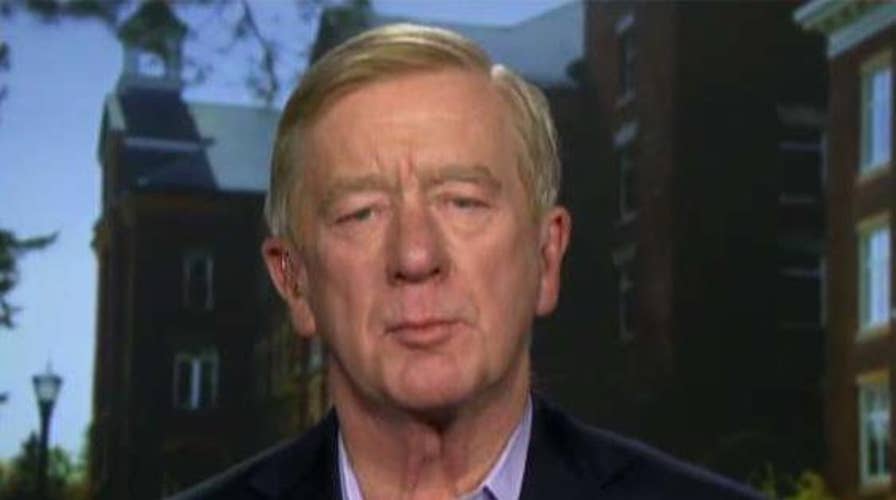
Bill Weld on opposing Trump in 2020 primary: Somebody has to do it
Former Massachusetts Gov. Bill Weld discusses launching his presidential run and becoming the first primary challenger to President Trump.
This is a rush transcript from "Your World," April 16, 2019. This copy may not be in its final form and may be updated.
NEIL CAVUTO, HOST: These are the 2020 presidential candidates, for now. And a lot of them rail against the rich always, but Bernie Sanders just went a little bit further.
(BEGIN VIDEO CLIP)
SEN. BERNIE SANDERS, I-VT.: Are people going to pay more in taxes? Yes. But, at the end of the day, the overwhelming majority of people are going to end up paying less for health care because they're not paying premiums, co-payments, and deductibles.
(CHEERING AND APPLAUSE)
(END VIDEO CLIP)
CAVUTO: All right, here's the differentiator from that chat last night, Senator Sanders saying that people are going to pay more in taxes, and, by the way, not just the rich or the very rich. Maybe you too.
He says, when it comes to health care, we will all be richer for it, so people will actually be happy because of it.
Welcome, everybody. I'm Neil Cavuto. And this is "Your World."
We're going to get to a lot more of that in just a moment.
First to Fox Business Network's Hillary Vaughn in Washington on Bernie's big tax bet -- Hillary.
HILLARY VAUGHN, FOX NEWS CORRESPONDENT: Hey, Neil.
Well, 2020 candidate Bernie Sanders admits that just because he believes health care is a human right doesn't mean it's going to be free if the government replaces private insurance companies with his single-payer health care plan, Medicare for all.
(BEGIN VIDEO CLIP)
MARTHA MACCALLUM, FOX NEWS ANCHOR: You're going to pay one way or the other. They're going to pay one way or the other.
SANDERS: But, look, Martha -- Martha...
MACCALLUM: Whether it's in your income tax or your payroll tax, you're going to pay.
SANDERS: Right. Look, health care is not free.
MACCALLUM: Of course not.
SANDERS: You never heard me suggest that we're going to magically...
MACCALLUM: You just said it was going to free for everyone.
SANDERS: It's going to be free at the point of when you use it, OK?
You go to -- why are you so shocked by this?
MACCALLUM: Because someone's got to pay.
SANDERS: Somebody is going to pay.
MACCALLUM: Who are they?
(END VIDEO CLIP)
VAUGHN: Sanders says that a government takeover will be more fiscally efficient than letting private insurance companies bring in billions of dollars in profits. Sanders says putting the government in charge will actually cut costs because they are cutting out the middleman, insurance companies, promising the crowd last night that the government would do something private insurance companies don't let you do, pick any doctor you want and any hospital you want.
(BEGIN VIDEO CLIP)
SANDERS: You'll go to any doctor that you want, you'll go to any hospital that you want. And, by the way, millions of people today are in networks which prevent them from doing that. So this gives you freedom of choice. With regard to the doctors you go to or the hospitals you to go.
(END VIDEO CLIP)
VAUGHN: Neil, a Medicare for all tight plan isn't without its problems. Just last week, the feds discovered a $1.2 billion Medicare fraud scheme that took advantage of hundreds of thousands of Medicare patients.
The DOJ charged 24 people and it called it one of the largest health care frauds in U.S. history -- Neil.
CAVUTO: All right, Hillary, thank you very, very much, Hillary Vaughn on all of that.
Now, what, of course, is a differentiator with this early read of the candidates of the Democratic Party vying for the nation's highest office is that to a man or woman they do want to raise taxes on the rich. Now, Senator Sanders has expanded that to not just the rich -- and, to be fair, even though he himself is rich and a millionaire and part of the 1 percent, he is going to eat his own pudding, as I said, and tax himself.
But, in the long run, he said, it would be beneficial for everyone.
Step back from all of this and the significance of it. When is the last time you remember a prominent candidate running for the highest office in the land arguing for a tax hike? Does this ring a bell?
(BEGIN VIDEO CLIP)
WALTER MONDALE, FORMER VICE PRESIDENT: The budget will be squeezed. Taxes will go up. And anyone who says they won't is not telling the truth to the American people.
(CHEERING AND APPLAUSE)
(END VIDEO CLIP)
CAVUTO: Now, of course, he went on to lose the entire country, except him home state of Minnesota the District of Columbia.
So is that what awaits any Democrat who entertains something even remotely similar?
Hitha Herzog is with us of H Squared Research, Democratic strategist Scott Levenson, and Alexandra Wilkes with the America Rising Corporation.
You know, interesting. When I looked at the history of this, Alexandra, of course, it's always risky to talk about raising taxes, period, but normally it's OK for Democratic candidates to espouse targeting the rich.
To be fair to the senator, what he's saying is, no, no, more than the rich, but everyone will benefit by expanding that pool.
ALEXANDRA WILKES, AMERICA RISING CORP.: You know, I will give Bernie Sanders credit for honesty, because a lot of these Democratic candidates are talking about these big-ticket spending items, and they're just saying, oh, we will just tax the rich more to pay for it, when in fact that you can't tax the rich enough to pay for these items.
So what Bernie Sanders is saying is that now we're going to bring those taxes down to the middle class. And according to a recent study, it's going to be about $20,000 more a family if you want to pay for Medicare for all, if you want to pay for free college tuition.
There's going to be a lot of pain felt by middle-class families. And I think that recent reports that show that with the Tax Cuts and Jobs Act, most people felt like they didn't get a tax cut -- I will blame the Democrats and some of the media on that for the messaging woes there.
But what that tells me...
CAVUTO: Well, they argue they didn't see enough of it, right?
WILKES: That tells me that people already feel squeezed enough.
SCOTT LEVENSON, DEMOCRATIC STRATEGIST: But it's, I think, important to have historical perspective here.
When the United States was entering its boom years in '49, throughout the '50s, up until 1963, we didn't have a 70 percent tax rate. We had a 90 percent tax rate, Neil. So I...
CAVUTO: But he's again going beyond just upper-income rates, right?
LEVENSON: But we're talking about a year when Honeywell, when JetBlue, when Netflix, when Amazon, when General Motors, paid no federal taxes.
So there's plenty of room on the $10 million earners.
(CROSSTALK)
CAVUTO: But why not do something with Elizabeth Warren and all was advocating, go after those companies, if that's the route you're going to take, than cite individuals?
(CROSSTALK)
LEVENSON: There's no doubt about it. That' inclusive...
(CROSSTALK)
CAVUTO: Is this suicidal, what he's something, whatever the virtues it might have?
(CROSSTALK)
LEVENSON: I think it's important. There's a big distinction between what he's doing and what Walter Mondale did.
There was no good news in what Walter Mondale did. He was playing defense. What Bernie is doing is aspirational.
(CROSSTALK)
HITHA HERZOG, RETAIL WATCHER: Where is the -- where's the good news on that? I don't...
LEVENSON: I'm sorry.
I mean, health care for all, most people who can't afford their own would suggest that health care and providing health care to Americans is good news.
(CROSSTALK)
CAVUTO: Just to be clear -- and I will let you finish, if you want to finish that.
But to be clear, 150 million Americans have private health insurance, and whatever they complain about certain aspects of that, they like it, they don't like it -- and they don't want to jettison for something that might be a risk.
LEVENSON: But I don't think there's one American you could tell you the true value added to health care delivery that insurance companies are giving us.
(CROSSTALK)
HERZOG: If any -- I can -- listen, being a small business owner, I can tell you...
LEVENSON: As I am.
HERZOG: OK.
I can tell you that having this universal health care and having the -- having to in the past pay for that...
(CROSSTALK)
LEVENSON: Well, we don't have universal health care.
HERZOG: Well, according to what we have with Obamacare, having to accommodate as a small -- as a small business owner, it was a massive impact on me.
(CROSSTALK)
LEVENSON: That's why we need to get rid of the insurance companies.
(CROSSTALK)
HERZOG: I could not hire people.
CAVUTO: You get rid of the insurance companies, you also get rid of the health care that they provide. I understand where you're coming from.
(CROSSTALK)
LEVENSON: They actually don't provide health care, Neil.
(CROSSTALK)
CAVUTO: You know the instrumental role they have.
People get a lot of their coverage, health care coverage through their insurance companies. And they are the ones that Bernie Sanders is saying you don't need them anymore in the quest...
(CROSSTALK)
LEVENSON: They are the middleman.
CAVUTO: All right, fine, but I'm just saying tell that to a lot of people who are by and large satisfied with what they have got.
WILKES: And this was even shocking when Kamala Harris said this at the beginning of her presidential campaign.
CAVUTO: She dialed it back.
WILKES: And she had to dial it back, because it was just -- it was the ugly truth of what Medicare for all means.
It means you lose your private insurance. And once most Americans heard that, that campaign really had to backpedal in order to rein in the messaging on that, because that is the ugly reality.
HERZOG: Also, if anyone has been treated with some sort of version of Medicare, it's nowhere near the type of service that you get with private insurance.
(CROSSTALK)
CAVUTO: They didn't think that this would amount to much, that they thought targeting the rich was one thing. Expanding it to the degree where you look at the math and you're going to pay for all this, you got to go beyond that limited pool.
Do any of you worry that -- especially you're a prominent Democratic here - - do you worry that some of the prominent candidates are kissing their chances goodbye?
LEVENSON: Do I wonder whether there's a real need for an educational moment for the American public to recognize that, if you want to be aspirational, we want to do things like universal health care...
CAVUTO: You are going to have to pay through the nose?
LEVENSON: ... it's going to cost money.
CAVUTO: OK. And you think the American people are ready to do that?
LEVENSON: I think it's clear that the American people are ready to do that.
And I think it's clear that people recognize that if you had a 90 percent...
CAVUTO: American people, confidence surveys, the lowest unemployment rate among key demographic groups, one after another, do you think they're prepared to interrupt that right now?
LEVENSON: I think there are virtually no Americans who recognize that there was a 90 percent tax rate in our boom years.
CAVUTO: But that's not what I'm asking.
Would they interrupt what they enjoy now for what you're envisioning?
LEVENSON: Oh, no, I think they would for something better.
HERZOG: And I really -- I would have to argue against that.
LEVENSON: That they wouldn't pay more for something better?
HERZOG: They would definitely not pay something more for something -- and that this wouldn't necessarily be anything better.
I mean, you're talking about -- we're talking about -- actually, I don't know which Americans you're talking about that would want to pay for this kind of...
LEVENSON: A better health care.
WILKES: Well, to your point, Neil, what you're saying is that this is going to cause a great economic disruption.
And it will. And I think what the president has going for him coming into 2020 is that the economy is doing so well. So when people are -- when we're talking about disrupting a major sector of the economy ahead of a presidential election, where the economy is doing well, they're going to say...
(CROSSTALK)
CAVUTO: He's talking about dislocation. I understand what Scott is getting into.
But you're jumping the shark here a little bit then to go to the degree he is recommending. You usually do that in the middle of some economic crisis. We're not there.
LEVENSON: But I do think it's important for leaders to be aspirational.
And when every other Western nation has figured out universal health care...
(CROSSTALK)
WILKES: Yes, but America doesn't aspire to other nations.
(CROSSTALK)
CAVUTO: I want to thank you very much.
We have got a lot of news here we're following, including what's going on in Paris and this service that is going on as we speak in Paris.
They're still trying to get to the bottom of what happened to the Notre Dame Cathedral and exactly why.
Molly Line is in Paris, where at least 50 investigators are trying to get to the bottom of it -- Molly.
MOLLY LINE, FOX NEWS CORRESPONDENT: Neil, just a few moments ago, we actually heard a group of people break out in song here.
They seemed to be really an excellent choir, just outside here next to the River Seine. Meanwhile, there's still little bits of ash that are floating here in the air. But the streets surrounding the island here where the grand cathedral, where Notre Dame sits, have reopened.
And we watched throughout the afternoon as investigators, as the experts looked at this scene and worked to assess the structural integrity of what remains. But at this point yesterday, that massive fire was under way. Notre Dame's iconic sphere had crashed down through the roof, and it raged for 12 hours.
There were fears that all would be lost. But investigators say the famous edifice, those world-renowned twin towers at the front, have been saved, and the determination now as to whether or not the structure is safe, safe to investigate, safe to seek further answers.
But the working theory here is that this was a tragic accident related to renovations of that spire and the surrounding structure. Much of the roof was made of timber, some of it hundreds of years old, and, as witnessed, would burn swiftly.
France's wealthy and elite business families, including those involved in the country's elite fashion houses, have promised an outpouring worth millions of dollars. And French President Emmanuel Macron has vowed to swiftly rebuild.
(BEGIN VIDEO CLIP)
EMMANUEL MACRON, FRENCH PRESIDENT (through translator): And I'm telling you today, with strength, we are these people of rebuilders. We have a lot to rebuild. So, yes, we will build the Cathedral of Notre Dame even more beautiful. And I want for this to be done within the next five years.
(END VIDEO CLIP)
LINE: So, I mean, imagine. It's an enormous cathedral and an enormous job just to determine the structural integrity, so that these dozens of investigators that plan and want to get inside can begin their work as well -- Neil.
CAVUTO: All right, Molly, thank you very much.
This vigil, which we're told will happen late into the evening here, no timetable set, just that Parisians and those who visit the City of Lights want to have a moment together to remember.
(COMMERCIAL BREAK)
CAVUTO: All right, we have, what, a dozen-and-a-half prominent Democratic candidates trying to take out the president and assume control of the White House, but the president might have some trouble in his own house. I'm talking within the Republican Party.
Former Massachusetts Governor Bill Weld, of course, the former Libertarian vice presidential candidate, is up for the challenge and willing to take on the president in 2020 for the Republican nomination.
He joins us right now to discuss why he's going to do it.
Governor, very good to have you.
BILL WELD, R-PRESIDENTIAL CANDIDATE: Neil, always pleasure to be back with you.
And here I am all alone in second place. Wouldn't a lot of those Democrats give their...
(CROSSTALK)
(LAUGHTER)
WELD: ... to be there?
CAVUTO: All right.
Why now, though, Governor, I mean, right? The president has enormous support within the Republican Party. Nine out of 10 Republicans like him, support him, are going to be with him. And a good many of them don't even remember you.
What do you -- what do you say?
WELD: Well, I think there's a lot of issues that have to be vetted.
And nobody has put up their hand and planted a flag. And I think somebody has to do it. I think the president -- you and I have discussed this. I think he's really not an economic conservative. He hasn't cut spending, vetoed spending at all. I have done that.
And if I get to Washington, that's the first thing I would do, would be to cut spending, which permits further tax cuts. I'm not at one with the president on foreign policy. I think he's insulting our allies and really cozying up to dictators, almost as though he wanted more autocratic facets of the regime to be -- to be -- to come to the United States, which is the opposite of what I want.
So there's a lot to talk about. I think it might even be good for the president to be put through his paces, as it were, and have to account for, answer for his positions. Too often, I think they amount to one word, hoax for climate change, wall for immigration.
Let's flesh that out a little bit. So I think it could be good for the country.
CAVUTO: Well, why don't you let the Democrats flesh it out, Governor?
The rap against you is that you were a two-term governor. It's been 25 years since you were on the public scene there in that role. Even your critics say you were a very solid governor. You were, I guess, a fiscal conservative, more socially liberal, open to gay marriage, when many in your party were not.
So you have some appealing qualities, but, in this environment, where Republicans think it's Donald Trump who has delivered this strong economy, Donald Trump who has delivered this market on the cusp of breaking records across the board again, and that you're Johnny-come-lately.
What do you think?
WELD: I'm not so sure presidents and governors don't get too much credit for good times and too much blame for bad times.
But, be that as it may, those stratospheric approval ratings that you refer to, those are basically the Republican state committees and the Republican officials and their close allies who are definitely going to vote in that Republican primary.
CAVUTO: No doubt, but they don't flip over you.
They remember, Governor, fairly or not, when you supported Barack Obama over John McCain. They remember the fact that you bolted from the party to be a Libertarian candidate, then went back to the Republican Party. So they see in you sort of like a flimsy friend. What do you say to them?
WELD: Well, I have been -- except for my Libertarian run, I have been a registered Republican since I was 18 years old, which is more than you can say for the current incumbent.
But I don't think that's an important point. My politics have really never changed, no matter what hat I was running. I always was on the small-L libertarian side.
CAVUTO: But it's important in primaries, right? It's important in primaries, caucuses, that sort of thing, yes?
WELD: Yes.
No, but candidly, it matters a lot who votes in the primaries. And in Massachusetts, when I was running, the independents -- it's a crossover state like New Hampshire.
CAVUTO: Right.
WELD: The independents came in and voted for me 6-1. That's how I got elected.
And I'm going to try to make a case to the millennials, to the Gen-X'ers, to suburban women who may agree with me on social issues that they should come in and vote in the Republican Party and cast a vote that's going to make a difference between one of two people, and not one of 15 people.
We will see. But, anyway, that's the strategy.
CAVUTO: All right.
Did you give the president a heads-up, by the way, hey, I want to challenge you?
WELD: I didn't.
I happened to have very friendly conversations in the last couple of days with Governor Kasich of Ohio, Governor Hogan in Maryland. But those were the only heads-up discussions that I had with anybody. And that was just discretionary.
(CROSSTALK)
CAVUTO: I'm sorry, sir.
Did either of them express interest that they too were thinking of running, or did they just wish you well?
WELD: Well, they did wish me well. But I think it's fair to say that both of them are looking at the situation, and if the politics changes somewhat, I think either or both of them might be interested.
And I think I indicated to each of them that that would be no skin off my teeth. That would be a broader conversation. It might be harder for the Republican -- for the president to duck debates if there were two or three other candidates in the race.
So I have been encouraging the both of those people. And I think we all want the same thing, which is an airing of the issues. There are really an awful lot of...
CAVUTO: But if he defeated you, Governor, and got the nomination, would you support him over the Democratic candidate?
WELD: I -- and this is not a word you want to hear from me on your nice show, but I think the president's mean-spiritedness would mean that I could not endorse him for the presidency.
I'm not saying I would endorse the Democrat. Might sit it out, as many people did in 2016.
CAVUTO: Then how would you put it together, Governor.
Of course, from Massachusetts, that's obviously good exposure in New Hampshire. Many a Massachusetts resident as come on to win in that fine state. But how would you cobble something together after that to get to the 1,236 delegates you would need to be the nominee?
WELD: Well, I would start with the six New England states.
I would spend a lot of time in the Mid-Atlantic states, New York, Pennsylvania, Maryland, Delaware, where I have spent a lot of time over the years. California, Oregon, Washington are hospitable. The Intermountain West is hospitable, some of the Southwest, not all the Mountain states, but some.
And there would be areas of the Deep South where, obviously, I'm not going to strike a resounding chord there, but other areas where there may be some opportunity. Certainly, I would contest New York strongly.
And starting with New York and California and the Northeastern states, the other Northeastern states, that's a good head start. And then the last question to be answered would be, what about the Rust Belt? What about the three states that the Republican -- that the president won at the end, Pennsylvania, Michigan and Wisconsin?
CAVUTO: So, there, you might cobble something together.
We will watch very, very closely. Sir, thank you very, very much.
WELD: Thank you, Neil.
CAVUTO: A likely challenger to President Donald Trump for the Republican nomination.
And past challenges to try to take down an incumbent president, they come close. They don't necessarily always get the brass ring.
We will have more after this.
(COMMERCIAL BREAK)
(BEGIN VIDEO CLIP)
REP. NANCY PELOSI, D-CALIF.: When we won this election, it wasn't in districts like mine or Alexandria's. However, she's a wonderful member of Congress, I think all of our colleagues will attest.
But those are districts that are solidly Democratic. This glass of water would win with a D next to its name...
(LAUGHTER)
PELOSI: ... in those districts.
(END VIDEO CLIP)
CAVUTO: Did Nancy Pelosi just take a jab at Democratic Congresswoman Alexandria Ocasio-Cortez? This after she downplayed the influence of the congresswoman's wing of the Democratic Party as like five people in a "60 Minutes" interview.
So, is the speaker trying to rein in her party's more progressive members, in the hopes of scoring well, that is, Democrats scoring well in the 2020 election?
Independent Women's Forum's Inez Stepman is here. We have got Democratic strategist David Morey and our own Charlie Gasparino.
So, Inez, what is your sense of how she was framing that, complimentary of the congresswoman, but reminding folks that, look, there are some districts where the Democrat is always going to win, and those -- what was left out here is among the 40 who did come in and take over the House, most were moderate? What do you think?
INEZ STEPMAN, INDEPENDENT WOMEN'S FORUM: That's right.
Most of those districts were moderate. They were suburban districts. In fact, 31 of them were districts that Donald Trump won in 2016. So Nancy Pelosi definitely has her eye on those districts for 2020.
That being said, the fact that she has to reference AOC and the 68 Democrats, not five, 68 Democrats who vote with her 95 percent of the time constantly, the way she does, I think says a lot about where the heart and soul of the Democratic Party is going.
And I think that she knows that deep down, but she doesn't want to communicate that exact message to those 31 districts who voted for Donald Trump and 2016 that she has to hold to hold the House.
CAVUTO: That is a perilous position for a Democratic leader to be in, period, David.
But I'm just wondering what your sense of how the leadership -- that is, the Democratic leadership -- and I will include Chuck Schumer in that and other prominent officials -- who worry that this passion on the left, meritorious though it might be, can go a little too far?
Barack Obama has said that he's concerned that you have to come up with ways to pay for things, all but saying we got to chill here, right?
DAVID MOREY, DEMOCRATIC STRATEGIST: Yes, good to be with you, Neil.
CAVUTO: Same here.
Monday Listen, Nancy Pelosi is leading change and for the moment showing the rest of the government how to do so. She knows that she will lose, the Democrats will lose in 2020 if they go far left. That's what happened in 1980 after Reagan went to the Democrats in the U.K.
It happened in 1979 to the Labor Party when Thatcher won. AOC is to, me, more of a pace car than a party leader. She won in a left-leaning district with less than 16,000 votes in the primary, 110 in the general, and, in some ways, look at the larger picture in 2018.
There were 43 flips from Republican to Democrat. Forty of them were right down the middle, including five in Pennsylvania, where I now am. So I think Speaker Pelosi, real quickly, is managing three audiences, Twitter followers, the national electorate, and the floor votes.
And they're different audiences and distinct audiences.
CAVUTO: Charlie?
CHARLIE GASPARINO, FOX NEWS SENIOR CORRESPONDENT: I agree.
I mean, listen, I spend a lot of time talking to Wall Street guys who are big Democratic Party bundlers. They raise a lot of money. They have direct access to the -- to the candidates themselves.
I will tell you this, that they believe that anybody but Bernie Sanders can beat Donald Trump. So, to see Bernie Sanders out there, if you look at like a seven-person race, he's got whatever, 23 percent of the vote, it even shows Bernie Sanders at least now doing well against Trump.
They don't think it's going to hold, but at least now he looks like he's doing well. When they see that, there is a freak-out. Now, you don't have to just believe me. Look at The New York Times today.
But I'm telling you I have been speaking over the last couple of weeks, when these poll numbers come out, with showing Bernie essentially in the lead in a very crowded field.
Larry Fink has said it. There's no more establishment Democrat on Wall Street than Larry Fink. He's always -- his names is always bandied about to be treasury secretary, was close to Clinton, close to -- very close to Obama.
CAVUTO: You're talking the BlackRock...
(CROSSTALK)
GASPARINO: Yes, BlackRock CEO.
He is saying point blank that Bernie Sanders can win. And that scares the hell out of him.
CAVUTO: And as we also follow numbers here and the dollars raised, and among these candidates, some of really had eye-popping numbers, but, collectively, it's -- it's been about 80 million or so from the start amongst all of them.
The president alone, in just the latest period, 30-plus million dollars, $100 hundred million already banked for a race for which he is more prepared than any of them, even combined.
And I'm just wondering if that bespeaks of the passion or lack of it in the Democratic camp. What do you think?
STEPMAN: Well, I think money is really important in these kinds of races, but the last few cycles we have seen show that media coverage and earned media coverage is at least as important and enthusiasm among the base.
CAVUTO: Absolutely, probably more so, yes. Probably more so, yes.
STEPMAN: Yes, enthusiasm among the base is really, really important, which is why Nancy Pelosi has such a hard tightrope to walk here, because she knows about those moderate districts that she has to hold.
But in order to build the enthusiasm in her base that we saw in 2018, in order to build that blue wave, she's going to have to appeal to the folks who really like AOC. They really liked the hard left of the Democratic Party. They're not afraid of the word socialism, which, by the way, as the child of immigrants who fled communism, terrifies me completely, but that's the reality.
There are a lot of people who are excited about that word.
(CROSSTALK)
GASPARINO: They do have Donald Trump to generate enthusiasm from their base.
I mean, let's not be -- let's be clear here. Most of these candidates are progressive. They're not loony far -- they're not socialists, like Bernie Sanders, but they're progressives.
And the Democrats, if they put out -- they can have their cake and eat it too, just because you have Donald Trump stoking their base.
MOREY: I agree.
CAVUTO: You know, David, I just wonder, do you think, given the fact that a lot of them talk about raising taxes, albeit most are focusing on the upper income, that that's a message that might fall on deaf ears?
Do you, as someone wants to see a Democrat in the White House, fear that this is going to backfire?
MOREY: Yes, they got to be careful. They got to talk more about tax reform than tax raises.
And you had clips on Mondale doing that. That didn't work so well in 1984.
CAVUTO: No, it did not.
MOREY: Look, there's a moment where the Democrats can when they go high to the center. The center is open, because the president arguably has overserved his base more than any president in American history.
GASPARINO: Yes.
MOREY: And they got to go high. They got to get above all the disruption, dysfunction and gridlock.
CAVUTO: All right, we will watch it closely. Guys, thank you very, very much.
As they were speaking, we're getting some crucial numbers in from corporate America and the earnings season. Netflix is down about 1.5 percent, disappointing with forward guidance. It's making some pretty good calls and expanding, but not at the rate some thought.
IBM disappointing on the revenue front, that stock dipping a little bit.
Wall Street, by the way, was up about 68 points.
We will have more after this.
(COMMERCIAL BREAK)
CAVUTO: All right, Attorney General William Barr very close now, less than two days away, from that redacted Mueller report.
Here's what we can tell you, though. The more that's blacked out like this, the more a lot of critics are going to freak out.
We're all over it after this.
(COMMERCIAL BREAK)
CAVUTO: Here's a good thing about not being a lawyer myself. I speak in very simple terms. And, generally, the rule of thumb on this redacted Mueller report due out Thursday is, the more that's blacked down, the more Democrats in particular are going to freak out. And, sometimes, they can black out a lot in this stuff.
The host of "The Liberty File" on Fox Nation, Judge Andrew Napolitano, here to say that a good deal of that report, maybe up to half or more, could be redacted or blacked out. Right?
ANDREW NAPOLITANO, FOX NEWS JUDICIAL ANALYST: Well, you, nonlawyer that you are -- and I know you're very happy that you're not a lawyer.
CAVUTO: Thank God, right?
NAPOLITANO: Put your thumb right on it. Blackout equals freak-out.
I mean, the more that is blacked out, the less credibility this will have. And that puts the attorney general in a conundrum, because much of what he will black out, he is not at liberty to reveal.
But where there is wiggle room, if he errs on the side of blacking out, he's going to be embarrassed once that's revealed. And, eventually, it will be revealed.
My feeling is, what will come out on Thursday morning will be half blacked out. And the Democrats will say, come on, this is not the Mueller report. This is the Barr version of the Mueller report.
On the other hand, if there's very little that's blacked out, if the sense of what Bob Mueller says he found comes through, then there will be very little griping from sensible people.
CAVUTO: You said that eventually it would come out.
NAPOLITANO: I believe that the House Judiciary Committee will subpoena it. And the attorney general will not ignore the subpoena. He will do the right thing.
He will send his lawyers into court to quash the subpoena. And that federal judge before whom that application is made will say, let me see the whole thing, and I will decide whether it's in the public interest to reveal it or in the president's interest to conceal it.
And I believe she will err on the side of revealing it.
CAVUTO: Now, obviously, Barr knows that something heavily redacted or blacked out is going to ignite this wrath and rage.
NAPOLITANO: Yes, yes.
CAVUTO: But he's in a no-win situation.
NAPOLITANO: He's in a no-win situation with respect to what we call 6(e). That's materials that went before the grand jury about a person who wasn't indicted, like the president.
There's other information there. The Mueller team interviewed about 30 White House staff. What did they say about the president? Did they...
CAVUTO: We're told that they're getting annoyed that this could all come out too, right?
NAPOLITANO: Yes, they're worried about their jobs. Does that mean they said bad stuff about him? Does that mean they told the truth about him? Did they tell it to a grand jury?
CAVUTO: But I'm sure they gave a heads-up to the president or the chief at the time, look, Mueller's people want to talk to us, right?
NAPOLITANO: I think you're obliged to do that. And I'm going to suggest that that's what they did.
CAVUTO: Yes.
NAPOLITANO: But how it ends up, I don't know.
Now, there are many...
CAVUTO: Can you explain again, who would be and what would be redacted? What are the kind of things typically you look to redact?
NAPOLITANO: Testimony before a grand jury about a person who wasn't indicted, matters that are classified, confidential, secret, top-secret, investigations that are still going on, information which, if it -- if it is revealed, would impair national security.
Now, the big one is testimony before the grand jury about people not indicted. Translated, anything anybody told the grand jurors about the president of the United States is going to be redacted, and the Democrats will not accept that.
CAVUTO: If he -- a lot was redacted, Judge, wouldn't Mueller, his folks, even Rod Rosenstein, say, whoa, whoa, whoa, you redacted too much?
NAPOLITANO: I don't -- I don't know. I don't know what kind of team players Mueller and Rosenstein will be once Bill Barr's redactions come out.
For all we know Rod Rosenstein and Bob Mueller are participating in these redaction decisions themselves. We don't know.
CAVUTO: So, they would mutually agree, just like the bullet points that came out on this somewhat with -- they presumably knew about those.
NAPOLITANO: One would think so.
Some of Mueller's team rumbled, the flavor of what we found didn't come through in the four pages. So you wait until you see what comes out, if it does come out.
But, look, there are members of the House Judiciary Committee whose purpose it is to second-guess Bob Mueller as to whether or not there's enough evidence to prove a crime and second-guess Bill Barr as to whether there's enough evidence to prove a crime.
And in order for them to do that second-guessing, they're going to demand to see everything.
CAVUTO: My goodness. I know you're going to have a busy day Thursday.
(LAUGHTER)
NAPOLITANO: I think so.
CAVUTO: I think Thursday is a day you're on every FOX show, every FOX Nation show, your own show.
(LAUGHTER)
CAVUTO: You will interrupt yourself.
All right, Thursday is going to be one heck of a day.
NAPOLITANO: You're the best. You're the best, Neil.
CAVUTO: It's sort of like when the bond market goes crazy. Cavuto, where is he?
(LAUGHTER)
CAVUTO: We will have more after this.
(COMMERCIAL BREAK)
(BEGIN VIDEO CLIP)
NARRATOR: The great Cathedral of Notre Dame, as the French Armored Division moves to complete the liberation of Paris, capital of France liberated by its own people and by a French division.
(END VIDEO CLIP)
CAVUTO: All right, it's a landmark with so much history behind it, an iconic symbol of everything that is France and so much that is Europe steeped in history and culture, and now will require a lot of money to rebuild.
And people around the world are already responding in droves.
Susan Li has more.
Hey, Susan.
SUSAN LI, FOX NEWS CORRESPONDENT: Hey, Neil.
Rebuilding the great cathedral could cost as much as $8 billion, according to some estimates. French President Emmanuel Macron hoping Notre Dame can be rebuilt in five years. But to help pay to rescue the Lady of France, the country's wealthiest families are chipping in.
First, the owner of Gucci and Yves Saint Laurent, Kering CEO Francois-Henri Pinault, pledging over $100 million. And then the third richest man in the world and France's wealthiest, Louis Vuitton -- the owner of Louis Vuitton, the founder, Bernard Arnault, doubling that amount, donating over $200 million to restore Notre Dame.
L'Oreal's heir and the richest woman the world, Francoise Bettencourt, also contributing over $200 million. And France's famous dynasties citing patriotism and also the country's shared cultural identity as their motivation.
French companies like oil giant Total, services firm Capgemini also putting in money as well, and even Apple on this side of the world, the world's most valuable company, Tim Cook tweeting that Apple will be donating to the rebuilding efforts to help restore Notre Dame's precious heritage for future generations.
Insurers will most likely pay for the bulk of the repair work, according to analysts, but even the Paris City Hall is offering $50 million in renovations. And nonprofits like the Fondation du Patrimoine and the U.S.- based French Heritage Society are setting up funds.
Now, there are also a dozen GoFundMe pages as well to support the restoration efforts -- Neil.
CAVUTO: Your French accent is impeccable.
(LAUGHTER)
LI: Canada, le Canada.
CAVUTO: Wow.
LI: Yes.
CAVUTO: I have nothing I can say. All right, thank you very much, Susan Li, the middle of all of that.
In the meantime, we have got some new concerns now for United Airlines, added to American and Southwest, on flight cancellations, and all because of those MAX jet issues. And it going to mean that if you have got reservations, you might want to double- and triple-check whether you still have them for the spring and summer.
We will explain.
(COMMERCIAL BREAK)
CAVUTO: All right, so you didn't think this 737 MAX stuff affected you.
Well, we have three major airlines right now that are hinting at delays, cancellations for a number of flights, maybe one of them yours.
Travel analyst Mark Murphy.
I guess, Mark, what they're saying is, these planes are going to be grounded a while, maybe right through the summer.
MARK MURPHY, TRAVEL EXPERT: Right.
CAVUTO: So what does this all mean?
MURPHY: So, well, the good news is, it's a very small percentage of the overall fleets. So that's a great thing.
I think what they're doing is they're just being very proactive, meaning like when you have weather coming in, you know how they proactively cancel thousands of flights sometimes, there's a big storm, and then the storm never materializes?
I think they're doing the same thing here because they don't have the confidence, in my opinion, that Boeing is going to get the fix in place. And that's why they're pushing stuff out literally into mid-August at this point in terms of canceling any flights that were going to be using these particular planes.
The good news is they have plenty of planes that they can bring in as backups. So you shouldn't be disrupted if you're on one of those routes that these MAX planes typically fly on.
CAVUTO: Will that show up -- I'm showing my ignorance here, Mark -- on your ticket reservation, that the plane that's designated for you is a MAX plane?
MURPHY: Well, right now, they're all grounded. So you don't have to worry about that. You're not going to be on it.
CAVUTO: But I guess what I'm asking is, when it is time to fly and they re-confirm or whatever, and you see, oh, my gosh, it's one of these planes, and you're paranoid about it, maybe for good reason, what do you do?
MURPHY: Correct.
So you can see what the equipment is supposed to be, but it's never guarantee that it will be that equipment. So the airline reserves the right to switch out planes, go to an Airbus, go to a Boeing 737, 57, whatever, and then you have no recourse because if they change the equipment, you don't get a refund on your ticket.
You can't say, oh, I don't want to fly that plane. You either fly it or you lose that money on that ticket, or you pay the change fee, a change to a different flight, plus a difference in fare.
So you're kind of out of luck. But you can look ahead at those airlines. And I believe the biggest one is Southwest has about 34 these planes. So you're not talking about a big number when they have over 700 planes in the air at Southwest and well over 1,000 with American and United in their total fleets.
CAVUTO: All right. We will watch very, very closely. Mark Murphy, travel analyst, TravelPulse.com, joining us in Fort Lauderdale.
MURPHY: Thank you, sir.
CAVUTO: All right, you got a tax cut last year, but if you're like two out of three Americans who got that tax cut, you don't believe you did. And that is the problem for Republicans, how to fight the view that a tax cut didn't happen, when it did.
(COMMERCIAL BREAK)
CAVUTO: You know, they say perception is reality.
Then, for Republicans, this perception might be a tough reality, the fact that more Americans simply do not believe they ever got a tax cut from last year. Look at that top line, those who believe that they would get a tax cut vs. those that actually got one.
And there's a confusion that the percentage of Americans who believe that they did, that it didn't jibe, and that this doesn't really help Republicans' push to say it was a godsend to almost most taxpayers, which, by the way, it was.
Karl Rove with us right now.
Karl, a weird disconnect, isn't it?
KARL ROVE, FORMER SENIOR ADVISER TO PRESIDENT GEORGE W. BUSH: Yes.
Look, when do you do something like the Republicans did on the tax cut, you need to explain it and stay on it. And, for example, last year, saying, OK, everybody be prepared, withholding tables and the way this tax cap was passed and when it was passed, you may not begin to see it until next year.
So right now write down -- when you filed your 2017 taxes, write down how much money you made, and how much your total tax bill was. Probably got a refund, but write down those two figures. How much did you make? How much do you pay in taxes? And then compare it when you file your 2018 taxes.
And we know from the tax tables that the vast majority of Americans, particularly outside the Northeast, would have been able to say, well, I made -- I made as much or more, but my tax -- the money I paid in taxes was less.
CAVUTO: What's kind of weird, though, is that even though most Americans did enjoy a tax cut and all of that, and that the evil 1 percenters, especially in those high-tax states, didn't get a disproportionate share of that because of that, it's falling on deaf ears.
And I'm wondering if that ignores the market run-up, the boom in the economy, the very big surge in jobs we have seen across all key demographic groups. Is it being missed? Or is this a matter of politics, just pound the negative?
ROVE: Well, look, this is -- the tax cut is -- we're sort of -- we're losing the messaging battle on it, have been losing it for months, because you need to, as I say, stay on it, explain it and stay on it.
But the overall economy, look, the president's job approval today I think is 43 or 44, if you averaged all the recent polls, but his approval on the economy is in the high 50s. And think about CNN. They had a poll last month -- 71 percent of the American people that they surveyed said the economy was either very good or good for them.
So people are feeling it in their own lives. And they're seeing it in their paychecks. We have seen now -- Larry Lindsey, a former colleague of the Council of -- or excuse me -- at the National Economic Council in the Bush White House, had an interesting paper the other day.
He pointed out that in the five years leading into 2016, wages were increasing. But the increases for supervisors were running 75 percent -- or excuse me -- 40 percent ahead of what they were for workers.
But in the last two years, wages are continuing to grow. In fact, they're accelerating. But now workers are getting wage increases that are 25 percent larger than their supervisors. People are feeling that in their own personal finances.
But the Republicans have -- we needed to have the president spend more time talking about the tax cut. And we needed to have ways that we explained to them that the tax -- they could figure out what kind of a tax cut they were going to get, because, again, the withholding tables sort of hide both how much money is being taken out of your paycheck, and they also to some degree hide how much money is being given back to you in your paycheck in the form of lower tax payments.
CAVUTO: Yes.
You can also look at that over the course of the year and how much is coming out of the paycheck vs. what's back into it over 52 periods or 26, depending how often you're paid.
ROVE: Right. Right.
Could I switch gears, if you will indulge me? I had Bill Weld here, the former Massachusetts governor, who is set to take on the president for the Republican presidential nomination.
I know it's an uphill battle. He thinks that he could start off strongly in New Hampshire, maybe spread that to cobble together some other New England wins, resonate in big states like New York, Michigan. What do you think of that strategy?
ROVE: Well, look, he's probably right that, as the former governor of Massachusetts, albeit some number of years ago, that he could be...
CAVUTO: Right, 25.
ROVE: Yes, 25 years, 20-some-odd years ago.
He could be effective in New Hampshire, because he's the next-door neighbor. But that's only the starting place. And it's hard to see where he's going to get traction after that.
Think about it. Iowa, New Hampshire, Nevada, South Carolina, those are going to be the first four contests. And then about half of the delegates to the Republican National Convention are going to be chosen in the first month of the primaries next year, March -- February through March 3 of next year.
And I just -- it's hard to see how, even if he was able to get lightning in New Hampshire, that he could take it anywhere from there. But he's right. He's got to demonstrate, and he's going to have to demonstrate early, some strength in New Hampshire.
CAVUTO: All right, Karl, thank you very much. I threw a lot at you there, Karl Rove.
ROVE: You bet.
CAVUTO: By the way, we have a big show coming up tomorrow, the prime minister of Poland joining us, very close, tight with the president, and his commitments to defense and the Warsaw Pact.
All of that tomorrow.
Content and Programming Copyright 2019 Fox News Network, LLC. ALL RIGHTS RESERVED. Copyright 2019 CQ-Roll Call, Inc. All materials herein are protected by United States copyright law and may not be reproduced, distributed, transmitted, displayed, published or broadcast without the prior written permission of CQ-Roll Call. You may not alter or remove any trademark, copyright or other notice from copies of the content.
