







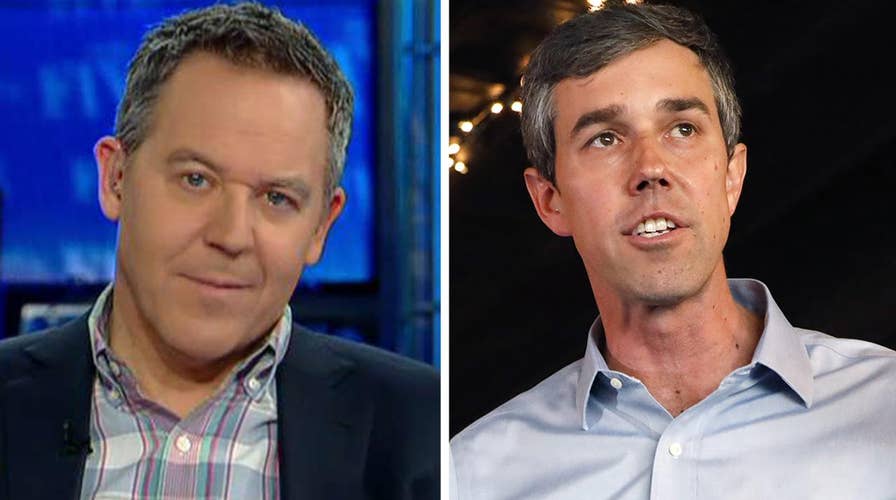
Gutfeld on Beto's Apology
Beto apologizes after saying his wife raises their children 'sometimes with my help.'
This is a rush transcript from "The Five," March 18, 2019. This copy may not be in its final form and may be updated.
GREG GUTFELD, CO-HOST: Hi, I'm Greg Gutfeld with Emily Compagno, Juan Williams, Jesse Watters, and she swims laps in a shot glass, Dana Perino. Used that one -- "The Five."
If you already thought the Democratic 2020 candidates were a frightened pack of cocktail wennies, get a load of Beto, a guy so sturdy, he's as sturdy as a gummy worm. You want pathetic? Here's pathetic. He felt he had to apologize over a sick joke he made about his wife. Now before we play this joke, you might want to scoot the kids out of the room.
(BEGIN VIDEO CLIP)
BETO O'ROURKE, PRESIDENTIAL CANDIDATE: I just got a call from my wife Amy. She's back in El Paso, Texas, where she is raising, sometimes with my help, Ulysses who's 12 years old, Molly who's 10, and their little brother Henry who is 8 years old.
(END VIDEO CLIP)
GUTFELD: He apologized for that. In case you missed it, he apologized for "sometimes with my help." He apologized for that. OK. Here's a quick mental exercise. Imagine a guy apologizing for that ever becoming president. Now he felt he had to apologize because, quote, people were outraged, meaning three cranks on twitter. But in the era of scalp first, think later, humor is the first to go.
When cnn.com article claims many female Democratic operatives were activists were triggered. For once, media, can we get a head count on many? Seriously, what kind of person gets offended over that? Wouldn't the right response be, look, it's a joke. If you can take a joke, we're going to have a real problem when I become president. Sadly, Beto went the other way.
(BEGIN VIDEO CLIP)
O'ROURKE: Not only will I not say that, but only much more thoughtful going forward in the ways that I talk about our marriage. And also the way in which I acknowledge the truth of the criticism that I have enjoyed white privilege.
(END VIDEO CLIP)
GUTFELD: Welcome to the modern liberal man, a snuggie full of guilt and fear. Notice how he threw in that white privilege just in case. The virtue signaler now brands our economy racist.
(BEGIN VIDEO CLIP)
O'ROURKE: I think the only way to meet some of these historic challenges is to be able to use this engine of capitalism. It won't be government intervention or policy alone that makes it possible. Now having said that, it is clearly an imperfect, unfair, unjust, and racist capitalist economy.
(END VIDEO CLIP)
(LAUGHTER)
GUTFELD: OK. Now try other economies, you know the ones that aren't as awesome in eradicating poverty. Our racist system has done more to help humanity than any ever. But what would he know about economies? He inherited and married his money, making him a perfect lefty, relying on the wealth of others to support his silly ideas, oversized ego, and absurd hand gestures. But, hey, attributes to real job.
All right, Juan, you and I sit here and we have made comments about being married, right? We've made jokes about what it's like to be married, for you a long time, for me not so long. He apologized for that.
JUAN WILLIAMS, CO-HOST: Yeah. I thought it was weak, unnecessary. But I'm a big booster of fathers, and so I do think if the idea is that you've got to be involved, you can't just be on the road and say I'm making money. I'm bringing in the bread, so, baby, you take care of the kids. That's -- I think that's out of line. But I'm a big booster of fatherhood.
But he -- I think right now what you're seeing on the left is a reaction which is that they feel like they've got to somehow conform, especially in a time when, you know, slight slipup can make big news and knock you out of the race. You know, to my mind, if this is about Trump going after his hand gestures, people saying he's P.C. and a snowflake, hey, Republicans, wake up. This guy just raised $600 million.
GUTFELD: Six hundred?
DANA PERINO, CO-HOST: Six million.
WILLIAMS: Six million.
GUTFELD: Jesus.
WILLIAMS: Six million. I'd just say 6 million. I was thinking in terms of how he beat, Dana, Bernie Sanders. He's way ahead of Amy Klobuchar who's also raised substantial amounts of money. And even farther ahead of Elizabeth Warren. So, to me, this raising this money was a surprise, Greg, because I didn't know that he was -- I knew he'd raised 80 million in the Texas race against Cruz. And I think you wrote that off to Cruz being a less than great candidate.
GUTFELD: Yes.
WILLIAMS: But this now is against fellow Democrats and people say we don't know him. We don't know his positions. Guess what, Democrats like this guy. He has real energy, and you're seeing some of the Obama people now flock to his campaign.
GUTFELD: I don't know, Dana. You know that women were upset because they couldn't make that joke. Do you actually believe people are sincerely outraged?
PERINO: I was thinking about though that I've made the joke in reverse. It's not a child, right? But, like, I post all these great pictures of Jasper on Instagram. I wrote a book about Jasper.
GUTFELD: It's debatable that they're great.
PERINO: Who takes care of Jasper?
GUTFELD: Yeah, who takes care of --
PERINO: It's not me. It's Peter --
GUTFELD: Peter.
PERINO: -- is taking care of Jasper.
GUTFELD: Wow.
PERINO: I will not apologize.
GUTFELD: He's a stay-at-home dog owner.
PERINO: I will not apologize for that. He does work.
PERINO: You're the Yoko. He's the John.
PERINO: Exactly. He works from home.
GUTFELD: Yes.
PERINO: If you think about the other part of this is that there was a lot of people saying, oh, yeah, it's such a bad rollout because Beto had to apologize. Well, one, there's the money. But also, arguably, Kirsten Gillibrand had a much worse rollout.
GUTFELD: Right.
PERINO: She officially announced this weekend with the video and literally no one is talking about it.
GUTFELD: Yeah, yeah, yeah.
PERINO: I think that his rollout is better because here we are we're leading our show with it.
GUTFELD: Jesse, you know what, I think he's stealing your I am Watters, this is my world thing. He's doing it in every scene.
JESSE WATTERS, CO-HOST: As a guy that likes hand gestures, I have to marvel at some of these. Here's a new one that I didn't know existed, this is ah, ah, ah, OK. And then there's the other one where he's talking about his wife Amy. He goes, Amy. Amy. I'm not sure what that represents. But I also don't understand why he apologized. He was actually praising Amy.
GUTFELD: Yes.
WATTERS: And what is he supposed to do? He's running for president. He needs to get out -- outside of his house to run for president. Is he going to take the kids out of El Paso and put them in school in Iowa, so he can co-parent in Iowa? I don't understand. He's like Gumby. That's how soft this guy is.
I don't also like the white privilege comment. I, as a white man understand. I probably have privileges that I don't even realize I have. But, to say that race is determinative of success I think is unfair to all the other things. Like great determination, good looks, things like that.
GUTFELD: Good looks.
WATTERS: To point and look at a successful white person and say, hey, he got that because he's white, discounts all the hard work that got there.
GUTFELD: He has a different kind of privilege. He has rich parents and rich wife privilege, which -- it's pretty good privilege, Emily. What do you make of this?
EMILY COMPAGNO, GUEST CO-HOST: Yeah, I agree with you that I think, you know, we're -- beware if he actually assumes that office for someone who can apologize and bend with the wind like that for something so little. I think that the media, though, is covering for him. He's running on charisma and personal narrative. I see none of it.
(CROSSTALK)
COMPAGNO: I think it's ridiculous. And I think, you know, the whole like sitting on the story for two years or whatever --
GUTFELD: Yeah.
COMPAGNO: -- that group that he was a part of, that was a precursor to anonymous. And he said, oh, I was really just on the margins. And his quote was I wanted to be the cool kid. I wanted to be as smart as them or whatever. And that's what I see that he's doing here. There's no substance, but for some reason it's really spit-balling and it's snowballing.
And yet, you know, Bernie Sanders has just raised just a little bit behind him. So I don't think we should count him out on the left. And also, he shattered records with the senate race, too. Like you've said, the fund raising and he still didn't win.
GUTFELD: You know there're two things, one -- apparently there was a reporter that hid an article about Beto O'Rourke until after the senate race and his excuse was he was writing a book, which is kind of interesting. And then we have Joe Biden accidentally announcing he's running for president -- only accidentally.
(BEGIN VIDEO CLIP)
FORMER VICE PRESIDENT JOE BIDEN: I'm told you're criticized by the new left. I'm the most progressive record of anybody running -- anybody who would run.
(APPLAUSE)
BIDEN: I didn't mean.
(APPLAUSE)
BIDEN: Anybody who would run.
(END VIDEO CLIP)
GUTFELD: Why is he waiting?
PERINO: Soft launch.
WATTERS: It's pretty soft. I've to defend Joe. I think what he was saying is the United States Senate because he's been running for the senate for, what, three decades. That's what it was.
WILLIAMS: He's running. It's just about -- it's a foregone conclusion. I think he has the luxury of taking his time. So I don't worry about that with Joe. I think the bigger issue for him is, and this comes back to something we touched on about Beto, about white privilege and all the like, is he going to be viewed as an older white male or can he catch up?
I think most Democrats, especially in Iowa, just want someone who can beat Donald Trump. But to your point about Beto's comment about race and privilege, white males, Jesse, but you go back and look at American history. Look at real estate in this country, segregated neighborhoods, how wealth is built. Look at the new deal and who got excluded from the new deal. Typically, agriculture workers, people who -- the black people.
WATTERS: I would agree with that, Juan. But I would also say there's a lot of very poor white working-class people in this country that look around and say, what privilege?
WILLIAMS: Yeah -- right because --
JESSE: What are you talking about?
WILLIAMS: Right. But there's no question about the historical disadvantage of being black that compounds that whatever disadvantage there was for poor whites.
GUTFELD: Then you've got to figure out what the solution is and I'm skeptical of what the solutions are that are being offered from that side. I've a few answers myself. I'll share them with you during the break.
PERINO: Thank you.
GUTFELD: Up next, a big liberal city is ready to roll out a plan that gives people cash to do nothing.
(COMMERCIAL BREAK)
WILLIAMS: Newark, New Jersey, now planning to test a universal basic income program. It would guarantee residents money every month whether they're working or not. Here's the city's mayor.
(BEGIN VIDEO CLIP)
MAYOR RAS BARAKA (D), NEWARK, NEW JERSEY: We believe in universal basic income. Martin Luther King believed in universal basic income. Especially in a time when studies have shown that families that have a crisis of just $400 in a month may experience a setback that may be difficult, even impossible for them to recover from. We're a third of our city still lives in poverty. We have to have a mind to build, a mind to work, and all we're asking for you to do is to help us work and build this city.
(END VIDEO CLIP)
WILLIAMS: Similar programs have been tested in countries like Finland and Canada, but they were ultimately shut down. Newark's plan comes just a month after a California city started offering residents in low income areas $500 a month.
So, Greg, I know you have been -- you actually advanced the way we all think and talk about changes in the workforce in this country because one of the fundamental changes taking place is, you know, automation.
GUTFELD: Yeah.
WILLIAMS: And so, fewer jobs are available. So does this make sense in that context to you?
GUTFELD: I -- what scares me is I don't think we have enough new ideas about this. I mean, it's easy -- I'm a capitalist, free-market guy. I immediately hate this idea, but I'm aware through workplace automation, you're talking 40 million people, cooks, waiters, clerks, truckers are going to lose their jobs, and there has to be something there for them in the meantime.
I came across this crazy experiment in Japan. So I'm for these experiments. I think we should try stuff out. There's a restaurant in Japan where the waiters are all robots because that's where it's gonna go, but they're controlled by paralyzed humans at a distant facility. They're eye blinking controls the robots taking your orders.
So, if people who are paralyzed have a desire to work, that's what makes me wonder about how can people not work. If you can find jobs for paralyzed humans, universal basic income should be tied to some kind of work at home. I think it would be better for both of them, for both the community and the workers, so they have something to contribute. If paralyzed people can get jobs, anybody can get jobs.
WILLIAMS: All right. So, Emily, what we know is 2017 Pew Poll said 60 percent of Americans favor guaranteed income, but what they really favor is a job guarantee. I think this speaks to their anxiety about losing jobs or jobs not being available. How does this proposition of a guaranteed basic income strike you?
COMPAGNO: I feel so strongly about this. It strikes me as playing into the fiscal dumpster fire that is New Jersey. That state is on the three lowest in the entire country for the fiscal dumpster fire. So for example, they have 50 percent less assets than they need to meet their future obligations, including all of their pension plans that they're mired in. It was ranked this year as the all-time worst for business, tax climate.
Everybody is fleeing and yet that state decided to raise taxes individually at the state level and for businesses. So sure, this idea too, on top of that, give free and come to people makes a lot of sense. That state is ridiculous. And I think it would behoove it instead to conduct an audit to shave spending, to then save and be able to meet their fiduciary obligations and incentivize businesses to grow in that state so they wouldn't have to shell out free money that doesn't work anyway.
And my last point is that we have twice as many millionaires in this country as Finland even has residents. So for people to make the comparisons of like, oh, that experiment, you know, whatever. All of that means that in Stockton P.S. was like the first city in California to declare bankruptcy. So that entire experiment too, I feel like it's ridiculous.
WILLIAMS: OK. So, Jesse, the senator from New Jersey, Cory Booker, now running for president, has introduced the bill, the American opportunity act. He would give every child born in country a thousand dollars in a bank account, and every year an additional 2,000. What do you think of this?
WATTERS: I kind of like that idea to be honest with you, I can't believe I'm admitting that. That sounds good. It's like a little -- like a little bond for a baby. Baby bond is that what they call it? Fine, I'm for it. I think what this is -- this is like subsidizing chilling.
WILLIAMS: Wait, what happened there?
(CROSSTALK)
GUTFELD: She almost passed out.
WATTERS: Would that add to fiscal dumpster fire?
COMPAGNO: Yes, like gasoline on the dumpster.
WATTERS: OK. I do -- I don't like this though because it's basically subsidizing chilling on the couch. This is like welfare for writers. People sit around. They paint a picture. They jam on their guitar. I'm supposed to pay for that? No way. You don't think people from all over the country, all the loafers are going to walk over to Newark and just set up shop and sit just around and do nothing on the couch and play video games all day?
We'll have Canadians crossing the northern border. Forget about Mexico. Just to come to Newark, New Jersey, so they can sit around and collect their free money. I like welfare because it's conditions-based. You have to meet a certain requirement. You have to be a poor mother. You have to be disabled, something like that. But then you're trying to get off welfare. That's the goal.
If you're just basically saying I'm going to give you free money not to work, that's going to destroy motivation, destroy innovation, and it just destroys the whole country, Juan.
WILLIAMS: OK, all right. So, Dana, I want to ask you on an intellectual level about Milton Friedman, because Milton Friedman --
WATTERS: I caught that, Juan.
(LAUGHTER)
WILLIAMS: Well, no, because I think you made a strong point. I didn't have any problem with that. I'm just saying --
WATTERS: Just not an intellectual point.
WILLIAMS: Well, no -- you know, I think the world of Dana. So --
WATTERS: OK.
WATTERS: So, Dana, again -- what is going on here?
(LAUGHTER)
WILLIAMS: So, Dana, Milton Friedman who's, you know, renowned conserve economists used to make the case that, in fact, he wanted universal basic income because he said then you could do away with all the bureaucracy. No more welfare. No more --
GUTFELD: But would they --
WILLIAMS: What?
GUTFELD: But would they do that? They wouldn't though.
PERINO: And also, of course, you also would have to -- I think, you would have to means test it. Meaning that people who make a certain amount of income should not be given the universal basic income, so then you're actually right back into the soup of what Jesse is talking about, which is that means based rather than means testing.
I think that there are -- well, guarantee this. The government will not be ready to deal with the policy problems that come from the automation that you and Greg are talking about. Government will lag behind. We're always lagging behind like on privacy issues and everything where the government is always going to be behind.
But there is one issue I think that Milton Friedman and -- actually, I think Emily would appreciate this, I think you might appreciate this, which is that you could actually start putting it into place now that as a company automates, that because you're going to lose that income, the tax revenue from those employers, right, because they get payroll tax, whatever. Tax the robots. And I think that that might be a way -- I know, we don't like --
GUTFELD: They don't vote. Taxation without representation, robots are going to go terminator on us.
PERINO: But it might make a company think twice about automation and like -- how many people are going to go out of business. Or if it goes out of business, then at least you have the tax revenue to help take care of other things --
GUTFELD: Taxing robots.
WILLIAMS: Well, you know, a friend of mine went to the Budweiser plant in New Jersey the other day, and he said there's nobody there. Like three guys running the automated machines that load your bud, anyway. Chelsea Clinton confronted by a group of NYU activists, New York University who don't know NYU. The terrible tragedy that they're claiming Chelsea Clinton caused, next on THE FIVE.
(COMMERCIAL BREAK)
WATTERS: Radical NYU students cornering Chelsea Clinton at a vigil for the victims of the New Zealand shootings and blaming her for the massacre.
(BEGIN VIDEO CLIP)
UNIDENTIFIED FEMALE: After all that you've done (INAUDIBLE).
CHELSEA CLINTON: I do believe words matter. I believe --
UNIDENTIFIED FEMALE: They do matter. . .
UNIDENTIFIED FEMALE: This right here is the result of a massacre stoked by people like you and the words that you put out. And I want you to know that and I want you to feel that deep inside. Forty-nine people died because of the rhetoric you put out there.
CLINTON: I'm so sorry. I don't think --
UNIDENTIFIED MALE: What does I'm sorry you feel that way mean?
(END VIDEO CLIP)
WATTERS: After bipartisan backlash condemning the confrontation, BuzzFeed actually giving the activists a guest column so they could take yet another shot at Clinton. So, I guess, Emily, this is because of Chelsea saying that whatever Omar said was anti-Semitic. And these activists think that she was stoking Islamophobia by doing that. That's why they confronted her. Can you believe that?
COMPAGNO: Honestly, I can't. Chelsea Clinton, to me, is like the most benign individual on the planet. So having this, kind of, you know, spring attack and then having that go viral is like kicking -- it's the wrong focus. And I also think that all of the comments surrounding it too -- I can't keep up. Like she's saying I'm sorry you feel that way. And last time I checked that was (ph) 101. But they're like, no, that's not enough.
And then they're saying that Ilhan Omar's comments, she was speaking the truth, and that all they wanted to do was have a very safe space for their fellow Muslims to mourn. So I can't keep up with -- is it OK to feel solidarity with others? Last time I checked, we're supposed to, you know, be against all forms of hate speech. But it seems to me that they are parsing and picking and choosing, and then picking on, again, the most benign person ever to make their point.
WATTERS: Yeah, Chelsea Clinton, Juan, managed to unite Bill de Blasio and Donald Trump Jr., both of those guys said leave Chelsea alone.
WILLIAMS: Yeah, and Emily, too. Yeah, everybody agree. I want to add my name because I thought that she handled it with grace. I mean, she was under fire there. It's not just Muslim students. There was a Jewish student and a Muslim student who are making this claim. And, you know, I can understand people say, hey, some of the criticism of Omar, they're really going after her.
And at some point, you wonder what this is really about because Omar is allowed to have her point of view. Chelsea Clinton is allowed to have her point of view. The big difference here is that -- when I was in college, sometimes things like this would happen. I got into it with the college president once, but we didn't have cell phones. Now you have a cell phone, you have a video and, of course, then it blows up.
COMPAGNO: What did you get into with the president about?
WILLIAMS: I told him that Haverford was a school for country gentlemen sons.
GUTFELD: Harsh words.
(CROSSTALK)
(LAUGHTER)
WATTERS: All right. Dana, so this is, I think, exemplifies the left civil war among -- over anti-Semitism. We saw it in the halls of Congress and now we're seeing it out on the street.
PERINO: I know why she kept --I believe I know why Chelsea Clinton kept her cool. She just wanted to diffuse the situation.
WATTERS: Hard to do.
PERINO: So you're dealing that with students and I'm not really around students that much, so I may -- might not have. But wouldn't it have been great if she had said, "Let me tell you a couple of things," right?
WILLIAMS: Ooh.
PERINO: Because who is going to stand up on the Left and say, "Enough?" Who is that going to be because it can't be us like no one's -- like they're not watching THE FIVE, and go, "Yes, you know what? We should really change that rhetoric?"
GUTFELD: Yes.
PERINO: But who on the Left is going to stand up and do that? Will it be Kamala Harris or Beto O'Rourke or Joe Biden, I don't--
GUTFELD: Well, it's definitely--
PERINO: I don't know.
GUTFELD: --it's definitely not Beto O'Rourke. He apologized for -- this is the same story--
PERINO: Yes.
GUTFELD: --Beto folding, sorry, you were going through them (ph).
PERINO: No, no, I'm done.
GUTFELD: I hate these students because they're making me sympathetic to Chelsea Clinton. I can't stand Chelsea Clinton. Now, I got to defend her. The Golden Rule, when you're attacking somebody, "Make sure she's not pregnant at the time." That's not a good look either.
PERINO: No.
GUTFELD: It just seemed like it was this like -- it was just bizarre. Look, the students are equating denunciation of anti-Semitism with anti-Muslim bigotry. That's really scary because then that means --
PERINO: Yes.
GUTFELD: --you shouldn't be criticism -- criticizing anti-Semitism.
This offers kind of a glimpse of why a lot of classic Liberals are moving though out of the party because the people that are in the Left, that Left side of the party, are saying no debate.
PERINO: Yes.
GUTFELD: We're not debating you.
PERINO: Cult.
GUTFELD: So, you're there, and you want to -- you want to have a discussion, but they're saying, "No." Personally, you are responsible for the death of 50 people. You're a disgusting human being. You can't have a debate with that.
So, you -- you end up with the staunchest defenders being Republicans because we aren't going to--
PERINO: Yes.
GUTFELD: --we aren't going to -- we don't -- we don't care about the social media mob the way they do.
WATTERS: And also, remember, or the Republicans that were victims of a lot of this mob behavior--
GUTFELD: We're used to it.
WATTERS: --after the Kavanaugh stuff, you know, people confronting people at restaurants and--
COMPAGNO: Yes.
WATTERS: --all over the halls of Congress where they sleep, where they pump their gas, Maxine, remember that? That's why we're so sympathetic. Let us pump our gas in peace.
Green New Deal supporters getting hit with a harsh reality check about their socialist agenda. Stay with us.
(COMMERCIAL BREAK)
PERINO: Many 2020 candidates are backing the idea of a Green New Deal.
(BEGIN VIDEO CLIP)
SEN. KAMALA HARRIS (D), CALIFORNIA: I support a Green New Deal, and I will tell you why. Climate change is an existential threat to us and we have got to deal with the reality of it.
SEN. AMY KLOBUCHAR, (D) MINNESOTA: The Green New Deal is so important right now for our country. I will as the first day as a President, sign us back into the International Climate Change agreement.
(CROWD CHEERING AND CLAPPING)
KLOBUCHAR: That is on day one.
SEN. CORY BOOKER, (D) NEW JERSEY: There's a lot of people now that are blowing back on the Green New Deal. They're like, "Oh, it's impractical! Oh, it's too expensive! Oh, it's all of this!" If we used to govern our dreams that way, we would have never gone to the moon.
And when the planet has been in peril in the past, who came forward to save Earth from the scourge of -- of Nazi and totalitarian regimes? We came forward.
(END VIDEO CLIP)
PERINO: But the proposal which is estimated to cost tens of trillions of dollars is facing a tough new reality. A report now saying hundreds of American cities and towns can't afford the rising cost of recycling and have been forced to cancel their programs.
So, Emily, I'm going to go to you on this because about in Seattle right there, there's a lot of recycling, there's a lot of recycling here, and then you find out that because China is not taking all of our recycling anymore, some cities like in Pennsylvania, they're burning it.
COMPAGNO: Yes.
PERINO: On Florida, Florida.
COMPAGNO: Yes. Our city, excuse me, passed an ordinance where if you fail to recycle or if you fail to compost that you would be cited and fined. I literally watched the garbage can slice my thing and then, when it first rolled out, and put then a little note that said like "Great job! Keep it up."
The point is however that Yale just came out with a study that said 68 percent of Americans will not even pay $10 a month for climate change meaning that when, of course, when you add rising cost to things, normal individuals and normal households are not going to pay this increased cost, right?
That's -- that's unduly burdensome. I think there's a lot of -- I hate using the phrase of virtue signaling, but like there -- there's a lot of that going around where it's all misguided and it's misplaced because the realities are that when you get down to the specifics, people are unable to pay or they don't know what they're talking about like with--
PERINO: Right.
COMPAGNO: --straws versus commercial fishing nets--
PERINO: Yes.
COMPAGNO: --and the Paris Accord versus efficacy. It's all just--
PERINO: And here's the thing, Greg--
COMPAGNO: --it's all smoke and mirrors.
PERINO: --like we have been conditioned and--
GUTFELD: Oh--
PERINO: --to start to practice recycling, we put things in the right bins, and then you find out it's not going to the right place.
GUTFELD: I am trying to get my wife to stop recycling. And she's like -- she's like bit brainwashed. It is a cult. We have spent so much time and money separating things that all end up in the same place.
You separate them and then they throw them back, and we've been duped by a lie. This is a lie. Recycling is a lie. It doesn't work.
Meanwhile, technology that could have delivered lasting solutions has been condemned. I call it, of course, nuclear power. You know, we should all have little adorable reactors in our backyards.
PERINO: I mean put the stuff in there?
GUTFELD: Yes. Just like the biggest -- talk about like you can't rely on the sun or the wind because our economy, it's too unreliable. But nuclear power would provide the energy base, and would do the trick. So, I think that we got to start thinking about that.
And a lot of environmentalists are moving towards--
PERINO: They're moving towards--
GUTFELD: --nuclear as the Green technology.
PERINO: But do they're -- are the Republicans vulnerable though, Jesse, on this issue of climate change because younger people, especially, big bloc of voters, they want to do something. But what -- what can the Republicans say they are for?
WATTERS: Well, I had Frank Luntz on my show the other day, Dana, who is--
PERINO: Yes.
GUTFELD: Must have been a hard get.
WATTERS: It's a tough booking. And, you know, he's like the best marketing strategist around. And he said, "Voters love the phrase Green New Deal." It polls extremely high. They don't know what it is. But they love the phrase of the--
COMPAGNO: The idea.
WATTERS: --slogan, right? So, I believe Green is the Trojan horse and New Deal is just socialism. They're just throwing Green in there to make people want to--
GUTFELD: Yes.
WATTERS: --buy into socialism and it's just an excuse for people to spend trillions of dollars. But look at what the Democrats do. Everything they push is because of fear.
You're all going to die because the climate is going to warm up. If you do the tax cuts, we're all going to die. If we repeal Obamacare, we're all going to die, because they can't make a persuasive argument based on the facts.
Beto O'Rourke even bought into this. He supports the Green New Deal, and they asked him why. And he goes, "Well, in a few years, it's going to be so hot in El Paso, human beings won't be able to live in El Paso."
Think about that for a second. It's too hot for El Paso? That's impossible.
PERINO: Now, Juan, let me ask you. Are Republicans missing the boat on this?
WILLIAMS: Big time. In fact, you asked Jesse a question, and he never answered it. You said -- she said, what is it that Republicans have to offer on this, and I guess it's pulling out of climate change deals and the like, but, you know, the big thing--
GUTFELD: I said nuclear power.
WILLIAMS: No, that's but we do have nuclear power.
GUTFELD: We need more of it.
PERINO: We need more of--
WILLIAMS: OK. That's a -- that's an argument.
COMPAGNO: That's capital for (ph) innovation.
WILLIAMS: But let me just finish up and say--
GUTFELD: Yes.
WILLIAMS: --I think that the reason that the New Green Deal is so popular is because people want to do something. They just don't want to have no -- no conversation or put-down people who are trying to do something. They say, "Well, what is in this Green New Deal?"
The -- the Right says, "Hey, it won't work. How do you fund it? Is it realistic?" And then they go on about airplanes and hamburgers, total ridiculous stuff caricaturing the thing.
But most people here--
WATTERS: No, of course, you said it (ph) yourself.
WILLIAMS: --and they say, "Guess what? The environment is at risk. Climate change is real. And we want to do something. We just don't know how to handle it. And Green New Deal"--
COMPAGNO: And then--
WILLIAMS: --just like Frank Luntz told you, "has a resonance with voters."
COMPAGNO: All in for that, all in for that (ph).
GUTFELD: Niall Ferguson said it should be called the Green Leap Forward.
PERINO: Oh, yes. Yes, yes.
COMPAGNO: Did you guys see how Coca-Cola is coming out with their own--
WILLIAMS: Yes.
COMPAGNO: --you know, their own thing to -- to -- to recycle and come up with a plan? That type of innovation doesn't happen in an over-regulated choked economy, which is what Democrats are for.
So, to me, Republicans and -- and Conservatives are for limiting government ownership and government overreach, enabling private citizens and private companies to do that innovation on their own because, Lord knows, it's not going to happen from a government agency.
PERINO: Well, and also, if the cities can't afford the recycling programs, like how are we actually going to forward thing (ph)?
WILLIAMS: Well, that's the question. How do we go forward?
COMPAGNO: Yes.
WILLIAMS: By the way, I have something to pull your heartstring, Dana.
PERINO: Uh-oh.
WILLIAMS: They had a story today about whales dying at an alarming rate because guess what, they're eating plastic.
PERINO: No, I know. Don't--
COMPAGNO: They're from commercial fishing nets.
PERINO: --don't get me started on the plastic. I'm upset about the--
COMPAGNO: That's commercial fishing nets.
PERINO: --plastic. OK. If you like to hit the snooze button, you may want to stop. We're going to tell you why, next.
(COMMERCIAL BREAK)
COMPAGNO: It's just been good (ph).
When my alarm goes off in the morning, I get up right away, so you can probably tell, but I've come close to murdering my husband because he insists on hitting the snooze button. Now, experts are saying snoozing is actually bad for your mental health. Some even want Apple to delete the feature off of phones.
So, who on THE FIVE is guilty of snoozing? Juan, do you snooze?
WILLIAMS: I -- you mean do I like -- I don't hit any button but I lay there, I'll tell you that. I lay there because I just get up slowly.
But I -- I was so curious about this article. It said that when you hit the snooze button, and then fall back asleep, when you wake up again, your body is like "Oh, oh, oh," because you get this rush of cortisol, and apparently, that's a stress hormone.
COMPAGNO: Yes.
WILLIAMS: To me, it's just like, OK, well, yes but some people really want -- they say you should sleep for half an hour, if you're going to go back to sleep.
GUTFELD: Mm.
COMPAGNO: Oh? I -- I mean I -- I wake up with a heart attack like how can you not when something is blaring your ear. Jesse, would you -- I feel like you probably snooze, and are annoying.
WATTERS: What? What?
COMPAGNO: I feel like -- I feel -- well tell us about you, won't you (ph)?
WATTERS: Tell me what you think about my snoozing? I -- I've spent a long time of my career getting up at 5 o'clock in the morning, and getting right into work at 7:00 A.M., 6:30. And now, I don't have to do that anymore. So, I wake -- there's mine, right?
I -- we have a 7:00 A.M., and then I have an 8:00 A.M.
COMPAGNO: Wow.
WATTERS: And that's all I need.
PERINO: Wow.
COMPAGNO: Wow, it's great.
WATTERS: Why -- you like -- you probably read three books by 7:00.
PERINO: Just about.
WATTERS: Few shots, few polls (ph).
PERINO: I'd never snoozed. I never did because I felt like that was being lazy or that I would like I have somewhat (ph) like a self-discipline. Now, here are all of mine.
WATTERS: Whoa!
COMPAGNO: Oh.
PERINO: Sometimes it just depends on where I am and like how much time I need to get ready, so I -- I think that I have -- they have earlier than that too.
WATTERS: You snooze a lot.
PERINO: I don't snooze.
WATTERS: No, that's not a snooze.
PERINO: No, I never snooze. Those are my alarms.
GUTFELD: Those are just her -- those are her alarms every day.
WATTERS: But that's like a self-snooze.
PERINO: But I also--
WILLIAMS: Not really -- not everyday day.
PERINO: --I -- I would tell you, I think it's maybe three times a year that I need woken up by an alarm. I always wake up before the alarm.
WILLIAMS: Yes.
COMPAGNO: Even when you travel?
PERINO: I just tell myself, "Got to wake up at 4:30."
COMPAGNO: Wow.
GUTFELD: You also go to bed at 6:30 P.M.
PERINO: Well there is that too.
WATTERS: Yes.
GUTFELD: It's easy to wake up at 5:00 when you've been sleeping for 12 hours.
PERINO: So good.
WATTERS: And not drinking.
GUTFELD: Exactly. That's the thing about -- drinking, you do wake up -- you wake up a lot.
WATTERS: Yes.
WILLIAMS: Get older--
GUTFELD: And as you get older, you keep waking up more and more, I don't know.
WILLIAMS: That's right.
GUTFELD: I just--
COMPAGNO: What about you? I mean--
GUTFELD: I'm a lucid dreamer, so I like having alarms, because you're going to wake up, and you go back to bed, you have these crazy dreams, it's fantastic, especially with ZzzQuil, so I do a little combination morning.
I -- I wake up like, "Greg," give myself like a half an hour. Why are these snoozes nine minutes? Did you notice this?
PERINO: No.
GUTFELD: They're all snooze they're like they have a--
COMPAGNO: Yes.
GUTFELD: Why is it nine minutes?
COMPAGNO: Didn't that use to be seven--
GUTFELD: I don't know.
COMPAGNO: --or you're (ph) like totally hallucinate that because I feel like now I can't tell if it's seven or nine.
PERINO: Can't you set the -- can't you set the snooze at what you want? I mean--
COMPAGNO: I don't know.
GUTFELD: No. I -- why don't you turn on your (ph) phone?
COMPAGNO: It is 2019 after all.
GUTFELD: No. But like a set snooze is nine minutes, I think.
PERINO: Oh, is it nine minutes? I didn't know that.
GUTFELD: Yes. It's that (ph)--
WATTERS: Juan, do you have one of those alarm clocks that we just saw in the background that's like circular with the button that like hits like that?
WILLIAMS: I do have one.
WATTERS: I knew it like that, that's Juan's--
WILLIAMS: But you know what?
WATTERS: --alarm right there.
WILLIAMS: But you know what? I didn't buy. It just came with this place I'm staying in. But I must say, what I use is the phone--
WATTERS: Yes.
WILLIAMS: --but it's at my list, as you saw it, it just because you're in different places. If you got to give a speech, you got to get up to help somebody, different times, but I'm like Dana.
WATTERS: You have a clock.
WILLIAMS: I just basically wake up. You know, look, I -- I can wake up at 4:15, seems to have (ph)--
WATTERS: Whoa! Wait, is that Juan's--
COMPAGNO: That's -- that's--
WILLIAMS: Yes. That's me.
WATTERS: --that 4:15 one?
WILLIAMS: Yes. Sometimes you got to go, you got to go.
PERINO: Got him worry about (ph) show.
GUTFELD: Wow!
WILLIAMS: Or how about an airplane, you know?
PERINO: Yes.
GUTFELD: Airplanes could take off.
COMPAGNO: I delete all of mine though. I hate looking at a screen with a ton of stuff.
PERINO: I do too.
COMPAGNO: That's our -- one was from yesterday. One was from today. And then I--
PERINO: I do too (ph).
COMPAGNO: --that -- even that is one too many. That's my phone.
PERINO: Really?
COMPAGNO: Yes. I have to delete everything.
PERINO: I should -- I guess I should delete mine.
WILLIAMS: Why?
COMPAGNO: Yes, you should, because it's cleaner that way. And it's--
WILLIAMS: It's not clean. You--
COMPAGNO: --visually pleasing.
WILLIAMS: --you don't have to go back and recreate it every time you need to wake up.
GUTFELD: I just set an alarm to stay awake during this segment.
COMPAGNO: So nice of you.
WATTERS: Always attacking the producers, Greg.
PERINO: All right.
WATTERS: You're going to pay for that.
GUTFELD: No. No. Alarms, this is a very important -- very important topic, you know--
PERINO: It's bad for your mental health.
GUTFELD: --you're -- you're snoozing. It's bad for your mental health.
COMPAGNO: Yes, it is (ph).
GUTFELD: The way -- basically, what they're saying, Emily, is that people that use a lot of wake, they're -- they're -- they might be psychotic.
PERINO: Also, just get up, get up and work, you're Americans.
WATTERS: Yes.
GUTFELD: Wow.
WATTERS: Not -- but if you have universal income--
COMPAGNO: Exactly. Till you're given Medicare (ph)--
WATTERS: --snooze all day, baby.
COMPAGNO: All right, guys, One More Thing is up next.
(COMMERCIAL BREAK)
GUTFELD: It is time now for One More Thing. Dana, start it off.
PERINO: I think I will although I just have to -- Emily just apologized to Jesse for calling him a snoozer.
WATTERS: That's a Beto move, Emily.
COMPAGNO: More like -- more like it came down a little (ph)--
PERINO: You're so nice.
COMPAGNO: Please forgive (ph) because I was like -- said annoying. This was like--
WATTERS: Apology not accepted.
PERINO: Apology not accepted. That is striking (ph) her all week. OK.
Yesterday was the United Airlines Half Marathon in New York City, and Thomas Panek, you can see him here, made history by becoming the first blind runner led by guide dogs to finish the race.
He had a team of three Labradors to help out. It was Waffle, Westley, and Gus. They all took turns by his side. He finished in like 2.5 hours, like amazing. This is part of the Running Guides Program that Thomas created, and it's really amazing, guiding eyes for the blind.
GUTFELD: Yes. You know, that was the United Airlines Marathon. I heard that they asked 10 runners if they could leave for a later marathon.
PERINO: Yes. Well, they did it. Take a listen to him real quick.
(BEGIN VIDEO CLIP)
THOMAS PANEK, PRESIDENT & CEO, GUIDING EYES FOR THE BLIND: He's so calm. He's so together. He knows what he's doing. He just guided me on the course safely and got me first to Finish Line.
Just to say to people who are blind, get out there. You can do it. You can do anything.
(END VIDEO CLIP)
PERINO: Pretty awesome, awesome, awesome. Animals are great, Greg.
GUTFELD: Where were they running?
PERINO: New York City.
GUTFELD: Running blind in New York, that takes serious--
WATTERS: They closed the course.
COMPAGNO: Yes, it's just far (ph).
GUTFELD: Yes, I know. I was going to say--
WILLIAMS: Perfect, perfect (ph).
GUTFELD: All right.
WILLIAMS: But I must say--
PERINO: Good dog.
WILLIAMS: --that is so courageous.
GUTFELD: Yes.
WILLIAMS: That's awesome.
GUTFELD: Yes.
WILLIAMS: Anyway, Justice Ruth Bader Ginsburg had her 86th birthday on Friday. To celebrate the oldest Supreme Court Justice, some of her fans gathered outside the Supreme Court. They did an exercise that Justice Ginsburg made famous, planks. They also sang Happy Birthday. Watch.
(BEGIN VIDEO CLIP)
(PEOPLE SINGING HAPPY BIRTHDAY TO JUSTICE RUTH BADER GINSBURG)
(END VIDEO CLIP)
WILLIAMS: In addition to Justice Ginsburg, my son Tony celebrated his birthday this weekend. Here we are at dinner.
His sister, the Legal Eagle (ph) made a cake for Tony. It looked like a soccer ball for the College Soccer Star, and she wrapped a scarf celebrating the local Soccer Club, D.C. United, around the cake. Happy birthday, Tony.
COMPAGNO: Cute (ph).
WILLIAMS: What a fine son!
GUTFELD: They celebrate Clarence Thomas' birthday like that? I don't think so.
PERINO: That's fine (ph).
WATTERS: No. Kavanaugh's birthday.
GUTFELD: Kavanaugh's birthday.
WATTERS: Everybody has a drink and have a cagar (ph).
GUTFELD: Yes.
WATTERS: That's right.
GUTFELD: All right, it's time--
WILLIAMS: You -- you Liberals are something else.
GUTFELD: Ha-ha, ha-ha, let's do this.
(BEGIN VIDEO CLIP)
(MUSIC)
TEXT: ANIMALS ARE GREAT!
(END VIDEO CLIP)
GUTFELD: Sometimes I wish I was as limber as this little sucker here, this little pug. Check -- check him out. Look at him in there, in his little thing. He's -- he's got his foot in his mouth. He's got a little itch on his foot.
You ever wonder you were -- if you could just stretch like that, how great it would be?
PERINO: Contort yourself into--
GUTFELD: Yes.
PERINO: --crazy positions--
GUTFELD: Yes. Yes.
PERINO: --like that?
GUTFELD: And he's not even embarrassed. I would be embarrassed if somebody walked in on me, and I had my foot in my mouth, although I often do. I do have my foot in my mouth often on THE FIVE. Anyway, I'm just stretching this one out.
All right, Jesse, that's why--
WATTERS: There you go.
GUTFELD: Better when I saw it on screen.
(BEGIN VIDEO CLIP)
(MUSIC)
TEXT: ANIMALS ARE GREAT!
(END VIDEO CLIP)
GUTFELD: I hope he's all right, Jesse.
WATTERS: I think he's just fine.
GUTFELD: OK.
WATTERS: For -- for someone who's had his foot in his mouth before, get over it.
All right, I took the twins skiing this weekend up at Windham in the Catskills, and I met the best instructor ever, Ray Curtis. He's the Snowsports School Chairman, Manager over there, basically taught the girls to be excellent skiers.
They're now just going down the Double Black Diamonds. There they are, Ellie and Sophia. We had a great time. And dad did not get injured. And that was the key to the--
PERINO: That's -- that's the new goal.
WATTERS: --having a great skiing tutor to not injuring yourself, all right? So--
GUTFELD: Are you a good skier?
WATTERS: --we had a good time, thank you. I can get down the hill.
GUTFELD: Yes, yes, yes. Do you sit on regular -- you do -- still do Bunny Hill's (ph)?
WATTERS: With the twins, I do. But I can go a little higher than that, Greg.
GUTFELD: Well, very good, very good.
WILLIAMS: You know what I say? "Go Daddy, Go," because that was terrific.
WATTERS: That's right.
WILLIAMS: See we're talking about being a good dad.
GUTFELD: All right, Emily, let's hope you have something interesting this time.
COMPAGNO: I do because animals are great, Greg. This is about a turkey, and a turkey appears to play crossing guard, so his other turkeys can cross the road amid traffic.
PERINO: They're cute (ph).
COMPAGNO: Now, a flock of turkeys is called a rafter, by the way, I just learned this. We all did. Look at him, it's so cute. And I just love how like obediently all the cars are. But anyway, this is a New Hampshire turkey, playing crossing guard for his feathered friends.
(BEGIN VIDEO CLIP)
(TURKEY PLAYS CROSSING GUARD AS PALS CROSS THE ROAD VIDEO)
(END VIDEO CLIP)
PERINO: That's amazing.
COMPAGNO: It seems to be conscious fellow (ph) spreading out its feathers--
PERINO: It's fine.
GUTFELD: Now, what if he knows what he's doing?
COMPAGNO: --staging the plane (ph).
GUTFELD: Do you think he knows what he's doing, Emily?
COMPAGNO: I think he knew, totally. PS, you guys remember that case, and I think it was Ireland, where this woman stopped for a flock of ducks--
PERINO: Yes.
COMPAGNO: --crossing the street, and then that motorcycle came and hit, and she was convicted of manslaughter. Anyway, so right here the turkey is--
PERINO: What?
GUTFELD: I don't remember -- I don't remember that story, Emily.
COMPAGNO: Sorry.
GUTFELD: I don't remember that story.
COMPAGNO: Pretty amazed for me now (ph).
PERINO: Motorcycle hit her?
COMPAGNO: Yes. And there was a fatality and so she was subsequently prosecuted and--
WILLIAMS: That's crazy.
COMPAGNO: --and convicted. I know it.
PERINO: She didn't (ph) stop for the ducks.
COMPAGNO: So here, the turkey was doing it, so that no human had to get in trouble for it.
WATTERS: Well--
GUTFELD: Very interesting story, Emily.
COMPAGNO: Yes.
GUTFELD: Wow.
PERINO: Wow.
WILLIAMS: Yes. I think I--
WATTERS: Well de Blasio was just up in New Hampshire.
GUTFELD: Oh, right (ph).
WATTERS: Six people showed up--
PERINO: Wow!
WATTERS: --to his event, just six.
WILLIAMS: Were you there?
GUTFELD: They were all turkeys.
WATTERS: A rafter.
GUTFELD: A rafter.
WILLIAMS: A rafter, OK.
GUTFELD: All right, set your DVRs. Never miss an episode. "Special Report" up next.
Content and Programming Copyright 2019 Fox News Network, LLC. ALL RIGHTS RESERVED. Copyright 2019 CQ-Roll Call, Inc. All materials herein are protected by United States copyright law and may not be reproduced, distributed, transmitted, displayed, published or broadcast without the prior written permission of CQ-Roll Call. You may not alter or remove any trademark, copyright or other notice from copies of the content.
