




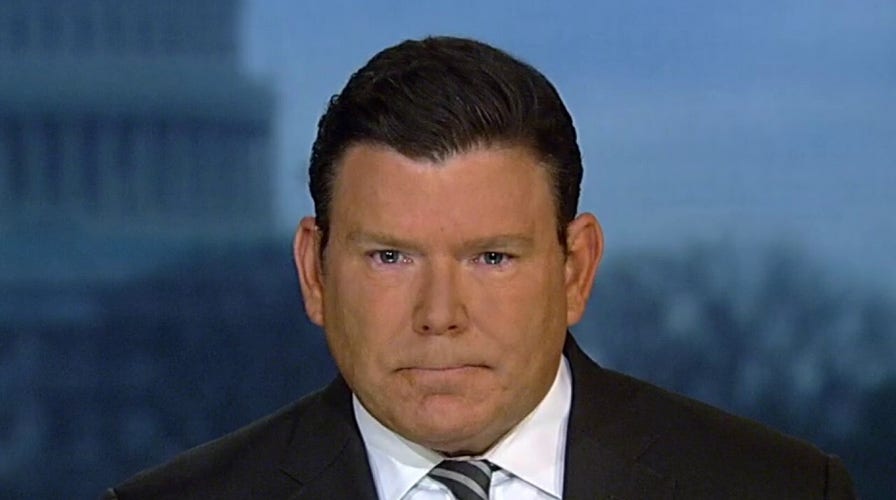
Baier: Dr. Fauci, other doctors very authentic, straightforward on coronavirus
'Special Report' anchor Bret Baier reacts the White House press conference where President Trump declared a national emergency.
This is a rush transcript from "Your World with Neil Cavuto," March 13, 2020. This copy may not be in its final form and may be updated.
DONALD TRUMP, PRESIDENT OF THE UNITED STATES: The CDC has published guidelines on the coronavirus.gov to enable its -- coronavirus.gov and it's very, very heavily used right now, I will say, to enable every American to respond to this epidemic and to protect themselves, their families, and their communities.
While the risks to young and healthy Americans remains very low -- yes, we've learned about this over the last two weeks -- anyone can be a carrier for the virus and risk transmission to older Americans and those with underlying health conditions and those who are most at risk. They have not done very well, older Americans who are -- especially if they have a health problem. They have not done well.
We must take all precautions and be responsible for the actions that we take and that we see other people take. We want to prevent the spread and the transmission of the disease. It's incredible what sports -- what's happening with the sporting world where so many of the great sports we've gotten so used to at this time of the year. They're not going to be meeting, and they've done a great service actually, but that would be another way that it could be -- problems could be caused.
But this is why I outlined on Wednesday my administration's fact that we've issued a requirement suspending all medically unnecessary visits to various places but particularly nursing homes. We should all be working off the same playbook when it comes to protecting Americans. We have to.
We need to be consistent in adopting measure to limit the spread of the virus. The virus is the same whether it's spreading in cities, towns, or rural communities. The tools and tactics for attacking it are similar no matter where you go -- no matter where you go. You have some hot spots throughout the world right now that people would have never thought possible. They're being very seriously affected.
Key among these efforts are breaking chains of transmission between people. These measures have been adapted by many companies, universities, and schools. And we want to protect the safety and the health of their employees and their students. I encourage everyone to follow the guidelines we've issued by CDC on these commonsense measures. A lot of it's commonsense.
For the areas where the virus is spreading, the CDC is advising communities to postpone large gathering, postpone assemblies, social functions, and sporting events, stagger recess and lunch for schools that aren't canceled, limit in-person meetings, increase scheduled cleanings, and cancel work- sponsored travel among numerous other steps that could be taken.
Americans are the strongest and most resilient people on Earth, and in the coming weeks we will all have to make changes and sacrifices, but these short-term sacrifices will produce long-term gain. And again, I've said we're learning a lot for the future and future problems like this or worse -- or worse. It could get worse.
The next eight weeks are critical. We can learn, and we will turn a corner on this virus. Some of the doctors say it will wash through. It will flow through. Interesting terms, and very accurate. I think you're going to find a number of weeks it's going to be a very active term.
In times of hardship, the true character of America always shines through. We live in the company of the greatest heroes and the most inspiring citizens anywhere in the world. We want to take care of our people. We want to draw on the strength of our history, draw on the strength of our people, and we will get through this. All together we will just get through.
So much progress has already been made, and frankly the numbers because of steps that have been taken are at a level that a lot of people are surprised, especially when you compare them with other places, with far smaller populations.
The spirit and the will of our nation is unbreakable. We will defeat this threat. When America is tested, America rises to the occasion. And to those families and citizens who are worried and concerned for themselves and their loved ones, I want you to know that your federal government will unleash every authority, resource, and tool in its disposal to safeguard the lives and health of our people.
So we're with you every step of the way. No nation is more prepared or more equipped to face down this crisis. As you know, we are rated number one in the world. We're also helping other nations. Many of the nations, we're helping them a lot, and they're doing OK in some cases and some cases they're not doing well at all, but we're working with a lot of groups of people and a lot of other nations.
With faith and heart and hope and love and determination, we will succeed, we will prevail, we will be very, very successful and we'll learn for the future. Thank you all very much. If you have any questions, we can take some.
Go ahead, John, please.
And if you'd like to ask some of the folks up here, would be fine. Please.
QUESTION: Sure. Mr. President, where are you with the House bill? Yesterday, we talked to you in the Oval Office, you were opposed to it. What has happened since then? And what's the holdup on that?
TRUMP: Well, we just don't think they're giving enough. We don't think the Democrats are giving enough. We're negotiating. We thought we had something, but all of a sudden they didn't agree to certain things that they agreed to. So we could have something, but we don't think they're giving enough. They're not -- they're not doing what's right for the country.
QUESTION: And if I could ask Dr. Fauci?
TRUMP: Go ahead, please.
QUESTION: Thank you, Mr. President. You just mentioned waiving interest for student loans...
TRUMP: Yeah.
QUESTION: ... you talked about buying oil from the SPR -- or adding to the SPR. What other specific targeted measures is your administration thinking about taking? The Treasury secretary, Steve Mnuchin, said today that you're just in the second inning of things that...
TRUMP: Yeah. Well...
QUESTION: ... you might be undergoing.
TRUMP: ... that's true. And we're looking at many different things, as you know. You know some of them, they've been written about very widely. But we're going to be releasing a paper in about two hours, stating quite a few other steps, very important ones.
Please, go ahead.
QUESTION: ... sir, if you wouldn't mind?
TRUMP: Please, go ahead.
QUESTION: Thank you so much, Mr. President. I want to -- I want to know if you are in contact with the Brazilian president, Bolsonaro, after a member of his delegation, who was with you Saturday, was tested positive.
And also, I want to ask another question if you'll let me. Senators Lindsey Graham and also Senator Scott -- Rick Scott are self-isolating. Are you planning to take any kind of precautionary measure to protect you and also your staff who was there...
TRUMP: No, I...
QUESTION: ... with him?
TRUMP: ... we have no symptoms whatsoever. And we have -- we had a great meeting with the president of Brazil, Bolsonaro, great guy, very -- very tremendous. He's doing a fantastic job for Brazil.
And as you know, he tested negative, meaning nothing wrong this morning, and we got that word too. Because we did have dinner with him, we were sitting next to each other for a long period of time.
QUESTION: But are you in contact with him over the coronavirus crisis?
TRUMP: No, we have -- we have -- we're talking about it, country-to- country. But we did discuss if he had a problem. It was reported that he may have it, and he doesn't, fortunately.
Yeah?
QUESTION: Thank you so much, Mr. President. Dr. Fauci said earlier this week that the lag in testing was in fact a failing. Do you take responsibility for that? And when can you guarantee that every single American who needs a test will be able to have a test? What's the date of that?
TRUMP: Yeah. No, I don't take responsibility at all because we were given a -- a set of circumstances, and we were given rules, regulations and specifications from a different time. Wasn't meant for this kind of an event, with the kind of numbers that we're talking about.
And what we've done is redesigned it very quickly, with the help of the people behind me, and we're now in very, very strong shape. I think we'll be announcing, as I said, Sunday night. And this will start very quickly and we -- we'll have -- we'll have the ability to do in the millions over a very, very quick period of time. So, no.
And what we have done -- and we are going to be leaving a very indelible print for the future, in case something like this happens again -- but it was a -- and that's not the fault of anybody. And frankly, the old system worked very well for smaller numbers, much smaller numbers. But not for these kinds of numbers.
Tony, maybe you'd like to say something...
QUESTION: By Sunday night? Will you have -- yes, please. By Sunday night, will every American be able to get a test?
DR. ANTHONY FAUCI, DIRECTOR, NATIONAL INSTITUTE OF ALLERGY AND INFECTIOUS DISEASES: So, just to reiterate what I said to many of you multiple times, it's a (INAUDIBLE) of a system.
The system was not designed -- for what it was designed for, it worked very well. The CDC designed a good system. If you want to get the kind of blanket testing and availability that anybody can get it, or you could even do surveillance to find out what the penetrance is. You have to embrace the private sector. And this is exactly what you're seeing, because you can't do it without it.
So when I said that, I meant the system was not designed for what we need. Now, looking forward, the system will take care of it.
QUESTION: Mr. President, with respect, you...
TRUMP: And interestingly, if you go back -- please. If you go back to the Swine Flu, it was nothing like this, they didn't do testing like this. And actually, they lost approximately 14,000 people. And they didn't do the testing. They started thinking about testing when it was far too late.
What we've done -- and one of the reasons I think people are respecting what we've done, we've done it very early, we've gotten it very early and we've also kept a lot of people out. Yes, please, go ahead.
QUESTION: Mr. President, the last administration said that they had tested a million people at this point. You've been President for three years ...
(CROSSTALK)
QUESTION: ... but with respect, you've been President for three years and Wuhan was suffering ...
TRUMP: They had a very big failure with swine flu -- very big failure.
QUESTION: Thank you, Mr. President. I want to ask you about the European travel ban that goes into effect at midnight tonight and the exemption that you've offered to the UK. There are 17 countries that are in the so-called Schengen zone that have fewer coronavirus cases than the UK.
And just in the past 24 hours, the UK has added 208 coronavirus cases to their total. Why did they, Mr. President, deserve an exemption and would you consider adding them to this travel ban list?
TRUMP: Well that was recommended to me by a group of professionals and we are looking at it based on the new numbers that are coming out and we may have to include them in the list of countries that we will -- you could say ban or whatever it is -- during this period of time.
But yeah, the numbers have gone up fairly precipitously over the last 24 hours so we may be adding that and we may be adding a couple of others and we may frankly start thinking about taking some off.
(CROSSTALK)
TRUMP: Go ahead.
QUESTION: Thank you, Mr. President. I'm a correspondent with Hong Kong Phoenix TV.
You have been mentioned -- you have mentioned that the number in China has been decreasing, China has made tremendous progress in the past weeks.
I'm wondering how much confidence does this give you to control the virus in the United States? And do you see the data China has been sharing with the United States has been helpful?
TRUMP: I think it has been helpful. We've been working very much with China. I've spoken, as you know, with President Xi. They went through hell and their numbers are starting to look very good, they really -- they're really looking very good, we're very happy about that.
We are sharing data, yes. In fact, we're sharing quite a bit of data, including the fact that some of our pharmaceutical companies are working over there right now with large groups of people.
Yeah, go ahead, please.
QUESTION: Thank you, Mr. President. You spoke with Canadian Prime Minister Trudeau yesterday. Did you discuss the potential closing of the border between the -- Canada and the U.S.? And by extension, are you considering ways to salvage the $2 billion daily trade between the two countries?
TRUMP: So we didn't discuss the border. We've had a very good relationship. Just about finished with the USMCA, as you know. He called -- actually, he called to tell me that. I think that was the primary reason for the call.
At the time, his wife had not been diagnosed and she's a lovely lady -- wonderful lady -- great lady. And since then, I've heard, read that the result was that she has it and I was a little surprised, I think he was surprised, also. We did discuss it prior, too. She's going to be fine but he thought that she would not most likely have the virus. Unfortunately, she does.
But we didn't discuss the border yesterday, no. Go ahead, please. If you have any questions for these great geniuses up here, you should -- even a business question related to what we're talking about.
QUESTION: Mr. President, Ross Palombo from ABC News Miami.
As a relatively new Floridian, what is your message today to the cruise line industry and the travel industry that Florida depends upon? And since Senator Rick Scott and Miami-Dade Mayor Carlos Gimenez have the same exposure as you and they are self-isolating, what's your message to them? That they shouldn't be?
TRUMP: Well I don't know that I had an exposure but I don't have any of the symptoms and we do have a White House doctor and I should say many White House doctors to -- frankly and I asked them that same question and they said you don't have any symptoms whatsoever.
And we don't want people without symptoms to go and do the test. The test is not insignificant. As far as the cruise line business, we're with them all the way. It's a great business -- it's a great U.S. business, frankly and I know how important they are to the country -- that includes airlines but the cruise line business obviously was hit very hard.
We had a tremendous success out in Oakland, where we moved it -- Vice President Pence did a fantastic job with that. We worked with UK, we worked with Canada. They took their people back -- and Canada's approximately 600 people. UK, likewise, took a large number of people back to the United Kingdom.
And we have people quarantined. It was a big operation and it worked out really -- you don't hear about it anymore, it worked out really well. You - - Mike, you even may want to say something about that cause that was really done properly.
MIKE PENCE, VICE PRESIDENT OF THE UNITED STATES: Well, thank you, Mr. President. And that -- that -- that program with the Grand Princess, the ship, is continuing to be administered in the highest standards and orderly way, as the president directed. And American's that needed treatment have received it.
I spoke to the governor of Iowa today and some of those who now have been cleared are -- are able, in proper supervision, to be returning to Iowa. They're making arrangements for them to do that. Others in Texas, others in Georgia -- again, it's another example of the extraordinary cooperation of Governor Abbott, Governor Gavin Newsom, and Governor Brian Kemp of Georgia.
But to add to that, the president directed me last Saturday to travel down to Miami, we met with all the leaders of the cruise line industry. Several cruise lines have announced a 60-day pause in operations. Our Department of Homeland Security has praised them for doing that because of the unique health challenges particularly presented to seniors with underlying conditions.
We have a proposal from the cruise line industry but they're currently considering what other steps that they might take, perhaps even similar to what those other lines have taken. We're anticipating some response on that in the next 24 hours.
But as the president said, the American people cherish our cruise line industry, the men and women who work on the ships, the men and women who work on the shore, all the economies that are so benefited by a vibrant cruise line industry.
And what the president's directed us to do is, whether there -- whether there is a pause in the moment, as some cruise lines are doing -- and as well all continue to discuss, we want to work with the cruise line industry to ensure that when we come through this that cruise lines and the medical services that are available and -- for the passengers and all of the crew, that -- that -- that cruise lines are safer than ever before and prosper for many years to come.
TRUMP: (OFF-MIKE) OK, thanks.
QUESTION: Mr. President...
(CROSSTALK)
QUESTION: Mr. President...
TRUMP: Go ahead, please.
QUESTION: This question is for Drs. Fauci and Birx. Dr. Fauci, based on what you currently know, what is the trajectory for when this outbreak will peak? How long will the American people have to remain on this emergency footing?
And for Dr. Birx, as the administration tries to get its arms around this test kit shortage issue, the next glaring need could be respirators and related hospital equipment. So what is the administration doing right now to ramp-up production of respirators and that kind of equipment, should this outbreak persist?
FAUCI: So when you have an outbreak like this, particularly if you're trying to interfere with it, it's really impossible to predict the time element of when it's going to peak and when it's naturally going to go down.
So if you look at the situation where countries really did not get to the point of trying to contain and mitigate very well, you'll see a peak over several weeks and then down again over another several weeks. What we're trying to do with the efforts that we're doing is to blunt that peak.
And I've mentioned it many times, and I think it's important and appropriate for me to mention it again because it answers your question -- when you talk about preventing infections from without in -- which is the kind of travel restrictions we're talking about -- then how do you handle what you already have in your country? You continue some sort of containment, but you also do mitigation and you try to proportion it to the areas where there are the most infections.
The success of that, and how much you make this turn into this, is going to give you the amount of time. If we're successful, it'll be less. If we're not successful, it's going to be more. But these kinds of things generally run out in a few months; hopefully, we'll make it several weeks -- eight, nine, whatever weeks. But I can't give you a number because it depends on how successful we are.
DR. DEBORAH BIRX, WHITE HOUSE CORONAVIRUS RESPONSE COORDINATOR: Great, thank you. It's a great question. And Dr. Fauci and I have worked together a very long time and continue -- it's a privilege to work with him every day. So you can learn very -- and I appreciate there was some graphics done by some of the reporting over the last several days. If you align the data from China with the data from South Korea, you can start to see almost a complete overlay of that data. And so that's what we're tracking very closely, as well as Italy.
But you have an excellent question. I just want to make one note. In South Korea -- I want to repeat -- only 4 percent of the tests were positive. That means 96 percent of the people had a different respiratory disease because we're in the middle of flu season, cold season, and all of the other respiratory diseases that we get every day.
In LabCorp and Quest's early data, they're running about 1 percent to 2 percent positive. That means that we have a lot more other respiratory disease out there besides the coronavirus. And that's why the screening is critical. But even with the screening, we're going to run what we think are very low rates. Needless to say though, we are taking it extraordinarily seriously to plan for what could come -- not what -- what Dr. Fauci talked about blunting the curve, that makes it much less high need at that peak of the curve that we're all planning for.
So we're in full inventory of all of our assets, by the president on unlocking and this emergency order, and the Secretary of HHS ability, it unlocks all of those stockpiles, those needs -- what the VA has, what the DOD has, what the National Guard has and what every hospital has.
And the Hospital Emergency Preparedness Plan allows them to defer elective issues to keep those hospital beds open for those who might need it. So we're in full planning mode for each of those things.
TRUMP: And I might add that we're in the process, and in some cases have already done it -- ordered a large number of respirators just in case. We hope we don't need them, but we've ordered a large number.
Yes, go ahead please.
QUESTION: Thank you very much, Mr. President. In your speech to the nation you mentioned the situation in China and South Korea have improved and you are thinking about removing the restrictions, also the warning...
TRUMP: Right.
QUESTION: ...in place right now. When can we expect that announcement, and how do you see the overall progress that Asian countries made?
TRUMP: Well some are making progress, some are not -- as you know. But some are making progress, and as they make progress, as they get to the number that we all think is right -- that they know is right, we know is right, we'll be opening it up. And some are really moving along rapidly, we hope to be able to open things up as quickly as possible.
Go ahead, please -- go ahead.
QUESTION: Thank you, Mr. President. I'd like to ask Secretary Azar and Dr. Fauci just how -- Dr. Fauci, OK...
TRUMP: All right, better -- better, not 100 percent, but 90 percent.
QUESTION: Right.
TRUMP: Go ahead.
QUESTION: These affects the elderly primarily, and in that sense it's an unusual disease, is any specific research being done as to why it effects our senior citizens more than others?
FAUCI: So, I don't mean to diminish your question, but we already know why it would affect senior citizens more, because when you talk about anything that requires a robust immune system -- as you get older, your immune system is not as potent as it is when you were young.
And that's the reason why, when you talk about even influenza, which we have extraordinary experience with over decades and decades, the people who are very vulnerable are the elderly and those with underlying conditions.
The same thing holds true for a variety of other disease -- why cancer is more prevalent in some -- mostly in older individuals because the immune system that screens for it is less robust. So it really is something that is kind of well-known over a lot of studies.
TRUMP: OK, OAN, please. OAN.
QUESTION: Mr. President, the Chinese officials are expressing some tones of discontent with how -- where the source of this virus has come from, and they're spinning some odd narratives, what are your response to the Chinese officials who are doing that? And have they signaled any kind of resistance to upcoming trade talks in response to how we're handling this virus?
TRUMP: No, we have our deal with China. They're going to be buying $250 billion worth of goods and $50 billion from our farmers. And that's a great deal for our country; it's about time somebody did that. And, frankly, phase two, we'll start negotiating.
I did read one article, but I don't think that article was representative - - certainly not of my conversations with President Xi. And they know where it came from, they all know where it came from -- we all know where it came from.
QUESTION: Thank you, Mr. President Yamiche Alcindor for PBS NewsHour...
TRUMP: Yes.
QUESTION: ...my first question is, you said that you don't take responsibility, but you did disband the White House Pandemic Office and officials that were working in that office left this administration abruptly.
So what responsibility do you take to that? And officials that worked in that office said that you -- that the White House lost valuable time because that office was disbanded, what do you make of that?
TRUMP: Well I just think it's a nasty question because what we've done is - - and Tony has said numerous times that we've saved thousands of lives because of the quick closing. And when you say me, I didn't do it -- we have a group of people, I could ask perhaps in my administration, but I could perhaps ask Tony about that, because I don't know anything about it.
I mean, you say we did that -- I don't know anything about it...
QUESTION: You don't know about the...
TRUMP: ...disbanding, no, I don't know...
QUESTION: ...about the reorganization that happened at the National Security Council?
TRUMP: ...it's the -- it's the administration...
(CROSSTALK)
TRUMP: ... perhaps they do that. You know, people let people go. You used to be with a different newspaper than you are now. You know, things like that happen. OK, please go ahead.
QUESTION: (OFF-MIKE)
TRUMP: We're doing a great job. Let me tell you, these professionals behind me and the -- these great, incredible doctors and business people, the best in the world -- and I can say that, whether it's retailers or -- or labs or anything you want to say, these are the best in the world. We're doing a great job.
We have 40 people right now -- 40. Compare that with other countries that have many, many times that amount. And one of the reasons we have 40 and others have -- and again, that number's going up, just so you understand. And a number of cases, which are very small, relatively speaking -- it's going up.
But we've done a great job because we acted quickly, we acted early, and there's nothing we could've done that was better than closing our borders to highly infected areas. Please, go ahead.
QUESTION: Thank you, Mr. President. Vanessa Jaklitsch for NTN24 for Latin America countries...
THE PRESIDENT: Yes, sure.
QUESTION: ... and also for Spain, La Razon and Antena 3. I would like to ask you two very brief questions. One: For how long we're going to have the emergency -- I mean, the national emergency? And...
TRUMP: I hope not long but it's there now and it gives tremendous powers for things that we need -- tremendous power, actually -- and the Stafford Act and various other things that we're involved with and have studied and memorized in so many different ways and forms.
It gives the kind of power that we need to get rid of this virus and we're going to do it very quickly and I hope we won't need it very long but whatever it takes.
QUESTION: So for now, we still don't know for how long. And something very important I wanted to ask you is, like, how do you think -- do you really think it's essential, coordinating with other countries, and learning from the lessons that they already suffered, these same situation countries, of course like China and South Korea but now recently Italy and Spain? And how is that coordination done? Thank you so much, Mr. President.
TRUMP: ... we're in touch with Italy and, you know, it's -- it's a country that we love. We have tremendous -- millions and millions of people originally -- origins from Italy and we're working with them. They are in a very -- they're in -- probably, relatively speaking, the toughest position of all.
We're in touch with everybody -- we're in touch with -- when I say everybody, we're in touch with many of the countries that you know about, that you're writing about, and they're calling us asking for advice, they're asking for the advice of the people behind me.
Italy's got a tough situation but they're -- they're really -- they have really clamped down. I think they're going to see some very good results. It's tough, what they did. They really took their medicine but they're going to see some much better results.
Yeah, Jeff?
QUESTION: Thank you, sir. With regard to domestic travel, should Americans feel safe or should Americans at all be traveling to states such as Washington state, New York, and other hot spots within this country?
And a follow up on Brazil. You're asking people who come back from a -- from Europe -- Americans who are coming back from Europe to self-quarantine for a couple of weeks. You were in a picture with somebody who now has coronavirus, from Brazil, at Mar-a-Lago. How is that different?
TRUMP: Well I'll tell you, first of all, I'm not coming back from some place.
QUESTION: But you were exposed.
TRUMP: We -- there was somebody that they say has it, I have no idea who he is, but I take pictures and it lasts for literally seconds. I don't know the gentleman that we're talking about, I have no idea who he is. I haven't seen the picture. I said there's a picture of somebody but I take sometimes hundreds of pictures a day and that night, I was taking hundreds of pictures, so I just don't know.
Now I did sit with the President for probably two hours but he's tested negative so that's good.
QUESTION: It's just a matter of -- and the -- the domestic ...
TRUMP: Go ahead, please.
QUESTION: Domestic travel, the first part of the question, sir, about domestic travel?
TRUMP: I would say if you stay home, it's not bad -- it's not bad. Now there are certain parts of the country that are essentially have no -- have zero problem. Washington's been very tough, in particular, a nursing home, and Washington -- the state of Washington's been very tough. It's been a big percentage of -- when you talk about the 40 deaths, that's been a big percentage of the deaths, as you know very well, and they all came from a very -- certain area, unfortunately. Please, go ahead -- go ahead. OK.
QUESTION: Thank you very much, Mr. President. Cordelia Lynch, Sky News.
You talked this week about the UK doing a good job in tackling coronavirus. In light of the rising cases, are you changing your mind about that? You also just spoke about possible travel restrictions. Have you discussed when they might be put in place?
TRUMP: Well in light of the results, as we discussed before -- in light of the results, we're going to be looking at it and I know the -- the task force is looking at it very strongly -- Vice President, everybody. It was looking good but they've -- the results have been building up pretty rapidly.
So we'll -- we'll be taking another look at that, yes, absolutely. Go ahead, please.
QUESTION: Mr. President, thank you, and I want to first follow up on Jeff's question because the person you were standing next to, whether you know who he is or not, tested positive for coronavirus. Dr. Fauci said this morning if you stand next to somebody who tested positive, you should self isolate and get a test. You say your White House doctor is telling you something different. Who should Americans listen to? And my second question is...
TRUMP: I think they have to listen to their doctors, and I think they shouldn't be jumping to get the tests unless it's necessary, but I think they have to listen to their doctors. And I mean, I don't know. I haven't seen the picture. Somebody says there's a picture with somebody taking a picture of me, but I haven't seen it.
QUESTION: And doctors have said you might have it even if...
TRUMP: But I can tell you...
QUESTION: ... you don't have symptoms.
TRUMP: Well...
QUESTION: Are you being selfish by not getting tested and potentially exposing...
TRUMP: Well, I didn't say I wasn't going to be tested.
QUESTION: Are you going to be?
TRUMP: Mostly like, yes. Most likely. Not for that reason...
QUESTION: When do you think that'll happen?
TRUMP: ... but because I think I will do it anyway.
QUESTION: Will you let us know the results?
TRUMP: Fairly soon. We're working on that. We're working out a schedule.
QUESTION: My second question, Mr. President, that was a follow up...
TRUMP: Go ahead. Yes.
QUESTION: I know there's been a lot of talk about testing. I just want to make sure we're clear, though, because we've been hearing from doctors who say as of today they still can't get patients tested who need a test. So as of today, can everyone who a doctor wants to have tested get tested? And if not, when? When will doctors...
TRUMP: Well, that's been true for awhile, but I'll let Mike -- why don't you answer that, Mike, please?
PENCE: Well, as the president said and Dr. Fauci has articulated, the nature of our current system where the CDC has samples sent and tests are performed or state labs perform tests or in some cases university and hospital labs perform tests is generally adequate for an infectious disease or for people getting diagnostic work done.
But given the sheer scale of this, the president tasked us with bringing together this extraordinary public and private partnership. Today by some estimates when you add all the labs together, and today the president made it possible for every state in the country and their state labs to authorize labs across their state to do coronavirus testing.
We're estimating somewhere between 15,000 and 20,000 tests a day are able to be performed, but very soon with the program that was announced today, Americans will be able to visit one of the sites closest to them as described on the Web site. If they're symptomatic, if the questionnaire indicates it be able to have a test there, and these incredible companies will process the test and they'll receive that information.
But for now, the best advice that we can give for people to speak to their doctor as the president has just said, and if the doctor indicates that physician if it's not a university hospital or an otherwise authorized lab can contact the state lab. And again, every state lab in the country can perform tests today.
But what the president charged us with when I was tasked to take over the White House Coronavirus Task Force was open up tests all across the country. The president said a few days ago that we made it clear that any American that wanted to get a test would be able clinically to get a test because I literally heard from the Governor of Washington state who said the doctors in Washington state were saying that if you were only mildly symptomatic they would not order a test, and fortunately the president directed CDC to clarify that.
Now, anyone in consultation with their physician regardless of their symptoms can request a test and their doctors will contact those agencies, those labs in their state, but very soon Americans will be able to go into these drive-in sites and be able to obtain and participate in a test. Dr. Birx, is there more to amplify that?
BIRX: No, I think -- I think that's perfectly said. I think just to review once more time about the testing, with LabCorp and Quest, I think many of you have been to doctor's office and seen the little boxes outside.
What they do is they deliver both the specimen collection piece because remember it's a nasal swab. It's not a tube of blood. So they've delivered that to doctor's offices and hospitals, and then they will arrange to pick that up.
The important piece in this all is they've gone from a machine that may have a lower throughput to the potential to have automated extraction. I know you don't want all of these details, but it's really key for the laboratory people.
It's an automated extraction of the RNA that then runs in an automated way on the machine, with no one touching it, and the result comes out at the other end.
So, sample to machine to results. That cuts out a lot of the manual pieces that were happening that were delaying the test results.
QUESTION: And so with that, what's the timeline like from when you're tested, to when you get results? Like next week, what should people expect?
BIRX: Well, with the prior testing, it was taking several days because the test is slower. We believe, with this test, because of its throughput, that the testing can be from start, remember it has to transport, to the laboratory that will run it and then we're hoping that all can be finished within 24 hours, which is very similar to other tests that you receive today.
These are not point of care tests. We are working on point of care tests but we have to realize point of care tests takes six months or more to develop, so we're not waiting for those. We're still diagnosing this on nucleic acid, so it's an antibody, this is actually the antigen that the actual virus in your nose that we're amplifying.
TRUMP: I think you have to remember though, we're working very closely with states, and those, you have a smaller form and more targeted form of government going in and doing it, like in New York, where the relationship is very good.
Like Gavin Newsom, where he made some very complimentary -- cause at California, he made some really complimentary comments the other day about how we're working together, we worked on the ship together, but we worked on a lot of other things together having to do with this, and we're -- really, the relationship that we have, I can't think of a bad relationship.
We're helping them, we're funding them in some cases, depending on what it is you're talking about, and we're all working together very closely, so we've done really, I think, a tremendous job of teamwork with the different states, alright one or two more, and if you have questions for these folks? Does anybody have a question for the folks up here? Who has a question up here? You have, okay go ahead, if you have a question, go ahead.
QUESTION: Thank you, i have one for you as well.
TRUMP: OK, I thought, I know you want. I was waiting -- I was waiting for that, go ahead.
QUESTION: No, but I do have one for them because I haven't heard this yet.
TRUMP: Ask them first please.
QUESTION: Yes I will. Okay, with regards to the CEO's. Can you please tell us when you expect to see items like hand sanitizer that have been going out of stock very quickly back on the shelves? There have been a lot of reports about that? And for you, Mr. President, could you talk about a potential bailout for the cruise industry, you had suggested that could happen, is that something you're still looking at, and how much would that be?
TRUMP: Well, I didn't suggest that it could happen, but I can tell you it's an industry that was very badly impacted by what's going on with the virus, and it's a great industry, it's a very important industry, and we will be helping them and we will be helping the airline industry if we have to, assuming we have.
So far, people haven't been asking, but if they should be asking, we'll -- we want to make sure our airlines are very strong and then one day -- and one day all of a sudden wasn't looking so good. Interestingly, we were just talking -- I was talking to Doug, and the numbers they're doing from the retailing standpoint, I guess because of this, Europe is this is like the opposite. All of you have been -- you've been selling a lot -- a lot of stuff. Do you want to answer the question as to the hand sanitizers?
DOUG MCMILLON, CEO, WALMART: Sure. Yes.
Specifically, the areas where we're seeing pressure in the supply chain are surface cleaners, cleaning supplies, paper goods in particular, and hand sanitizer is going to be very difficult to have 100 percent in stock on for some time. We're still replenishing it and shipping it, but as soon as it hits the store it's going. The same thing's true for the categories I've just mentioned, so all the retailers would be working hand in hand with the suppliers to bring that to the market as fast as we can.
QUESTION: What is your advice though for Americans who are seeking those items? What is your advice? They're selling out online, they're selling out in the stores?
MCMILLON: I think -- I think this team has given you other examples of what people can do to fight back against this virus and you should look at the entire list. Dr. Fauci. Dr. Fauci speak to them, it would be good.
TRUMP: Please.
FAUCI: I mean, obviously, it sounds very simplistic, but wash your hands as often as you possibly can, and I know you're not always in a position to be able to wash your hands, but, wash them as much as you can. If you don't have the alcohol wipes, try and get them. If you can't get them, just try as best as possible to do it. I mean, you've got to do the best you can.
ALEX AZAR, U.S. HEALTH AND HUMAN SERVICES SECRETARY: Well, just general preparedness, you know. You want to wash your hands, you want to keep distance from people, and if you are around someone sick, just keep away from them. Just basic, basic public health, no, these guys have sold a lot of toilet paper.
I don't know if there seems to -- Tony did you need to give some guidance that -- that toilet paper is not an effective prevention against getting the coronavirus, they are selling out, but the -- soap and water, hot water, soap, 20 seconds, that's how you do it.
TRUMP: OK, one more -- go ahead. Go ahead -- no, over here behind you -- behind you.
QUESTION: Thank you very much, Mr. President. You have a great team, of course.
TRUMP: That's true, thank you.
QUESTION: Are you happy from the Chinese response? What correctly really told you -- what really happened those days?
And second, Prime Minister Modi, or India, have closed borders until April 15th. If you have spoken with the Prime Minister of India, and if they have needed any help?
And finally, sir, any message for the small businesses? Because they are losing some businesses because of this. Thank you, sir.
TRUMP: Well on small businesses, the Small Business Administration is now stacked with money to help them, and we're going to make the money readily available if they need it -- small businesses.
We had a great time in India, it was an incredible two days and he's a great friend of mine, and he's a friend of his people because he was greeted incredibly warmly, as was I, in that stadium -- that was an incredible event, and I loved being with him. So just, say hello to him.
But we talked about everything -- we talked about far more than just borders. And as far as President Xi likewise, he's a friend of mine. I believe that we are dealing in good faith, that we just worked -- as you know, and as I just said we just worked an incredible deal -- a big deal -- one of the biggest deals ever made of any kind, big even by the standards of some of the people here that deal with China.
But I think that they want to get to the bottom of things also. We're working -- our drugs company, our pharmaceutical companies are working very closely with China, and with India as you know, and with -- all over the world, and they're all over the world.
These are magnificent companies that are very, very knowledgeable and it's -- we're very lucky to have them, because I think you're going to come up with -- whether it's therapeutic or whether it's just help -- help in getting better.
And then ultimately a vaccine which takes a little bit longer because of the test periods, and a couple of other reasons. You're going to have it very quickly because of the great knowledge -- and they'll have it very quickly, they've made a tremendous amount of progress.
Thank you all very much. We appreciate it. Thank you. Thank you very much.
CHARLES PAYNE, FOX NEWS HOST: President Trump just wrapping up a very long press conference, with a lot of major breaking news.
The stock market reacting by going up, almost recapturing all of yesterday's losses, the biggest single-point gain in history.
Welcome, everyone. I'm Charles Payne, for Neil Cavuto, and this is "Your World."
The press conference just now on the COVID-19 outbreak. President Trump was speaking. Wall Street started to buy, and buy big time, the Dow again surging to its biggest point gain ever, the 10th biggest percentage gain ever.
I want to go to Deirdre Bolton at the Nasdaq on this wild end to a wild week -- Deirdre.
DEIRDRE BOLTON, FOX BUSINESS CORRESPONDENT: Yes, Charles, what a pleasure to be speaking about the markets today, right after yesterday, which was the worst day since 1987.
So, today, as you said, biggest point gains ever for the Dow, the S&P 500, and the Nasdaq, a massive rally, no other way to say it. You mentioned this, too. Charles, of course, as we got towards the close, we closed at the highs of the session.
So, if people are wondering which groups really supported the markets, gave them that juice as we went towards the close, two key groups. You had financials and technology.
Now, if you look at the Dow all by itself, Apple, Goldman, Microsoft, American Express, J.P. Morgan Chase, and Visa, they were responsible for half of the Dow's gains.
Another indicator that sometimes we focus on just measuring fear, that VIX, that measure of volatility, yesterday, it was above 50. Today, it was halved. You had the biggest drop on the VIX in about three years. So safe to say at least some investors were feeling reassured about what they heard.
And, of course, there was this drumbeat run-up to the president's press conference, which was slated to start at 3:00 p.m., started a little bit later, but did seem to reassure a lot of investors, which is why we saw more steam going into the close.
I do want to mention, Charles, we are still technically in a bear market, as we know, 20 percent off the recent highs, but a good way towards earning back some of those points today -- Charles, in the meantime, back to you.
PAYNE: All right, absolutely.
And, again, the names of these companies that President Trump brought up, the Walgreens up 11 percent, CVS up 8 percent, Walmart up 9 percent, Laboratory Corp of America up 9 percent, Quest Diagnostics, that stock up 8 percent.
The private sector being involved with the government, Wall Street loved it. This will expedite the process. Now we will be able to get testing throughout this country.
And, again, this was -- really, no one anticipated this, although perhaps we should have.
Folks, we will be right back with Bret Baier.
(COMMERCIAL BREAK)
PAYNE: President Trump just declaring a national emergency over the coronavirus.
Anchor of "Special Report" Bret Baier joins me now.
Bret, what do you think? Wall Street liked it.
BRET BAIER, FOX NEWS ANCHOR: Definitely, Charles. Listen, the market jumps 900 points since the beginning of this Rose Garden news conference.
And it was just really impressive to see the president roll out with all of those CEOs together in this kind of all-together mentality, the messaging being that our nation together can defeat this coronavirus.
It was impressive just to see companies that compete against each other to come out and say, we're doing this for the good of the country. Now, how that rolls out and what it looks like, clearly, the market saw some comfort, as you note, but the timing of getting it around the country will be the next challenge.
I also think, Charles, it's really comforting that Dr. Anthony Fauci, Tony Fauci, is very -- he just has this personality that he has now been an authentic arbiter of straight talk when it comes to all of this stuff. He doesn't sugarcoat it. And it's just straight to the point.
And I think a lot of the scientists and doctors around this effort on that team are exhibiting those same messaging points.
PAYNE: I told someone earlier today, I'm chalking it up. He's going to be TIME's man of the year, Dr. Fauci, without a doubt.
He is the one person, outside of Bret Baier...
(LAUGHTER)
PAYNE: ... that people on both sides of the political aisle love.
Let me ask you about the question, though, that was brought up over and over again with respect to President Trump being tested. At one point, he finally said: Listen, I am going to get tested at some time.
But the media was sort of fixated on that.
BAIER: Yes, I mean, it's -- it's a big thing.
As the government is saying, if you come in contact with someone, self- quarantine, Ivanka Trump is working from home today, and is self- quarantining, I guess.
The question is, will the president? And that is why the media is asking that question.
I thought it was interesting. He said he is going to get tested. We don't know when that's going to happen. But I'm sure it'll be a rollout in one of these new test kits that they have talked about today.
The companies working on getting these drive-by tests facilities in a system that was not set up, Charles, is a major lift. And the fact that they're doing it so fast is a big thing for our nation.
PAYNE: You know what's amazing about it, Bret, too?
This is equivalent to what China did building hospitals from scratch. We didn't have to do that, because we leveraged the infrastructure of Walgreens, CVS, Walmart, major companies, to your point, normally competing against each other, all joining together in the public-private partnership.
Thank you so much, Bret. We will see you later on tonight.
BAIER: All right, Charles, we will see you.
PAYNE: All right, folks, we're going to go now live to Olympia, Washington, Governor Jay Inslee giving an update on the COVID-19 outbreak.
Let's watch.
GOV. JAY INSLEE (D-WA): I will come back.
Yes, sir.
QUESTION: (OFF-MIKE) the school workers.
rMD+IT_rMD-IT_INSLEE: Yes.
QUESTION: (OFF-MIKE)
INSLEE: Well, it helps them possibly -- and this is only a possibility at the moment -- with coverage of unemployment insurance.
The type of declaration the president made today probably will not be able to help in that nature of that specific requirement.
But I will tell you how it will help -- and I'm glad this happened today -- is to really add motivation of Americans to help us in this effort. And I'm really serious about this.
You know, Chris and I and school directors and legislators, we're doing some positive things together. I'm very -- I talked to Republican leaders today. I really appreciate their leadership in the legislature getting the funding package through of $200 million.
But the people who really count here are just John and Joe Smith, the citizens.
I will give you an example. What's really going to be the most effective thing here are people making individual decisions to do social distancing and keep this virus from overtaking the state of Washington.
Small example, if we have to go into meetings, here's a small thing. Let's make sure that we have an empty chair next to us when we go into meetings, so that we got at least six feet apart.
That strategy could be as important as any presidential declaration. And I say that really urging people to join this cause. I'm pleased that many are. I'm pleased that some of our older Washingtonians and those with health care are staying home and keeping themselves out of harm's way. We're seeing a lot of great things happening by private citizens.
And we want to continue to encourage them.
QUESTION: (OFF-MIKE)
INSLEE: Well, I'm going to let Chris handle that.
UNIDENTIFIED MALE: Thank you, Governor.
We have got an expectation of our districts that they're going to use their existing benefits that they get. There's both state supports and federal supports. Again, that food supply is secure. Our warehouses are ready to go.
Most districts are going to create multiple checkpoints in their community where families can come and get breakfast or lunch. Some of them are already working on distribution models, where they're going to deliver and bring that.
Our reporting system will be on several factors that the governor has asked us to report on, nutritional services, child care for health care workers and first responders, our seniors and juniors' progress.
All of these will go as an expectation that districts write plans about those. And by the end of next week, we will be collecting those plans to know what the game plan is in each of the 295 school districts.
QUESTION: (OFF-MIKE)
UNIDENTIFIED MALE: They will. They will.
And, again, this is one where a lot of them have very sophisticated systems already. They're already an ECEAP provider. They're already a before- or after-school program provider. And it's a matter of sort of filling in the gaps.
We do have districts who don't do any of this stuff right now. And, so for them, it's a harder launch, it's a harder start. And you might see them partnering with the nonprofit community or the private sector, where there are capacity opportunities, and just simply utilizing them in partnership.
QUESTION: (OFF-MIKE)
UNIDENTIFIED MALE: This is a balancing act between making sure that we take the right health stance. And I think...
PAYNE: Major breaking news out of Washington state and, of course, from President Trump.
I want to get the read from this -- on all of this from North Dakota Republican Senator John Hoeven.
Senator, thanks for joining us.
SEN. JOHN HOEVEN (R-ND): Good to be with you, Charles.
PAYNE: Your thoughts on what I thought was a remarkable press conference for President Trump?
Was not ready for that, but it was a positive surprise, incorporating the largest, smartest, most powerful corporations in this country to help us help curb this epidemic.
HOEVEN: That's right.
It's not only an all-of-government approach. We have also got the ingenuity of American enterprise. So, we have got the American people working hard at the social distancing. We have got American companies jumping on the task, American ingenuity, all of a government approach at the federal and the state level.
So, yes, very impressive.
PAYNE: President Trump also said he's allowing states to have emergency operating centers and to activate emergency preparedness plans.
You know, of course, about running a state as well. Any ideas on how North Dakota may implement some of these?
HOEVEN: Right on.
I was a governor for 10 years. And that's very helpful, because, again, with the national emergency declaration the president has issued, you now not only have those Stafford funds that he talked to -- about. You also have a lot more flexibility.
So, now you have all 50 states setting up emergency centers, then working with the new tests, the new approach to testing, where you have got these stores now, like Walmart and Walgreens and Target, can get people. Not only do you have a faster test, but you have a lot greater throughput.
So that's why I say it's not only the federal government response. You're unleashing the power of all the states and private enterprise...
PAYNE: Right.
HOEVEN: ... along with our great people, you know, taking the necessary precautions.
PAYNE: Senator, we're truncated here. We appreciate your time.
We will see you again real soon.
Folks, we will be right back.
(COMMERCIAL BREAK)
PAYNE: Will there be a vote tonight on the coronavirus bill?
Chad Pergram is on Capitol Hill with the very latest -- Chad.
CHAD PERGRAM, FOX NEWS CONGRESSIONAL CORRESPONDENT: We're trying to figure that out.
I just consulted with an aide to House Speaker Nancy Pelosi, and she said they're trying to figure that out right now. It appears that Republicans are not going to support this. They have reservations because President Trump is not behind it.
And House Speaker Nancy Pelosi and Treasury Secretary Steven Mnuchin have spoken 11 times today, including a couple of times during the president's remarks.
The president was vague as to the reasons he opposes this. He said, we don't think they are giving enough. But we don't really know what the opposition is. Some Republicans said that the opposition -- quote -- "was technical" -- Charles.
PAYNE: Chad, thank you very much.
And I think the stakes just got a lot higher after the market's response to the president's offer here.
Folks, that's going to do it for us. We ended it on a great note, the markets recovering some.
Have a fantastic weekend.
"The Five" starts now.
Content and Programming Copyright 2020 Fox News Network, LLC. ALL RIGHTS RESERVED. Copyright 2020 ASC Services II Media, LLC. All materials herein are protected by United States copyright law and may not be reproduced, distributed, transmitted, displayed, published or broadcast without the prior written permission of ASC Services II Media, LLC. You may not alter or remove any trademark, copyright or other notice from copies of the content.
