











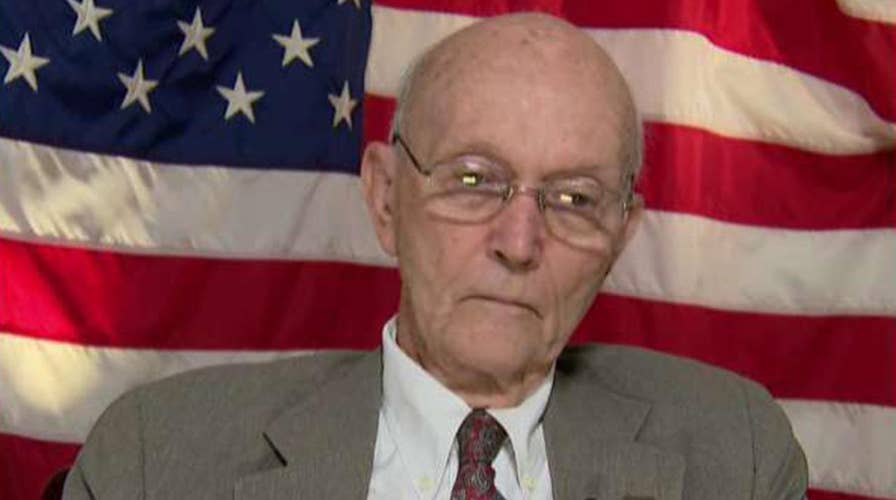
Apollo 11 astronaut Michael Collins reflects on the 50th anniversary of historic Moon landing
Michael Collins says NASA should focus efforts on missions to Mars.
This is a rush transcript from "Your World," July 18, 2019. This copy may not be in its final form and may be updated.
(BEGIN VIDEO CLIP)
JON STEWART, FORMER HOST, "THE DAILY SHOW": It's absolutely outrageous.
And you will pardon me if I'm not impressed in any way by Rand Paul's fiscal responsibility virtue signaling.
Rand Paul presented tissue paper avoidance of the $1.5 trillion tax cut that added hundreds of billions of dollars to our deficit. And now he stands up at the last minute, after 15 years of blood, sweat and tears from the 9/11 community, to say that it's all over now. Now we're going to balance the budget on the backs of the 9/11 first-responder community.
(END VIDEO CLIP)
NEIL CAVUTO, ANCHOR: First the rip and now today the response, after Jon Stewart eviscerates Rand Paul for blocking a Senate bill that would extend the 9/11 Victims Compensation Fund, the senator eviscerates back, because, today, Rand Paul is here.
And so is Al Green, the Texas congressman who led that failed effort in the House to impeach the president of the United States. Let's just say the congressman ain't done. Wait until you hear what he's planning to do next.
And here's a duo you don't see together every day, former Republican House Speaker John Boehner and former Democratic bigwig Joe Crowley, yes, the same Joe Crowley who Alexandria Ocasio-Cortez primaried right out of a job -- why these two men have buried the hatchet and say both parties better do the same.
And this week that we remember the first man to walk on the moon, let us not forget the one who did not because, Apollo 11 command module pilot Michael Collins is here, and only here.
And a truly out-of-this-world "Your World" is now.
Welcome, everybody. I'm glad to have you. I'm Neil Cavuto, and so much to get to, so let us get to it.
First up, settling an 18-year-long battle that rages on.
At issue, compensating the now thousands of rescue workers from 9/11 who are still waiting for help from Washington. Jon Stewart says Rand Paul is making things difficult. Rand Paul says Jon Stewart is making things up.
(BEGIN VIDEOTAPE)
SEN. RAND PAUL, R-KY: Look, I know Jon Stewart. And Jon Stewart is sometimes funny, sometimes informed.
But, in this case, he's neither funny, nor informed.
I have spent my entire Senate career putting forward pay-fors for any time spending is expanded. As soon ago as two weeks ago, I put forward a pay- for, for the border funding. I put forward a pay-for the disaster funding. I do this on every new bit of funding.
So he's really not informed. And his name-calling just sort of exposes him as a left-winger, part of the left-wing mob that really isn't using his brain and is willing to call people names.
And it's -- it's really kind of disgusting, because, see, he pretended for years when he was on his comedy show to be somebody who could see both sides and see through the B.S. on both sides.
Well, now he is the B.S. The B.S. meter is through the roof, when you see him calling people names, calling people an abomination, when I'm asking something very reasonable, that an amendment be included to consider whether we should pay for this, from taking money somewhere else in the budget.
It doesn't actually reduce the deficit. It just keeps the deficit from getting bigger. It's a very reasonable thing. I have done it dozens and dozens of times, including on the tax bill.
The left-wing mob says, oh, but you're for tax cuts, but you're not doing anything to offset the tax cuts. There's something called pay-go. And I was the leader in trying to keep that in the tax bill. It was in the tax bill when we passed it and was later taken out of the tax bill, over my objections.
So the whole thing is misrepresented and not true.
CAVUTO: But did you vote for that when it was taken out, I mean, or was it too late?
PAUL: No, it was still in. It was still in, actually.
(CROSSTALK)
CAVUTO: I mean, their argument that they have been making is that you were OK paying for...
PAUL: Yes, I know.
CAVUTO: ... for a tax cut, but not this stuff.
PAUL: Right.
But they're misinformed. And they're either liars or misinformed. When we passed the tax bill, the pay-go provision was in the tax bill. So, as we passed the bill, the next instruction should have been, by the end of the year, we would have had to cut spending.
In a subsequent bill, they went ahead and got rid of the pay-go rules in some big enormous spending bill. I objected to it, and I forced an amendment vote on it. And only nine people voted with me.
But when I voted for the tax bill, it actually had provisions in it that says you would have to cut spending if there's any less revenue.
But the left-wing mob doesn't care about the truth. Jon Stewart doesn't care about the truth. It's all about me, me, me, Jon Stewart. Look at me. I'm on TV.
But here's the thing, is -- here's the thing.
CAVUTO: Do you regret that tax bill vote then, Senator, given what happened on the pay-go thing?
PAUL: No, because I voted for a tax bill with the pay-go provision in it.
CAVUTO: I know. I know But now knowing that they took that out after, do you regret that vote?
PAUL: No.
I regret -- I regret that 91 of my colleagues voted to take pay-go out when I didn't. But you shouldn't blame me for that.
The other thing about the tax bill that the left won't tell you is, guess what? When we cut corporate tax rates, we got more revenue. Art Laffer was right. Supply-side economics works. You lower tax rates, and you can sometimes get more revenue.
Revenue went up after the tax cuts. The deficit did too, but because we refuse to address spending in this town.
And what I don't like about this, about the lies and the ad hominem attacks from Jon Stewart and Kirsten Gillibrand and the whole left-wing mob is, they are telling a lie. I have consistently been for spending cuts, even on tax bills. And I'm going to offer one on this bill also.
No matter how good the cause is, we should offset the spending. It makes no sense to borrow money from China to give it to...
(CROSSTALK)
PAUL: ... no matter how good the idea is.
(CROSSTALK)
CAVUTO: I understand.
But, if you don't offset it, are you, Rand Paul, saying you will not vote for this, you will not vote for this measure?
PAUL: I don't vote for any spending that's not offset. I didn't vote for the border spending recently, even though I support more money for the border, because the responsible thing to do is to take that money from somewhere else in the budget.
So I have consistently voted against spending bills if they do not -- if they are not budget terribly neutral and if we don't expand the deficit. I won't vote for it.
We have a $22 trillion debt. We're borrowing most than -- almost $2 million every minute. And I have consistently sounded that theme.
And what is really disgusting is people like Jon Stewart lie to the American public. People like Kirsten Gillibrand lie to the American public.
I have been absolutely consistent from the get-go. I have forced like four or five votes this year on having offset spending cuts to new spending. I lose every time, because Republicans and Democrats are terrible.
CAVUTO: But if you stick to that, Senator, if you stick to that -- and it might be perfectly budgetarily meritable, but it's $10.2 billion over a decade.
You have already said that, if it is not paid for, they don't find some way to pay for that money...
(CROSSTALK)
CAVUTO: ... then you would not support this measure, right?
PAUL: Right.
But here's -- it's worse than that, Neil. It's not $10.2 billion over 10 years. It's about $2 billion a year every year until 2092. There is no limit.
This is the thing. This bill Is completely irresponsible. You know what it says for how much money we're going to spend? Such sums as are necessary.
So if Jon Stewart could read, maybe he would read the bill, and say, oh, my God, who would -- who in their right mind would vote for a bill that doesn't have a dollar amount in it? It has no dollar amount...
(CROSSTALK)
PAUL: ... 2092.
CAVUTO: But there's no way of knowing. There's no way of knowing, right? Isn't that part of the problem?
PAUL: Well, that's...
CAVUTO: Because there was no way to forecast...
PAUL: Right. So, the responsible...
CAVUTO: ... illnesses and sicknesses that came as a result, right?
PAUL: We do this -- we do this on disasters, too.
CAVUTO: Right.
PAUL: So we just make up an enormous number.
What you would do, if you were responsible, is, you would allocate it for three, four or five years and come back and reassess it. That's a responsible way to budget.
But to have an open-ended thing that goes to 2092? Really? We're going to have a spending bill that says you spend whatever you want until 2092. It doesn't matter how good the cause is. It's irresponsible.
And, really, people need to wake up and not be so sort of overwhelmed by celebrity that they take out-and-out falsehoods and ad hominem attacks from really a gutter snipe like Jon Stewart.
CAVUTO: All right, but people are dying, more than they thought, as a result. And...
(CROSSTALK)
PAUL: And they're getting money. And they're getting money, Neil.
(CROSSTALK)
CAVUTO: All right, but are you satisfied that it could stop, that, if this doesn't happen, it's going to stop?
PAUL: See, this is the false narrative that Jon Stewart and Kirsten Gillibrand want you to believe.
There's $2 billion in the fund. And, as we speak, payments are going out every day. We have given $12 billion. This isn't a stingy country. This isn't a country who forgot the 9/11 heroes or the firemen. This is a country that's already paid $12 billion to those people who both died and have died since then.
This is a country that will continue to do more. But we shouldn't completely lose our head and say, oh, well, it's a good cause, so we really shouldn't have any budgetary restraints. That is -- that is completely foolish.
CAVUTO: But there are -- whatever your cause, right, Senator, there are no budgetary -- this president is presiding over what will be the second trillion-dollar deficit in a row. No one seems to be watching the till, right?
PAUL: Except for me.
And I continue to watch it. No matter how good the cause is, I say, if you want to spend new money, find waste elsewhere in a $4.2 trillion spending budget. It's everywhere.
How about the $300,000 we spent on Japanese quail to see if they're more sexually promiscuous on cocaine? How about the $2 million we spent studying whether or not if someone sneezes on the food in front of you at the cafeteria, whether you're more or less likely to get the food?
That runs throughout the budget. And until you're willing to cut that kind of stuff out to pay for something more important, like the 9/11 victims, you're not doing your job.
Just to add it on and borrow it is inexcusable. It's wrong. And it really is what's wrong with Washington, is that everybody fears people like Jon Stewart will say, you lack humanity.
People fear that. And they fear that celebrity. So they're unwilling to stay up and speak truth to lies. And that's what I'm willing to do.
CAVUTO: But even leaving -- even leaving Jon Stewart out of it, I mean, a lot of these -- those who have acquired these illnesses and other sicknesses that come with this, they're going to have a hard time understanding your attention to the budget and deficits that they see running out of control.
And they're going to go back to you and Senator Mike Lee and say, you stopped this for me, something that could help me.
PAUL: Well, actually, even that's a lie, Neil.
The bill is going forward. Because Mike Lee and I stood up on principle, guess what? They're going to give us our amendments. I have just come from the floor. Our amendments are going to be voted on next week. And we will have a vote.
But the American people will get to see who doesn't care about the debt.
CAVUTO: And so this will pass? This will pass, in other words?
PAUL: No. We will vote, and we will lose.
There's only about 10 to 15 people in the Senate who care about the deficit. So my forcing a vote...
CAVUTO: No, no, what I mean is, this will -- what Jon Stewart and John Feal and others are arguing for, it's ultimately going to happen?
PAUL: It's going to pass, yes.
CAVUTO: OK.
PAUL: And it's going to get a vote on.
So, when they argue and they bellyache and say, oh, he's blocking the bill, no, I'm trying to have a debate in our country about whether or not deficits matter and whether or not we should offset new spending.
And I think I should be commended and loudly cheered for being one of the few fiscally responsible people up here. And I think we ought to set the record straight, because Jon Stewart can't just have a free pass to lie to people, think he's a celebrity, and think facts don't matter.
Look, the left wing every day is accusing Donald Trump of not adhering to the facts. Here's Jon Stewart making up his own set of facts, so he can feel good about himself. And we shouldn't let it stand.
CAVUTO: Let me switch real quickly to the Iranian foreign minister, Javad Zarif.
You are apparently open to meeting with him. We heard the president today saying he doesn't know too much about it, but he's open to something like that.
What do you expect to come of that?
PAUL: I think diplomacy is a good idea.
And I think that, if sanctions are to work, you also have to talk about removing them. So, I think the discussion now, since we have maximum pressure on and maximum sanctions on Iran, now we have to say, what would we be willing to remove them for? What type of behavior would we be willing to remove them for?
I think there is a possible opening that Iran would sign an agreement saying that they won't develop a nuclear weapon ever. That would be a huge breakthrough.
I think President Trump is one of the few people who actually could get that deal. And he will get it because he's strong and he's showing maximum pressure. But he's also willing to talk.
This is a president who's willing to talk to Kim Jong-un from North Korea. It's a president who's also offered to meet with the Iranians. I hope it will take place. I hope there will be diplomacy.
And, once again, I'm for -- I'm fighting to try to prevent war. And I think that should be something that's commended, not excoriated.
CAVUTO: Senator, you mentioned the president.
I would be remiss if I didn't get his clarification today -- or attempted clarification -- of comments made at a North Carolina rally last night, where, when referring to Congresswoman Ilhan Omar of Minnesota, the Somalia native who came to this country in her childhood, go back, go back, go back, that he was trying to temper that down -- tamp that down, and he regrets what happened.
What did you think?
PAUL: You know, I have met a lot of people from Somalia, from Bosnia. In my town, we have a lot of refugees. I treated many of them as patients. Many of them are good people, have integrated in our community, become business owners, restaurant owners, trucking company owners, and are good people.
And so I see the good side of refugees who appreciate what a great country we have.
I have been disturbed and I talk to people every day who are worried about how Omar just bashes our country, and says it's terrible. She wanted justice. She came here.
She -- we -- we provided for. We gave her all kinds of benefits when she came to this country. She was elected to Congress, which is an enormous privilege that was -- that was given to her.
And yet she continues to bash our country as being this terrible, awful, no-good, rotten place.
And I kind of side with the president on this, that I do think she needs to be called out. And her -- her constituents will ultimately have to decide whether they want somebody who really just kind of hates the place that gave her all these great things, or whether she does appreciate really a lot of good things about our country.
CAVUTO: Do you think the president just chose the wrong words, or do you go as far as some Democrats do, that he's a racist?
PAUL: No, I don't -- I didn't see anything racist in it.
A racist comment is when you refer to somebody based on the color of their skin. I think he referred to the content of their speech.
And so, if we're going to live in a society where you cannot criticize someone because of the color of their skin, because any criticism of someone of a different race would be called racist, we live in a world of such political correctness, we're never getting anywhere.
Look, I'm opposed to the socialism that AOC is promoting, and Omar, and Tlaib -- or Tlaib. I'm opposed to all of that.
It has nothing to do with the color of their skin. But I can't call them out for their socialism or for their ungratefulness to our country because of the color of their skin?
No, I think the left wing went crazy on the president. And they do on everything. And it's mob rule. Mob rules Twitter. Mob rules Facebook. And they're trying to squelch any kind of -- any kind of dissension or any kind of pushback from the right.
(END VIDEOTAPE)
CAVUTO: All right, that was Senator Rand Paul.
His counterpart, Mike Lee of Utah, just announcing that they have gotten unanimous consent for a vote on two amendments and final passage of the 9/11 Victims Compensation Fund.
This includes offsets for the $10.2 billion this will cost over the next decade. That feature will likely be voted down, but the votes are there to approve the compensation fund extension in a matter of days.
We will keep you posted.
Meanwhile, if at first you don't succeed, try, try again? Or is that trial, trial again?
I'm talking about the failed effort in the House to impeach the president, after a majority of House Democrats joined their Republican colleagues to vote down the measure.
The man who introduced those articles of impeachment, Democratic Congressman Al Green, is not giving up on this fight to take the president down.
Congressman, good to have you.
REP. AL GREEN, D-TX: Good to be with you, Mr. Cavuto.
And if I may say so, it wasn't a failure. We had 58 votes the first time, 66 the second time, and nearly 100 the third time.
And I have said consistently that this is a process. And the process continues.
In the Negro National Anthem, we have the words, "March on until victory is won." We will march on.
The Edmund Pettus Bridge was crossed more than once before they got to Montgomery.
CAVUTO: All right, so what is the next step you're going to take?
GREEN: It's my belief that we will take a moment, and, hopefully, the president will decide that he will not be as inciteful with his rhetoric.
Unfortunately, we did see the event last night. And that caused me to have little hope.
But I still think we will take some time. And, if appropriate, we will bring additional articles of impeachment. I believe that the Judiciary Committee, at some point, has to do something with the investigation.
I don't believe in paralysis by analysis. So, at some point, if the Judiciary Committee doesn't act, I will.
I have no desire to do this myself. But I do believe that the Constitution ought to be honored.
CAVUTO: All right. Well, they said, even some who like you and support what you're trying to do, that you were going in a kind of a weird lane here, Congressman, that this had nothing to do with the Constitution, but you're concerns that the president was racist.
And you even went back to the Andrew Johnson impeachment hearings that actually had nothing to do with racism, as you allege, but everything to do with a president who didn't get congressional approval for appointments.
I could go on and on.
GREEN: That is incorrect.
CAVUTO: But they say that you were not even addressing a high crime and misdemeanor. You were just going off in the Twilight Zone.
GREEN: Well, I will defend their right to say what they have said, even though they are wrong.
If you will kindly read the 10th article of impeachment against Andrew Johnson, you will find that he was impeached for a high misdemeanor. If you find...
(CROSSTALK)
CAVUTO: But it had nothing to do with racism. It had nothing to do with his not seeking approval for appointments, that that was it. But you made it a racial thing, which was not the case.
GREEN: If you will allow me to finish my sentence, I will address your point.
He, Mr. Cavuto, was impeached because he spoke ill of Congress, Mr. Johnson, Andrew Johnson, 1868. I beg that people would read article 10 of the articles of impeachment.
Now, I have read them, Mr. Cavuto.
CAVUTO: I actually -- I actually have. I actually have, sir.
So the reason why I mention it is, he was speaking out against Congress. You're quite right about that.
But you let that morph into a racial thing. And that's why your colleagues say, even though some of them were kind of pushing impeachment themselves down the road, they couldn't pounce on this, because there was nothing there, no high crime and misdemeanor there, in this regard.
You say what?
GREEN: I will -- well, I am, but I have to complete my thought, because it transitions into my answer.
Mr. Johnson, Andrew Johnson, didn't commit a crime. It was a high misdemeanor, not a high crime and misdemeanor. Check the article of impeachment.
Now...
(CROSSTALK)
CAVUTO: But it wasn't racial, was it? It was not racial.
GREEN: Yes, it was. He was a bigot.
CAVUTO: No, no, no, no. But that wasn't what the impeachment was about. And you know that.
GREEN: Well, no, I don't know that.
If you will read the articles of impeachment...
(CROSSTALK)
CAVUTO: I did. I did. And you said it was racial. It wasn't racial.
GREEN: Well, Mr. Cavuto...
CAVUTO: Neil is fine.
GREEN: The reason -- the reason -- Mr. Cavuto, I respect you.
CAVUTO: Well, I respect you. I will call you Congressman.
(LAUGHTER)
GREEN: Thank you.
Well, but Mr. -- you can call me whatever. My mother named me Alexander. And that's what I'm most proud of.
(LAUGHTER)
GREEN: But here's the point.
When he was haranguing Congress, it was all about the slaves who were being freed, and he wasn't moving as expeditiously to perfect the freedom process.
Now, moving on to Mr. Trump, Mr. Trump, he has said things that are inciteful.
But if you will remember, when we and I have -- you and I have talked before, I have said that you have to cause harm to society. So he's causing harm to society, pursuant to The Federalist Papers, Federalist 65.
I see that you like to get into the weeds. And I enjoy doing so too.
CAVUTO: All right, I wish we had more time.
But, bottom line, you're not giving up on this. You're going to try to regroup, get another vote going. You're quite right to say, with every vote you have tried, it's gotten a little bit more and more and more.
Where do you think it's going, ultimately?
GREEN: Well, it's going where Federalist 65 says it can go.
CAVUTO: All right.
GREEN: If the president continues to do harm to society with his inciteful and hateful rhetoric, then he will be impeached.
A president can be impeached for this. As a matter of fact, the president could have been impeached last night.
(CROSSTALK)
CAVUTO: By the way, if you're going to go after people for hateful rhetoric, Congressman, you might as well empty out Washington, right?
GREEN: No, not right.
CAVUTO: All right.
GREEN: The president happens to have quite a bully pulpit.
CAVUTO: OK.
GREEN: And the president gives us inciteful language against specific people.
We haven't had a president to do this in our lifetimes, Mr. Cavuto.
CAVUTO: All right.
GREEN: Just last night, what happened was horrible.
CAVUTO: All right.
GREEN: It was horrific. And the president should back off.
CAVUTO: We shall see. We shall see.
GREEN: And I thank you for the time, sir. Thank you.
CAVUTO: Congressman, I'm going to put you down as a maybe on the president for the time being, Al Green from Texas.
Thank you, sir, very much.
GREEN: Thank you, sir.
CAVUTO: All right, 50 years ago, we were only days away from two men walking on the surface of the moon. But don't forget the one Apollo 11 astronaut who didn't, because Michael Collins made history too.
Wait until you hear his story. And who better to tell it than the command module pilot himself? Because Michael Collins, usually not one to do a lot of press interviews, well, he's talking to us -- after this.
(COMMERCIAL BREAK)
CAVUTO: Contrary to a lot of press accounts this week, Apollo 11 actually had three astronauts.
Seems that everyone is talking about Neil Armstrong and Buzz Aldrin, as they should, the two men who walked on the lunar surface, oddly not so much the just-as-historic Michael Collins, who orbited just above that surface.
Fifteen years ago, on the 35th anniversary of that historic mission, I spoke to all three astronauts, asked Michael Collins about the theories the whole thing was a hoax.
(BEGIN VIDEO CLIP)
CAVUTO: The conspiracy theorists who said that you guys never -- never got to the moon, that this was a sham, it was all a show.
I know how your colleague Buzz Aldrin dealt with that issue, but does it bug you, with these conspiracy guys on this 35th anniversary saying, on this very day, that that was the case?
MICHAEL COLLINS, FORMER NASA ASTRONAUT: I just don't know how to answer that.
They saw the gigantic Saturn rocket go off from Cape Canaveral. It went somewhere.
(LAUGHTER)
COLLINS: They saw the pictures of a small Earth. They were taken from some great distance. They saw Neil and Buzz on the surface of what appeared to me to be a moon. I didn't see any cigarette butts or anything lying around out there.
(LAUGHTER)
COLLINS: So, I'm convinced that we went. But how do you convince someone who is not, I have no idea. It's beyond me.
You notice, Buzz, I'm asking this question from a remote television studio, so you can't deck me.
(END VIDEO CLIP)
CAVUTO: And Buzz Aldrin did deck a guy who said that.
(CROSSTALK)
COLLINS: I have no desire to deck you.
CAVUTO: Michael Collins.
(LAUGHTER)
CAVUTO: It's very good to have you, Michael Collins. Thank you for taking the time.
How do you feel, 50 years?
COLLINS: I feel old, man.
(LAUGHTER)
COLLINS: How do you feel? Well, you're -- you're just a child.
But I feel really, really old.
CAVUTO: You know, how was it for you? I know you have been asked this so much. There you are circling the moon alone in the command module.
You said it was very, very peaceful. You were enjoying yourself. You couldn't view them on TV, as the world was. What did you do?
COLLINS: Well, I had -- no, I had a good time.
I'm always asked -- or I was asked -- right after the flight, the prevalent question was, weren't you lonely? You were the loneliest man in the loneliest orbit of the loneliest part of the mission that has ever gone away around the lonely moon. Weren't you lonely?
(LAUGHTER)
COLLINS: And I thought that was -- I thought that was ridiculous.
I didn't want to talk about that. I wasn't in the slightest lonely. I was fine. I had hot coffee. And I had music, even, if I wanted it.
Now, what I really wanted to talk about was white mice. And then they would look at me and think, uh-oh, something's gone -- gone off with him. He's talking about white mice.
(LAUGHTER)
COLLINS: But when we were over -- the flight was over, we went back to our homes in Houston. They put us into isolation, quarantine with a colony of about 30 white mice.
And the reason was, of course, that some scientists had thought we might have brought lethal pathogens back from the moon, and they were trying to protect us.
So, if the white mice survived and were healthy, they were going to free us. And if the white mice all sickened, I hate to think of the consequences.
About that time, I was reading a book, "Of Mice and Men." And I got thinking about it. And the three of us, yes, we had done it. We went to the moon and we came back. But was that good or bad, a triumph or a failure?
It depended on the white mice and their health.
(LAUGHTER)
COLLINS: So, of mice and men.
I figured the mice were a lot more important in that endeavor than the men were.
CAVUTO: Yes, I think John Steinbeck would be proud.
So let me ask you. We talk about going to the moon again. There's an attempt to sort of restart the whole space program with the -- using the moon as a launching pad.
And I have always thought that it just seemed odd, having done that and achieved that, that we're going back to that. I get the strategy, that maybe that's a launching point for bigger and broader missions.
What do you think of all that?
COLLINS: I think it's well-researched.
My friend Neil Armstrong, who I think was a far more competent engineer than I, thought that -- in discussing Mars, he thought there were chinks of missing knowledge along the way, and that those chinks could perhaps be filled in at least partially by a stopover or some intermediate step of going back to the moon.
It wasn't clearly delineated. Neil died almost five years ago, but that was one of the questions.
So I think the current plan has been well-thought-out, but I just disagree with it. I think we ought to shoot directly for planet Mars. I used to joke when I came back from Apollo 11 that I had been sent to the wrong planet, that NASA should be renamed the National Aeronautics and Mars Administration.
(LAUGHTER)
COLLINS: I -- 27 years ago, I even wrote a book, a whole boring book on mission to Mars.
And I have always been a believer in Mars. I would choose a direct -- I would call it -- the JFK Mars Direct Express is what I would call it.
(LAUGHTER)
COLLINS: I would name it after President Kennedy, because he was such a wonderful guide for us on the Apollo venture.
One man -- going to put a man on the moon or return him by the end of the decade. He told us what we were going to do and when we were going to do it, and we just have to fill in the how.
And that was of immeasurable help, as we were trying to get all the pieces to fit that we needed, all the information we needed, 400,000, would you believe, Americans at one time working on that program.
CAVUTO: Oh, it was incredible. It was incredible.
COLLINS: And Kennedy's -- yes. Yes.
And Kennedy's voice really expedited the whole thing.
CAVUTO: I always thought that Kennedy was very shrewd in using the Soviet Union, and the threat that they are beating us and all in the early days in which they were, and that galvanized public support and the high bills that came with getting the space program to the point that it did, and you and Neil and Buzz ultimately landing on the moon.
And he would, sadly, tragically die before -- without seeing that. But his mission was realized.
Do we think -- do you think we need that kind of galvanizing competitive threat to do it again? Or can we do it on our own?
COLLINS: No, I think we can do it on our own. And I will come back to that in just a second.
But, first, let me say that his attitude, from where he sat in the White House, was quite different from me, mine. I was a peasant and way down the organizational chart somewhere.
And we knew -- we astronauts knew about the Russian program. We knew it was a very sound program going back to their Konstantin Tsiolkovsky, who outlined some of these plans over a century ago.
CAVUTO: Right.
COLLINS: So, we respected the Soviets.
But, day to day, going about all the chores that we were faced with, thinking about the Soviets or looking at them was almost like looking through a scrim perhaps. We vaguely were aware of what was going on there. But we didn't waste a whole lot of time paying attention to it.
CAVUTO: It was brilliant. In retrospect, Michael, it was a good strategy to take.
And your calmness in amazing pressure then and through today is amazing to watch.
Thank you very much for being such an inspiration to America and the world, Michael Collins.
After this.
(COMMERCIAL BREAK)
CAVUTO: Microsoft is the latest big name to announce earnings and sales, handily beating estimates on both counts. The stock is up about 1 percent after-hours.
This trend continues. Most are beating the estimates that were out there.
We're back in 60 seconds.
(COMMERCIAL BREAK)
(BEGIN VIDEO CLIP)
DONALD TRUMP, PRESIDENT: It was quite a chant.
And I felt a little bit badly about it. But I will say this. I did. And I started speaking very quickly, but it started up rather, rather fast, as you probably noticed.
QUESTION: So you will tell your supporters never to...
(CROSSTALK)
TRUMP: Well, I would say that I -- I wasn't happy with it. I disagree with it.
But, again, I didn't say -- I didn't say that. They did.
(END VIDEO CLIP)
CAVUTO: All right, the president trying to distance himself from those "Send her back" chants at his rally last night. They were directed at Minnesota Democrat Ilhan Omar.
Earlier today on FOX Business, I talked to a former Republican Speaker John Boehner, former New York Democratic Congressman Joe Crowley on the tone in Washington they say is actually getting worse.
(BEGIN VIDEO CLIP)
JOHN BOEHNER, FORMER SPEAKER OF THE HOUSE: I just think some of the political rhetoric today is -- it's just gotten a little loud.
And the nation would be, I think, better off if everybody just chilled out a little bit. And...
CAVUTO: But they're not chilling, Congressman.
BOEHNER: Well, somebody has got to say it. And I just did.
(LAUGHTER)
CAVUTO: You just did.
JOE CROWLEY, FORMER U.S. CONGRESSMAN: Well, I think John is right.
The rhetoric is way over the top from all angles, quite frankly.
But I personally expect leadership to come from the top. And I hope that at some point we can -- we can get down to really -- really tackling the issues that matter to the American people.
(END VIDEO CLIP)
CAVUTO: And, by the way, what teamed these two guys up there is an issue they concerned about these multi employer pension plans that are the verge of going belly up, and that could result in upwards of 1.5 million retirees either seeing their entire pensions wiped out or dramatically cut down.
The Washington Examiner's Emily Larsen.
Emily, it's a good cause. It's a good mission, but, in this environment, I don't know if there's really much of a good chance of it happening.
EMILY LARSEN, THE WASHINGTON EXAMINER: Yes.
I mean, this outrage cycle with President Trump and the tweets on Ilhan Omar and everything, that's -- besides the fact that everybody's calling his tweets racist and everything racist, the other thing that we're seeing is that there's people just exhausted by this cycle of outrage and everybody responding to that.
And so I think that things got a little bit out of hand for Donald Trump. All the Republicans -- a lot of Republicans were condemning what happened at the rally, and some of them even condemning what he said in his tweets about Ilhan Omar.
And I think that's what caused him to walk -- distance himself from what happened last night.
CAVUTO: I had a chance to look back at the tone and the posture he took. And he said that he spoke quickly to try to get them to stop chanting.
I didn't see that. Maybe that was what he was hoping to do or trying to do. But I didn't see it. He seemed to be galvanized by the crowd, which would be human nature. I get it.
But a lot of his Republican colleagues, including John Thune and a host of others, have told me that they do wish -- and this is even prior to this event -- he would dial it back a little bit. What's your sense?
LARSEN: Yes, I think that these Republican congressmen are worried not only about the sentiment that it gives, but also what this means for the Republican Party as a whole.
They're -- the Republicans are always being accused of being racist for things that are not even in the wheelhouse of the comments that we saw from President Trump and the comments at this rally.
And so when you have something that's so much more explicit like this, I think that that worries them, especially going into the 2020 election, and they expressed that sentiment to the president.
CAVUTO: All right, Emily, thank you very, very much.
By the way, if you do want to catch that interview with the former congressmen, it is on the FOXBusiness.com site. The full interview is there and what they hope to see happen in Washington, even though it doesn't look likely.
Meanwhile, tamp things down. If you saw a special hearing today, let's just say, good luck with that.
(COMMERCIAL BREAK)
CAVUTO: All right, the acting DHS secretary, Kevin McAleenan, testifying before the House Oversight Committee on the whole border crisis.
Let's just say things got testy.
FOX Business Network's Hillary Vaughn from Capitol Hill with the latest.
Hey, Hillary.
HILLARY VAUGHN, CORRESPONDENT: Hey, Neil.
Things got heated between the top Democrat and the top Republican on the House Oversight Committee, Chairman Elijah Cummings and Ranking Member Jim Jordan trading barbs over what's happening right now at the border.
(BEGIN VIDEO CLIP)
REP. ELIJAH CUMMINGS, D-MD: What does that mean? What does that mean when a child is sitting in their own feces, can't take a shower?
Come on, man. What's that about? None of us would have our children in that position.
REP. JIM JORDAN, R-OH: They denied the resources for two-and-a-half months. And then when the problem gets so bad, they say, oh, it's your fault. They finally send the money, but they still put limitations on you, because they want the political issue, when we're talking about kids.
We all care about the kids.
(END VIDEO CLIP)
VAUGHN: DHS Secretary Kevin McAleenan isn't just asking for more money. He also wants Congress to amend the Flores agreement that prevents law enforcement from detaining children for longer than 20 days.
He says that restriction has triggered a surge at the border because people crossing over with kids know that they will not be held long enough to see a judge and instead will be released.
(BEGIN VIDEO CLIP)
REP. RASHIDA TLAIB, D-MICH.: You want to keep kids longer. It's been very clear from this administration you want to kids -- keep kids longer.
KEVIN MCALEENAN, ACTING SECRETARY OF HOMELAND SECURITY: We want to keep families together.
(END VIDEO CLIP)
VAUGHN: Congressman Mark Meadows telling the committee he wants to push for funding for more facilities and beds within the next seven days, definitely before they break for August recess -- Neil.
CAVUTO: All right, Hillary, that seemed to go well, Hillary Vaughn on Capitol Hill.
Well, 50 years since men walked on the moon, let us not forget the other men who would follow. Sadly, Apollo 12's Alan Bean and Apollo 17's Gene Cernan are gone, but their daughters are here.
And a very out-of-this-world family reunion, kind of, is next.
(COMMERCIAL BREAK)
(BEGIN VIDEO CLIP)
GENE CERNAN, FORMER NASA ASTRONAUT: Say, man, what a great guy you are. You're the last guy went to the moon.
I do it when you ask me. And my kids, when my grandkids were going up, it's always been poppy's moon.
My granddaughter, who is now 20 at Texas A&M, she was, give or take -- I don't know -- 4 or 5 years old, I held her in my arms.
And I said, "Ashley, that's the moon." And I'm -- 5 years old. "And poppy went to the moon." And she's listening.
And I have a habit of talking too much anyway. And I said, "And poppy walked on the moon. He lived on the moon. And the moon is way out in heavens, where God lives."
And I kept trying to -- maybe something will -- and she remembers that. And then she closed. "Gee, poppy, I didn't know you went to heaven."
We leave as we came and, God willing, as we shall return, with peace and hope for all mankind.
(END VIDEO CLIP)
CAVUTO: That was Apollo 17 astronaut Gene Cernan, the last man on the moon, but, remember, not the only man on the moon. There were 12 in all, including Alan Bean of Apollo 12.
I still cannot believe these two pioneers are gone. I was lucky to know them both and share time with them both. It was an honor.
But, man, can you imagine being their kids and growing up with them? How great is that?
And how great is it that their daughters are here? They honor us today, because joining me now from Space Center Houston are Tracy Cernan and Amy Bean.
Ladies, welcome. I'm honored.
TRACY CERNAN, DAUGHTER OF GENE CERNAN: Oh, thanks, Neil. We're glad to be here.
AMY SUE BEAN, DAUGHTER OF ALAN BEAN: Thank you, Neil. We're happy to be here with this celebration.
CAVUTO: What a great time and a great moment.
Tracy, I'm thinking of your dad. And he would always say that he didn't want to be the last man to walk on the moon, just the latest man to have done so, human being.
He wanted us to go back. And now it looks like we are. So it sounds like your stubborn dad got his way or will get his way. How do you feel this whole week?
CERNAN: Oh, this week's been great.
The -- just all the excitement over the anniversary and the 50th year celebration. And, yes, you're right, Neil. Daddy didn't want to be the last one to walk on the moon. He always wanted someone to follow behind him.
And I think he would be very excited that they have the new program, Artemis, and that it's either going to be a man or a woman headed there. And I'm sure he has -- looking up there saying, come on, hurry up. I'm waiting for you.
(LAUGHTER)
CAVUTO: Amy, I remember your dad was fond of saying there are a lot of things that unmanned capsules can do, go to these distant planets and these far edges of the solar system and beyond, but there's some things that only a human being can do, and a human being can relay to the world, and a human being coming back to the world can share.
He was very big on the fact that human beings need to be there.
BEAN: Oh, he absolutely was.
We had the feelings. We had the thoughts. We had the spirit. And we have to convey that to other human beings. And an unmanned probe, you just can't do that. Can't do it. Can't communicate with other humans.
CAVUTO: No, you really can't.
Tracy, I'm thinking, you're one of the few as a permanent reminder, even though you never went to the moon, that your dad left on the moon. Could you tell us about that?
CERNAN: Yes, dad wrote my initials on the moon. It was like an afterthought, he said, to him as he was setting the cameras ready for the liftoff. But he did that.
And it's a very special bond that I think we have, and we always have, and I will always have with him, because, back in his mind, he was still thinking of me and of my mom and getting home to us, even though we had all those important responsibilities and to make sure he got off the moon.
CAVUTO: You know, what's amazing about him too is, he loved just the whole sense of excitement and sharing it.
And, Amy, the same with your dad. And it was a unique core of individuals, if you think about it. Only 12 had this special place in human history.
And I'm wondering, how did he share that with you growing up and with the extended family?
CERNAN: He always talked -- he did talk often about it, and especially as we're growing up.
When we were little, when he would come home during the -- after working all week long and being gone all week, he was a dad. We did dad things. We horseback-rode, we camped, we fished, we did all sorts of fun death things.
But older, when we got -- he communicated it. And he always just really wanted to inspire kids. Dad was very focused on education and on the STEM and just really told kids that, dream the impossible and go out and do it.
He only wanted to fly aircraft carriers off of -- fly airplanes off aircraft carriers. And look what he did. He walked on the moon. So...
CAVUTO: You know, Amy, when -- I remember speaking to your dad and that already, by Apollo 12, viewership for that mission was way down, and that's to be expected, from Apollo 11.
And if it had not been the accident in Apollo 13, where we almost lost that crew, it would have been very, very different, but with every moon landing after that, Apollo 14, 15, 16, 17, little less, little less.
And he had a sense -- that is your dad -- that maybe, Amy, that this was getting to be like a passing phenomenon. And it worried him, that that would decide the fate of Apollo and the fate of space travel. Did he ever get over that?
BEAN: I think he got over it.
CAVUTO: All right, it froze there. And, hopefully, we will correct this here.
But one of the things that both of these astronauts shared, whether you came right after Apollo 11, in the case of Alan Bean and Apollo 12, or certainly Gene Cernan and Apollo 17, this fear that it was winding down, already at the Apollo 11 mission, having achieved this monumental moment, that there wasn't the ratings draw, the appeal that there had been.
And it weighed on them.
We have lost both of these ladies now. So, obviously, I just wanted to share some of these videos that we took when I was with Gene Cernan. There are others where I was happy to be with Alan Bean.
I always like to tell the story, having known them well, that I wanted to be an astronaut myself when I was a kid. My parents wisely took me to Cape Canaveral and to Huntsville, Alabama, Space Center to have a look at these capsules and realize that, well, I was a chubby kid.
I couldn't -- I couldn't fit in the capsule. And they said, well, maybe you have to have other dreams. So I became a television anchor.
(LAUGHTER)
CAVUTO: You're welcome, America.
I told that story to Gene Cernan, who said, you made the right choice.
More after this.
(COMMERCIAL BREAK)
CAVUTO: I don't know if any of you get NASA TV, but all this week, they have been showing images and film, some of it never before seen, of the Apollo 11 astronauts walking on the lunar surface.
Obviously in honor of the 50th anniversary of the Apollo 11 flight and the missions since, and a reminder of the -- what we were able to achieve, as the nation was otherwise distracted by everything from Vietnam, to political assassinations, to the deaths of astronauts, in this case, just a little more than two years before Apollo 11's successful launch.
We're going to continue exploring that this week and on Saturday with not only Buzz Aldrin, the second man to walk on the moon. We talked, of course, to Michael Collins, who was his crewmate on Apollo 11, but Gene Kranz. He was an instrumental role, a flight control director, later got to fly in Skylab himself, looking back at that very special time.
I left out a very important Gene Cernan story I just want to very quickly share with you, the last man to walk on the moon.
My son was a big fan of astronauts, and particularly Gene Cernan, and went to the viewing of his documentary. And, of course, he treated my son like a star, even though my son was just happy to miss school, as a result, to see this guy.
But he left an impression.
And Gene Cernan said, "Someday, you're going to go to Mars."
I told him, not before I force him there myself.
(LAUGHTER)
CAVUTO: Cernan laughed. That's what heroes do.
We miss them all.
"The Five" is now.
Content and Programming Copyright 2019 Fox News Network, LLC. ALL RIGHTS RESERVED. Copyright 2019 ASC Services II Media, LLC. All materials herein are protected by United States copyright law and may not be reproduced, distributed, transmitted, displayed, published or broadcast without the prior written permission of ASC Services II Media, LLC. You may not alter or remove any trademark, copyright or other notice from copies of the content.
