




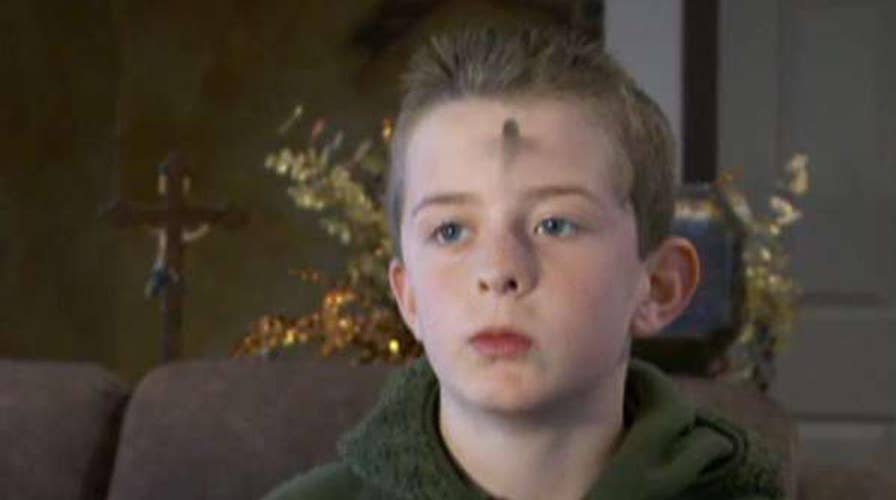
4th grader told to remove Ash Wednesday ashes
Fourth grade student William McLeod talks about being told to wash off his ashes by his teacher on 'The Story.'
This is a rush transcript from "The Story," March 7, 2019. This copy may not be in its final form and may be updated.
MARTHA MACCALLUM, HOST: Big night. We'll pick it up from here, Bret. Thank you very much. As you just heard, President Trump's former campaign chairman Paul Manafort has been sentenced to about four years in prison. We're going to take you live to the scene there. Doug McKelway is standing by outside the courthouse.
Doug, as it was just pointed out, these are on bank and tax fraud charges. There are other charges that are awaiting him in D.C., five days from now. But tell us what you can from Virginia tonight.
DOUG MCKELWAY, CORRESPONDENT: Yes, the guilty counts as we know are five counts of filing false income tax returns from the year 2010, 11, 12, 13, and 14. One count of failing to file reports of foreign bank accounts and two counts of bank fraud. A total sentence for all of those charges, those guilty charges, 47 months, which works out to three years and 11 months.
Paul Manafort made his appearance in court to hear that today and did not look well. According to our courtroom producers who were inside, he came in on a wheelchair. Literally, had to lift each leg out of the wheelchair to be seated in the courtroom.
He also carried a cane. He said in the judge before, the sentencing was handed down, "To say that I am humiliated and ashamed would be a gross understatement." He talked about the outpouring of love and support he has received.
Having been separated from his family for the last several months has been hard. He said, he told Judge Ellis that he appreciated the trial that the judge has conducted and he choked up over saying that.
He said that being in solitary confinement has affected his health in a very serious way, and it was plainly evident to all in the courtroom. Next stop, the D.C. District Court. And Judge Amy Berman Jackson, who is inclined, probably, would be safe to say to be less sympathetic to Manafort.
She is the judge who imposed solitary confinement on him some nine months ago. Proactive solitary confinement where he has remained all of these months. It is a form of isolation, which Amnesty International has called inhumane. That happens next Wednesday. Martha, back to you.
MACCALLUM: And just -- Doug, just to keep you here for a moment, those are the charges -- Judge Ellis pointed out today that the charges that he dealt with here had nothing to do with Russian collusion.
A lot of this relates to the work that he did as a foreign lobbyist, and you know, there were questions about his late FARA, which is -- you know, a registration as a foreign lobbyist.
So, this has been really based much more in the period of his work when he was a lobbyist with Roger Stone and Charlie Black back in those days. Correct?
MCKELWAY: That's very correct. Good, you point that out, Martha. The judge made a few different references to Russian collusion, and not in a positive way.
He made that reference that this was not about Russia collusion. It sort of out of the blue, which it struck people as kind of odd. It's maybe suggested to some that he thought the whole Russia collusion thing was bogus.
And then later on in the trial, A Doug Andres, the government attorney, made reference to being on the special counsel's team. The judge interrupted him, and said, "No, it's the government position. I don't want to hear special counsel." As if to suggest the whole special counsel operation is not a part of the American legal system. Martha.
MACCALLUM: So, four years and the next sentencing in five days in D.C. Court. Thank you very much, Doug McKelway, covering this throughout the day. It was really delayed by several hours as we waited for that decision. Now it's out. Doug, thank you.
Also, breaking tonight, a sharp divide between House Democrats as they battled over how to condemn what many saw as anti-Semitism from their freshman member, Ilhan Omar.
Her supporters appear to have won here tonight leading to an eight-page resolution that threw in every kind of hate you could imagine, practically, an official proclamation that if you didn't realize it, hate is bad.
In a moment, reminiscent of the debate over Black Lives Matter versus All Lives Matter, it seems in this case, they went with all hate matters. And those who wanted her to be called out for anti-Semitism are not getting what they wanted tonight.
So, they produced a document that condemns anti-Semitism, anti-Islamic acts, white supremacists citing many of the recent horrific crimes that we've seen. But also, reaches back to a cornucopia of hate that would appear to many to have been long agreed upon such as the incarceration of Americans, of Japanese descent during World War II.
The loyalty of President John F. Kennedy being questioned because of his Catholic faith. The Dreyfus Affair, and Muslim bigotry post 9/11.
So, this document is eight pages. You can you see now how actual legislation often turned out to be 5,000-10,000 pages at times. And perhaps, why Congress has an approval rating of 18 percent. Something to think about tonight.
Earlier, I spoke with former Connecticut senator and vice presidential candidate, Joe Lieberman, who've been very outspoken on all of this. And asked him, if we really need a resolution to say that we all agree that hate is bad.
(BEGIN VIDEOTAPE)
JOE LIEBERMAN, I-CONN., FORMER SENATOR: I read the resolution, and it reminds me of the old line that a camel is a horse designed by a committee. So, this is a resolution drafted by a caucus.
So, it started out being a resolution to condemn anti-Semitism because of the anti-Semitic remarks made by Congresswoman Omar.
MACCALLUM: Yes.
LIEBERMAN: Her name is left out and now --
MACCALLUM: Do you agree with that, that her name was left out?
LIEBERMAN: I don't. I mean, I think, this resolution as it's passed, though it's a bit of a hodgepodge, nonetheless is a statement against all forms of hatred. As your introduction said. It went way back to the Dreyfus Affair and John F. Kennedy's Catholicism, et cetera.
MACCALLUM: Yes.
LIEBERMAN: But OK, let's say it's a basic statement against hatred. But really what the House of Representatives still has to do and it didn't do today is to call out and hold accountable Congresswoman Omar for the anti- Semitic comments it made.
This is the way -- look, what people of public life say matters, and if the House of Representatives doesn't deal specifically in response to what Congresswoman Omar said, it's going to give a message to other people in Congress, the next time they want to get up and say something racist or homophobic or against another religion. So I think, they only did part of the job today.
MACCALLUM: I mean, a resolution doesn't have much teeth anyway. It just says, here is something we all agree on. So, when you have a resolution that doesn't even call out the behavior that you discussed, it seems like it has even, even less grit to it. CAIR, the Council on American Islamic Relations has just put out this statement. "Unfortunately, this resolution was introduced to silence legitimate criticism of domestic support for the discriminatory and segregationist policies of a foreign government that receives billions of American taxpayer dollars." What do you say to that, Senator?
LIEBERMAN: Well, that's just not true. There's -- unfortunately, in my opinion, there is broad bipartisan support for a strong US-Israel relationship, and for our fellow democracy Israel. Occasionally, their people object to specific Israeli policies that's appropriate in our democracy.
What Congresswoman Omar said was not just a reasoned disagreement with the policies of the Israeli government, it was just plain anti-Semitic going back to raising questions of dual loyalty of Jewish money. It's deeply offensive.
And I always say to people when I speak that -- you know, I feel blessed to have been born in America. I love this country that is the typical reaction of American Jews. A lot of American Jews and Christians also profoundly support Israel. But that's not its role in conflict with our devotion first, to America.
MACCALLUM: You know, it seemed at first, she was conciliatory in response to the first round of comments. But now, she is not. She is pushing back. And I think it could make an argument looking at this resolution that she won that battle.
And James Clyburn said this which I want to see what you think about. He said, "There are people who tell me -- Well, my parents are Holocaust survivors. My parents did this. It's more personal with her. I've talked to her, I can tell you she is living through a lot of pain."
So, he's referring to her background as a Somali. Born in Somalia, who lived in a Kenyan refugee camp. What do you make of that comment?
LIEBERMAN: Well I'm -- I know Jim Clyburn, he's a -- he's a fine person. I'm surprised he said that. First up I can tell you, to be really personal about this, my wife, Hadassah is a child of survivors. She grew up in a household where her mother who was in Auschwitz screamed out in the middle of her sleep at night because of nightmares about what she went through.
I'm sure Congresswoman Omar went through some hell in Somalia. But it's no excuse for coming here, getting elected to Congress having the special responsibility that goes with being a member of Congress in our democracy and making anti-Semitic statements.
She really ought to be criticized for it by her colleagues in the House, so it doesn't happen again.
MACCALLUM: Yes.
LIEBERMAN: Not just against Jews, but against any group with our society.
(CROSSTALK)
MACCALLUM: I mean, there is a line in here that rejects the perpetuation of anti-Semitic stereotypes, including the pernicious myth of dual loyalty and foreign allegiance. But it does not name her as we said.
When you look at what's happening in Europe, and you look at the rise of anti-Semitism and hate crimes that we've seen here in the United States. And you see that this group in, in your party, in the House that is getting together around some of these ideas. How much does that concern you?
LIEBERMAN: Well, it concerns me a lot. I mean, look, that's hard to believe that anti-Semitism is beginning to express itself in Europe and in some ways in America.
The kind of statements that Congresswoman Omar made, which are anti-Semitic do not reflect the rank-and-file of the Democratic Party. But if people in the Democratic Party don't stand up respectfully and hold her accountable for her anti-Semitic remarks, then, others are going to feel they can do the same, or they can take on other groups -- religious, racial, or anything else, at with hatred. And that undercuts the unity that has always been the great strength of America.
MACCALLUM: Senator Lieberman, thank you very much, sir. Good to have you with us tonight.
LIEBERMAN: Thank, Martha. Thank you.
(END VIDEOTAPE)
MACCALLUM: Here now to respond, Jehmu Green, former Democratic National Committee chair and candidate, and Fox News contributor. Jehmu, good to have you with us tonight. Thanks for being here.
JEHMU GREEN, CONTRIBUTOR: Good evening, Martha.
MACCALLUM: Obviously, Joe Lieberman, who have been around the party a long time is concerned about what he saw play out in this resolution and what it represents in the big picture for Democrats. What do you think about that?
GREEN: Well, let me start by saying for full disclosure, I have known Representative Ilhan Omar. For several years, I serve on a board that run lead where we help train her run for office. And knowing as a victim of oppression, as a refugee herself, I know that she does not have hate in her heart. And I know for a fact that she is not an anti-Semite. The intent is what I think matters here.
And there's been a lot of -- you know, muddying of the waters by Republicans who want to politicize this and have this be a black mark on Democrats. But it's her intent to simply have the same amount of scrutiny on a group like AIPAC that we do when it comes to the NRA or pharmaceutical companies.
She has shown, Martha, as a leader that she unequivocally apologized. She's also shown that she's willing to grow, she's shown that she's willing to listen. But what I'm most proud of her is that she's shown that she also stands by her convictions.
And I know that as a woman of color, she comes under more scrutiny and is an easier target than other people in the political limelight that's something I'm going to be talking about at South by Southwest here in Austin, Texas in a matter of days.
MACCALLUM: Well, she did -- she did apologize for the early comments, and she said that she is not an anti-Semite. And then, after that -- you know, she sort of got support. You know, and I think people rallied around her somewhat. And then, she made more comments about dual loyalty.
And those are really sort of -- you know, dog whistle phrases that Jews, Jews take very personally that indicate that their loyalty to this country is not truthful. And as you heard Joe Lieberman say, you know, he feels that, that is clear anti-Semitism. And those comments were made after she apologized, and she seemed somewhat emboldened.
GREEN: Well, I think that again, this is about her intent. She wants to talk about the substance of this issue. Perhaps she got some of her words wrong, and that happens to many people.
MACCALLUM: Right.
GREEN: But, it is a little bit shocking to look at the hypocrisy of Republicans who we just found out that there were literal Nazis phone- banking for Representative Steve King. And fundraising for his campaign.
(CROSSTALK)
MACCALLUM: He was reprimanded and he was called out by name.
GREEN: This support for him has been going on for 10 years. This should be a political issue, this is something that we should talk about --
(CROSSTALK)
MACCALLUM: Well, you know, I think, it's very fair to say that it took too long, but he has been reprimanded by name and he also was removed from his committee. Is that -- that's what they would probably say in their behalf.
So, but at your point is well-taken. Jehmu, thank you very much. Great to see you tonight.
GREEN: Thanks, Martha.
MACCALLUM: Thank you. So, coming up next. The new legal drama that could have exposed salacious details in the case of billionaire sex offender Jeffrey Epstein. New information after this.
(COMMERCIAL BREAK)
MACCALLUM: So there are some new legal twists tonight in the case of billionaire sex offender Jeffrey Epstein. A court now weighing whether to unseal critical documents from his case that could expose details of sex trafficking allegations and his controversial very lenient, many would say, plea deal. Trace Gallagher has the details for us from our West Coast Newsroom. Hi, Trace!
TRACE GALLAGHER, ANCHOR: Hi, Martha! This panel of judges on the Second Circuit Court of Appeals in New York didn't issue a ruling but certainly suggested it was leaning toward releasing most if not all of the 1,000-plus documents in this case. The belief is that many of these records could reveal significant evidence of the underage sex trafficking ring allegedly run by the billionaire sex offender Jeffrey Epstein.
Here's the origin a woman named Virginia Giuffre claims she was recruited into the sectioning by Jeffrey Epstein's former girlfriend Ghislaine Maxwell. In 2015 when Maxwell publicly denied the allegation, Giuffre sued her for defamation. In 2017 on the eve of the trial, the case was settled and the documents sealed, attorneys for Ghislaine Maxwell want the documents to remain sealed to protect the privacy of those who gave depositions.
The Miami Herald argues that keeping those documents sealed violates the First Amendment and the right to access court records. Harvard Law Professor Alan Dershowitz who was accused of participating in the sex ring also wants those documents to go public. Watch.
(BEGIN VIDEO CLIP)
ALAN DERSHOWITZ, ATTORNEY: They will categorically show that Virginia Roberts Giuffre deliberately, willfully, intentionally, in a very well- planned way decided to frame me for something she knows I didn't do.
(END VIDEO CLIP)
GALLAGHER: Here's the other thing. Back in 2008, Jeffrey Epstein was given a sweetheart of a plea deal that gave him and others who may have been linked to the underage sex ring immunity from federal prosecution. That deal was brokered by former Miami U.S. Attorney Alexander Acosta who's now President Trump's Labor Secretary.
Last week a federal judge ruled the plea bargain was illegal because Acosta and other prosecutors failed to inform Epstein's victims about the deal. Those victims have now sued and their case is being handled by prosecutors in Atlanta.
But to come full circle, the question now is if the documents in the second circuit court are unsealed what other information might they reveal about who was involved in this alleged sex ring. Martha?
MACCALLUM: That's a great question. We will see. Trace, thank you very much. Coming up next right here, a panel of Democratic voters on whether moderation is key and who they like for 2020.
(COMMERCIAL BREAK)
HOWARD SCHULTZ, FORMER CEO, STARBUCKS: I know Vice President Biden well. I respect him. I welcome him into the race. I question whether he not unlike Mayor Bloomberg who I also have a most respect for can find the pathway as a centrist person within the Democratic platform today.
But I think it would be a good thing for the party and a good thing for the country if Senator Biden came in.
(END VIDEO CLIP)
MACCALLUM: Very interesting. Billionaire businessman Howard Schultz today, he's mulling an independent bid for the presidency saying that even he would be OK with it if former Vice President Joe Biden jumped in the 2020 ring. So what do voters think? Here are five Democrats who voted for various candidates in the primary. It's great to have all of you with us. Thank you for being here tonight.
Just show up and so people get a sense from 2016 because I know you already said you're comfortable this. Who voted for Bernie Sanders last time around? And what about Hillary Clinton? OK, all right. So in terms of -- Marissa, let me start with you. In terms of what Howard Schultz just said. Do you think it'd be good for the race if Joe Biden got in?
MARISSA CARO, DEMOCRATIC VOTER: Well, I think that the Democratic Party as a whole needs to move a little bit more to the center. Although I did support Bernie Sanders in the 2016 primary, I think that in order for the Democrats to take the White House back, we need to kind of move more to the center.
I'm not sure if Joe Biden is the right candidate to do that. But what concerns me about Schultz is that if he's running as a third party candidate, he may take some of those votes away from Joe Biden which would cost us the election.
MACCALLUM: So I'm just curious because Bernie Sanders -- obviously Hillary is not in the race this time, but would you vote for Bernie Sanders again? Are you excited about him being back in the race?
CARO: I am excited from a personal standpoint. I think a lot of what he has to say has good intentions. Do I think that most of it is feasible to be carried out on a national level? I'm not sure. I think even his policies need to be pulled in a little bit more towards the center to kind of get a more widespread appeal.
MACCALLUM: So what about -- would you vote for Bernie again?
YUSEF RHYMER, DEMOCRATIC VOTER: Absolutely.
MACCALLUM: You would?
RHYMER: You know, like I'm a big Bernie supporter. I think that you know, the political revolution is an important thing that you know, we should try to have in this country so we can you know, slip a lot of our Congress so really you know, matches the makeup of us as American people. You know, like -- and I think that you know, if we can overturn Citizens United, maybe some of these big policies actually can get in that debt in the future.
MACCALLUM: All right, here's Joe Biden talking about the current Vice President Mike Pence. Let's play it.
(BEGIN VIDEO CLIP)
JOE BIDEN, FORMER VICE PRESIDENT: The fact of the matter is it was followed on by a guy, a decent guy, our vice president.
(END VIDEO CLIP)
MACCALLUM: What do you guys think about that on this end, Stephen?
STEVEN GLASS, DEMOCRATIC VOTER: I think that clip there shows why Vice President Biden would be an ideal candidate and an ideal president. Right now, the political climate is terrible and everybody is trying to not only just win but to beat their opponent and kick them while they're down.
The Vice President Vice President Biden has a history of reaching across the aisle, actually getting something done. And I think it would be refreshing to see the government actually work on behalf of the people and not just fight within themselves.
MACCALLUM: So how many of you would vote for Joe Biden if the race was today? Wow, interesting. OK, four. And you're going to stick with Bernie.
RHYMER: Of course.
MACCALLUM: Sticking with Bernie. In terms of what really matters to you this time around, what's the most important thing that you want to get out of this election? Phillip?
PHILLIP HAMILTON, DEMOCRATIC VOTER: You know, I think its 2020 approaches you know, for the Democrats I don't know necessarily if their objective needs to be Florida, Florida, Florida as number one as much as it needs to be Wisconsin, Michigan, Pennsylvania. Those states have to come back.
And I think some Marissa's point, what we're looking for as a party is kind of that inspirational candidate that can unite the AOC wing of the party with the Pelosi-Schumer wing of the party.
MACCALLUM: Are you worried about the AOC wing of the party?
HAMILTON: I'm not worried about them, but I do respect them, and I do believe that as with Obama whenever he had the umbrella coalition, that has to happen if we're getting those states back.
MACCALLUM: But they're not -- I mean you know, President Obama was way in a different place politically in terms of the issues than AOC and Tlaib are at this point. Who -- are any of you concerned about the impact that they may have on the race and whether not you know, Donald Trump might win if they put somebody like that in?
CARO: I'm not concerned about the progressive left. I think we need a progressive left. I think that we do need to have representation of all of our country in our Democratic Party.
I think that they need to be a little bit more willing to compromise. OK, we're not going to have free four-year college tuition. Could we compromise with expanding Pell grants? Could we compromise with maybe tuition-free two-year community college.
I think that they have to be able to meet centrist Democrats in the middle a little bit.
MACCALLUM: I want to talk about Elizabeth Warren here for a second. Let's play a sound bite. She was asked yet again about the fact that she checked Native American in boxes in the past. Watch this.
(BEGIN VIDEO CLIP)
DAVID AXELROD, CNN SENIOR POLITICAL COMMENTATOR: The question that I have never understood is why? Why did you in 1986 fill out on your, I guess it was your law license or something, an application American Indian? Why did you check those boxes?
SEN. ELIZABETH WARREN, D-MASS.: I shouldn't have done it. I'm not a person of color. I am not a citizen of a tribe.
(END VIDEO CLIP)
MACCALLUM: Carinne, what do you think about that response?
CARINNE MURPHY, DEMOCRATIC VOTER: I believe that this is just fluff -- fluff talk. I think it's taking away from the issues. I believe that our nation is in crisis we don't have a middle class. We do not -- we have a homelessness problem, we have a food and security problem.
And I think by talking about these issues it takes away from the platforms of the good candidates. The administration right now what they are doing for our country isn't good and we need to really look at everyone's platform all of the candidates right now in this election cycle and see what they stand for.
MACCALLUM: You know, in terms of getting rid of President Trump because obviously, you know, any Democrat wants their candidate to win. Is that the most important thing or is there an issue that is even bigger than that for you, Steven.
STEVEN GLASS, DEMOCRATIC VOTER: Well, they seem to go hand in hand.
MACCALLUM: OK.
GLASS: Obviously, I would like to see a Democrat win because I think the current rhetoric and the direction that we have a leadership fiasco going on from the White House right now and the direction that the country is going in under the current administration is bad and it's going to take decades to clean up if he went into another term.
MACCALLUM: Yes.
GLASS: However, I don't want to see a Democrat win just for the sake of winning.
MACCALLUM: OK.
GLASS: I think that there are real issues that need to be addressed.
MACCALLUM: I want to ask each one of you but we have about 20 seconds left. Your favorite candidate the person that you really hope when you look at all these people that might get in the race. The person you'd love to see in the White House. Steven?
GLASS: Can we give Barack Obama a third term?
MACCALLUM: I don't think he is running this time around.
GLASS: Then I have to say Joe Biden.
MACCALLUM: Joe Biden. Carrine?
MURPHY: Right now, I'm torn between Elizabeth Warren and Cory Booker. However, all the candidates right now, we have a bunch of great Democratic candidates. From the idea of socialized --
(CROSSTALK)
MACCALLUM: I only gave you one. All right. So, Elizabeth Warren is number one for you right now.
MURPHY: Yes.
MACCALLUM: OK. Yousef (Ph)?
UNIDENTIFIED MALE: I like Elizabeth Warren also. I think she is a great progressive.
MACCALLUM: Yes.
UNIDENTIFIED MALE: But it has to be Bernie Sanders for me. I think Medicare for all is a huge issue that can really help, you know, help kind of, you know, eliminate poverty a little bit and --
MACCALLUM: Phillip, I'm going to move on.
PHILLIP HAMILTON, CRIMINAL DEFENSE ATTORNEY: Cory Booker.
MACCALLUM: Cory Booker.
HAMILTON: When I talk about that inspirational candidate that I think can bring that umbrella of coalition that --
(CROSSTALK)
MACCALLUM: You think he's the guy to do it.
HAMILTON: I look directly at him.
MACCALLUM: Marissa?
UNIDENTIFIED FEMALE: Cory Booker or Amy Klobuchar.
MACCALLUM: Interesting. I didn't hear Kamala Harris once. And a lot of people thinks she is the strongest candidate out there but nobody -- nobody said that.
HAMILTON: I think with Kamala Harris the issue -- I'm a criminal defense attorney. I think one of the huge issues we have right now is with criminal justice reform and I think that she is liable potentially with some of the decisions that she made when she was a prosecutor, you know.
MACCALLUM: That's something she is going to have to deal with --
(CROSSTALK)
HAMILTON: I think so.
MACCALLUM: -- in this race. All right. Thank you so much. Great conversation. Great having all of you here. Thank you.
MURPHY: Thank you.
UNIDENTIFIED FEMALE: Thank you so much.
UNIDENTIFIED MALE: Thank you.
MACCALLUM: Coming up next, is it time to stop listening to Michael Jackson's music? That debate is coming up next.
(COMMERCIAL BREAK)
MACCALLUM: Michael Jackson' Thriller album sold a record setting 66 million copies worldwide. His iconic hits live across multiple generations but some are suggesting that it is time to stop looking the other way on the Michael Jackson issue in light of the bombshell documentary "Leaving Neverland" which features two men who say that they were sexually abused by the pop star as children.
(BEGIN VIDEO CLIP)
UNIDENTIFIED MALE: He said that I was his first sexual experience. And he would say that all the time. He is the biggest entertainer and he is a creative genius and that creative genius thinks that you are special what's not to like, right?
(END VIDEO CLIP)
MACCALLUM: Here now Rashad Richey, radio talk show most and political commentator. Rashad, you know, it's hard to listen to those two men now talk about what it was like in their childhood. Of course, there is still debate over whether or not they are telling the truth. But should Americans stop listening to Michael Jackson?
RASHAD RICHEY, RADIO TALK SHOW HOST: If you believe Michael Jackson is a monster and child molester you should no longer listen to his music. That's my opinion. And I will say this. Either we as a society are going to stand up for child victims or we are going to stand up for people who can sing. I prefer to stand up with children rather than those that simply have talent.
MACCALLUM: So, I mean, the truth is that he is obviously not here to defend himself anymore. Corey Feldman, here is a tweet from Corey Feldman who has said all along that this is not true that these go young men are now grown men who are in this documentary testified completely the opposite when they had their chance under oath.
Corey Feldman never once swore in my presence, never touched me inappropriately, never ever suggested we should be lovers in any way. I feel like if people could hear our conversations, they would hear the innocence in them. No hint of perversion." What do you say to that?
RICHEY: Yes. In addition to the now testimony or now evidence being presented, you also have facts, faxes, you have voice mails that were left and you have the contextualization of people basically worshipping Michael Jackson.
I got to tell you this honestly. If you would have asked me these two or three years ago, I would have said hey, I don't think Michael Jackson did anything monstrous to children.
After looking at the documentary, reviewing the evidence, I'm leaning on the side that this guy may actually be a monster and I have no problem whatsoever not listening to another song he's ever made. I'm still waiting for more evidence to come out. I think the other shoe is going to drop --
MACCALLUM: Yes. It needs to be.
RICHEY: -- because public sentiment means a lot.
MACCALLUM: You know, obviously his family is pushing back hard. They are suing HBO. There is so much money at stake here. You know, obviously the whole catalog of music, $250 million in that investment.
RICHEY: Right.
MACCALLUM: Then you've got this one show that Cirque du Soleil does in Las Vegas which we're going to play a little bit of right now. They've made $3.5 million. It's just one of the most popular shows in Las Vegas. And then you've got a Broadway show that is Michael Jackson, you know, start to finish music and Michael -- and figures dancing like Michael Jackson that was supposed to be in Chicago in a preview. They've now cancelled that but there is already so much money sunk into that coming to New York. I don't know what's going to happen to all of these investments.
RICHEY: Yes. They are going to lose money.
MACCALLUM: Yes.
RICHEY: Right now, Michael Jackson is part of that narrative similar to R. Kelly and many others. But it does show this. Celebrity creates a level of protection still even in this era. The alleged victims will never have their day in court. Michael Jackson will never have his day in court. But the legacy will have its day in the court of public opinion. And that's what's happening right now.
MACCALLUM: Rashad, thank you very much. Good to have you here tonight. Rashad Richey.
RICHEY: Thank you.
MACCALLUM: You bet. So, coming up next, this fourth grader said that his teacher made him wash his ashes off on Ash Wednesday. He is live next.
(COMMERCIAL BREAK)
MACCALLUM: William McCleod is a fourth grader in Utah. And like hundreds of millions of Catholics he received ashes in the shape of a cross on his forehead for Ash Wednesday. But the nine-year-old says that when he got to school his teacher said what is on your head, wipe that off. And she gave him a wipe to wipe it off.
Tonight, that teacher is on administrative leave.
William joins us now with his grandmother Karen. Good to have both of you with us. Thank you so much for being here.
So, William, you're not alone. I was last night on the show I think we have a picture. I also had my ashes on and I guarantee you that there were some people out there who didn't understand what that smudge was on my forehead. So, what did your friends say when you walked into school with your ashes, William?
WILLIAM MCLEOD, FOURTH GRADER STUDENT: So, they said like, what are those? I was like, I'm Catholic and it's Ash Wednesday, and they put ashes on your head. It's the first day of lent. They are like, well, where do they get the ashes from like a burning? No. From like the last Palm Sunday.
MACCALLUM: That's right. And what did your teacher, what did she say and what did she do, William?
MCLEOD: So, when she saw it, she was like what is that? And she said that's not -- and I told her what it was. She said that's not appropriate in the school. Go wipe it off and she pulled me to the corner.
MACCALLUM: No.
MCLEAOD: Yes, she gave me the disinfection wipe and made me to wipe it off. And I tried to tell her two times. And then she told me two times to wipe it off in front of my friends in the corner. I wiped it off and she said more until it was like gone.
MACCALLUM: No.
MCLEAOD: That from --
(CROSSTALK)
MACCALLUM: Were you upset?
MCLEOD: Yes. When I went -- so when I went in the office I was crying because I felt like I was in trouble.
MACCALLUM: Yes. That's heartbreaking. Karen, what was your response?
KAREN FISHER, WILLIAM MCLEOD'S GRANDMOTHER: I was plenty angry. I got the call from the principal.
MACCALLUM: So, the principal called you and said -- what did he say?
FISHER: The first thing she said is William is not in trouble.
MACCALLUM: OK.
FISHER: And she said but she said this is a situation and she told me that he -- she saw him with no ashes on his forehead and had thought maybe he had gotten rid of them.
MACCALLUM: Yes.
FISHER: But then I found out he was told to wipe them off after trying to explain them to her twice.
MACCALLUM: And what did you say to the teacher about all of that?
FISHER: The teacher had called me later and I told her I wasn't happy and she asked me what can I do? And I said nothing. I have never been in this situation. You know, I've raised four boys here and this has never happened. So, I didn't know what to do whether I should call my priest or what.
MACCALLUM: Well, she wrote a note now. She said William, I'm so sorry about what happened today. I hope we can move forward from this. Mrs. P." So, William, do you accept her apology?
MCLEOD: Yes. I kind of feel bad.
MACCALLUM: You feel bad for her. Do you think she genuinely didn't know what they were?
But you did you explain it. And it is -- the whole thing is really disturbing. I don't blame you. So, what did you -- William, what did you give up for lent?
MCLEOD: Fortnite.
MACCALLUM: Fortnite. Is that going to be hard for you?
MCLEOD: Not really.
MACCALLUM: No? Do you like to play Fortnite? I gave up Instagram so that's kind of like giving up Fortnite I guess if that was your age. Karen, you must be very proud of him.
FISHER: I am. He is a good boy.
MACCALLUM: Yes. He is a good boy.
FISHER: I am proud of him.
MACCALLUM: All right. We wish you both well. And we hope that it was ultimately a good lesson all around. So thank you very much, William. All the best to you. I hope you get a lot of candy on Easter Sunday. And Karen, thank you very much for bringing William in tonight.
FISHER: Thank you.
MACCALLUM: We appreciate it.
FISHER: Thank you.
MACCALLUM: Coming up tonight on “The Story,” the untold story of our good friend Janice Dean next.
(COMMERCIAL BREAK)
(BEGIN VIDEO CLIP)
JANICE DEAN, SENIOR METEOROLOGIST: When I was sitting at the news desk and he came out and he had it, and he pointed it right at the head of the reporter, the traffic reporter. And it was like, you were living this nightmare and everyone around you knew it.
UNIDENTIFIED FEMALE: Yes.
DEAN: But they didn't do anything.
(END VIDEO CLIP)
MACCALLUM: Wow. Janice Dean our very own Fox News senior meteorologist opening up about what it was like to work for radio host Don Imus. It's one of several stories that she shares in her new memoir which is called "Mostly Sunny" which Janice always is. And there are other trials and tribulations though that have been untold until now. Watch this.
(BEGIN VIDEOTAPE)
DEAN: I had a home invasion in Houston when I was living there. I lived in Houston probably four years of my life of my career. I started out in radio. And then I did some television.
One night I went out with friends and I was living in a -- I was living by myself in a one-bedroom first floor apartment. And I opened up the window one night because if you ever lived, ever lived in Houston cool nights are a rarity. So, I had the window open a little bit.
I forgot to close the window. And I woke up to somebody poking me in the shoulder an intruder with a bandanna on his face with a knife in his hand, so he was about 10 inches away from me.
And my first reaction was to say hi to him. I was just -- I just said hi, can I help you? And he proceeded to ask me to take off my clothes. And my reaction was to try to convince him otherwise.
I layer up at night. I still do. I still wear men's flannel pajamas. In reality, when I look back, I think that might have --
MACCALLUM: Yes.
DEAN: -- saved me. So, I started off with my sweatshirt and he motioned to me and said no, I want you to take off your pants first. So, I did that but all the while he is telling me to do this, I keep saying to him, please don't do. I have jewelry. I have money. I just went to the bank. I have a brand-new car. I kept saying that over and over again and I was very calm.
These guys sometimes get excited over women that are fighting them back or screaming and I didn't. I just remained very calm. Pretended my whole body was disconnected. And just kept telling him all the things I could give him instead of him attempting to rape me or otherwise. And I was able to convince him.
I got -- you know, I took off articles of clothing but I was able to convince him finally that he said take me to your jewelry box.
So, fast forward, he took my jewelry. We went out to the living room. I was about to give him the contents of my purse in which I realized he had already gone through my purse beforehand.
MACCALLUM: Yes.
DEAN: And then there was either a car alarm or something that sounded like a gunshot in the parking lot and he ran out of my apartment. So, you know, even though he never assaulted me physically, I still had emotional scars.
MACCALLUM: I think there is a vulnerability to you and openness to you that has really helped that sort of the mostly sunny side because as we are pointing out here. You went, you've been through some really tough times. I want to circle back though because I love the Steven Tyler story.
I was a classic rock D.J. back home.
MACCALLUM: Which I love. What a great job.
DEAN: I love it. It was one of my favorite jobs of all time. And I was young. I mean, at that time I think it was 23 or 24. So I was right out of college. I was doing the afternoon drive program and I had a chance to go back stage because we were on location at the place where the concert was going to be. It was an outdoor show at Lansdowne Park in Ottawa for all of you Ottawa fans. And Aerosmith was playing.
And we had the chance to go back stage and meet, you know, Joe and Steven Tyler. He sort of scans the room. I'm at the back with my little group. And he looks at everybody, you know, a very charismatic guy. Hey, how is it going everybody? And I just felt his eyes on me right away. I thought OK. What is looking over at me?
MACCALLUM: Yes.
DEAN: Somebody next to me? What's going on? Does he recognize somebody? He made a bee line right in my direction and said hi, I'm Steven Tyler, what's your name? The first group goes up and they are about to take the picture. And Steven Tyler goes, "Janice, Janice dean. Where is Janice dean?" And I was like ha. Here I am. "Come on up here. I need you right next to me."
And at the very end he said, you know, basically, what are you doing later?
MACCALLUM: Right.
DEAN: Do you want to come to the show? When I said well, I was hoping to get an interview with you. He said, we could try to make that happen and make sure that this person takes care of you and come back stage.
So, I said to him, OK, yes. That sounds great. But could I get a picture just you and me? Is that OK?
MACCALLUM: Right.
DEAN: He is like yes, come on over here. So, I was the only one that got the picture with him but I never went back stage.
Fast forward 20 years later, I'm on Fox & Friends on the weekend and they were playing "Love in an Elevator" in my ear.
MACCALLUM: Right.
DEAN: And I was like, I have this great story about Steven Tyler. I told it on the air in a short snippet. I've been meaning to ask if anyone knows Steven Tyler, I would love for him to sign that photo.
And guess what happens. I get somebody on Twitter that says I know his P.R. people send the picture to this person.
MACCALLUM: Right.
DEAN: He finally signed the picture. I have it in my office. It says, "Dear Janice, full frontal, Steven Tyler."
MACCALLUM: Yes.
DEAN: Of course.
MACCALLUM: Such a great story.
DEAN: Yes.
MACCALLUM: There is so much more to your story and you are mostly sunny all the time. And I think that that in and of itself is such a great tribute to you and you are so good at what you do. So, I'm just really glad that everybody is going to get to know you a little better through this book.
DEAN: Thank you.
MACCALLUM: Thank you so much for being here.
DEAN: Thank you for being part of my journey because you have been part of my journey.
MACCALLUM: We have been here together a long time.
DEAN: We have.
(END VIDEOTAPE)
MACCALLUM: We love Janice. Janice's book "Mostly Sunny" is available now. You can listen to the full interview that Janice and I did on The Untold Story podcast. That's going to be up on Monday. So that is "The Story" on this Thursday night. "The Story" goes on right here tomorrow night at seven. "Tucker Carlson" coming up next. Good night, everybody.
Content and Programming Copyright 2019 Fox News Network, LLC. ALL RIGHTS RESERVED. Copyright 2019 ASC Services II Media, LLC. All materials herein are protected by United States copyright law and may not be reproduced, distributed, transmitted, displayed, published or broadcast without the prior written permission of ASC Services II Media, LLC. You may not alter or remove any trademark, copyright or other notice from copies of the content.
