


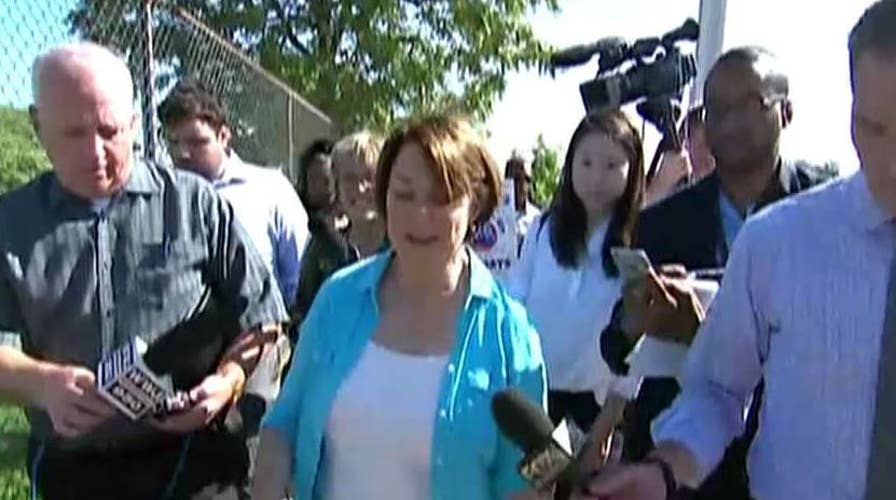
2020 hopeful Amy Klobuchar visits GM strikers
UAW sent a letter to members saying some progress has been made in negotiations with GM; Grady Trimble reports.
This is a rush transcript from "Your World," September 19, 2019. This copy may not be in its final form and may be updated.
NEIL CAVUTO, ANCHOR: All-out war, Iran is threatening it, so how will the U.S. respond to it?
Welcome, everybody. I'm Neil Cavuto.
And the Department of Defense is briefing members of the House Armed Services Committee this very hour on the attacks on those Saudi oil facilities, this as Iran's foreign minister is threatening to fight to the last American if it is attacked, that is, Iran is attacked, by the U.S. or Saudi Arabia.
Oil holding steady, despite these mounting tensions.
John Roberts at the White House with all the latest -- hey, John.
JOHN ROBERTS, CHIEF WHITE HOUSE CORRESPONDENT: Neil, good afternoon to you.
A lot more on this in the days ahead. Secretary of State Mike Pompeo will be back in Washington, D.C., tomorrow, where he will brief the president on his talks with officials in both Saudi Arabia and Abu Dhabi.
Mike Pompeo saying definitively he believes this was Iran. No doubt, he says, on who is behind it. Listen here.
(BEGIN VIDEO CLIP)
MIKE POMPEO, U.S. SECRETARY OF STATE: I think it's abundantly clear. And there is an enormous consensus in the region that we know precisely who conducted these attacks. it was Iran. I didn't hear -- I didn't hear anybody in the region who doubted that for a single moment.
(END VIDEO CLIP)
ROBERTS: Pompeo declared this to be an act of war, pointing the finger at Iran even prior to today.
But the president has yet to make that definitive declaration itself. This morning, at a CNBC conference, Vice President Mike Pence said the president's national security team is going to meet tomorrow as part of a thorough, deliberative process. Here's Pence.
(BEGIN VIDEO CLIP)
MIKE PENCE, VICE PRESIDENT: The president has basically said, let's get to the bottom of what happened. We have organized an international investigation into what happened.
But the president will take all of this into account. And he will review the facts and he will make a decision about next steps.
(END VIDEO CLIP)
ROBERTS: The United States will also make the case to the United Nations to seek some sort of support for actions against Iran. That likely will not happen until next week.
On the border yesterday, the president said that he has got plenty of options, though he is playing his hands close to his vest in terms of what he might do. Listen here.
(BEGIN VIDEO CLIP)
DONALD TRUMP, PRESIDENT: We will see what happens. A lot of things could happen. If we can have a peaceful solution, that's good. It's possible that that won't happen. But there's never been a stronger country militarily, not even close.
(END VIDEO CLIP)
ROBERTS: Iran is threatening all-out war, as you pointed out at the top of this, Neil, still saying that it had nothing to do with last Saturday's attacks.
Listen to what the Iranian foreign minister, Javad Zarif, said earlier today:
(BEGIN VIDEO CLIP)
MOHAMMAD JAVAD ZARIF, IRANIAN FOREIGN MINISTER: I think it is important for the Saudi government to understand what they're trying to achieve. Do they want to fight Iran until the last American soldier? Is that -- is that their aim?
Because if that is the aim, they can be assured that this won't be the case.
QUESTION: Why?
ZARIF: Because Iran will defend itself.
(END VIDEO CLIP)
ROBERTS: President Trump has instructed the Treasury Department to tighten the screws on Iran to come up with new sanctions within the next 24 to 48 hours.
The vice president also announcing today, Neil, that the United States is going to limit the number of visas for the Iranian delegation at the United Nations General Assembly next week.
I think any retaliatory action, Neil, will probably wait until after the United States makes the case at the United Nations. So I think we're still a few days away from that, if it happens at all -- Neil.
CAVUTO: And I believe, John, the president has talked about whatever response would be proportionate.
ROBERTS: Exactly.
CAVUTO: Do you know what he meant by that?
ROBERTS: Yes, he was asked about that as he was leaving on his trip to Arizona and California.
The president hinted that maybe striking similar oil facilities in Iran might be something that's in the cards, but the president also said he'd like to solve this peacefully if he -- if he possibly could. So I think there's still a lot of options open.
I think there's a lot of talking that's going on behind the scenes that we don't know about to try to avoid an all-out conflict, because even if the United States did prevail in a conflict like that, Neil, it would -- it would create havoc in the Middle East.
CAVUTO: To put it mildly.
John Roberts, thank you, my friend, very much, John at the White House.
Should the U.S. even be backing Saudi Arabia in this fight, if it comes to that?
Well, Democratic presidential candidate Tulsi Gabbard telling me on this show yesterday, not really.
(BEGIN VIDEO CLIP)
REP. TULSI GABBARD, D-HI, PRESIDENTIAL CANDIDATE: I'm focused on how we can best keep the American people safe, on how we can make sure that we are -- we have our national security intact.
And so whatever actions that we take....
CAVUTO: And the Saudis are a bigger threat? And the Saudis are a bigger threat to that safety than Iran? I just want to be clear, Congresswoman.
GABBARD: The Saudis are directly supporting the very terrorist group that attacked us on 9/11 and that continue to pose a threat to the American people today.
CAVUTO: So, if the president were to take action against Iran, with or without Saudi intelligence or help, that would be a bad move, in your eyes?
GABBARD: That would be a very bad move. It wouldn't serve the interests of the United States.
(END VIDEO CLIP)
CAVUTO: Indiana Republican Senator Todd Young recently meeting with the Saudi Crown Prince Salman. He joins me right now.
Senator, what do you think of her position?
SEN. TODD YOUNG, R-IND.: As I understand her position, it's that we should allow Iran to continue firing missiles into -- and drones into other countries' territories, violating their sovereignty, upsetting international oil markets, and continuing to perpetuate their funding of terrorist proxy forces around the Middle East and around the world, without any sort of proportionate response.
I think that's an untenable position. But I do share with the congresswoman a position that we need to do everything we can to avoid a war. We need to do everything we can to reestablish deterrence and ensure that we don't involve ourselves in some sort of situation that leads to further escalation and immerse ourself in a military conflict that we can't get out of.
I know that's the number one priority of the president of the United States, is trying to prevent war, rather than get into war. And that's why he's been incredibly emphatic about that.
CAVUTO: Senator, you're probably familiar with the fact that the congresswoman said that the president risks pimping out our soldiers on behalf of the Saudis.
What did you make of that?
YOUNG: If -- I didn't understand the first part of the question, but...
CAVUTO: Sure.
She charged that the president is pimping out our soldiers to the Saudis.
YOUNG: No.
Look, Saudi Arabia they have been, for sure, a complicated security partner over the years. And truth be told, because Republicans have pressed so hard over the years to ensure that we can exploit our own natural resources, our own oil and gas, we're less dependent on oil and gas resources from this region.
But, with all that said, that country remains important. It's important because we have 60,000 Americans on the ground right now. So, by definition, we want to make sure those Americans are safe and secure.
But perhaps even of greater importance, as we look eight or nine years into the future, because of the JCPOA, or the so-called Iran nuclear agreement that President Obama signed onto and that so many Democrats here in Washington have been supportive of, because of that agreement, the Iranians, the largest state sponsor of international terrorism, will have official legal sanction in just a number of years to be in breakout capacity, meaning they could develop a nuclear weapon to put on top of the missile technology they continue to develop.
So that's why it's important that the president is going to be speaking to our allies, to partners, really to the world at the United Nations, asking everyone to come together and see how we can continue to apply maximum economic pressure on the Iranians to bring them to the table, which is really the endgame here.
We want to bring the Iranians to the table, so that we can negotiate a peaceful settlement and get a better deal.
CAVUTO: Senator, thank you very much.
YOUNG: Thank you very much.
CAVUTO: All right, in the meantime, one thing is very clear.
The State Department at the Pentagon are not on the same page on this, the State Department raising concerns that Iran was indeed behind this, the Defense Department not thoroughly convinced, in fact, taking a more wait- and-see approach until it is.
Retired Air Force Lieutenant General David Deptula.
General, is it usual for Defense and State to be at odds on something this big? I mean, they either were or they weren't. I read from the Pentagon review at this point they're not 100 percent. Perhaps the State Department is. Are you?
LT. GEN. DAVID DEPTULA, RET., U.S. AIR FORCE: Well, to answer your last question first, based on everything I have seen, there's like no doubt that these attacks originated from Iran using Iranian equipment, under the authority of the supreme leader of Iran. So we can put that aside.
With respect to your first question, are there differences in the perspective between State and Defense? Yes, you bet there are. I mean, there are differences inside State and inside Defense.
CAVUTO: Sure. Sure.
DEPTULA: This is a significant issue. So...
CAVUTO: But there wasn't any difference, as far as you know, sir, that one is not quite convinced Iran's behind this, and the other is, or that that could jeopardize how the president responds to this?
DEPTULA: No, I think that the real issue here is the larger question.
And the larger question is, look, what ultimately are the United States' objectives that are directly affected with this latest aggressive move by Iran?
And so what comes into play in the discussion of the variety of different options, both the economic, as well as perhaps using elements of military force to coerce Iran to understand that it's in their best interest not to pursue the development of nuclear weapons and delivery means.
So that's what this is really about. And that's why you see deliberations ongoing in State, in the Department of Defense, and across the board.
CAVUTO: Right.
General, the president has talked about -- and I was raising it with our White House correspondent, John Roberts -- about proportionate response to this, if indeed it is fingered to Iran.
But if a proportionate response means going, let's say, after Iranian oil fields vs. Saudi oil fields, what they are alleged to have targeted, wouldn't that boomerang potentially on us? We're more energy-independent than we have ever been, of course, but for the world, it could mean higher oil -- energy prices.
Other defense analysts have said the more targeted approach might be going after their drones.
What do you think?
DEPTULA: Well, Neil, once again, the question needs to be put in the context -- or the answer needs to be put in the context of an overarching strategy.
First, what the president needs to be doing -- and, in fact, all indicators are that he needs to form a coalition. Once again, this is an indication that Iran is trying to stimulate and put the United States into the position of being the aggressor, so that they can gain the support of their domestic population and put the United States out there as the one who is the aggressor.
Well, so what that means is, we need to be pretty smart when we think about what our options are. And I think being smart is to continue to turn the economic screws to coerce the Iranians that they have got to change their behavior.
Now, there might be some elements of military action that go along with this strategy. I would suggest that probably the most prudent way is to do it not in a very overt fashion, but in a covert fashion.
One day, an Iranian oil transport all of a sudden is missing. Command-and- control facilities start operating. There's no attribution. It just happens.
The Iranians will get the message.
CAVUTO: All right, but we need to do it in concert with others, and that would include the Saudis. If they don't participate, would you be leery?
DEPTULA: Absolutely.
CAVUTO: OK.
DEPTULA: I mean, look, the attack was on the Saudi infrastructure...
CAVUTO: Right.
DEPTULA: ... and on the sovereign nation of Saudi Arabia.
So, this all has to be part of a coalition. That's why we have got to be careful that we don't fall into the trap that the Iranians are trying to pull us into, and that's into a direct confrontation involving the United States. That's what they want to happen.
CAVUTO: Got it. That certainly seems to be the case.
General, thank you very much.
DEPTULA: You bet, Neil.
CAVUTO: Meanwhile, his job is safe for now, because to hear the president talk about it, the Federal Reserve chairman, Jerome Powell, might not be a bad idea for him to freshen up his resume, even if experts say, try as he might, the president is probably stuck with Powell, whether he likes it or not.
(COMMERCIAL BREAK)
(BEGIN VIDEO CLIP)
TRUMP: They have raised too fast. And I have been saying this openly. And they have lowered too slow.
QUESTION: Chairman Powell's job is safe?
TRUMP: It's safe. Yes, it's safe. I mean, sure. Why not?
QUESTION: You paused.
TRUMP: No, I don't pause. I mean, he's got a job, and I'm disappointed in him. I'm very disappointed in him.
(END VIDEO CLIP)
CAVUTO: Yes, he's safe. It's whatever.
(LAUGHTER)
CAVUTO: Wow. Is that a ringing endorsement? Hmm, I don't know.
The president still hitting Fed Chairman Jerome Powell very hard. Could he be setting him up as a fall guy if the economy takes a turn?
Charlie Gasparino with us, Axios reporter Alayna Treene, market watcher Erin Gibbs.
The president has long been critical, Erin, as you know, of the Fed's policies, that they hiked too soon too fast, and now they're unwinding it. Even the Fed has pretty much acknowledged that. But he has said that, if they were more aggressive in the rate cuts even now, they could go a long way toward reversing this.
But it doesn't look like that's in the cards. So what do you think?
ERIN GIBBS, GIBBS WEALTH MANAGEMENT: No, I think that, to your point, he's definitely setting the Fed up as the potential fall guy, because Wall Street is fine with what happened.
We were basically flat. We're in a wait-and-see period. We are more concerned about tariffs than we are about the federal rate cuts. So I think there might be one more ahead, but, for now, Wall Street is very satisfied with what they did.
CAVUTO: Jerome Powell has posited, Alayna, that the reason he is cutting is because of the trade situation.
I don't know whether that was meant to zing the president, but to say, I wouldn't be in this predicament, we wouldn't be in this predicament if you -- if we didn't have this cloud over us.
Do you agree with that?
ALAYNA TREENE, AXIOS: Well, this was a big question that a lot of reporters yesterday were asking Fed Chair Jerome Powell, was, they did -- they questioned, are -- were these cuts, this quarter-point of a cut, was that to appease the president, who has clearly been making these public declarations for months now, asking him to cut rates?
But the Fed chair said, this is more of the economy's doing great, yes, but this is to assuage some concerns with consumers, and especially those on Wall Street, that the trade war is creating this uncertainty.
So rather than it being like the economy is in a bad place, we need to cut rates to help it, it's more of, we see these dark clouds on the horizon, why don't we cut rates by a quarter-point to potentially hold off a potential economic downturn?
And that was what his argument was.
CAVUTO: Charlie, what do you think of this battle, that it will ensue probably right to the election, between the president and the man he picked to run the Federal Reserve?
He's obviously disappointed in Jerome Powell. Powell isn't going anywhere. So how's this all going to play out?
CHARLIE GASPARINO, SENIOR CORRESPONDENT: It's very interesting.
Well, first off, we should point out, if Jerome Powell wanted to appease the president, he would have probably cut 50 basis points, all right? So that's how -- that's how you would appease them.
Listen, Neil, I don't agree with what the president's doing here on a lot of issues. He's right that Jerome Powell missed the boat. He didn't see the storm clouds when they were forming in December. And he wasn't just -- he was raising the Fed Funds Rate and unloading the balance sheet on the long end. So that was a real problem. That caused the economy to slow significantly.
That said, you know, listen, these sort of battles between Fed chairs and presidents happen all the time. They just don't happen the way this is happening.
CAVUTO: Right. In the open, right.
GASPARINO: It's usually done through -- yes, it's usually done through surrogates, and...
CAVUTO: Yes. Like, when I trash you, never to your face. Always behind your back.
GASPARINO: Yes. Well, of course, yes. No, you do it to my face.
(LAUGHTER)
GASPARINO: But that's what I love about you.
(LAUGHTER)
GASPARINO: But -- no, but if you can think about it, there's something really honest about this. The president doesn't like it. He's saying so.
CAVUTO: Yes.
GASPARINO: And, usually, it's done by the guys behind the scenes, but this is playing out for everybody to see.
(CROSSTALK)
CAVUTO: You know, that's a good point. There's no doubting where the president's coming from.
GASPARINO: Yes.
CAVUTO: Erin, let me get your take, then, on where this goes.
If the Fed is to be read correctly, to your point -- I think it's a solid point -- that this is not going to be an unending process of rate cut after rate cut after rate cut.
How's that going to play out?
GIBBS: I think, look, whenever there's lower rates, that's going to help the stock market. So we might have one more cut, possibly two, which might will help push up stocks and then keep the yields very low, help with mortgages.
But I don't see this being a big move, unless we really see some bigger fears about the recession. So, remember, rate cuts sound great, because it sounds like it's cheaper money, but it actually means because the economy's doing worse, that there are clouds overhanging us.
So I would actually like to not see rate cuts, because that means the economy is doing better. And, sometimes, we forget about these things.
CAVUTO: The resiliency of this economy, Alayna, is remarkable. It's the one thing that the president clearly has going in his favor.
It might be off its more rocketing pace, but it's still fairly impressive. Is there a sense that people know that, and that that ultimately will save the day for the president? What are you hearing from people how this is playing out?
TREENE: Well, I mean, the biggest concern with people with inside the White House, as well as on the Trump campaign, is that if there is some sort of economic downturn, that is a huge issue for his reelection.
If the economy tanks, the president is in trouble in 2020.
CAVUTO: Yes, all that time.
TREENE: And so that's where, when we see the president complaining about rate cuts, complaining about what happened yesterday, that's where this is coming into play, because, if anything happens, and the economy takes a downturn...
(CROSSTALK)
CAVUTO: We don't know.
Real quick point, Charlie, very quick.
GASPARINO: Well, they are worried in the White House about the economy, and clearly on trade. And it's, like, the Larry Kudlows, the Mnuchins are clearly worried about a slowdown caused by that.
CAVUTO: Yes, they don't want to see that go south, do they? They don't want to see it go south.
GASPARINO: Yes.
CAVUTO: The Dow down 52 points on cross-concerns on all of these.
We will have more after this.
(COMMERCIAL BREAK)
CAVUTO: All right, some new worries about possible terror ties in that case about a former American Airlines mechanic, now charged with sabotaging an airplane.
Phil Keating in Miami on what is sparking those concerns.
Hey, Phil.
PHIL KEATING, CORRESPONDENT: Hey, Neil.
That mechanic admits he sabotage that commercial jet, but he says it wasn't to harm anyone, it was just to make some extra cash.
And after more than a month, though, the FBI's Joint Terrorism Task Force investigating this man and the case, still to date no terrorism-related charges have been filed against him. Yet U.S. prosecutors in court now suggests thing that terrorism could have played a motive, and the result, bond denied.
The federal magistrate ordered Abdul-Majeed Marouf Ahmed Alani to continue to be held behind bars. In court, prosecutors revealed that FBI agents found ISIS videos on his phone showing graphic killings, and that he forwarded one of those videos to somebody with the urging for Allah to take revenge against non-Muslims.
Also, according to an American Airlines co-worker, Ahmed Alani told him that his brother was in Iraq and a member of ISIS, and that he flew to Baghdad in March to visit him, which the FBI says he lied about.
In July, the Miami-to-Nassau flight with 150 passengers on board turned back before taking off after an error light appeared regarding the navigation system in the cockpit.
Ahmed Alani's defense attorneys say a second navigation system still works and that the government is blowing this case out of proportion. Ahmed Alani's family flew into Miami for yesterday's bond hearing, saying nothing to the cameras; 60-year-old Ahmed Alani was born in Iraq and is a naturalized U.S. citizen.
He is charged with one count of willfully damaging, destroying or disabling aircraft. He says he thought if he could force that plane back to fix a mechanical problem, he being the mechanic would get more work and thus more overtime, which, in fact, actually did happen.
If convicted, he faces up to 20 years in federal prison. He will be back in downtown Miami at the U.S. courthouse tomorrow morning for his arraignment, where he will enter a plea of either guilty or not guilty. And we will be there, Neil.
CAVUTO: All right, Phil, great reporting, as always, Phil Keating on all that.
Meanwhile, adding to these terror fears, federal prosecutors indicting a New Jersey man, a separate case, for terrorist activities, claiming that he was scouting out locations in New York for Hezbollah to conduct a terror attack.
Former CIA operative Mike Baker on all of these confluence, developments that have a lot of folks getting nervous.
Mike, what do you think?
MIKE BAKER, FORMER CIA COVERT OPERATIONS OFFICER: Well, I mean, I think it's a -- it's a good reminder that, even though we're all fatigued from the war on terror, and sometimes we would just like to make it all go away and put it out of our mind, that that's not how it works.
Going to the latter story first, the arrest of the Hezbollah operative here in the United States, it's not the first time that's happened. We have picked up in cases, convicted other Hezbollah operatives.
And this individual happens to be a naturalized U.S. citizen. But he did that in 2005. The only problem is, in 1997, he joined Hezbollah, which has been a designated terrorist organization. It's a proxy for Iran, for the regime. And they carry out a great number of operations around the globe. He joined that organization in '97, so eight years before he lied on his citizenship papers and said he'd never been a member of a terrorist organization.
He since has spent his time doing a variety of things, including getting trained in explosives of weapons by Hezbollah, and conducting surveillance on a variety of targets, primarily in the New York City area, in the event that Hezbollah wants to, or, frankly, the Iranian regime wants to, in the future, conduct terrorist attacks on our own soil.
CAVUTO: Mike -- and I know over the years we have talked, you have always reminded me of how airlines, airplanes remain a focus of terrorists.
And then we get, lo and behold, this new development on this mechanic who was apparently trying to sabotage a plane. And it wasn't for the reasons or presumably for the reasons he stated. It could be much more sinister.
And you heard about the ISIS videos and destructive videos that he had available.
What is it with planes? What is it with targeting airlines? With all the safeguards and precautions, it is an unending focus of attack.
BAKER: It is. It's high-profile.
And it has -- it's been a target for decades, for generations. It will continue to be so.
And I think the biggest takeaway from this case with Alani and -- the American Airlines mechanic, who's now in jail and awaiting his trial...
CAVUTO: Right.
BAKER: ... the big takeaway from that is not just his particular case.
What it should force us to do is to rethink the way the TSA and the FAA, the two primary organizations responsible for screening potential airline employees, how they do that vetting, how they do the background checks.
There are some gaps. There are problems with the way they do it.
(CROSSTALK)
CAVUTO: Well, there are charges with guy, Mike, that he was militarized during that time, and now the others are charging that he might have become more radicalized going in as a mechanic.
BAKER: Right.
CAVUTO: But it is scary.
BAKER: Right.
And it's -- and it's -- whether it's someone who's being radicalized in a terrorist sense, or whether it's somebody who's starting to have personal issues, and that's going to impact their ability to think rationally, and they may lash out because of gambling or substance abuse.
The problem with background checks and vetting, not just with airlines, but a large number of other critical infrastructure areas, is that it's not an ongoing process.
The applicant comes in, he wants the job, you do the -- or she wants the job. You do the background check. Maybe you do civil, criminal. Maybe the FBI, depending on the job, does the background to some degree.
But then that's it. They get hired. The problem is, you have to continuously update that.
CAVUTO: Absolutely.
BAKER: And that should include social media. It should include a review of that person's social media usage.
But we tend to shy away, because, oh, that's a privacy issue. But it's not enough to just do one background check or one vetting on an individual, hire them and say, it's all good. This guy worked for American Airlines for almost 30 years.
CAVUTO: You're right.
BAKER: It should have been happening annually.
CAVUTO: And continually updated.
Mike Baker, thank you very, very much, my friend.
BAKER: Yes.
CAVUTO: Good catching up with you.
BAKER: Sure.
CAVUTO: Meanwhile, a little face-to-Facebook on Capitol Hill, Mark Zuckerberg making the rounds today. How did it go?
After this.
(COMMERCIAL BREAK)
CAVUTO: Hundreds rescued in Houston, as a tropical depression depresses and drenches Southeast Texas. A flash flood warning in effect for most of the area until later tonight. We will update you.
Back in 60.
(COMMERCIAL BREAK)
CAVUTO: Well, what the Zuck?
Facebook CEO Mark Zuckerberg going to Washington, getting an earful from lawmakers.
To FOX Business Network's Hillary Vaughn on what he's hearing -- Hillary.
HILLARY VAUGHN, CORRESPONDENT: Hey, Neil.
Well, Mark Zuckerberg wants the whole world to share about their lives on Facebook, but we caught up with him today. He didn't have anything to share with us.
(BEGIN VIDEO CLIP)
MARK ZUCKERBERG, CHAIRMAN AND CEO, FACEBOOK: I'm sorry. I'm not taking questions.
(END VIDEO CLIP)
VAUGHN: But Zuckerberg was taking questions from some of his toughest critics in Congress.
He started the day meeting with Senator Mike Lee, who questioned the CEO about Facebook's conservative bias and antitrust concerns.
And then he had face time with one of the loudest Facebook skeptics on the Hill, Senator Josh Hawley, who's called for a third-party audit of Facebook to prove their platform is not rigged against conservatives.
This wasn't necessarily a meet-cute between the two. Hawley says he caught Zuckerberg off-guard with his questions.
(BEGIN VIDEO CLIP)
SEN. JOSH HAWLEY, R-MO: The way that he can show that he's trying to do better is to sell Instagram and WhatsApp and to submit to an independent third party.
I think he was a little taken off-guard. And I think that he thought that wasn't a great idea.
(END VIDEO CLIP)
VAUGHN: Last night, Zuckerberg met for hours at a dinner with Democrats in the Senate, including Senator Mark Warner and Senator Richard Blumenthal, who wants Facebook to be broken up because he thinks big tech is too big.
But when asked if Zuckerberg was able to convince him that a breakup would be a bad idea, Blumenthal said he still has a long way to go before he changes his mind.
(BEGIN VIDEO CLIP)
SEN. RICHARD BLUMENTHAL, D-CONN.: Even though we may differ, I was very impressed by the thoughtful comments on privacy. And I'm hoping that we can work together on the matter, even as we may differ on other issues.
(END VIDEO CLIP)
VAUGHN: Neil, so there's a lot of concern that Facebook is getting too big. And there's a lot a lot of skepticism also on the Hill for Facebook's latest venture into cryptocurrency, with their new cryptocurrency, Libra.
A lot of people in Congress still not sold on that idea -- Neil.
CAVUTO: All right, Hillary, thank you very much.
Well, earlier today on FOX Business, I had a chance to talk to Virginia Democratic Senator Mark Warner, who helped arrange the Zuckerberg visit, asking him if Facebook is getting the message.
(BEGIN VIDEO CLIP)
SEN. MARK WARNER, D-VA: The Facebook leadership realizes that failure to have federal legislation in this space is actually going to hurt them and the whole platform industry in the long run.
I think there's never been companies like Facebook and Google that are of such size and power, without any kind of regulatory oversight.
(END VIDEO CLIP)
CAVUTO: My next guest agrees.
Attorney Lisa Kuharksi says some sort of regulation oversight is inevitable.
I guess we don't know what kind, right?
LISA KUHARKSI, ATTORNEY: Well, exactly.
I think what we're seeing is a lot of pressure on companies like Facebook that they can no longer hide behind the algorithm, so to speak. They tell us a lot about they have this oversight in place, they have software that picks out all of this language that we find offensive, that's prohibited, pornography, even political.
However, we can't see that -- we can't see that algorithm. It is proprietary. So now what we have is this next layer, Zuckerberg coming in and saying, I am now going to establish a committee, people to oversee our algorithm and to handle appeals.
So it's kind of their own compliance department.
(CROSSTALK)
CAVUTO: But they -- these legislators want a lot more than that.
Now, it's elevated to the point where they have got this digital currency we want to regulate, look at that. You're getting -- you're getting -- you're freaking us out, and that, simply, they have gotten too big for their britches. Right?
KUHARKSI: Well, they have gotten too big for their britches, and they haven't provided a lot of confidence, right, in the markets?
They haven't provided a lot of confidence to Congress. So what we're going to probably see is an extension of -- there's a telecommunications act, Section 230, which kind of protects giants like Facebook from being -- they are shielded from these third parties that post on their site and they cannot be held liable.
However, there are carve-outs since this act of 1996. So there are carve- outs that hold liability for terrorism. You have to -- you have to -- you have to prohibit that from your site, and also for pornography.
CAVUTO: Or bad guys trying to influence an election or something like that, right? But that is tough, right?
KUHARKSI: Right. Well, that actually is not protected.
CAVUTO: Right.
KUHARKSI: So, politics really is really kind of a hot-button issue, right. Like, how do you cover that?
CAVUTO: So, what about -- conservatives raise the bias issue and the algorithms that slam conservative opinion, for example, getting -- and I'm going and branching way beyond Facebook to Google and others.
Where is all of this going? Because both parties seem to agree, we have got to rein all these guys in. Facebook is the face of it for the time being, but what do you think?
KUHARKSI: It's going to go to some sort of regulation, right?
We're looking at -- we're looking at a section of a code that was actually established before any of us even knew what the Internet was or even what users were. So it does need to be massaged a little bit.
The thing that I think that we have to be careful of -- and, especially, I hope that the Hill is asking the right questions -- we need people who are technologically educated, so that, when they do these carve-outs...
CAVUTO: Have you seen these Q&A hearings, though?
KUHARKSI: You know, I mean...
CAVUTO: What button turns the thing on?
KUHARKSI: Yes, I think that education might be the key and getting some experts in.
But we also...
CAVUTO: But, in the end, just so I understand it, you do envision that there's going to be a government effort to rein these guys in?
KUHARKSI: I think the...
CAVUTO: Can you go too far here?
KUHARKSI: Yes.
And that's really the -- that's really the issue, right? I think that they're crying for a carve-out, especially protectionism, safety issues, privacy concerns.
But we don't want to go too far, so that we overreach and we quell startups, so the little guys, the smaller businesses, right, from coming into the market, because the giants, Google, Facebook, they can fight legal battles into the next...
CAVUTO: But today's giant is tomorrow's dinosaur, right? You got to be careful that market forces and competition...
KUHARKSI: You know, that used to be the case, right? But now we're seeing, like, the giants tend to eat up all the little people.
So we're trying to make a fair playing ground. Right?
CAVUTO: It's a tough balance. Tough balance.
KUHARKSI: I think the antitrust will also be impacted by this.
CAVUTO: All right, Lisa, thank you very, very much, brilliant legal mind on all of this.
In the meanwhile, here is one way to get striking GM workers to the table. Take away their health benefits to sort of speed up the process.
(COMMERCIAL BREAK)
CAVUTO: All right, it's day four in that GM auto workers strike, but the company this time upping the ante today, removing strikers' health benefits, apparently in an attempt to get them to make a deal.
FOX Business' Grady Trimble in Detroit with the latest.
What's this all about, Grady?
GRADY TRIMBLE, CORRESPONDENT: Well, Neil, that's certainly an important issue.
But we have also learned about some movement possibly in these contract negotiations. We have just learned that the UAW sent a letter to its members.
And here's part of what that letter says: "I can report to you today that, as of today, some progress has been made. The process of meeting will continue this weekend and beyond if a tentative agreement is not reached."
Meanwhile, Senator Amy Klobuchar paid the picketers here in Detroit a visit. The presidential hopeful brought them coffee and donuts, and she assured them that she has their backs.
(BEGIN VIDEO CLIP)
SEN. AMY KLOBUCHAR, D-MINN., PRESIDENTIAL CANDIDATE: And the hope is, when we did that, that wasn't just for the executives. That money was to make sure the companies, that we could have American-made cars.
And so that means American jobs that are good jobs.
(END VIDEO CLIP)
TRIMBLE: And the issue she's raising certainly part of those contract negotiations, including, as you mentioned, health care.
This is the first sign, though, in several days of this strike that we're seeing any movement in the right direction toward a deal -- Neil.
CAVUTO: Grady, thank you very, very much.
So who says you need to make the presidential debate have any hope of making any buzz? The presidential candidate who is doing a pretty nice job on her own without ever showing up on stage at all.
(COMMERCIAL BREAK)
CAVUTO: We are just getting word that a judge has blocked a California law that was aimed at forcing the president to release his tax returns separately in New York.
The president's attorneys have succeeded with a judge to have a stay of enforcement, the subpoenas that they were wishing to try to use to get the president's tax records.
So, in New York, where they're holding off on that, a stay while they wait for a hearing on this issue, and, in California, where a judge has sided with the president's request that forcing the release of his tax returns can't be done.
All right, we will keep you posted on that.
Meanwhile, Tulsi Gabbard the latest to prove that there is indeed life and indeed political oxygen even if you are sucked out of a debate, create buzz of your own.
The Hawaii congresswoman generating plenty of that with her charge that the president is, in her words, pimping out our soldiers to the Saudis. Good for the Saudis, she says, not so good for us.
Now, Gabbard is not alone. Other candidates are finding there is life for those who don't get to the big stage.
Here to discuss, Independent Women Forum's Andrea Bottner, Democratic strategist Marjorie Clifton.
I always say -- and I will end it with you, Marjorie -- I will pick your brain first on this -- that whether you agree or disagree with the approach someone like a Congresswoman Gabbard is taking on this issue of Saudi Arabia, she's generating buzz, she's generating headlines.
And given her appearance on this show last night, she is generating a lot of stories. So who says you need to be at the debate to get that?
MARJORIE CLIFTON, DEMOCRATIC STRATEGIST: Well, and frankly, if you look at the past debates, there wasn't a lot of differentiation happening with -- as you kind of go down-ballot, a lot of the candidates that were up there.
And so I think, at this point, this is almost the primary Hail Mary for a lot of them, and trying to figure out, can they get enough of the fund- raising, enough of the followers to actually be a credible candidate?
And, look, we elected Donald Trump, who won the same kind of tactics of, how do you create a buzz, how do you draw attention to yourself, even if it is a little bit outlandish? So I think, at this point, this is a strategy you're seeing Beto, you're seeing others employ, trying out this sort of little off-the-beaten-path approach to getting attention.
CAVUTO: I'm just wondering if others are taking cues, particularly from Tulsi Gabbard, about how to do that.
What do you think, Andrea.
ANDREA BOTTNER, INDEPENDENT WOMEN'S FORUM: Well, I absolutely agree.
It's anything for attention, whatever you can do to get to 2 percent and be on that Democratic debate stage next month. But what really bugs me about what she's done the last couple days -- I thank her for her service, but because of her service, she should know and does know how devastating it is to go to war.
And so when she's out there saying that the president's not moving quickly enough, and we're the servants of Saudi Arabia, it's almost like she's taunting him to make a very quick and brash decision.
And we have seen that he's not doing that. He's waiting for the facts to come in. And he's going to make an informed decision after working with our allies.
So I think her -- a lot of her criticism, other than using some gross language, it's also disingenuine (sic). And I take offense at it, especially because of her role as someone in our armed services.
CAVUTO: Well, I also -- on that particular point, I did correct her on something she thought the president said.
And whether you like or dislike the president, when it came for waiting up for reaction from the Saudis, I believe the president was stipulating he wanted more proof that the Iranians were behind it, and that the Saudis, obviously, since they had a lot of the shrapnel, everything on their territory, they would be able to quickly discern that.
BOTTNER: Absolutely.
CAVUTO: I don't believe he was going to then take orders from the Saudis to attack Iran.
But be that as it may, there are candidates who do less controversial things. Andrew Yang comes to mind. When you think of him, Marjorie, and the mosh pit thing and the dancing and all -- he's a very good dancer -- and he gets attention.
(LAUGHTER)
CAVUTO: And I think that, whether you're in a debate or not, that's the stuff that gets played.
What do you think?
BOTTNER: Yes.
CLIFTON: Yes. Well, I absolutely agree.
I mean, even think about in the last debate Julian Castro's one comment about, why would anyone listen to any of us when we're talking this way, and I think kind of calling out in some ways what people think, what they like.
Again, this is part of what the allure is of Donald Trump as a candidate to a lot of people. He says what's on his mind, whether you like it or not. He uses language that's offensive, whether you like it or not. And that does appeal to some people because it feels authentic.
And I think that is what Andrew Yang is trying to do, is sort of authentically be different and own that Silicon Valley tech approach. And I was recently in the area and talking to people. And people are talking about him.
And Tulsi Gabbard is the conversation du jour.
CAVUTO: No, you're right. You're right.
BOTTNER: Yes. Yes.
CLIFTON: You know?
And Beto's comments on guns as well. I mean, look, I mean, whether he...
CAVUTO: Buzz is buzz. It's not always good buzz, but buzz is buzz.
(CROSSTALK)
CAVUTO: Now, imagine if the president were to start to do a mosh pit kind of a thing or dancing, or -- Katy bar the door.
(LAUGHTER)
CAVUTO: Ladies, thank you both very, very much.
BOTTNER: Thank you.
CLIFTON: Thank you.
CAVUTO: You know, maybe I should try that. I should just do a little dancing.
(LAUGHTER)
CAVUTO: That would be scary. What am I thinking?
Anyway, some more airports are looking to use facial recognition technology to help passengers skip these long lines, right? But some privacy advocates are saying, oh, no, no, that's what's crossing the line -- after this.
(COMMERCIAL BREAK)
CAVUTO: A face-off over facial recognition, it's happening at airports.
Some airlines and travelers say it certainly speeds up the process. Others say, but at a cost.
Our Jacqui Heinrich looking into the whole matter at New York's JFK International Airport.
Jacqui, what's going on here?
JACQUI HEINRICH, CORRESPONDENT: Well, Neil, right now, this software is only being used at certain airports and with certain airlines and only on international flights.
But the ACLU is in opposition to it because TSA wants eventually to expand it to all flights, including domestic ones, and that's causing some privacy concerns.
The process is pretty simple. Rather than showing your passport and a ticket at the gate, you smile for a photo, and Customs and Border Protection sends that image to a cloud, where it matches it with a picture of you that they already have, typically from your passport.
CBP says it deletes pictures of U.S. citizens within 12 hours, but images of some aliens can be held up to 14 days. And they have not outright said that they will never share that data with other federal agencies.
The ACLU says there needs to be some laws limiting the technology.
(BEGIN VIDEO CLIP)
NEEMA SINGH GULIANI, ACLU: Congress has never clearly authorized the TSA to use this technology. And it's simply not ready for airport use. We haven't debated the privacy concerns. And, frankly, we don't even understand what the agency wants to do and how they will be storing and using this data.
(END VIDEO CLIP)
HEINRICH: CBP says it's really the fastest way to keep people safe. It's got a 97 percent match rate, and they have already stopped seven people posing as someone else from gaining access at airports -- Neil.
CAVUTO: Jacqui Heinrich.
Thank you very, very much, Jacqui.
All right, tomorrow on "Your World," we're going to have the former Defense Secretary under Bill Clinton William Cohen, what he makes of what's escalating right now in the Middle East, particularly regarding Saudi Arabia and, of course, what's happening with Iran, my special guest tomorrow.
Here comes "The Five".
Content and Programming Copyright 2019 Fox News Network, LLC. ALL RIGHTS RESERVED. Copyright 2019 ASC Services II Media, LLC. All materials herein are protected by United States copyright law and may not be reproduced, distributed, transmitted, displayed, published or broadcast without the prior written permission of ASC Services II Media, LLC. You may not alter or remove any trademark, copyright or other notice from copies of the content.
