








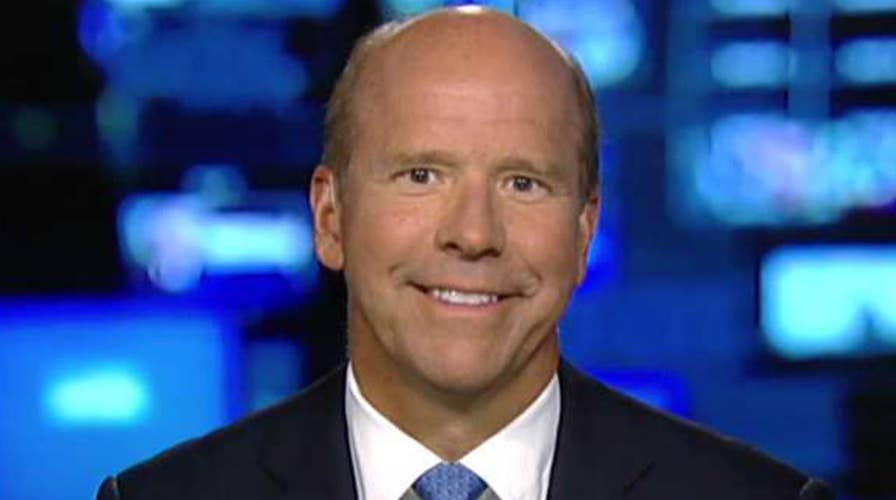
2020 Democratic hopeful on new debate requirements
DNC raises requirements for September debates; reaction from 2020 Democratic presidential candidate John Delaney.
This is a rush transcript from "The Story," May 30, 2019. This copy may not be in its final form and may be updated.
SANDRA SMITH, HOST: Bret, good evening. Thank you. And good evening, everybody. I'm Sandra Smith, in for Martha MacCallum tonight, and “The Story” tonight.
Attorney General William Barr, taking the gloves off. His target, Robert Mueller. Barr rejecting the special counsel's claim that the obstruction of justice decision was out of his hands.
(BEGIN VIDEO CLIP)
JAN CRAWFORD, CHIEF LEGAL CORRESPONDENT, CBS NEWS: Do you bring that interpretation?
WILLIAM BARR, ATTORNEY GENERAL: I personally felt he could have reached the decision.
(END VIDEO CLIP)
SMITH: More from the embattled attorney general in moments. But first, it's up to you to get Trump. That is essentially what Democrats heard when Robert Mueller said this yesterday.
(BEGIN VIDEO CLIP)
ROBERT MUELLER, FORMER DIRECTOR, FEDERAL BUREAU OF INVESTIGATION: The Constitution requires a process other than the criminal justice system to formally accuse a sitting president of wrongdoing.
(END VIDEO CLIP)
SMITH: That statement triggering a next level call for impeachment.
(BEGIN VIDEOTAPE)
MAYOR PETE BUTTIGIEG, D-IND., PRESIDENTIAL CANDIDATE: This is as close to an impeachment referral, as you could get.
SEN. KAMALA HARRIS, D-CALIF., PRESIDENTIAL CANDIDATE: He told us enough to interpret what he said as a referral for impeachment proceedings.
REP. JERROLD NADLER, D-N.Y.: With respect to impeachment question at this point, all options are on the table.
UNIDENTIFIED FEMALE: The Democratic-controlled Congress will have no choice but to open an impeachment inquiry into President Trump.
DON LEMON, HOST, CNN: That process has a name. It begins with the letter I, impeachment.
(END VIDEOTAPE)
SMITH: But remember, Speaker Pelosi's party is also made up of House Democrats facing potentially tight races. And recent polling shows that those voters want action on the issues. Healthcare, the economy, immigration, not impeachment. So, what will Pelosi play be as her party continued to fracture?
Here now, Republican Congressman Matt Gaetz, who sits on the committee responsible for bringing impeachment charges. And Juan Williams, Fox News political analyst and co-host of "THE FIVE". Good evening to both of you.
Congressman Gaetz, I'll start with you first. So, will Nancy Pelosi hold the line here?
REP. MATT GAETZ, R-FLA.: Nancy Pelosi is stuck between the general election voter, six out of 10 of whom do not support impeachment, and the woke left, where you have 70 percent of Democrat primary voters who are demanding impeachment.
So, it's really a lose-lose for the Speaker, if she, in fact, impeaches, she will alienate the very voters that Democrats hope to earn back in the next election. And if she doesn't act on impeachment, she will likely suppress the enthusiasm the Democrats are counting on to match the enthusiasm that certainly, President Trump has proven the ability to turn out on Election Day.
There is no basis for impeachment, the president acted in public. He acted -- you know, largely as there is a consequence of no underlying crime, and he acted pursuant to his Article II powers. And so, I think we ought to get on to the agenda that matters to the American people. But, I doubt we will because the Democrats will be answering to their cable news overlords on other networks.
SMITH: Well, Juan is right here. And I know you're chomping at the bit to respond to that. But you might as well look at the latest polling on this very issue of impeachment. Because Juan, this is a CNN poll, it shows a majority of voters, 57 percent agree that Congress should investigate whether if Trump committed obstruction of justice.
However, when compared to impeachment numbers in that same poll, 61 percent of voters were against impeaching and removing the president from office. So, what does Nancy Pelosi do next?
JUAN WILLIAMS, POLITICAL ANALYST: Well, I think that Congressman Gaetz is on target when he described the fact that -- I think it's 70 percent of Democrats think we should proceed with impeachment. It's that general public and those are the numbers that you just put up on the screen --
(CROSSTALK)
SMITH: Those numbers don't show up in Congress, Juan. It's not a majority of those Democrats in Congress.
WILLIAMS: No, in fact, I think POLITICO today sampled and found that they were only a few Democratic Congresspeople who were behind impeachment at this juncture.
But the question to me is a little different than the frame that Congressman Gaetz, offered. I think it's a matter of whether or not the responsibility of Congress to exercise oversight and accountability on the executive is fulfilled by this Congress.
If you let this president get away with what we heard he has done in terms of obstruction. According to Mueller --
(CROSSTALK)
SMITH: OK, oversight and accountability is one thing. But why not --
WILLIAMS: Yes, but you get --
SMITH: Why not move forward with impeachment, Juan?
WILLIAMS: Well, I'm saying that's the question. Because the politics of it which is what the congressman laid out for you, Sandra, would suggest she's caught in a box here because there's pressure from her base to do it, but if she's thinking about unseating President Trump, she says well, there's a contrary impulse from the larger electorate.
But I'm saying to you, there's also a question of congressional authority. The Congress is the number one branch of government, equal branch of government, and they should not let a president get away with obstruction of justice.
(CROSSTALK)
SMITH: All right, let's put the congressman respond to that.
GAETZ: Yes, I strongly --
SMITH: Congressman?
GAETZ: I strongly agree with the role of Congress to provide oversight. But frankly, after 22 months of an investigation into the president, why don't we spend a few months and figure out whether or not there was a corrupt origin of this investigation. Whether or not there was information withheld from the FISA Court. That would seem to be the more prominent question before us.
And I would agree with Robert Mueller in his statement that the biggest threat here is not that the president acted inappropriately after being falsely accused. The biggest threat is that Russians are trying to interfere with our elections. We should hold hearings on those questions, we should work together as a -- as a bipartisan Congress to try to react to and respond to that threat.
And frankly, based on what heard from the DOD, and the Department of Homeland Security and the FBI, so far. We haven't taken that threat seriously. But we want (INAUDIBLE) you because you know what --
(CROSSTALK)
SMITH: Right.
WILLIAMS: Well, I'm so proud of you, because you know what, I hope that you, Congressman, which, in fact, lead Republicans in this juncture. Because I don't see that we are taking steps as a country. Republicans and Democrats to prevent a repeat of Russian interference. Obviously, it benefited Republicans in the last election. We don't know where it goes next time.
(CROSSTALK)
SMITH: Well, I'm not so sure if it does --
WILLIAMS: You're saying, we need to do that now, and I couldn't agree more.
SMITH: Right.
GAETZ: Yes, we all have -- yes. And frankly, my Democrat colleague, Stephanie Murphy, and Michael Waltz. We're all working on legislation to fix this (INAUDIBLE) was impacted.
(CROSSTALK)
WILLIAMS: That's where we --
SMITH: All right. Hold on, I want to get back in here. Because this is - - this is the president earlier today, he was departing the White House and made comments on the lawn, and he was very targeted on his criticism on Robert Mueller. Here's the president.
DONALD TRUMP, PRESIDENT: Robert Mueller should have never been chosen. Because he wanted the FBI job and he didn't get it, and the next day, he was picked as special counsel. So, you tell somebody I'm sorry, you can't have the job. And then, after you say that, he is going to make a ruling on you that doesn't work that way. Plus, we had a business dispute. Plus, his relationship with Comey was extraordinary.
SMITH: So, that was the president doubling down on his criticism of Robert Mueller. Saying he was totally conflicted through this process. And he called him a never Trumper. Congressman, I just wonder -- you know, should Jerry Nadler, House Judiciary, subpoena Robert Mueller? Is that going to happen?
GAETZ: I know a lot of Republicans would be supportive of that because we have questions for Robert Mueller. It's a legitimate question to ask why Robert Mueller, included a team of people that had previously defended the Clinton Foundation against public records lawsuits. And people like Andrew Weissmann, who had gone to Hillary Clinton's victory party. We should be able to ask those questions. How Robert Mueller treated the handling of evidence by Peter Strzok and Lisa Page who obviously manifested their bias against the president is another legitimate question.
So, I think a lot of us were disappointed that we won't be hearing more from the special counsel.
(CROSSTALK)
SMITH: Well, we don't -- we don't know that (INAUDIBLE).
GAETZ: And like -- I guess its Robert Mueller's view that his report is like scripture.
SMITH: Yes.
GAETZ: Like it -- you know, it has its own -- it can't be questioned by anyone.
WILLIAMS: Let me just quickly say, isn't this ridiculous to have the president of the United States absolutely dismissing and besmirching Robert Mueller? Who I think is widely respected even after he wants to tell us no collusion, no obstruction, look at the Mueller report. Now, he conveys us, "Oh, that Mueller, he can't be trusted." You can't have it both ways, Mr. President. And I think it really suggests this is about bullying and trying to distract people from the charges against him.
SMITH: Well, that'd be interesting to see what happens, Juan. How do you answer that question? Should the Judiciary Committee subpoena Robert Mueller? Because he said he wanted the report to speak for itself, and then, he gave this (INAUDIBLE).
(CROSSTALK)
WILLIAMS: Oh, I absolutely think so. You know, I have -- so, the congressman lays out questions that come from the right. I have a totally different set of questions. Why didn't you interview President Trump? Why didn't you subpoena him if necessary? Why didn't you interview Donald Trump Jr.?
SMITH: Right.
WILLIAMS: There are several questions that need to be asked from any political point of view. And I don't think that Mueller has a right to simply say, I'm gone, look at the report.
SMITH: Well, I've got some questions but they're not for you two anymore. I'm done with you.
WILLIAMS: All right.
SMITH: Matt Gaetz and Juan Williams. Really appreciate your time tonight. Thank you.
GAETZ: Thanks, Sandra.
WILLIAMS: You're welcome.
SMITH: In a new interview, Attorney General William Barr, contradicting special counsel Robert Mueller, who suggested the ball is in Congress' court to hold the president accountable.
(BEGIN VIDEO CLIP)
CRAWFORD: He seemed to suggest yesterday that there was another venue for this and that was Congress.
BARR: Well, I'm not sure what he was suggesting. But -- you know, the Department of Justice doesn't use our powers of investigating crimes as an adjunct to Congress.
(END VIDEO CLIP)
SMITH: Here now, Andy McCarthy, former federal prosecutor, and a Fox News Contributor. I like Matt Gaetz and Juan Williams, but I have questions for you. So, we're moving on with you, Andy. Now, so can you tell us what this eventually would look like if Democrats were to go down this path and pursue impeachment and begin proceedings, what exactly does that look like, Andy?
ANDREW MCCARTHY, CONTRIBUTOR: Well, they can start out in the Judiciary Committee, I would think, Sandra. So, that committee is already set up, it's already doing work. It's got oversight responsibility over the -- over the Justice Department where a lot of the action is here.
The other alternative is they could create an impeachment committee, which would have -- I guess, remember when they created a Benghazi committee rather than deciding to go through the different committees that might have jurisdiction. They could do that with respect to impeachment as well. They could just set up a committee for that purpose.
SMITH: I've got some new sound from this new interview with Bill Barr, and he was asked the question what concerns he has or had about the investigation and how it played out. Here's the latest that we're hearing from this interview from William -- from William Barr.
(BEGIN VIDEO CLIP)
CRAWFORD: Do you have concerns about how they conducted the investigation?
BARR: Yes, but you know, sometimes people can convince themselves that what they're doing is in the higher interest, the better good. They don't realize that what they're doing is really antithetical to the democratic system we have.
(END VIDEO CLIP)
SMITH: So, that's the first time we're hearing that answer we've -- that'll be aired in its entirety sometimes tomorrow, we're getting bits and pieces of it. But how did you interpret that answer from Bill Barr?
MCCARTHY: That seems very sensible to me. I think what he's saying, Sandra, is that people can act excessively. They can take steps beyond what the factual information before them can demand. And still, be motivated in good faith by what they see as the protection of the United States.
So, for example, if I were an FBI counterintelligence agent, and I had a smidgen of evidence that potentially the Russians were trying to infiltrate a presidential campaign, but it wasn't enough under the guidelines that exist and under the law that exists to seek a FISA warrant or use confidential informants to try to infiltrate the campaign.
If I was so concerned about Russia, because Russia is such adversary challenge for the United States globally, I might err on the side of being overly aggressive. And while that would be understandable given the challenge of Russia, it would be insufficiently respectful to a very important democratic principle, which is that in this system, it's we, the sovereign, the people, who get to decide what our leaders are. And law- enforcement people, intelligence people, unelected bureaucrats, have to -- have a respectful distance from the democratic process.
You don't go past that norm, you don't interfere in the political process unless you have a very, very good reason. So, the question is what was their predicate here?
SMITH: Very interesting stuff. I heard you earlier today referenced Alan Dershowitz and this piece he quickly wrote after we heard that public statement from Robert Mueller yesterday.
He writes, "Shame on Robert Mueller for exceeding his role." We just had this debate about Robert Mueller and obviously looked at the criticism from the president earlier today. And that piece Alan Dershowitz, constitutional law professor writes this. "Virtually, everybody agrees that, in the normal case, a prosecutor should never go beyond publicly disclosing that there is insufficient evidence to indict. No responsible prosecutor should ever suggest that the subject of this investigation might indeed be guilty even if there was insufficient evidence or other reasons not to indict."
That was really interesting to hear from Alan Dershowitz. He made the case that those that were siding with Robert Mueller here might make the case that this was not an ordinary case. He says all the rules, same rules should apply here. Final thoughts, Andy.
MCCARTHY: Yes, I think -- I think, Alan is right about that in terms of just narrowly what it's proper for a prosecutor to do. The reason this investigation is screwed up from the beginning, Sandra, is it's never been a traditional prosecutor's investigation.
It started out as counterintelligence, which you don't need a prosecutor for. I've always thought the linear progression here is the counterintelligence investigation was a pretext to do a criminal investigation without a predicate crime.
The criminal investigation has been a pretext to gather what could be impeachment information to get that to Congress. And the impeachment inquiry is what this is really about which is not removing President Trump from power. That's never going to happen. What this is about is bruising him up that is the president until we get to autumn of next year, and they -- hopefully from their perspective have made him unelectable. I've always thought this was about hardball politics more than anything wrong.
SMITH: Well, Andy, you were with us in the morning yesterday when Robert Mueller made that statement.
MCCARTHY: Yes.
SMITH: I know we went to you right away, and you called his remarks explosive. So, it's good to follow up with you.
MCCARTHY: Well, I think, they are. He's kind of turbocharged, the people on the left who want to have Trump impeached, and he's made life very difficult for the 30 or 40 -- however many it is. Democrats who are in districts that are Trump friendly, who have been trying to walk this line of saying, "Yes, we think there was an impeachable conduct, but the Senate would never remove him, so, what's the point of going down this road?
What Muller did, Sandra, was give the base the which is much more rabidly anti-Trump ammunition to do really what Juan William said a few minutes ago which is to say if we don't act here, that means Trump is above the law and he gets away with it.
SMITH: And Dershowitz made that very similar point in this piece that you just said. Andy McCarthy, thank you for your time tonight. I appreciate it.
MCCARTHY: Thanks, Sandra.
SMITH: All right, up next, 2020 Democrats going after the DNC now after Tom Perez announced tougher requirements to qualify for the debate stage. One of those Democrats here exclusively next.
(COMMERCIAL BREAK)
SMITH: Fox News Alert. Louisiana's Democratic governor has signed a ban on abortion as early as six weeks into pregnancy. With Governor John Bel Edwards signature, Louisiana is the fifth state to enact a heartbeat bill joining Mississippi, Kentucky, Ohio, and Georgia. Alabama's law goes even further outlying virtually all abortions. The Louisiana bill will not go into effect unless Mississippi's law is upheld by a federal appeals court.
With less than one month until the first Democratic presidential debate of 2020, a new controversy. The DNC now making it harder for the 23 Democratic candidates to qualify for the second round of debates, doubling the standards. The new rules would require candidates to earn two percent support in four DNC approved polls over the summer, plus obtained contributions from at least 130,000 donors including at least 400 from 20 different states.
The higher standards could significantly narrow the crowded field. And one of those candidates unhappy with the DNC decision joins us now former Maryland Congressman and 2020 contender John Delaney. Good morning to you, John. I appreciate you coming on the program tonight.
JOHN DELANEY, D-PRESIDENTIAL CANDIDATE: It's great to be with you.
SMITH: All right, so why do you take issue with these requirements?
DELANEY: Well, I just like to know how they came up with them, right. I mean, I understand the goal of the DNC which is to narrow the field. And I don't actually have an issue with that. I understand why they're doing that. That makes sense. But these criteria that they've come up with to me seems somewhat arbitrary.
I mean, the polling standard makes total sense. But then they have these donor criteria and I just don't understand where that came from or what the thinking is behind that. And I don't actually think it's a good idea because as best I can tell as someone who's campaigned all over this country, a lot of Americans are struggling.
About 50 percent of the American people can't afford basic necessities like their housing or their utilities or their food. And you know, so if you look at the percentage of the American people that actually give money to political candidates, it's actually a pretty small percentage.
SMITH: Well, you're in a -- you're in a unique player in that right because your campaign is self-funded.
DELANEY: Well, it's not entirely self-funded but I just don't understand why the DNC has created this kind of money standard or this donor standard as a way of qualifying for the debates. It doesn't seem to represent anything other than who runs the most Facebook ads to raise money online. You know, I think polling standard makes a total sense --
SMITH: It sounds like you've come up -- it sounds like you've come up with some sort of theory as to why they've increased these requirements, is that the case?
DELANEY: No, I wish I did, right. That's why I actually sent a letter to Chairman Perez who by the way I have a lot of respect for and I think it's been a great public servant. But I just -- you know, I'm just curious as to who's putting these ideas in their head that this is actually the right way to create a filter.
Because really what the DNC is doing is they're acting like a gatekeeper and they're basically deciding who gets into these debates or who doesn't. And I just think they've created a filter which is based on these number of donors and they've given these donors basically the power to open --
SMITH: So you're suggesting that would favor obviously of certain candidates? And I ask you that because the Washington Times has put out this this this piece as Bernie Sanders supporters are apparently fearful that the DNC is now back and Biden like they did Hillary Clinton.
There's only one Bernie Sanders supporter that is quoted in the piece that I can tell. This person found it Occupied DNC and she makes the case that the mainstream media and the DNC are colluding against the American people. That's what it feels like. It's the same thing all over again.
I just wanted to get your reaction to that as we continue this conversation about the requirement for the debate.
DELANEY: Listen, I don't think they're doing -- I don't think they're doing that but what I do think they're doing is putting forth some arbitrary rules about who gets into the next round of debates that doesn't seem to me to serve the interest of democracy or the American people. I have no issue with them trying to narrow the field. That makes sense. Historically that's been done by polling averages. That also makes sense.
I just think this donor kind of money standard first of all isn't who we are as a party. I mean, I'm running for president to improve people's lives including so many Americans who are struggling. Most of these Americans can't give money to political candidates so I don't know why their voice --
SMITH: Well, the Republicans are going to make a case that the economy is thriving, John, so --
DELANEY: Right. But we all -- but listen, we all know that 50 percent of the American people can't afford $500 and 40 percent of the American people can't afford their basic necessities like rent and utilities and food.
Listen, I'm happy that the unemployment numbers are low, I'm happy that the economy's showing good momentum, but I think we can all agree that many Americans are still left behind and I just feel like this standard that the DNC has put forth doesn't give them a voice because they're not kind of writing checks to the Democratic Party.
SMITH: And you want to make your case so you can move up and in what is a very crowded field.
DELANEY: It is.
SMITH: We will see. You haven't heard back from the DNC yet since you wrote your letter, right?
DELANEY: We haven't.
SMITH: All right. Let us know when you do. I appreciate your time.
DELANEY: OK. Thanks for having me.
SMITH: Thanks, John. Next, new questions about where that U.S. trade deal with China really stands and whether President Trump should take its latest threats seriously.
(BEGIN VIDEO CLIP)
TRUMP: I think we're doing very well with China. We'll see what happens.
(COMMERCIAL BREAK)
SMITH: Escalating concerns tonight over U.S.-China trade relations as they increased. China accusing the U.S. of naked economic terrorism and their state media striking a similar tone publishing an op-ed that ominously says, quote, "We advise the U.S. side not to underestimate the Chinese side ability to safeguard its development rights and interests. Don't say we didn't warn you."
Despite the tough rhetoric, though, President Trump remaining positive in his outlook.
(BEGIN VIDEO CLIP)
TRUMP: I think we are doing very well with China. We'll see what happens. But I can tell you China very much wants to make a deal because the companies are leaving China to avoid the tariffs.
(END VIDEO CLIP)
SMITH: General Jack Keane is chairman of the Institute for the Study of War and a Fox News senior strategic analyst. And good evening to you, general. Apparently, I said good morning to last next guest. Nice to see you.
JACK KEANE, CONTRIBUTOR: Good to see you.
SMITH: So where does this trade war stand as it is today, general?
KEANE: Well, I don't think we are quite at the definition of an ultimate trade war. Clearly, China backed out of what was believed to be a coordinated deal, 150 pages, major recommendations. Their leadership backed away from it.
I think even though the chief negotiator agreed with the United States, they didn't want to do it because it looked like they were giving in to the United States.
We got to recognize that world image and domestic image for the communist party running China is a major, major issue. And I think even today that issue is -- was seen being played out. They've unleashed their state-owned media, Sandra, to come up with this bluster that you were quoting there and also to threaten us.
But President Xi isn't doing that. China knows full well that the president has imposed tariffs on them. And but at the end of the day, they don't want this relationship to go away. They desperately need the United States. We are their number one market.
And clearly, they want a relationship with these two major economies in the world and these two major militaries in the world. And they are trying to, I think, navigate through challenging waters for them.
Sandra, no American president in a generation has pushed back on China the way this president has done. That's number one. Two, there is a certain volatility here and unpredictability to the president, let's be frank about it. And that also adds to this.
I can't imagine how many hundreds of analysts they are trying to figure out what Trump's advisors are thinking so they can anticipate what moves the president may be making in the future. I think --
(CROSSTALK)
SMITH: And I know that -- I've heard Larry Kudlow suggest that there is a lot of misinterpretation on the part of the Chinese for how this administration plans to act. But, general, I just wonder, based on that threat, should the president take that seriously?
KEANE: I think he is taking it seriously. But I think he believes so much in personal diplomacy that he is advocating, listen, we still have an opportunity here. We still want to have good relations. He is staying positive and I think his guys are talking tough with the Chinese.
Also, we have to remember, that the Chinese have huge strategic goals here. Dominate and control the Indo-Pacific region which they have had a lot of success with operating below the level of conflict. Intimidation. Coordination. Predatory economics and eventually, replace the United States is what their goal around 2040, as stated public records speeches that Xi makes replace us as the world's dominant power in the world both economically and militarily.
SMITH: Well, the trade war is clearly escalating, general. Should the president stay at this.
KEANE: The rhetoric is escalating. I don't think, unless they stop slapping down things against each other, then the trade war itself is escalating. Right now, rhetoric.
We'll see where this goes. Is it potentially dangerous? Of course, it is. When these two economic powers are punching each other the way they are doing it. I'm optimistic that we will eventually get a deal. Because why? It's in both country's national interest.
SMITH: All right. General, can I run this breaking news by you? This is just coming in hitting the wires now by Reuters. North Korea has executed Kim Hyok Chol, its special envoy to the United States.
And I'm reading this directly from the wires. As foreign ministry officials who carried out working level negotiations for the second U.S.-North Korea summit in February holding them responsible for its collapse. This is according to a South Korean newspaper reporting on this just now. I want to get your reaction to that?
KEANE: Well, this is the person that Kim Jong-un had enormous confidence in. He was a chief negotiator for them. He has visited the White House. And he put the deal on the table for North Koreans. They put that deal on the table was pretty much the same deal they've done with previous administrations. We'll give up a little. In return we'll get sanction relief.
It didn't happen. President Trump said no. And certainly, this is the behavior that reminds us how repressive and outrageous and atrocious this leadership is in North Korea. And at a terrible expense it's a good reminder to us really what we are dealing with here.
SMITH: And a quick correction on the picture that we just showed. It was breaking news and this happens sometimes and this is the correct person that North Korea, according to this report has executed.
So, we will stay on that story and good to get your reaction to that. General Jack Keane, I appreciate it. Thank you.
KEANE: Yes. Good talking to you, Sandra.
SMITH: Yes. Thank you.
Here now Austan Goolsbee, former chief economist under President Obama. Going back to the trade war, Austan -- nice to see you tonight, by the way.
AUSTAN GOOLSBEE, FORMER CHIEF ECONOMIST FOR PRESIDENT BARACK OBAMA: Great to see you.
SMITH: What is the cost of this trade war? Who pays for it ultimately?
GOOLSBEE: Well, so far, I agree with what the general said that it hasn't escalated in the full-blown trade war. But, the tariffs so far. They've been on -- they have been in place for a year. And the data shows they have been paid 100 percent by the American consumer.
This was a tax on us, the prices went up by the full amount of the tariffs. We paid $50 billion or so in higher taxes for these goods. So that's why I think the -- if you are going to do something, if you are going to get an agreement, let's get it soon because all that's happened so far, is we have penalized ourselves $50 billion.
(CROSSTALK)
SMITH: Well, some will say that's easier said than done. But, Austan, so where do you --
GOOLSBEE: Yes.
SMITH: Where do you stand on this? Do you support the president going this tough on China?
GOOLSBEE: I don't think that he's being tough on China. He's being tough on us. I don't support it. I think tariffs are terrible. I think if you want to change Chinese behavior as we have in the past like when we got them to stop being a currency manipulator and devaluing against the U.S. dollar. You got to get allies. You got to get all the major economies of the world --
(CROSSTALK)
SMITH: All right. So, speaking of that, I want --
GOOLSBEE: -- who aren't normally our allies and we haven't done that because we have threatened trade war against our allies. So now they are not on our side.
SMITH: All right. Speaking of that I want to get this in here because we've got some more breaking news for our audience on this.
There is a new tweet out by the president, a moment ago, announcing tariffs on Mexico, "On June 10th, the United States will impose a 5 percent tariff on all goods coming in to our country from Mexico, until such time as illegal migrants coming through Mexico and into our country stop. The tariff will gradually increase until the illegal immigration problem is remedied."
So, this announcement just made by the president a moment ago at which time the tariffs will be removed details from the White House to follow. The president did say to expect a major announcement sometime today or tomorrow and there you have it. Your reaction, Austan?
GOOLSBEE: Well, I mean, I think two things. The first is the World Trade Organization which both we and Mexico are members of forbid this. That is illegal. You can't just single out one country and apply tariffs to them.
But, two, this is exactly what I mean. We negotiated a new NAFTA that hasn't passed Congress, but now the president is going to go to our trading partners and launch tariffs on them? You have seen him go to Europe and threaten Europe with tariffs.
And now simultaneously going to go threaten a trade war against China when we need our North American allies and Japan and Europe to be on our side to confront the Chinese, he is just ticking everyone off today. So, I just -- I don't think this is a right strategic approach.
SMITH: All right. Well, we will surely get more reaction from the White House as this news comes in to us just now. Austan Goolsbee, you were here to react to it. We thank you for that.
GOOLSBEE: Thanks.
SMITH: Thank you, Austan.
Well, it was “The Story” that stunned the nation. Chicago prosecutors dropping all charges against Jussie Smollett. Well, just moments ago, we learned “The Story” behind that story. We'll have the details on that next.
(COMMERCIAL BREAK)
SMITH: Breaking news in the Jussie Smollett case tonight as hundreds of previously sealed police files from the actors' case have just been made public.
Chicago police accused the "Empire" star of staging an attack against himself and filing a false police report back in January.
But, in March, the state's attorney dropped all charges against Smollett.
Trace Gallagher is live with a first look at what's in those just released documents. What are we seeing? Hey, Trace.
TRACE GALLAGHER, CORRESPONDENT: Hi, Sandra. These files include 460 pages of Chicago police reports and documents. We are still scouring them. But so far some pretty fascinating contradictions.
For example, this is the first time that we're learning it was during a supplemental police report that Jussie Smollett apparently remembered that his attackers yelled, quote, "this is MAGA country" followed by a racial slur.
Smollett identified his attackers as being white saying he could see through the eye holes of their ski masks. But now we know on the advice of his attorney, Smollett refused to look at a photo line-up of potential suspects that included the Osundairo brothers.
And when the brothers were finally arrested for the allege attacks Smollett admitted he knew them but told police they couldn't be the suspects because, quote, "they are black as sin."
Smollett later said he assumed his attackers were white because they said "MAGA country." Text messages also reveal that several months before the attack Smollett asked the Osundairo brothers if they had any contacts for Mollie and Whitney, meaning, ecstasy, cocaine and other pills.
And remember when Cook County State's Attorney Kim Foxx dropped the 16 counts against Smollett and Chicago police said they were blindsided? Well, maybe not so much.
The documents show that after Smollett was indicted on February 28th, quote, "Assistant States Attorney Lisa Lanier informed detectives that she felt the case would be settled with Smollett paying the city of Chicago 10,000 in restitution and doing community service." And that's exactly what happened almost one month later and here's what police said at the time. Watch.
(BEGIN VIDEO CLIP)
EDDIE JOHNSON, SUPERINTENDENT, CHICAGO POLICE DEPARTMENT: We found out about when you all did. Prosecutors have their discretion, of course. We still have to work with the states' attorney office. I'm sure we have some conversation after this.
(END VIDEO CLIP)
GALLAGHER: Now Chicago police say they were told the settlement was supposed to include Smollett admitting guilt but that's not what the documents say and that's certainly not what happened.
Next week police will release 69 hours of redacted videos which should include what the Osundairo brothers said when they confessed and accused Smollett of staging the whole thing. Sandra?
SMITH: Trace Gallagher, thank you. More on breaking news tonight. The president just announcing starting June 10th the United States will impose 5 percent tariff on all goods coming into the United States from Mexico until illegal migrants stop coming through Mexico into our country. This is breaking news. We are going to have more on this on the other side of the break. Dow Futures by the way plunging on that news.
(COMMERCIAL BREAK)
SMITH: As we learned just a few moments ago President Trump planning to impose tariffs on Mexican goods coming into this country. He announced it via a tweet after teasing it earlier today on the lawn of the White House as he was leaving. He said that to expect a dramatic announcement on the border.
Here is the president's tweet a moment ago. "On June 10th, the United States will impose a 5 percent tariff on all goods coming into our country from Mexico, until such time as illegal migrants coming through Mexico and into our country stop. The tariffs will gradually increase until the illegal immigration problem is remedied at which time the tariffs will be removed. Details from the White House to follow."
We have got a statement now from the president regarding these emergency measures as they are calling them to address the crisis at the border. That statement starts out talking about what they're calling the United States, America has been invaded by hundreds of thousands of people coming into Mexico and entering our country illegally.
As I mentioned, the president earlier today when he was departing the White House, he commented on a variety of issues. One of them was this. He said that there would be a big announcement coming, an immigration related announcement.
He said we are going to do something very dramatic on the border is what he said this morning is because people are coming into our country. So now we have the president threatening these new tariffs on Mexico that would begin June 10th on all goods coming from Mexico into the United States.
And as the tweet alludes, they would increase if that does not stop over time.
Markets are reacting to this tonight. They were down about 150 points, or they fell about 150 points on this news. It was a sharp drop. Dow Futures I should say they open about 6 o'clock --
SUSAN LI, FOX BUSINESS CORRESPONDENT: Yes.
SMITH: -- and they give us an indication how trading will be in the morning.
Susan Li joins us now from the Fox Business Network. Thank you for jumping on this breaking news for us.
LI: No problem.
SMITH: This is big news --
LI: It is.
SMITH: -- from the White House to impose a 5 percent tariff on Mexican goods.
LI: Especially when you are fighting another trade front with China at this point. That's why we have stock markets selling off down like 5 percent from the highs that we've seen the peak of 2019. So, look.
SMITH: Not tonight.
LI: Not tonight but over the last few weeks --
SMITH: Yes.
LI: -- since we were up about 18 percent for the S&P.
SMITH: Right.
LI: Best start to the new year since the late 1980s. But you should also keep in mind, this is not the first time that the White House and President Trump has threatened tariffs on Mexico.
Remember they talked about 25 percent tariffs on Mexican auto parts that come into this country if they didn't do anything about the border. So, this is not the first time that we have heard this.
In fact, 5 percent might be even less than 25 percent threat that we heard just about last year. But don't forget, that we're in the middle of trying to seal this USMCA which is the new NAFAT, NAFTA 2.0.
We know Mike Pence was in Canada speaking to Prime Minister Trudeau today to try to get that trade deal finalized. So, this obviously doesn't help if you're trying to get Congress on side to get this pass through.
SMITH: This comes amid on continued or recent calls by the president calls to also shut down the border. He said, quote, "Before we close the border, we'll put the tariffs on the cars" to reference back to your earlier point.
LI: Right.
SMITH: I don't think we'll ever have to close the border because the penalty of tariffs on cars coming to the U.S. from Mexico at 25 percent will be massive. Those were earlier comments by the president then now the news tonight, Susan Li.
So, markets are reacting. Obviously, this is going to be the big news tomorrow as to how this effects the economic situation.
LI: And don't forget, Mexico enjoys a 60 billion-dollar surplus trading with the U.S. Something that the president has already cited. And most of these are car ports. They also do a lot of garment business and a lot of parts that come into this country as well.
So, when he threatens to shut down the border there were concerns that maybe this will -- this is going to impact two-way trade since billions of dollars cross that border each and every year.
SMITH: I want to read this portion, because we now have the statement from the White House here. "Mexico must step up and help solve this problem." The White House wrote. "We welcome people who come to the United States legally. But we cannot allow our law to be broken and our borders to be violated. For years Mexico has not treated us fairly. But we are now asserting our rights as a sovereign nation."
The president has put it out there that he suggested tariffs would be more effective means to pressure Mexico to do more about this migrant situation.
LI: Right. Don't forget cutting off aid as well to those three nations Honduras, Guatemala and the like of that make up the most of the caravans, the individuals trying to cross that southern border.
But tariffs seem to be the favorite way that the president wants to tackle issues whether it has to do with China or Mexico, and these are countries that enjoy surpluses trading with the U.S. It's understood that they get a lot of money out of this country. So, in some ways I would say that the U.S. has a stronger position to negotiate from.
SMITH: Very interesting. So, there will be continued fallout from this. That news just breaking a few moments ago.
LI: Yes.
SMITH: Susan Li, we appreciate you jumping on that for us, thank you.
Up next, an inspiring story of America's heroes. Stay with us. We'll be right back.
(COMMERCIAL BREAK)
SMITH: Tonight, we continue to honor America's veterans. As we end the Memorial Day, we -- and look ahead to the 75th anniversary of D-Day.
Tonight, we're bringing you an inspiring story from California. Ninety-two- year-old Robert Chrismer is a World War II navy veteran who discovered the American flag flying in front of his Fresno home was stolen.
When he reported the theft to local law enforcement, they not only responded to his call, but brought him a brand-new flag. The Fresno County sheriff's deputies then hung the new flag just in time for Memorial Day.
The deputies thanked the war hero for his service, and then in the Facebook post reminded everyone that good deeds always outshine bad people.
And that is “The Story” for this Thursday night.
Content and Programming Copyright 2019 Fox News Network, LLC. ALL RIGHTS RESERVED. Copyright 2019 ASC Services II Media, LLC. All materials herein are protected by United States copyright law and may not be reproduced, distributed, transmitted, displayed, published or broadcast without the prior written permission of ASC Services II Media, LLC. You may not alter or remove any trademark, copyright or other notice from copies of the content.
