

















Trump vows Iran will never have nuclear weapon under his watch
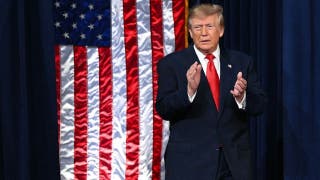
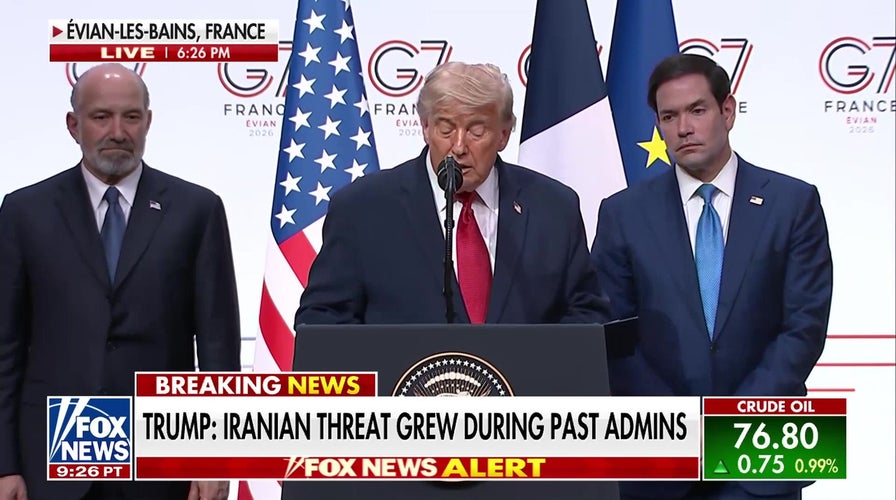
President Donald Trump says that no president has been tougher on Iran than him, stating Iran will never possess a nuclear weapon.
The single, most urgent priority of the House and Senate GOP ought to be passing Reconciliation 3.0 and thus funding not just President Donald Trump’s request of $1.5 trillion, but also the out-years when a likely Democratic majority in either the House or the Senate will not support the military we must have and especially address the munitions gap the battle with Iran has exposed.
The United States simply does not have the stockpile of interceptors we need in the age of missiles and drones. Whatever the definition of a "crash program" is, that definition ought to be put aside in favor of something far more ambitious.
We need enough interceptors for our own stockpiles, as well as enough for our allies in Israel, the Gulf States and Taiwan. Our Arab allies will pay cash on the barrel. From Israel, we should expect ongoing and expanding cooperation between the robust defense industry of the Jewish state and the Pentagon’s acquisition process. Taiwan already has a backlog of orders waiting to be filled.
US DRAINS CRITICAL MISSILE STOCKPILES IN IRAN WAR AS YEARSLONG REBUILD LOOMS
"Our procurement system is not designed for serious war fighting," Dr. Eliot A. Cohen told Aaron MacLean on the latter’s recent edition of the "School of War podcast. "You can see in this conflict the consequences of having had effortless superiority for a long time," Cohen added.
Dean Cohen is the 9th Dean of the Paul H. Nitze School of Advanced International Studies (SAIS) at Johns Hopkins University and a widely admired national security strategist and former Counselor to Secretary of State Condoleezza Rice during the second term of President George W. Bush.
Cohen was an original "Never Trumper" who admits in this podcast his regret at having been so absolutist in his opposition to President Trump, but does not relent in an objective assessment of the battle with Iran to date. Give the entire episode a listen but focus on the quotes above.
We have enjoyed complete air superiority in every conflict since the start of the First Gulf War. That era is over because of missiles and drones.
We could not suppress enough of Iran’s firepower to protect our Arab allies' infrastructure on land or ships passing through the Strait. Perhaps we did not try hard enough to do so, but after demolishing the remnants of the nuclear weapons program still left standing after 2025’s Operation Midnight Hammer as well as obliterating more than 75% of the defense industrial base of the Islamic Republic via tens of thousands of strikes by American and Israeli forces, the equation changed to favor the pause in kinetic battle envisioned by the MOU.
(I expect the negotiations to extend at least past November’s elections. It is very reasonable to expect a return to combat similar to Richard Nixon’s order for the Christmas Bombings of 1972 following Henry Kissinger’s declaration that "peace was at hand" in October of that year. If the junta atop the Islamic Revolutionary Guard Corps does not, in fact, deliver on the destruction or removal of all of their enriched uranium as well as inspection and destruction of Pickaxe mountain, I expect the battle to resume.)
In the meantime, we have to surge more defensive capabilities to our allies in the Gulf and Israel while also preparing our own military to open and keep open the Strait for as long as Iran attempts to close it in the future. That’s an expensive proposition.
The good news is that innovations in technology are surging through the West’s defense industries, including Ukraine’s, Israel’s and our own. But, Congress must send the unmistakable demand signal of the enormous uptick in spending and double or triple down on that signal with out-year appropriations just as it has just done with the Department of Homeland Security.
This is actually the most important reveal of the 40 days of combat beginning on February 28 and the week of renewed hostilities after Iran hit our Apache helicopter. (The second burst of combat should have told the Iranians that they will receive ten times back for every blow they attempt to land during the talks.)
CLICK HERE FOR MORE FOX NEWS OPINION
But while the American negotiators are at the (likely fruitless) effort to pin down Iranian negotiators on an actual disarmament and denuclearization plan, House and Senate Republicans have to put aside every home-grown and long-held belief about the size and nature of military spending. They have to act in the national interest and at a pace we have rarely seen in Congress.
Just as the Senate Majority Leader Mitch McConnell called on Senator Susan Collins and (then) Senator Marco Rubio to rush the Paycheck Protection Plan through the process surrounding the emergency response to COVID-19 that was the CARES Act that was passed by Congress on March 25, 2020, and signed into law by President Trump on March 27, 2020, so now Leader Thune should task Senator Collins and another senior senator or two to blitz the problems revealed by the battle with Iran and get the heavy lifting in defense spending for the balance of the Trump presidency done in weeks — not months or through "regular order."
CLICK HERE TO DOWNLOAD THE FOX NEWS APP
What has been revealed by the collision with Iran is that "regular order" will not do for this moment. We have had an enormous, consequential "reveal" about America’s military strengths, but also about our weaknesses and the gaps in our own and our allies’ defense.
Leader Thune, can rely on the trio of Collins Cotton and Wicker or others to come up with the design for Reconciliation 3.0, and Speaker Johnson can rely on their counterparts in the House. There is no mystery as to what they have to do if they want to provide for the common defense. It will be an enormous failure if a Republican House and Senate miss their moment to provide for that defense at least through the end of 2028.
Hugh Hewitt is a Fox News contributor and host of "The Hugh Hewitt Show" heard weekday afternoons from 3-6 p.m. ET on the Salem Radio Network and simulcast on Salem News Channel. Hugh drives Americans home on the East Coast and to lunch on the West Coast on over 400 affiliates nationwide and on all the streaming platforms where SNC can be seen. He is a frequent guest on the Fox News Channel’s news roundtable, hosted by Bret Baier weekdays at 6 p.m. ET. A son of Ohio and a graduate of Harvard College and the University of Michigan Law School, Hewitt has been a Professor of Law at Chapman University’s Fowler School of Law since 1996, where he teaches Constitutional Law. Hewitt launched his eponymous radio show from Los Angeles in 1990. Hewitt has frequently appeared on every major national news television network, hosted television shows for PBS and MSNBC, written for every major American paper, has authored a dozen books and moderated a score of Republican candidate debates, most recently the November 2023 Republican presidential debate in Miami and four Republican presidential debates in the 2015-16 cycle. Hewitt focuses his radio show and his column on the Constitution, national security, American politics and the Cleveland Browns and Guardians. Hewitt has interviewed tens of thousands of guests, from Democrats Hillary Clinton and John Kerry to Republican Presidents George W. Bush and Donald Trump over his 40 years in broadcasting. This column previews the lead story that will drive his radio/ TV show today.
