






















Mamdani shifts NYPD away from responding to homeless encampment calls
Retired NYPD Sergeant Joseph Imperatrice reacts to Mamdani's push to bar police officers from responding to homeless encampment calls and warns about the rising homeless population in New York City.
On Sept. 16, the First Circuit Court of Appeals cleared the way for the Department of Housing and Urban Development (HUD) to move forward with desperately needed reforms to the nation’s homelessness system.
After months of litigation by the Homeless Industrial Complex to repeatedly block these reforms, the decision allows HUD to redefine success and fund the programs that generate the greatest success in moving the homeless toward recovery, restoration and self-sufficiency.
And not a moment too soon.
TRUMP WANTS TO HELP 146,000 MENTALLY ILL WHO ARE HOMELESS. DEMOCRATS WANT TO STOP HIM
For more than a decade, federal homelessness policy has centered heavily on permanent housing placement, while the measures used to define and count homelessness have often obscured important differences between who is counted as homeless and who is being served through homelessness programs.
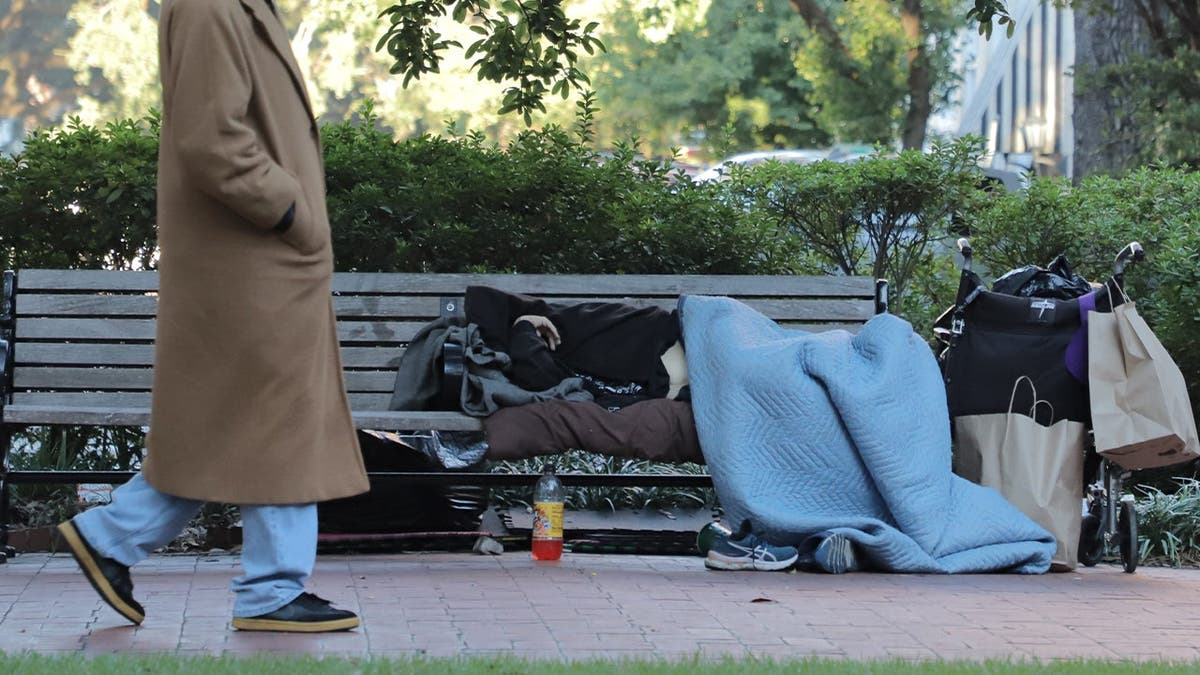
An unhoused individual rests on a bench in Reynolds Square on Tuesday, Oct. 21, 2025. (Richard Burkhart/Savannah Morning News / USA TODAY NETWORK via Imagn Images)
Success will now be measured by whether people are getting better: recovering, working, reconnecting and reclaiming their lives.
Getting here required that HUD officials confront a series of gimmicks that helped sustain the old system — promises, definitions and measures of success that painted a very different picture than what was happening on America’s streets.
SEATTLE MAYOR SAYS SOBRIETY WON'T BE REQUIRED AT NEW HOMELESS SHELTER
The first gimmick was in 2013 when President Barack Obama declared Housing First the predominant federal approach, promising to end homelessness in a decade by prioritizing permanent housing placement without requiring treatment, sobriety or other preconditions.
The promised end never came. By 2025, despite a 151% increase in taxpayer-funded beds, homelessness surged 27% and chronic homelessness by 81% — reaching the highest levels ever recorded in our nation’s history.

The problem was that we defined success as housing placements and system growth rather than recovery, self-sufficiency and restored lives.
Spending soared, the system expanded and homelessness grew with it.
That brings us to gimmick No. 2: housing people and then removing them from the homelessness count.
HUD’s Point-in-Time count excludes people already living in taxpayer-funded permanent housing for the homeless even though roughly 83% of HUD’s homelessness resources are devoted to housing them. That exposes a fundamental contradiction: If they are no longer counted as homeless, why does the nation’s largest homelessness agency continue devoting the majority of its resources to housing them?
SEATTLE CLEANED UP FOR THE WORLD CUP BUT ONLY WHILE THE WORLD WAS WATCHING, COMMENTATOR SAYS
Then came another statistical sleight of hand: rapid rehousing.
Success will now be measured by whether people are getting better: recovering, working, reconnecting and reclaiming their lives.
HUD classified rapid rehousing as permanent housing even though its rental assistance is time-limited to 24 months. Move a family into rapid rehousing, and they disappear from the point-in-time count. Move that same family into transitional housing — which can also last up to 24 months — and they remain officially homeless.
TAXPAYER-FUNDED 'METH MANSION' UNDER FIRE AS CRIME CONCERNS MOUNT AROUND HOMELESS CAMPUS
Same potential 24-month horizon. Two radically different statistical outcomes.
And the distinction mattered. As HUD steered communities away from transitional housing and toward rapid rehousing, HUD itself attributed declines in reported family homelessness in 2018 "largely" to that shift.
FURIOUS RESIDENTS CONFRONT HOMELESS HOUSING LEADERS AS POPULAR BEACH COMMUNITY HITS BREAKING POINT
Put the populations together and the picture changes dramatically: 1,456,923 Americans were either homeless or living in taxpayer-subsidized housing in 2025 — nearly twice the 745,652 captured by the headline point-in-time count.
That is one of the flaws in defining success primarily through housing status: The statistic can improve the moment someone crosses into a program classified as permanent housing, long before we know whether that person has achieved lasting stability or self-sufficiency.

Housing matters, but recovery, stability and self-sufficiency must be the finish line.
Then there is the "chronic" definition gimmick.
Under 12 years of Housing First rule, HUD has repeatedly changed how it defines and calculates chronic homelessness, making apples-to-apples comparisons across years increasingly difficult. Some changes temporarily altered who qualified as chronically homeless and therefore who appeared in federal statistics.
But this year, this HUD administration did the calculation and reports chronic homelessness is 81% higher than it was in 2013.
Perhaps the most consequential gimmick, however, involves homeless children and families.
In 2011, HUD made the decision to apply a far narrower standard than the Congress-codified McKinney-Vento definition to identify homeless children and youth in our nation’s schools. The result is a stunning federal contradiction: a child can be officially homeless under federal law while at school, yet that same child and family is moved into the shadows under HUD’s narrow definition simply because, after losing their housing, they are sleeping on someone else’s couch or in a motel room the government is not funding.
The definition disparity is staggering.
And the distinction mattered. As HUD steered communities away from transitional housing and toward rapid rehousing, HUD itself attributed declines in reported family homelessness in 2018 "largely" to that shift.
The Department of Education identified roughly 1.5 million homeless K–12 students in the 2023–24 school year, a number that includes only students. It does not count their parent(s), younger siblings not yet enrolled in school or other family members experiencing homelessness alongside them. Applying a conservative household adjustment suggests those students could represent more than 2.3 million Americans experiencing homelessness within families.
The result is that most homeless families are excluded from HUD’s homelessness count, and those excluded families do not qualify for HUD-funded homelessness assistance. HUD simply defined them out of the system that was supposed to support them. Pushing them into the shadows will have consequences reverberate for generations.
CLICK HERE FOR MORE FOX NEWS OPINION
Under the Trump administration, HUD now recognizes a basic truth: America cannot solve homelessness by narrowing definitions until millions disappear from the numbers — or by declaring success based simply on where someone sleeps.
CLICK HERE TO DOWNLOAD THE FOX NEWS APP
The era of statistical gimmicks and lowered expectations must end. It is time to measure what matters: lives recovered, restored and returned to self-sufficiency.
