
























New York City health officials warn of Legionnaires disease outbreak
NYC health officials warn residents of a Legionnaires disease outbreak with 23 confirmed cases. Dr. Stephanie Widmer explains the bacterial pneumonia, its symptoms like cough and fever, and its curability.
The Business Council of New York State is seeking to repeal "Prohibition-era" alcohol laws.
The New York Post reported that the organization launched its "New Yorkers Cheers for Change" campaign on Sunday, pushing a proposal that would counter the state's restrictions on alcohol sales.
"New York has some of the most restrictive Alcohol Beverage Control (ABC) laws the entire nation because they were created during the Prohibition-era. Current ABC laws impede economic growth, job opportunities, consumer choice, and New York’s own wine and distilled spirits industry," the organization's website read.
AMERICA'S FAVORITE BEERS — AND THE JOBS TIED TO THEM — ARE AT THE CENTER OF A BREWING TRADE FIGHT

New York's alcohol restrictions date back to 1934, near the end of the Prohibition era. (iStock)
The "Cheers for Change" campaign followed the 2023 Commission to Study Reform of the Alcohol Beverage Control Law, launched under New York Gov. Kathy Hochul, to recommend ways to update state laws, such as relaxing its 200 Foot Law and 500 Foot Law.
The state's 200 Foot Law prohibits the State Liquor Authority from issuing licenses to merchants selling within 200 feet of a school or place of worship. The 500 Foot Law restricts the issuing of licenses to businesses within 500 feet of three or more licensed establishments.
Both are part of the New York Alcoholic Beverage Control (ABC) Law, first enacted in 1934, immediately after Prohibition laws ended nationwide, for the purpose of regulating alcohol production and sales.
NEW YORK CITY LOST RESIDENTS ACROSS ALL INCOME LEVELS LAST YEAR, STUDY FINDS
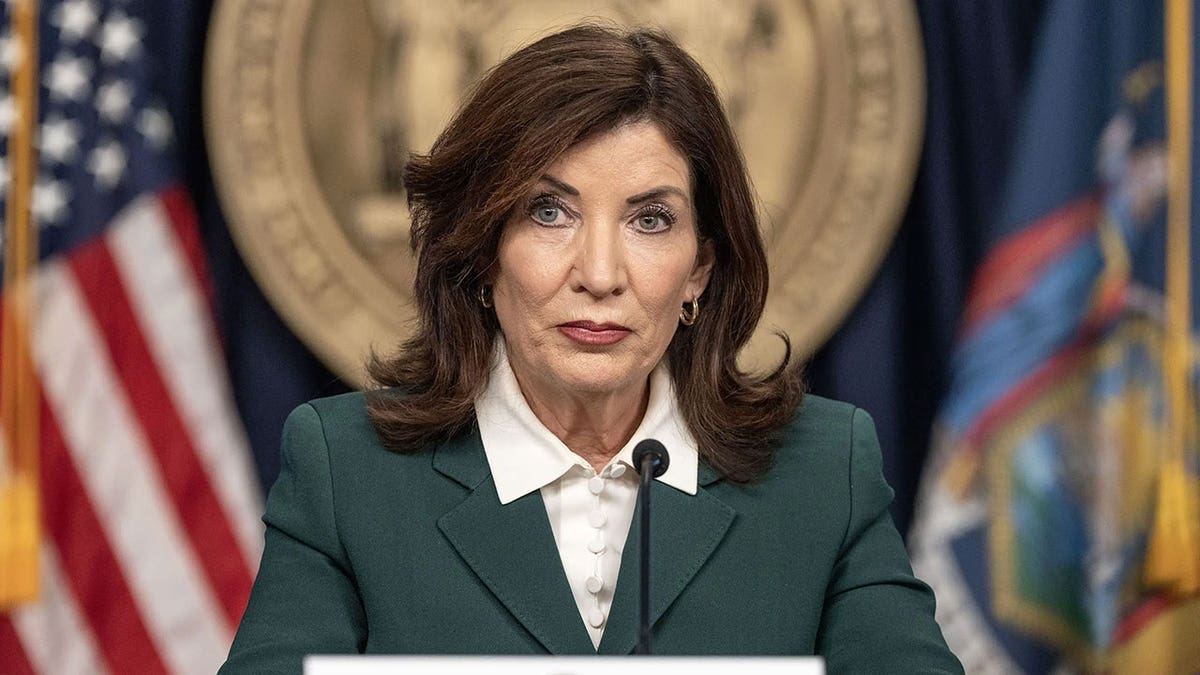
New York Gov. Kathy Hochul has supported efforts to pull back on alcohol restrictions. (Lev Radin/Pacific Press/LightRocket via Getty Images)
According to the website, pulling back on state regulations could create more than 4,000 new jobs and produce $500 million worth of new economic activity.
"Updating the 200-Foot and 500-Foot Laws and modernizing tied-house restrictions will remove unnecessary barriers to opening and growing restaurants, bars, and other hospitality businesses, ensuring New York’s regulatory framework reflects today’s economy and consumer demand," Andrew Rigie, executive director of the NYC Hospitality Alliance, said in a statement to the New York Post.
Paul Zuber, the executive vice president of the Business Council of New York State Business Council of New York State, told The New York Post that while progress has been made, and Hochul's efforts to modernize laws are recognized, there is "still a long way to go."

Some city council members have expressed concerns over weakening alcohol restrictions. (iStock)
Efforts to reform New York's alcohol laws, however, have faced some pushback from some local representatives concerned about the saturation of alcohol merchants within a neighborhood.
"We need a balance. We want to make sure there’s a dry cleaner, a dentist, a pharmacy, a card store in the neighborhood," City Councilman Harvey Epstein said to the New York Post.
"Governor Hochul remains committed to uplifting small businesses and supporting these vendors, including passing provisions in her FY27 budget that will protect retailers from unfair fees, help businesses open faster, streamline beer wholesale licensing and extend beverage services in movie theaters," Kassie White, deputy press secretary and press operations manager for Hochul, told Fox News Digital. "Governor Hochul looks forward to working with all stakeholders during the next legislative session to build on this progress."
CLICK HERE TO DOWNLOAD THE FOX NEWS APP
Zuber told Fox News Digital that, overall, public support has been largely positive.
"I think consumers by and large want a system that is modernized to meet their needs. For example, why does a consumer have to go to multiple retail outlets to buy simple products that should already be part of the mix, such as allowing liquor stores to sell complimentary products? There are so many examples that constantly make things harder for consumers, and we can fix that by modernizing the law," Zuber said.
