
Supreme Court justices grill both sides on Trump birthright citizenship order
The Supreme Court heard oral arguments Wednesday in Trump v. Barbara, a case challenging President Donald Trump's executive order seeking to end birthright citizenship for children of illegal aliens and other non-U.S. citizens. Justices grilled both sides of the argument during the two-hour session.
Coverage for this event has ended.
Justice Jackson uses stolen wallet analogy in birthright citizenship hearing
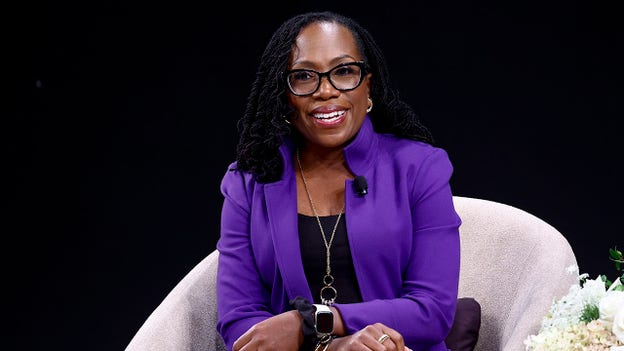
U.S. Supreme Court Justice Ketanji B. Jackson argued Wednesday that a temporary visitor can owe local allegiance to a foreign country simply by being present on their soil, even when committing a crime.
"I, a U.S. citizen, am visiting Japan. And what it means is that... if I steal someone's wallet in Japan, the Japanese authorities can arrest me and prosecute me," Jackson told ACLU National Legal Director Cecillia Wang.
"It's allegiance meaning can they control you as a matter of law. I can also rely on them if my wallet is stolen to, you know, under Japanese law, go and prosecute the person who has stolen it," she added.
Jackson argued that even temporary visitors can owe allegiance of foreign nations simply by being in that country.
Sauer cites ‘striking’ figures on secretive birth tourism in high-stakes SCOTUS case
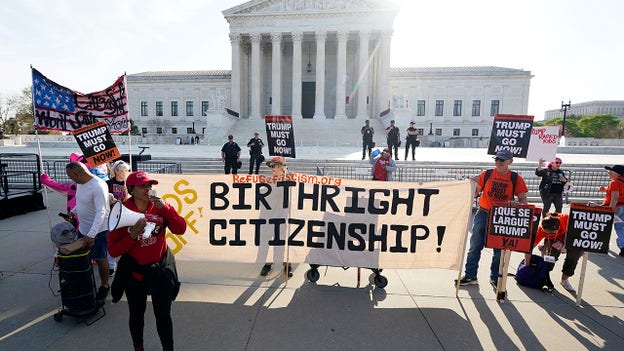
Birth tourism in the U.S. remains notoriously difficult to measure, but Solicitor General John Sauer on Wednesday pointed the Supreme Court to what he called "striking" figures as the justices weighed President Donald Trump’s effort to curb birthright citizenship.
"Here's a fact about it that I think is striking," Sauer said. "Media reported as early as 2015 that, based on Chinese media reports, there are 500 — 500 — birth tourism companies in the People's Republic of China whose business is to bring people here to give birth and return to that nation."
Sauer's response came after Chief Justice John Roberts asked him about the prevalence of birth tourism, which is the practice of traveling to the United States for the purpose of giving birth, so the child can automatically receive U.S. citizenship. Sauer acknowledged that "no one knows for sure" about firm data surrounding the industry, before citing media figures estimating more than 1 million cases, or even 1.5 million, from China alone.
Conservatives have long raised concerns about birth tourism.
Senate Republicans wrote in a 2022 report that it was a lucrative industry that "short circuits and demeans the U.S. naturalization process." But the scale of birth tourism remains elusive, and proponents of birthright citizenship have downplayed it, contending it occurs infrequently.
This post is an excerpt of an article by Ashley Oliver.
Alito invokes Scalia analogy in birthright citizenship fight over illegal immigration
Justice Samuel Alito invoked an analogy from the late Justice Antonin Scalia on Wednesday as the Supreme Court weighed whether birthright citizenship extended to children of illegal immigrants.
Alito said that Scalia had illustrated how to apply textualism to modern circumstances, a point he raised during high-stakes oral arguments over President Donald Trump’s effort to limit birthright citizenship under the 14th Amendment, which grants most people born in the United States automatic citizenship. Textualism is a legal view that courts should read the Constitution according to its text and original meaning.
Alito suggested that illegal immigration, like modern technologies such as microwaves, was basically unknown when the 14th Amendment was ratified in 1868. Alito acknowledged historical exceptions to the amendment, including children born to foreign diplomats and certain Native Americans, and he questioned whether illegal immigrants' children could be considered a comparable modern-day exception.
"Justice Scalia had an example that dealt with this situation," Alito said. "He imagined an old theft statute that was enacted well before anybody conceived of a microwave oven. And then afterwards, someone is charged with the crime of stealing a microwave oven. And this fellow says, 'Well, I can't be convicted under this because the microwave oven didn't exist at that time.' And he dismissed that. There's a general rule there, and you apply it to future applications."
This post is an excerpt of an article from Ashley Oliver.
Supreme Court posts audio, transcript of birthright citizenship hearing
The oral arguments from the case before the U.S. Supreme Court on the legality of the Trump administration's effort to end birthright citizenship were posted Wednesday afternoon.
The 160-page transcript outlines the case of Trump v. Barbara and the arguments made by U.S. Solicitor General D. John Sauer before the justices.
The audio from the the hearing, which lasted more than two hours, was also posted on the Supreme Court website.
Supreme Court skeptical of Trump birthright citizenship order, Roberts questions argument in case
A majority of Supreme Court justices on Wednesday appeared skeptical of President Donald Trump’s effort to end so-called birthright citizenship, using oral arguments to cite concerns over the legality and enforcement of an executive order that could reshape protections for millions of Americans.
At issue in the case, Trump v. Barbara, is the legality of an executive order Trump signed on his first day back in office, which seeks to end automatic citizenship for nearly all persons born in the U.S. to undocumented parents, or to parents with temporary non-immigrant visas in the U.S.
The high-stakes case brought into focus more than a century of executive branch action, Supreme Court precedent, and the text of the Constitution itself — or, more specifically, the Citizenship Clause of the 14th Amendment — which the administration argues has been misinterpreted in the more than 100 years since its passage.
President Donald Trump attended a portion of the oral arguments in person, making history and signaling just how closely he has been monitoring the issue.
Chief Justice John Roberts noted he was having a hard time making sense of the Trump administration's legal position on the 14th Amendment's exceptions to birthright citizenship, noting that they cite examples such as children of ambassadors, and children on warships, among other limited groups. "I'm not quite sure how you can get to that big group from such tiny and sort of idiosyncratic examples," Roberts said.
"We're in a new world now," told U.S. Solicitor General D. John Sauer told Roberts.
This post is an excerpt from an article by Breanne Deppisch, Bill Mears and Shannon Bream.
Democrats push back on efforts to end birthright citizenship
Democrats on Wednesday pushed back against efforts by the Trump administration to end birthright citizenship.
"If you were born in the United States of America, you are an American," the Homeland Dems account posted on X.
Democrats have opposed ending birthright citizenship, saying it would create a permanent underclass of people who are born, raised, and taxed in the United States but denied the right to vote or participate in democracy.
Miller calls birthright citizenship for children of illegal aliens a 'constitutional abomination'
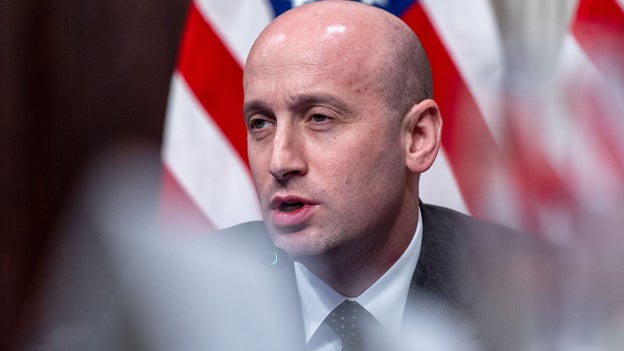
Stephen Miller, the White House deputy chief of staff for policy, argued against allowing the children of illegal immigrants to automatically become American citizens if born in the United States.
In a post on X, Miller noted that Congress has passed laws criminalizing and prohibiting the entry of illegal immigrants into the U.S.
"To say that this same class of excluded foreigners — whose very presence here is a crime — when Congress mandated a physical wall to keep them out — have a legal right to birth American Citizens is the gravest and most preposterous of all constitutional abominations."
Cruz calls for end to birthright citizenship, citing "terrible policy" and misinterpretation
Sen. Ted Cruz, R-Texas, on Wednesday said birthright citizenship needs to end one way or another.
In a series of posts on X, Cruz said the interpretation of the "terrible policy" is interpretation that is at odds with the understanding and intention of everyone involved in the writing and implementation of the Fourteenth Amendment.
"We need to end this policy using whatever vehicle we can, whether that be a constitutional amendment, legislation, executive order, or the courts," he added. "I’ve introduced legislation in the Senate to do exactly that."
Cruz said he filed an amicus brief with the U.S. Supreme Court in which he argued that the arguing that the Fourteenth Amendment does not grant automatic citizenship to children born in the U.S. to parents who are here illegally.
Cruz, as well as Republicans as a whole, have long argued that birthright citizenship has been abused and incentivizes illegal immigration and has created the "birth tourism" industry.
Trump delivers first public reaction after attending birthright citizenship arguments
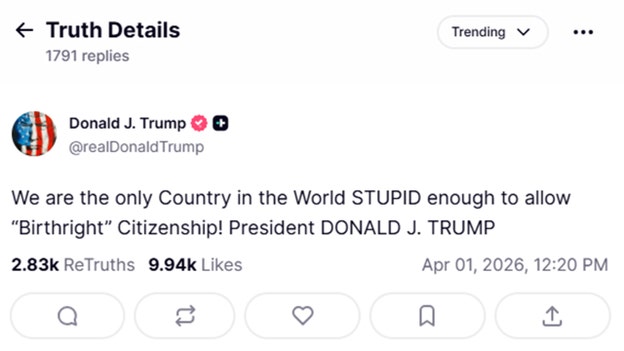
President Donald Trump offered his first public reaction after attending the Supreme Court's oral arguments on birthright citizenship on Wednesday.
"We are the only Country in the World STUPID enough to allow 'Birthright' Citizenship!" Trump wrote in a post on Truth Social.
Justices voiced strong pushback Wednesday against Trump's sweeping efforts to restrict who can be called an American, in a politically divisive case over automatic citizenship for some children born in the United States.
Inside Supreme Court: How Trump reacted during birthright citizenship hearing
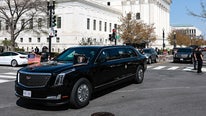
President Donald Trump attended Wednesday's oral arguments for more than an hour, with sources in the room telling Fox News he remained focused on the arguments.
Trump arrived roughly 10 minutes before the session began and stayed through the entirety of Solicitor General John Sauer's argument, which lasted 65 minutes.
Trump then stayed for seven minutes of argument from ACLU legal director Cecillia Wang's reply,
Trump did not speak for the duration, as court rules require. He left without making comment to the press.
When might the Supreme Court rule on Trump birthright citizenship order?
The Supreme Court is expected to issue a ruling on President Trump's effort to limit birthright citizenship before its term ends in late June or early July, after wrapping up oral arguments on Wednesday.
The court does not announce when it will hand down specific opinions.
An expected definitive high court ruling by early summer could have sweeping national implications – and possibly slow momentum – for Trump's get-tough immigration agenda, which has become a defining feature of his second White House term.
Oral arguments wrap in birthright citizenship case
Oral arguments have concluded at the Supreme Court after justices heard Solicitor General John Bauer defend President Donald Trump's executive order ending birthright citizenship for children of illegal immigrants.
Sauer gave a closing statement after ACLU legal director Cecillia Wang argued against the Trump administration's move.
The court is expected to issue a ruling in the case by the end of June.
ACLU lawyer lays out 'two paths to a win'
ACLU legal director Cecillia Wang says her side has "two paths" to victory over President Donald Trump's effort to limit birthright citizenship.
Wang made the statement under questioning from Justice Brett Kavanaugh on Wednesday.
"Last question, though, why would we address the constitutional issue? This is the last one. Why would he address the constitutional issue, given your argument on the statutory? Our usual practice, as you're well aware, of course, is to resolve things on statutory grounds and, and, not to do a constitutional ground," Kavanaugh said.
"Sure. You know, I think we obviously have these two paths to a win here. We're happy to win on either or both of them. I do think it would be prudent for the court to reaffirm its decision in Wong Kim Ark, where it's a landmark decision about the definition of national citizenship in this country. I just think it would be prudent for the court to go ahead and reaffirm that. But of course, we're happy to take a win on any ground," Wang responded.
Jackson says Alito makes 'good' point about Wong Kim Ark case
Justice Ketanji Brown Jackson said her colleague Justice Samuel Alito made a "good" point about the interpretation of U.S. v. Wong Kim Ark on Wednesday.
The point of agreement between the two typically opposed justices came as they were questioning ACLU legal director Cecillia Wang regarding birthright citizenship."
"Can I offer a possible explanation for why, Justice Gray made a point of putting domicile in what he said was the holding of the case," Alito said, referring to Wong Kim Ark. "There were many, many [migrants] who were horribly exploited, brought to the United States to work on the transcontinental railroad, to work in mines. they were worked to death. They were treated horrifically...They were overwhelmingly men. There wasn't an indication that they were-that they would stay here. They could stay here. They didn't have permanent homes. And the and the opinion is drawing a distinction between those two categories of people who would have been well understood at the time when Wong Kim Ark was decided."
"No, Justice Alito, I don't think that's a plausible explanation for why domiciles mentioned in Wong Kim work. Because, again, the controlling rule of decision based on the English common law and cases from schooner exchange to lynch versus clerk to state versus manual, which was the North Carolina decision that said, look, the rule in the United States from independence on has been the English common law rule," Wang said.
"But Miss Wang, isn't that explanation, I take Justice Alito's point, and I think he actually makes a good one in the sense that it could be that Justice Gray emphasized domicile to help the public accept the outcome of this case. You're suggesting that the emphasis on domicile was not a part of the rule, meaning he wasn't saying you had to be like a foreigner who is doing everything they can and who can't be naturalized. But he might have emphasized those facts in this case, precisely because Chinese immigrants were unwanted, precisely because he had to get this out into the public, and people were going to say, whoa, you're saying these people have to this this baby has to be a citizen. And so one could imagine that it was important from a standpoint of helping people accept this citizen rule under these circumstances, to emphasize that these particular people in this case were, in Justice Alito's first category," Jackson said.
"I think that is very possible, Justice Jackson and as evidence of that, I would point to the fact that if you look at the briefing in Wong Kim Ark, you'll see that even though the parties had stipulated in the in the district court that Wong Kim Ark's parents were domiciled in the United States, when the case came to the Supreme Court, the government's brief argued that it was impossible for Chinese immigrants to have domicile because they expressed the view that was common among people who opposed immigration by Chinese nationals to the United States. There was a common view that Chinese people were inherently temporary sojourners in the country. And so I do think it's possible Justice Alito and Justice Jackson, that he was trying to dispel that notion," Wang said.
Trump departs Supreme Court during ACLU arguments
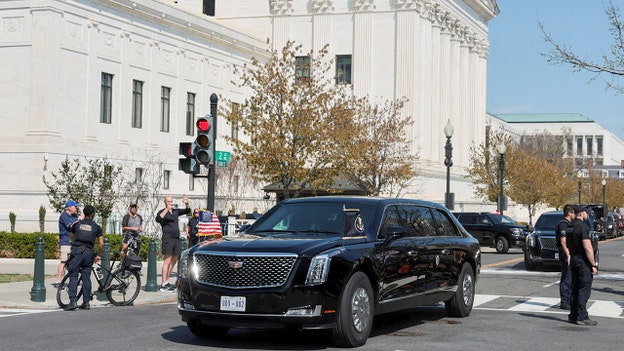
President Donald Trump departed the Supreme Court after listening to more than an hour of oral arguments regarding his executive order blocking birthright citizenship for children of illegal aliens.
Large groups of people crowded the street as he departed the building, shouting both praise and criticism of the president.
Alito challenges ACLU on reading of Wong Kim Ark opinion
Justice Samuel Alito pressed ACLU legal director Cecillia Wang on her reading of U.S. v. Wong Kim Ark, a central case in the birthright citizenship issue.
"I might agree with you if domicile had simply been sprinkled in the opinion, but, in Wong Kim Ark, it's a long opinion, but it begins by saying, here's the question, and it ends by coming back to the question, and it says, here's the question stated at the beginning of the opinion, namely, whether a child born in the United States of parents of Chinese descent who at the time of his birth are subjects of the Emperor of China, but have a permanent domicile and residence in the United States. And or are carrying on business. And he states the diplomatic exception. And he says, for the reasons above stated, this court is of the opinion that the question must be answered in the affirmative," Alito said.
"So why put domicile in? Sometimes it's hard to figure out what is the holding of the case here. He tells us this is the holding of the case. Why put domicile in there? It's just something it's it's something irrelevant that he wanted to throw in. It's like, you know, whether a child born in the United States of parents of Chinese descent who once resided at a particular, address in San Francisco who attempted to enter the country at the port of San Francisco. Why put it in if it's irrelevant?" Alito asked.
"Well, Justice Alito, I'll I can, I'll give you two responses. The first is that, again, it was a stipulated fact. The second is that regardless of what the judgment in the case was, which again, was an [unknown] application of the rule of decision. The rule of decision in Wong Kim Ark has binding precedential effect. Even if you think that Wong Kim Ark decided the case based on the stipulated facts, you have to follow that controlling rule of decision. And if you follow that rule, you get the same result. For people without domicile, one can Mark says, six times in the first parts of the opinion as well as on the page. The government focuses on that domicile is not relevant," Wang responded.
ACLU argues thousands of American babies would lose citizenship under Trump order
ACLU legal director Cecillia Wang has begun her oral argument against President Donald Trump's executive order on birthright citizenship before the Supreme Court.
"Ask any American what our citizenship rule is and they'll tell you everyone born here is a citizen alike," Wang began. "That rule was enshrined in the 14th amendment to put it out of the reach of any government official to destroy."
"When the government tried to strip Mr. Wong Kim Ark's citizenship on largely the same grounds they raised today, this court said no," Wang argued. "Thirty years after ratification, this court held that the 14th Amendment embodies the English common law rule. Virtually everyone born on U.S. soil is subject to its jurisdiction and is a citizen. It excludes only those cloaked with a fiction of extraterritoriality because they are subject to another sovereign's jurisdiction, even when they're in the United States. A close set of exceptions to an otherwise universal rule."
"My friend has now clearly said that the government is not asking you to overrule Wong Kim Ark. That is a fatal concession because Wong Kim Ark's controlling rule of decision precludes their parental domicile requirement. The dissent understood that, and the majority tells us six times in the opinion that domicile is irrelevant under common law. Lynch versus Clark was already the dominant American case on citizenship, and it held that the US born daughter of temporary visitors from Ireland who took the baby back to Ireland with them, that that daughter was a US citizen," she continued.
Jackson highlights 'hurdles' for US arguments
Justice Ketanji Brown Jackson pressed Solicitor General John Sauer about perceived "hurdles" to his arguments on Wednesday.
"Good morning, general. So I guess I am looking at your position in this case, and it boils down to requiring us to do at least these two things. One is believed that the framers were not importing the common law rule and understanding of birthright citizenship. And the second is to believe that what they were doing was departing from that common law rule in the way that you suggest, that is, in the they were seeking to have this turn on domicile. I think you have a number of hurdles to accomplish those two things," Jackson said.
"One of which I think is that when we look at this court's case law and no one I think has mentioned Schooner Exchange. But it appears that that was an 1812 case in which it seems as though the court had already accepted at the time of the ratification of the 14th Amendment, that the allegiance that you were talking about was the English common law rule, that, in other words, allegiance meant, that you are, covered by the laws of the jurisdiction that you can rely on the jurisdictions protection," she continued.
"Now, you're saying today. No, no, allegiance meant something about loyalty or that kind of idea. But if the Supreme Court had, prior to the 14th Amendment, established that allegiance meant the common law definition, I think your first hurdle is to help us understand why we would believe that when the common when the 14th amendment was ratified, the framers weren't just incorporating what we had previously said it meant," she said.
Gorsuch asks if Sauer thinks children of Native Americans are birthright citizens
Solicitor General John Sauer says that Native Americans are birthright citizens to the U.S. under the Trump administration's proposed changes to birthright citizenship.
Sauer made the statement during questioning from Justice Neil Gorsuch.
"Do you think Native Americans today are birthright citizens under your test and of your friends test?" Gorsuch asked.
"I think so. I mean, obviously they've been granted citizenship by statute," Sauer responded.
"Put aside the statute. Do you think they're birthright citizens?" Gorsuch pressed.
"No, I think the clear understanding that everybody agrees in the congressional debates is that the children of tribal Indians are not birthright citizens," Sauer said.
"I understand that's what they said, but your test is the domicile of the parents, and that would be the test you'd have us apply today, right?" Gorsuch responded.
"I think so on our test. Yeah. If they're lawfully domiciled here. Not sure I have to think that through, but but I'll that's my reaction," Sauer said.
Alito says federal officials have not effectively enforced immigration laws
Supreme Court Justice Samuel Alito argued federal officials have failed to effectively enforce immigration laws on Wednesday.
Alito made the point while questioning Solicitor General John Sauer at oral arguments on birthright citizenship.
"Under the minimum definition of domicile, which I think existed in 1868 and continues to exist today, a person's domicile is the place where he or she intends to make a permanent home. Now, normally you would think that a person who is subject to arrest at any time and removal could not establish a domicile. But we have an unusual situation here because our immigration laws have been ineffectively and in some instances, enthusiastically enforced by federal officials," Alito said.
"So, there are people who are subject to removal at any time if they are apprehended and they go through the proper procedures, but they have, in their minds, made a permanent home here and have established roots. And that raises a humanitarian problem. And I wonder if you could you could address that," Alito added.
"If I make one legal and one humanitarian. The legal point is, if you look at those cases, for example, Park, Carson against Reid, Park against Barr, this court's decisions in Elkins and against Moreno, they talk about the legal capacity to, you know, to create a domicile, excluding someone who may have the subjective intent, which otherwise would be determinative as being excluded on the humanitarian point," Sauer responded.
"I would point out, as I said at the beginning, Justice Alito, that the United States rule of nearly unrestricted birthright citizenship is an outlier among modern nations. It's a very small minority of nations that have that rule. For example, every every nation in Europe has a different role in the notion that they have a huge humanitarian crisis, as a result of not having that restricted birthright citizenship, I don't think is a strong argument. And I point out, obviously, for, you know, for reliance related," Sauer added.