Artemis II hits ‘two thirds’ mark on moon journey, shares new lunar photos: ‘History in the making’
Astronauts on the Artemis II mission are over two-thirds of the way to reaching the moon for a flyby mission that will make them Earth’s farthest emissaries and promises views of the moon’s far side.
Coverage for this event has ended.
Crew snaps stunning photo of the Earth appearing tiny ahead of Moon flyby
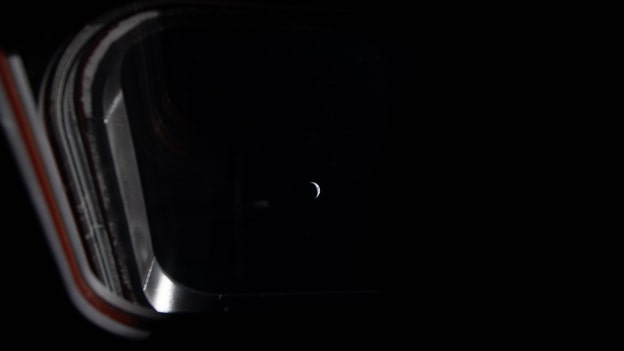
The Artemis II crew snapped a striking photo of Earth appearing tiny from space, just ahead of their expected lunar flyby Monday.
The image, shared by NASA on Sunday, shows only a thin crescent of Earth illuminated through a window of the Orion spacecraft.
“One last look at Earth before we reach the Moon,” NASA said in a post on X.
“This view of the Earth was captured on April 5, the fourth day of the Artemis II mission, from inside the Orion spacecraft. The four astronauts will reach their closest approach of the Moon tomorrow, April 6.”
Artemis II crew to track Apollo sites, scout future landing zones, capture planets during flyby
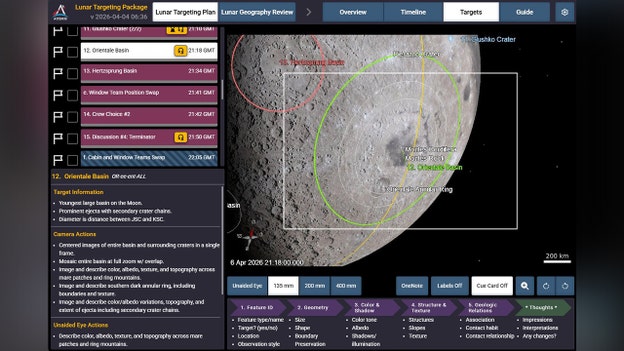
As Artemis II swings around the Moon on Monday, astronauts will track historic Apollo sites, scout future landing zones and capture rare views of nearby planets.
NASA outlined the assignment Sunday during its daily Artemis II mission status briefing at Johnson Space Center in Houston.
“The two Apollo sites they'll be able to see here at the beginning are the Apollo 12 and 14 landing sites as they progress through the several hour period where the moon is illuminated,” Artemis II Lunar Science lead Kelsey Young said.
Young added that the crew will also survey potential landing zones for future missions, including the mysterious Reiner Gamma formation — a bright lunar swirl associated with a localized magnetic anomaly — and the edge of the massive South Pole-Aitken basin, one of the Moon’s largest impact craters.
Astronauts will also search for the “earthshine” phenomenon, when sunlight reflected off Earth casts a faint glow across the Moon’s surface.
In addition, the crew is expected to photograph Mercury, Venus, Mars and Saturn at sunrise and sunset, while also observing a solar eclipse from Orion’s unique vantage point.
NASA reveals mockup of what Artemis II crew will see during 7-hour lunar flyby
A new video offers a preview of what the Artemis II crew is expected to see during their seven-hour lunar flyby on Monday.
NASA shared the 28-second mockup Sunday during its daily Artemis II mission status briefing at Johnson Space Center in Houston.
“This visualization is designed to show you what exactly the Artemis II astronauts will see outside their window during their lunar flyby,” the agency added in a post on X.
The footage, presented from an astronaut’s point of view, depicts the crew flying past a nearly fully lit side of the Moon, then passing behind its dark side before reemerging on the far side.
During this passage, Earth will vanish from the spacecraft’s view for roughly 40 minutes, creating a communications blackout and casting the crew in an eclipse-like darkness.
NASA explained the preview was possible now that the agency has a clearer understanding of the crew’s trajectory and the motion of the solar system during the mission.
“Now that the crew is on the way to the Moon, we finally know exactly which parts of the lunar surface will be sunlit during their closest approach, and dozens of scientists are hard at work in the back rooms of Mission Control in Houston," the agency said.
Crew sends Easter greetings from space in holiday message
The Artemis II crew marked the fifth day of their mission Sunday by sending Easter greetings to Earth.
Mission Specialist Christina Koch said the crew even celebrated the holiday by hiding eggs around the spacecraft, humorously noting that they were of the dehydrated scrambled egg variety.
“We wanted to take a minute to commemorate the holiday that we have at this time of year, something that many religions and many cultures hold dear,” Koch said. “It's a time of emotions such as joy, as well as solemness, honoring what's going on both in our world and in our religious beliefs.”
“We did hide a few eggs around the cabin,” she added. “They were the dehydrated scrambled egg variety, but we were all pretty happy with them.”
Canadian crewmember Jeremy Hansen also shared an Easter message, emphasizing love as a universal value beyond religious differences.
“Happy Easter everyone,” he said. “We're talking up here as a crew and we did want to send a special Easter message on this day and no matter your faith or religion, for me the teachings of Jesus were always a very simple truth of love, universal love.”
Reuters contributed to this report.
Artemis II crew marks Jeremy Hansen’s first flight with gold pin in milestone moment caught on video
Canadian astronaut Jeremy Hansen was honored Sunday by the Artemis II crew with a gold pin commemorating his first spaceflight as the team journeys toward the Moon.
The milestone moment was captured on camera as crewmates gathered around to celebrate, noting the gold pin replaces the silver one Hansen received after completing basic astronaut training.
“We wanted to kick off our Easter Sunday by honoring our crewmate, Jeremy Hansen,” the crew said in the video shared by NASA Artemis on X. “We have a longstanding tradition in the astronaut office of the traditional astronaut pin. And when you fly in space, you change from silver to gold. So, we figured today was the perfect day to honor our friend, Canadian astronaut Jeremy Hansen, with his flown astro pin.”
Hansen, with the Canadian Space Agency, expressed gratitude for those who made the mission possible for him.
“That’s humbling, took a lot of people to make this little representation that we have in the office, this tradition, come to reality for me,” he said. “So a lot of gratitude for all those people. This is a pretty special experience. Thanks for doing this guys.”
NASA chief Jared Isaacman says Artemis II would not be possible 'if it wasn't for President Trump'
NASA Administrator Jared Isaacman said the success of the historic Artemis II mission currently underway would not be possible "if it wasn't for President Trump," as the Orion spacecraft is set to pass beyond the far side of the Moon in the next 24 hours.
Isaacman detailed the mission’s progress, how technology has assisted in the success of Artemis II so far, and the role that President Donald Trump has played in the Artemis program during an interview with Fox News Digital.
"I want to be incredibly clear, we would not be at this moment right now with Artemis II if it wasn't for President Trump," Isaacman told Fox. "And we certainly would not have an achievable path now to get back to the lunar surface and build that enduring presence."
"On my first day on the job during President Trump's second term, he gave us a national space policy, a mandate to go to the moon with frequency, build the moon base, and do the other things like nuclear power and propulsion so someday American astronauts can plant the stars and stripes on Mars," Isaacman added.
This is an excerpt of an article by Fox News Digital’s Preston Mizell.
What happens during brief communication blackout when Artemis II flies behind the moon?
The Artemis II crew aboard the Orion capsule will lose contact with NASA’s Mission Control for nearly an hour as the spacecraft passes behind the dark side of the moon.
NASA is relying on its Deep Space Network to communicate with the crew, but the giant antennas in California, Spain and Australia won’t have a direct line of sight when Orion disappears behind the moon for approximately 40 minutes.
These communication blackouts also happened during the Apollo moonshots decades ago — a tense time for Mission Control.
Artemis flight director Judd Frieling noted, however, that science will see them through.
Frieling said that “physics takes over and physics will absolutely get us back to the front side of the moon.”
The Associated Press contributed to this report.
What to know about the solar eclipse during the Artemis II mission
The Artemis II crew will see a total solar eclipse during their journey to the moon.
While the eclipse won’t be visible from Earth, the astronauts aboard the Orion capsule will be treated to several minutes’ worth of views of the sun's outermost, radiating atmosphere, the corona.
NASA geologist Kelsey Young said the astronauts will be on the lookout for any unusual solar activity during the eclipse and will use their “unique vantage point” to describe the features of the solar corona, or crown.
To protect their eyes as they study and capture the solar views, NASA said all four astronauts brought eclipse glasses on the mission.
The Associated Press contributed to this report.
Artemis II crew shares stunning photos of Earth from space: 'There are no words'
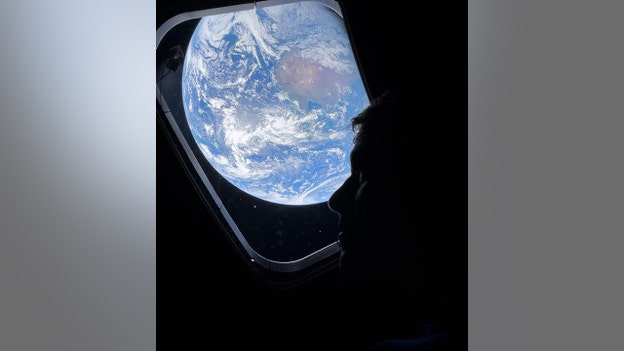
The Artemis II crew on Saturday shared stunning photos of planet Earth they’ve taken en route to the moon.
Artemis II Commander Reid Wiseman is pictured peering out of one of the Orion spacecraft's main cabin windows, looking back at Earth.
“There are no words,” Wiseman captioned the photo in a post on X.
The photo was taken on April 2 during the crew’s second day of spaceflight.
NASA has also shared a link to its multimedia library which it says will contain the latest imagery from the mission.
Artemis II astronauts face toilet trouble as they head toward the moon
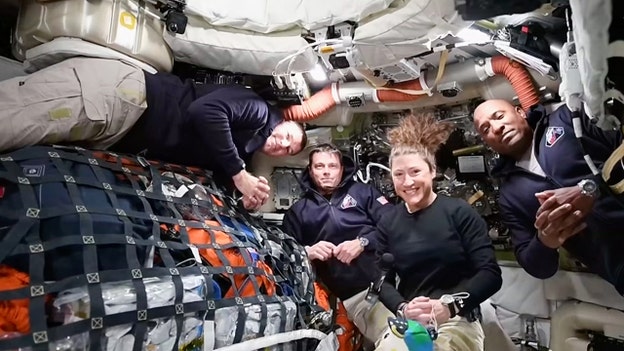
The four astronauts on the Artemis II mission are more than halfway to the moon after launching Wednesday from Kennedy Space Center, but a familiar problem has surfaced.
For the second time since launch, Orion’s toilet is malfunctioning. "During the night, we tried to vent the wastewater tank that's attached to the toilet.
We had problems with that, due to suspected blockage we think probably due to ice. So we directed the crew overnight to use their collapsible contingency urine devices," Judd Frieling, the Artemis II flight director, explained during a news conference Saturday.
The astronauts encountered a similar problem with the toilet on the first day of their mission.
The ship's lunar loo malfunctioned following liftoff and has remained a lingering issue.
Debbie Korth, NASA’s Orion program deputy manager, said the toilet is still operable.
"You know, this is a test flight. We're figuring out how these systems work together, but it is operable, and we have redundancy to get us through the mission," she said.
The toilet, NASA confirmed, is still available for astronauts to use for solid waste.
This is an excerpt from an article by Fox News Digital’s Michael Sinkewicz.
Astronauts capture new image of moon's Orientale basin: ‘First time … seen with human eyes’
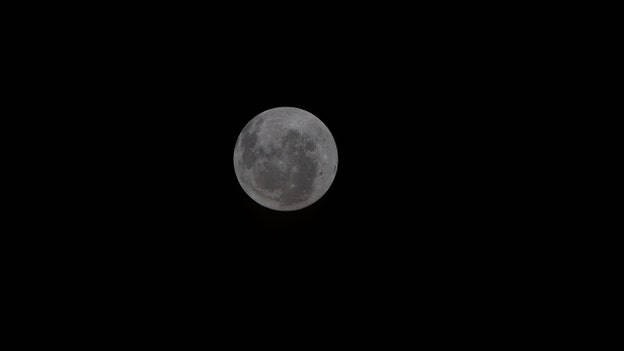
NASA has shared a new image of the moon taken during the Artemis II mission.
The picture, taken by the Artemis II crew, shows new details of the moon's Orientale basin, according to the space agency.
“In this new image from our @NASAArtemis II crew, you can see Orientale basin on the right edge of the lunar disk,” NASA wrote early Sunday. “This mission marks the first time the entire basin has been seen with human eyes.”
NASA added: “History in the making.”
When the crew embarks on its lunar flyby, the astronauts will split into pairs and take turns capturing the lunar views out their windows with cameras.
NASA geologist Kelsey Young previously said that the astronauts will be able make out “definite chunks of the far side that have never been seen” by humans, including a good portion of Orientale Basin.
The crew will use a suite of professional-quality cameras aboard, though each astronaut also has an iPhone for more informal, spur-of-the-minute picture-taking.
“They’ve practiced for many, many, many months on visualizations of the moon,” Young said over the weekend, “and getting their eyes on the real thing, I’m really, really looking forward to them bringing the moon a little closer to home on Monday.”
The Associated Press contributed to this report.
Artemis II astronauts ‘two thirds’ of the way to moon, NASA says
Artemis II has now completed two-thirds of its journey to moon to complete a lunar flyby mission, NASA said.
The space agency announced the astronauts reached the milestone in a social media post Saturday night.
At the time of the announcement, NASA said the spacecraft had traveled 187,633 miles from Earth, with 93,890 miles still to go before reaching the moon.
"During Flight Day 4, the astronauts aboard Orion went over plans to study the Moon during their upcoming lunar flyby and are currently practicing manually controlling the spacecraft,” NASA Artemis said in the announcement on social media.
Video in the post showed astronauts working aboard the spacecraft.
Live Coverage begins here