







Trump says he was 'testing' NATO allies after Iran operation, says Italy, Germany and France turned him down
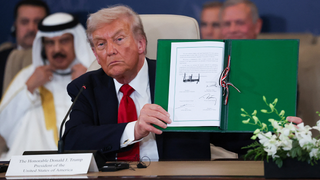
President Donald Trump said during a bilateral meeting with Turkish President Recep Tayyip Erdogan that he was "testing" NATO allies after the U.S. operation against Iran, naming which European countries let him down.
As President Donald Trump heads to Ankara, Turkey, for the upcoming NATO summit, Turkish President Recep Tayyip Erdoğan is again at the center of alliance politics.
Trump has praised Erdoğan as "a friend" and "a respected leader," underscoring a relationship that could shape defense talks between Washington and Turkey, including Turkey’s long-running effort to restore deeper military cooperation.
The moment highlights the remarkable position Erdoğan occupies today: Once regarded as one of NATO’s most troublesome allies after taking delivery of the Russian S-400 missile defense system in 2019, Turkey has become increasingly difficult for the alliance to sideline as the war in Ukraine drags on, instability grips the Middle East and the Black Sea grows more strategic.
For many, however, Erdoğan remains an enigma. Rather than being driven by a fixed worldview, experts argue, Erdoğan repeatedly has reinvented himself politically, adopting whichever ideology best serves his overriding objective: remaining in power.
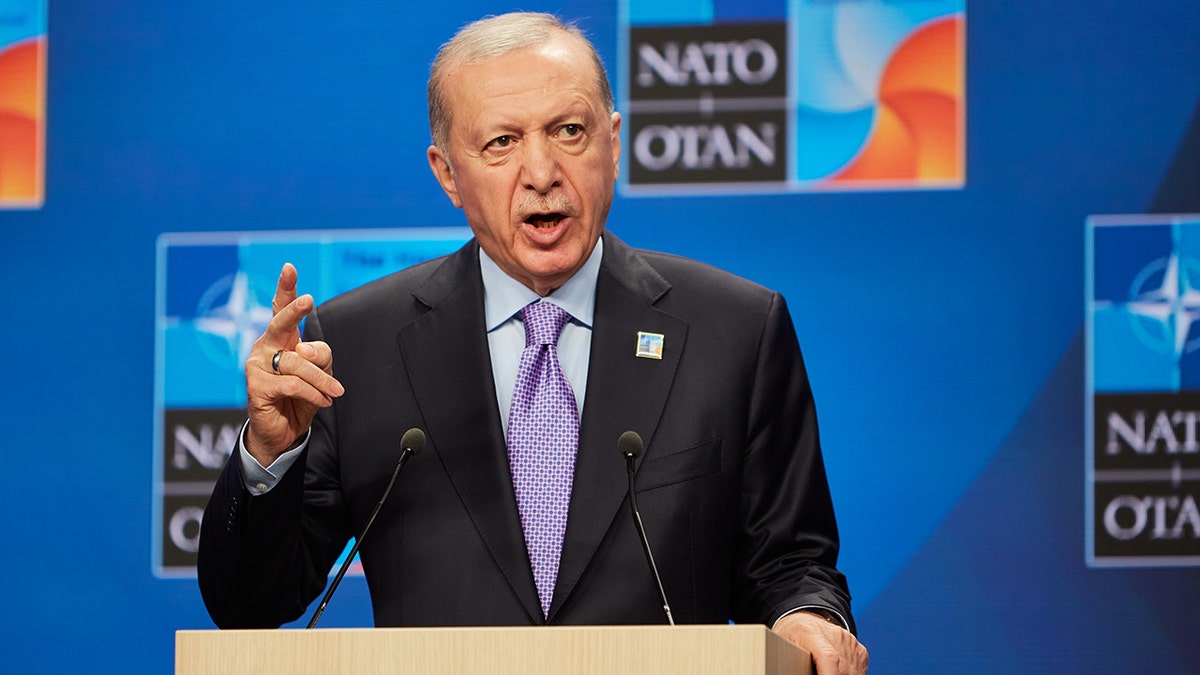
As President Donald Trump heads to Ankara, Turkey, for the upcoming NATO summit, Turkish President Recep Tayyip Erdoğan is again at the center of alliance politics. (Pierre Crom/Getty Images)
Erdoğan has ruled Turkey for more than two decades, evolving from an Istanbul mayor with Islamist roots into a pro-European reformer, then a nationalist strongman, and now a pivotal NATO power broker courted by Trump.
To supporters, he restored Turkey's global stature. To critics, he hollowed out its democracy while jailing rivals, journalists and activists. But Erdoğan's most defining trait, experts say, may be less ideology than survival.
Is he an Islamist? A nationalist? A Western ally? A Russian partner? An authoritarian?
Perhaps the most important thing to understand about Erdoğan is that he has been all of those things — at different moments, according to Gönül Tol, founding director of the Middle East Institute's Turkey Program and author of "Erdoğan's War: A Strongman's Struggle at Home and in Syria."
"He's not an ideological man," Tol told Fox News Digital. "He's very pragmatic, first and foremost a populist."
SIX KURDISH FIGHTERS KILLED IN IRGC AMBUSH AS CLASHES SPREAD ACROSS WESTERN IRAN
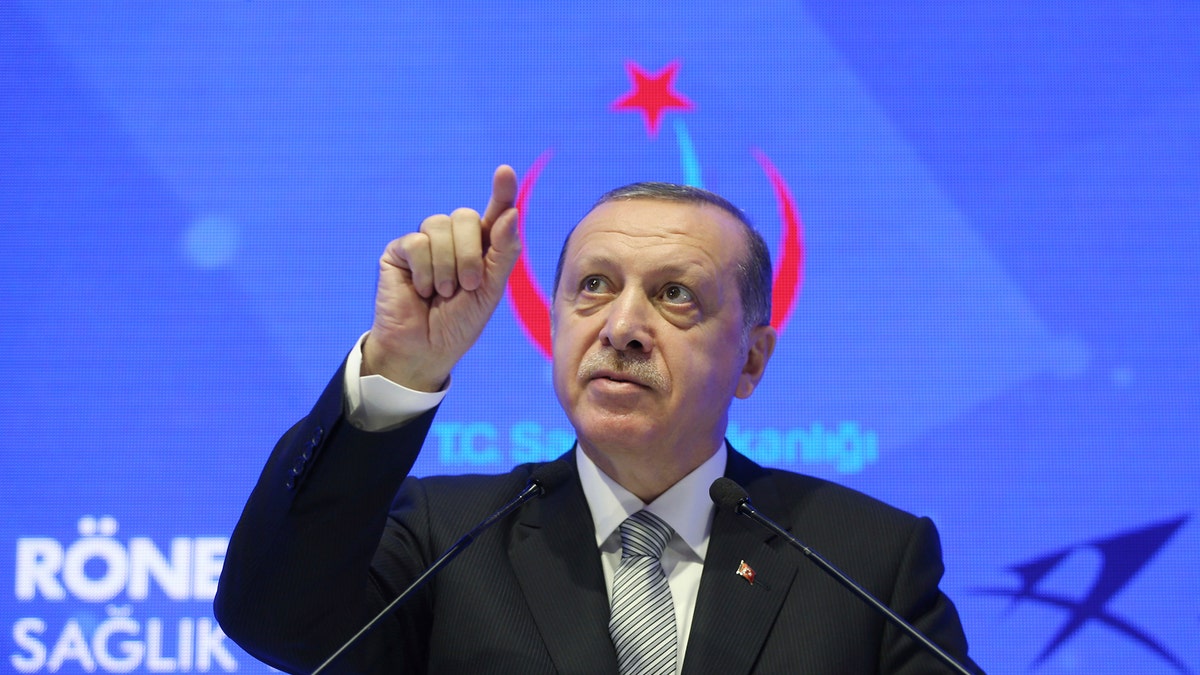
Turkish President Recep Tayyip Erdoğan remains an enigma for many. (AP)
Is Erdoğan a Conservative Democrat?
Erdoğan’s roots lie in Turkey’s Islamist political movement. Educated at an Imam Hatip religious school, he entered politics through National Outlook, a right-wing Islamist movement founded by Necmettin Erbakan, and eventually became mayor of Istanbul as a member of Erbakan’s Welfare Party.
But after founding the AKP, or Justice and Development Party, in 2001, Erdoğan abandoned the Islamist label, presenting himself instead as a "conservative democrat" committed to economic reform and closer ties with Europe — a shift that experts say marked the first of several political reinventions.
When Erdoğan and his Justice and Development Party first swept to power in 2002, Turkey was seeking membership in the European Union, military influence over politics was shrinking, and Erdoğan promised democratic reforms, economic modernization and closer ties with the West.
Many liberals and centrists initially supported him.
"He often said, 'I'm not an Islamist anymore. I'm a conservative democrat,'" Tol said. "And that brand really served him well."
Those early years transformed both Turkey's economy and Erdoğan's popularity.
TRUMP BETS ON FORMER NATO TROUBLEMAKER AS TURKEY'S STRATEGIC VALUE SURGES
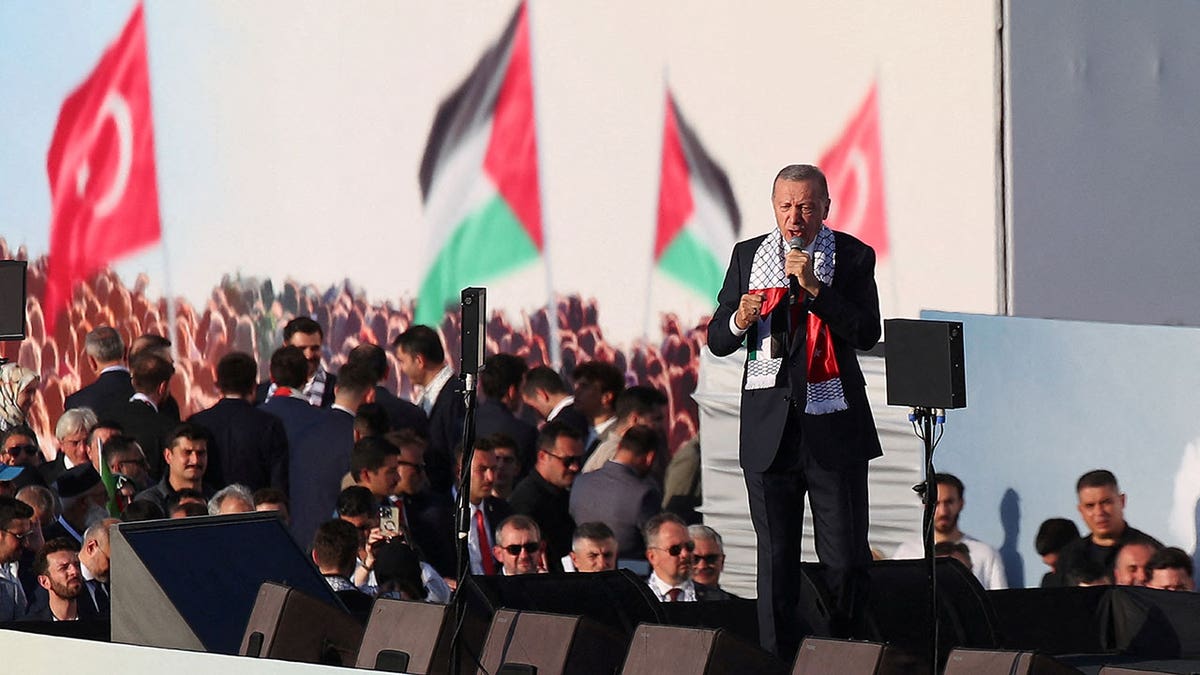
Many liberals and centrists initially supported Turkish President Tayyip Erdoğan. (Dilara Senkaya/Reuters)
Erdoğan backed Islamist movements
After consolidating power, Erdoğan began another political transformation.
Following the Arab Spring in 2011, he increasingly portrayed himself as a champion of political Islam, backing Islamist movements across the Middle East while presenting himself domestically as the defender of Turkey's conservative religious majority.
"He wanted to inject more Islam into public life, into education," Tol said. "He was using this more Islamist narrative... the goal was always to acquire more power."
That anti-Western turn went beyond rhetoric.
In 2016, Erdoğan accused the U.S.-led coalition of supporting terrorist groups in Syria, including ISIS and Kurdish militias that Turkey considers terrorist organizations— an allegation the State Department dismissed as "ludicrous," according to Reuters.
His increasingly vocal support for Hamas and sharp criticism of Israel became defining features of his foreign policy.
"The perpetrators of the massacre and the destruction taking place in Gaza are those providing unlimited support for Israel," Erdoğan said in 2023, adding that Israel's attacks and those backing them amounted to "murder and mental illness," according to Reuters.
Tol cautions against viewing those positions alone as evidence that Erdoğan remains primarily motivated by Islamism.
"Anti-Israel sentiment cuts across ideological lines in Turkey," she said, arguing that Erdoğan's foreign policy has consistently reflected political calculation more than religious doctrine.
TRUMP'S TURKEY ARMS SALE PROPOSAL SPARKS CONGRESSIONAL QUESTIONS BEFORE NATO SUMMIT
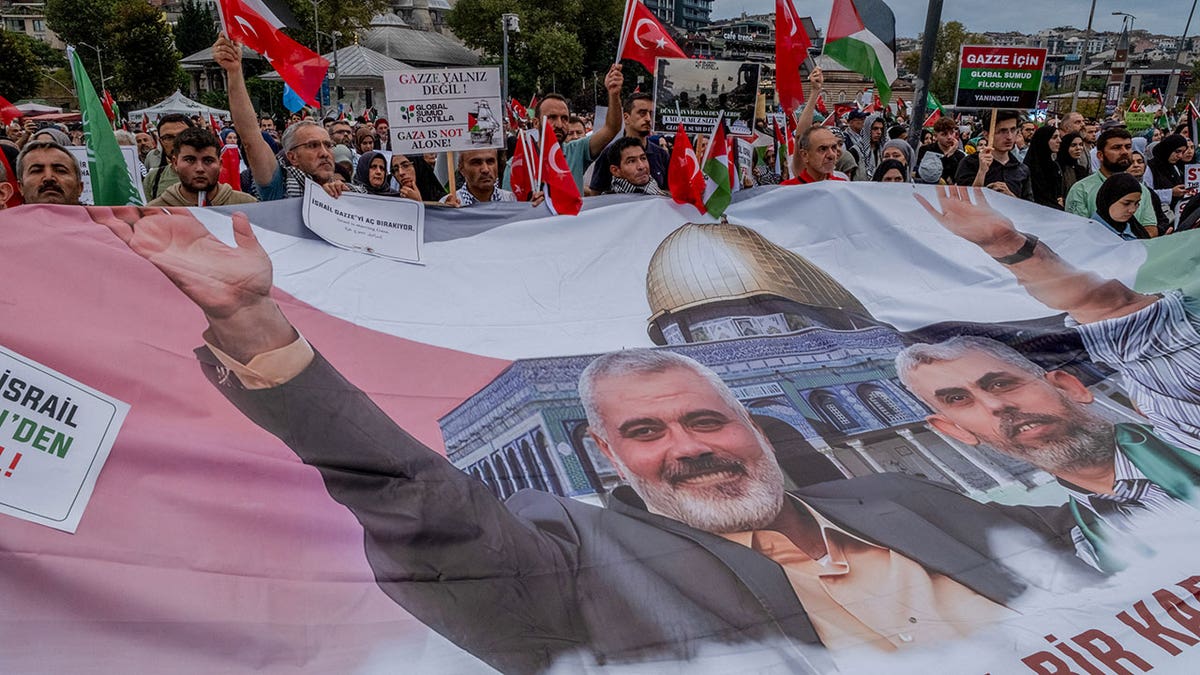
Protesters carry a banner with pictures of the slain Hamas leaders Ismail Haniyeh and Yahya Sinwar. (Murat Kocabas/SOPA Images/LightRocket via Getty Images)
Erdoğan’s rise as a nationalist leader
As Turkey's economy slowed and regional ambitions faltered, Erdoğan pivoted once again.
He embraced Turkish nationalism, built alliances with hardline nationalist parties and cultivated the image of an indispensable strongman capable of restoring Turkey's historical influence.
Supporters credit him with transforming Turkey into a regional power.
"He does have genuine support," Tol said, estimating his support at roughly 35%.
Some supporters depend on government assistance and patronage networks built under his rule. Others believe Erdoğan restored dignity to conservative religious Turks who long felt marginalized by the country's secular establishment.
Still others view his increasingly assertive foreign policy as proof Turkey has reclaimed its place on the world stage.
"They think, 'We have become a world-class nation,'" Tol said. "'Everyone is praising our president. Turkey is a big player.'"
While Erdoğan continues to command a loyal political base, critics say the price has been Turkey's democratic institutions.
Authorities increasingly have used courts and criminal investigations to sideline political opponents, including Istanbul Mayor Ekrem İmamoğlu, whose arrest earlier in 2026 triggered nationwide demonstrations, according to Human Rights Watch.
The organization says the government has intensified efforts to weaken Turkey's main opposition party despite its strong performance in the 2024 municipal elections.
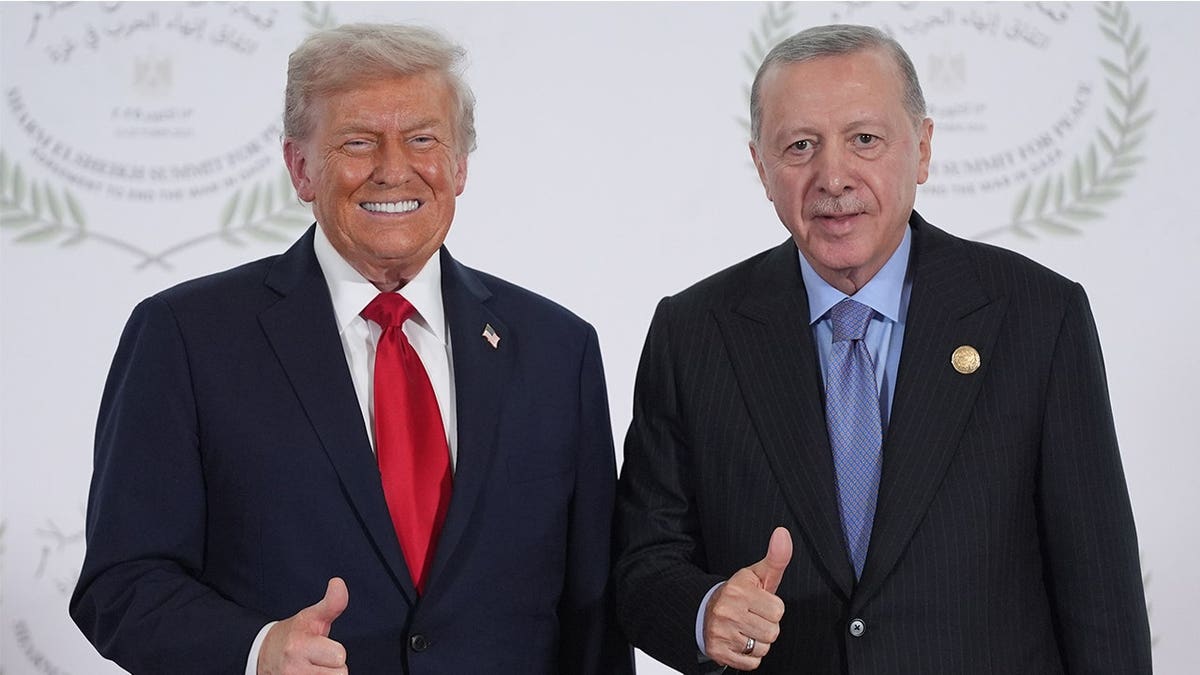
President Donald Trump greets Turkey's President Recep Tayyip Erdogan during a summit to support ending the war in Gaza, Oct. 13, 2025, in Sharm El Sheikh, Egypt. (Evan Vucci AP Photo/ Pool)
How Erdoğan uses Turkey’s NATO leverage
Today, Erdoğan finds himself in another political transformation.
After years of anti-Western rhetoric and disputes with Washington, Turkey has worked to repair relations with the United States and Europe.
That rhetoric was once central to Erdoğan's posture.
He accused the U.S.-led coalition in Syria of supporting terrorist groups, blasted Washington's sanctions over Turkey's purchase of the Russian S-400 missile defense system, calling them a "hostile attack" on Turkey's sovereign rights and defense industry, and repeatedly accused Western governments of enabling Israel's war in Gaza.
The shift comes as Turkey's strategic importance has grown dramatically.
The S-400 purchase remains at the center of one of the biggest unresolved disputes between Washington and Ankara. After Turkey took delivery of the Russian system in 2019, the U.S. expelled Turkey from the F-35 fighter jet program and later imposed sanctions on Turkey's defense procurement agency.
Former U.S. Ambassador to Turkey James Jeffrey recently told Fox News Digital that restoring Turkey to the F-35 program remains far more complicated than other defense deals because operating the Russian-made S-400 alongside America's most advanced stealth fighter could expose sensitive U.S. technology.
"The F-35 is a different issue," Jeffrey said, arguing that the problem is technical, not merely political.
Turkey controls the Bosporus and Dardanelles, fields NATO's second-largest military and plays a critical role in the Black Sea following Russia's invasion of Ukraine.
Jeffrey said that Turkey has been "essential to Ukraine staying in the fight," pointing to Turkey's enforcement of the Montreux Convention, a 1936 treaty that gives Turkey control over naval passage through the Bosporus and Dardanelles straits, its early delivery of Bayraktar drones to Ukraine, and its role as a mediator between Kyiv and Moscow.
"You can't contain Russia in the Black Sea without Turkey," Jeffrey said.
For Tol, however, Erdoğan's latest embrace of NATO is simply another example of his political flexibility.
"There was a time when he was very anti-Western, very critical of NATO, very critical of the United States," she said.
"And now look at him."
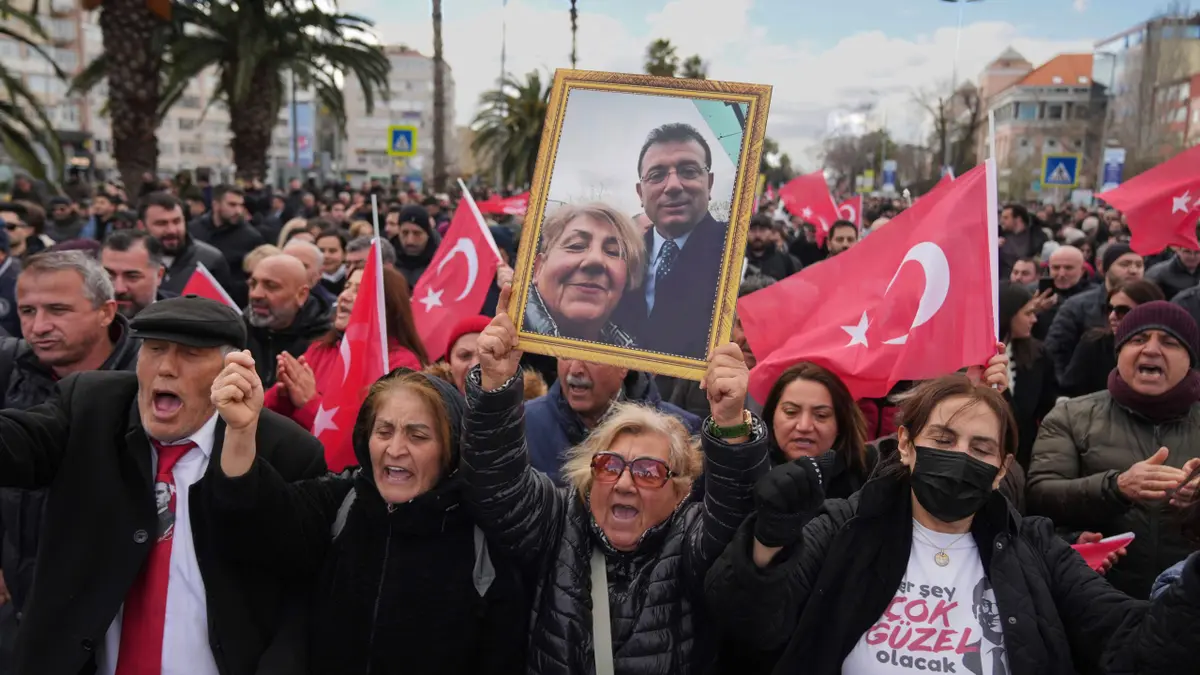
People chant slogans as they protest the arrest of Mayor Ekrem Imamoglu in Istanbul, Turkey, March 19, 2025. (Francisco Seco/The Associated Press )
Why is Erdoğan facing growing criticism
Human Rights Watch argues Erdoğan has used Turkey's growing importance to NATO as political cover while expanding pressure on journalists, activists and opposition figures.
Freedom House says Erdoğan has become "increasingly authoritarian" over the past decade, consolidating power through constitutional changes and the imprisonment of political opponents, independent journalists and civil society figures.
Turkey's prisons held more than 420,000 inmates — far exceeding their official capacity of roughly 304,000, according to a June 2026 report citing Turkish Justice Ministry figures.
NATO allies have grown quieter on Turkey's rights record as Ankara's strategic value has risen, Reuters reported ahead of the summit, with former U.S. Ambassador David Satterfield saying it remains important for the West to speak publicly about the "degradation of democratic institutions in Turkey."
Tol believes Erdoğan's domestic agenda can be understood through a single principle.
CLICK HERE TO DOWNLOAD THE FOX NEWS APP
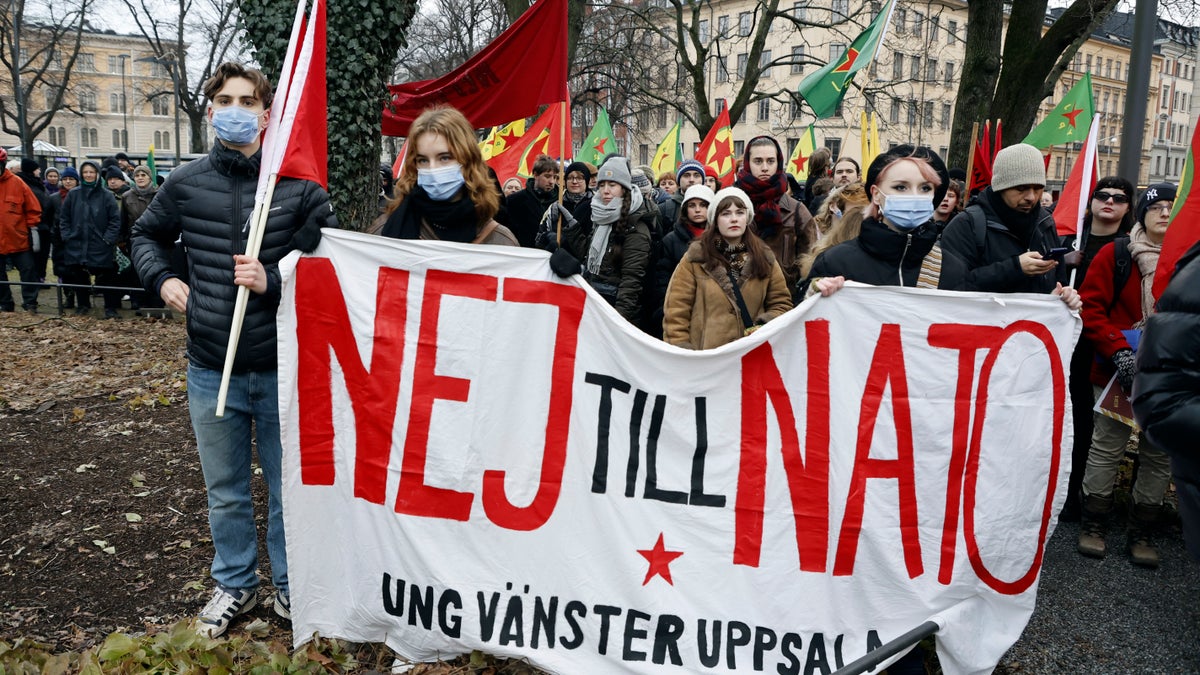
People take part in a demonstration against Turkish President Recep Tayyip Erdogan and Sweden's NATO bid arranged by The Kurdish Democratic Society Center in Sweden, in Stockholm, Jan. 21. 2023. (Christine Olsson/TT via AP)
"Everything is designed to keep him in power," she said. "Beyond that, I don't see a binding ideology that brings together all his policies."
As Trump heads to Turkey, that may be the key to understanding one of NATO's most consequential — and unpredictable — leaders.
Fox News Digital reached out to the Turkish government for comment.
Fox News Digital's Morgan Phillips and Reuters contributed to this report.
