



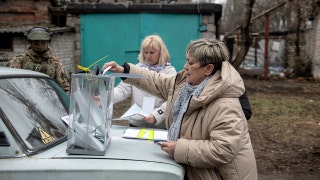





GENEVA – Sudan's government is blocking aid workers from entering the country before next month's referendum on independence for the south, a vote that could result in violent unrest if it isn't respected by all sides, the U.N.'s human rights chief said Thursday.
Human rights observers and aid workers need to be in place before Jan. 9 to prepare for possible unrest if the vote ends up splitting Africa's largest country in two, U.N. High Commissioner for Human Rights Navi Pillay told The Associated Press.
"There's a huge holdup of visas, almost 1,000," Pillay said in a wide-ranging interview at her Geneva office. "It just seems deliberate, this holdup on visas. I hope the Secretary-General (Ban Ki-moon) will address this directly with the government."
"It will really hamper human rights and humanitarian work if we're not there on the ground in time," she said. "All the U.N. agencies on the ground have to plan for some calamitous situation to erupt if the outcome of the referendum is not respected."
An official who answered the phone at Sudan's mission in Geneva described claims of a delay in issuing visas as "baseless." The woman, who gave her name as Naima Lazaar, said senior embassy officials were unavailable to discuss Pillay's claim.
The former South African judge said her own request for a visit to Sudan earlier this month was ignored by the government, which has blocked U.N. investigators from traveling to the country on several previous occasions.
Pillay called on Khartoum's allies, including members of the Organization of the Islamic Conference and China, to lean on Sudanese President Omar al-Bashir to respect human rights. Pressure from countries with heavy economic interests in South Africa had been key to ending the apartheid system there, she said.
Pillay cited her inability to visit Sudan as an example of the limitations of her role as the U.N.'s top human rights official. Since being appointed to the post in 2008, she has frequently found herself at the center of a three-way battle between governments, the U.N. and human rights groups.
In one infamous incident, Iranian President Mahmoud Ahmadinejad prompted a walkout by European diplomats with an inflammatory speech during a flagship U.N. anti-racism conference in 2009.
"I was a bit naive," Pillay said.
"I wondered why people were so afraid that he would use it as a political platform, but I see that they were right," she said. "I think that it was pretty evident to everyone that it is an inappropriate speech to make at that venue."
Ahmadinejad used his speech to deliver an angry diatribe against Israel, calling it the most "cruel and repressive racist regime." European delegates left the room and the entire event was tainted. U.S. and Israeli diplomats had boycotted the conference from the start.
Pillay said she is hopeful that Iran's government will receive her before the end of her term in 2012, despite her frequent criticism of human rights abuses in the country, including executions of minors, discrimination against women and restrictions on free speech.
The right to speak out about abuses is fundamental, she insisted, bringing up a theme that has prompted her to slam both China — over the imprisonment of Nobel winner Liu Xiaobo — and the United States in recent weeks.
In October, Pillay urged the U.S. and Iraq to investigate allegations of detainee abuse contained in leaked American war logs. "The whole WikiLeaks situation must be seen through the lens of freedom of expression," she said.
"Some of the code cables released by WikiLeaks disclose that the United States was aware that the Iraqis were perpetrating torture," she added. "If people are sitting with information of serious crimes being committed, that has to come out, so that we can address it. There are victims suffering and my job is to protect their rights."
