


JOHANNESBURG – When Africans send in troops to force solutions to political crises, it can be messy, dangerous and unpredictable — and demand cash and expertise most countries on this impoverished continent don't have.
And they can leave behind decidedly mixed feelings.
Morris Nimely was a child when West African armies came to his native Liberia in 1990, to keep warlord Charles Taylor from seizing the capital. They returned in 2003 as peacekeepers.
"Yes, they intervened to stop the advance of Charles Taylor's rebels," said Nimely, a university student majoring in sociology. "But the troops, or at least the vast majority of them, did not exercise caution and civility in dealing with the civilian population here."
Last month, West African governments threatened to dispatch commandos to Ivory Coast to remove incumbent leader Laurent Gbagbo, who has refused to step aside for the man who the international community says won the presidential election. Gbagbo's militant supporters have threatened to attack any African troops who might intervene. Already, attacks have been reported against U.N. peacekeepers who have been in the country since 2007 in the wake of a previous political crisis.
John Campbell, an Africa expert with the New York-based Council on Foreign Relations, said Western governments want to avoid taking the lead for fear of being accused of having neocolonial motives. But he said it's not always clear the governments and citizens being aided see intervention by other Africans as more welcome.
Military intervention in Ivory Coast "could set off a real bloodbath," Campbell said.
In 1998, West African armies forced military junta leaders to flee Sierra Leone, allowing an elected president to return to power. The troops from neighboring countries stayed until 2000, when a U.N. peacekeeping mission took over.
Julius Spencer, Sierra Leone's former minister of information said that in the early stages, the African force in his country was disorganized and ineffective, and needed Western support before it could be constructive. But without it, he said, "Sierra Leone would probably have been a failed State."
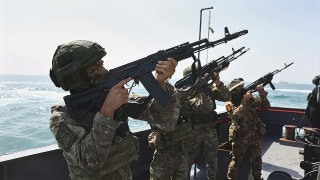
Today, Africans are doing duty as peacekeepers in places with little peace to keep. An African Union force first deployed to chaotic Somalia in 2007 now comprises some 6,000 Ugandans and Burundians.
Insurgents linked to al-Qaida have confined Somalia's U.N-backed government and the cash-strapped African troops into a few blocks of the capital. Uganda has paid dearly for participating — the insurgent group al-Shabab claimed responsibility for twin bombings in Uganda's capital as crowds gathered to watch the World Cup soccer final on television. Al-Shabab says the July blasts that killed 76 were retaliation for Ugandan troops' participation in the Somalia mission, and promised more attacks.
The U.S. sent troops to Somalia in the early 1990s but withdrew shortly after a military battle chronicled in the book and movie "Black Hawk Down," and has balked at returning.
As democracy takes hold and their economies improve, increasingly self-confident African governments have pledged to find solutions themselves to their continent's troubles. That has been embraced by the West.
Jennifer Cooke, director of the Africa program at the Washington-based Center for Strategic and International Studies, said the West, reluctant and often seeing little strategic reason to intervene in Africa, are pushing Africans to do so instead. She questioned the wisdom of the often poor and poorly trained armies of the world's least developed continent being sent into situations where even the best equipped and most experienced peacekeeping operation might stumble.
A 2003 uprising by Sudan's Darfuri ethnic Africans protesting neglect by the Arab-dominated central government provoked a savage response some have likened to genocide. An African Union mission deployed to Darfur in 2004 to monitor a shaky cease-fire was unable to quell violence. The next year, a U.N. mission was established to bolster the Africans, and the mandate was expanded to include providing humanitarian and demining help, protecting human rights and overseeing the return of refugees.
In a recent review of U.N.-African cooperation on peacekeeping, U.N. Secretary-General Ban Ki-moon said the challenge was finding "more planned, consistent and reliable arrangements" for funding and managing African efforts. But he praised the continent for coming "a long way in defining and refining its peace and security architecture since the end of the Cold War, and has been playing a fundamental role in promoting peace and security."
Since the end of the Cold War — when the continent was a proxy battleground for the Soviet Union and the West — African spending on weapons, training soldiers and other military needs rose 70 percent, according to the Stockholm International Peace Research Institute. The bulk of the increase was in the last decade.
Olawale Ismail, a Stockholm International Peace Research Institute expert Africa expert, said increased spending was necessary to make African armies more professional and effective. In Nigeria, for example, Ismail said military rulers starved the army in hopes of warding off countercoups, while civilian leaders who took over only in the last decade have tried to keep soldiers in their barracks by ensuring they had adequate salaries, training and equipment.
Nigeria, with its large military that includes special forces, would be key if Ivory Coast's neighbors were to intervene.
Nearly 9,000 U.N. peacekeepers — including African troops as well as forces from Bangladesh, France and Poland — are in Ivory Coast now, deployed there in 2004 to monitor a cease-fire in a north-south civil war. They have not been a force amid rising violence following the contested November elections.
The economy of Ivory Coast, the world's largest cocoa producer, was destroyed by a 2002-3 civil war, and now a new civil war is feared. Africans struggling to overcome poverty know investment and development can't take place without security.
"It's not as simplistic as the old guns or butter debate," said Deepayan Basu Ray of the development and aid group Oxfam.
Oxfam worked with the Stockholm International Peace Research Institute, widely recognized as having among the world's most comprehensive databases on global military spending, to assess whether there is a trade-off. They did find conclusively that military spending was increased at the expense of health or education. But they were concerned by other problems, including corruption, little or no public oversight on military expenditures, and increased national debt because military spending for poor countries often is funded by borrowing.
When it comes to peacekeeping, the U.S., Europe and the U.N. usually pay for African operations. The West also has paid to train African peacekeepers. But Africa expert Cooke said training and other support programs are relatively new, and will take time to have effect.
____
Associated Press writers Jonathan Paye-Layleh in Monrovia, Liberia and Clarence Roy-Macaulay in Freetown, Sierra Leone contributed to this report.
