


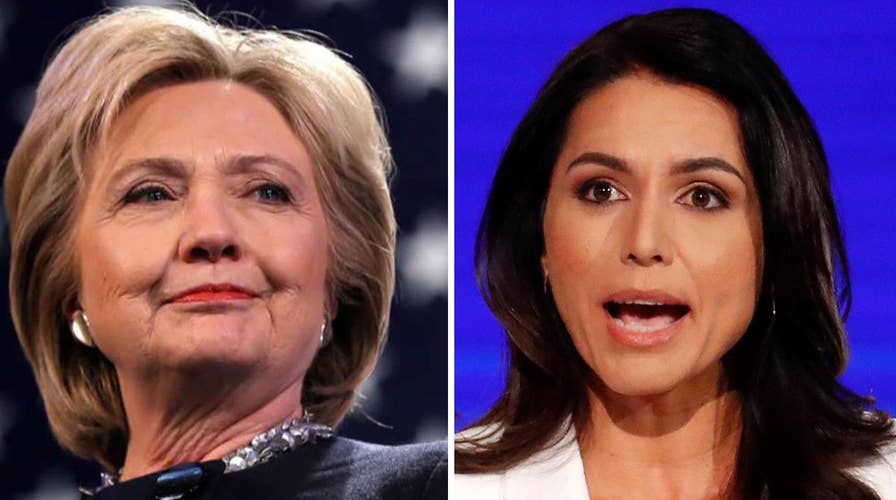
Tulsi Gabbard, Hillary Clinton clash over 'Russian asset' accusation
Reaction and analysis from Fox News correspondent-at-large Geraldo Rivera and former Schumer aide Chris Hahn.
This is a rush transcript from "The Story," October 22, 2019. This copy may not be in its final form and may be updated.
MARTHA MACCALLUM, ANCHOR: Hello there, Bret. Good to see you back in New York, as usual -- his week anyway. Good evening, everybody. I'm Martha MacCallum and this is “The Story.”
Breaking just moments ago, a little story quick one for you here at the top. A battle brewing as the NBA gets ready to tip-off tonight. The NBA- China story is exploding as Shaq comes out tonight and stands by Daryl Morey and stands by Hong Kong.
(BEGIN VIDEO CLIP)
SHAQUILLE O'NEAL, FORMER PROFESSIONAL AMERICAN BASKETBALL PLAYER: Daryl Morey was right. Whenever you see something wrong going on anywhere in the world, you should have the right to say that's not right and that's what he did.
(END VIDEO CLIP)
MACCALLUM: So, Twitter is exploding over this as they say and that others appeared to sort of stay on China's side a bit in that conversation at the table. But we're still getting in those comments. So, we'll bring you more as we get it.
And back to our top story tonight coming out of Washington is the impeachment probe out of step with sentiment in some of the swing states, with just 12 months to go before the election.
We've seen national polls that show a majority leaning towards impeachment. But take a look at this. In Pennsylvania, Michigan, Florida, North Carolina, Wisconsin, and Arizona, 53 percent say that they do not want to see the president impeached.
Then, another indicator out there is the big money that's pouring into the Trump campaign which has now raised $165 million that's the campaign alone, not RNC.
So, that's why we're comparing it as apples and apples with what Biden has raised -- Warren has raised. $60 million for Biden, $52 million for Warren, and $38 million for Pete Buttigieg. Be kind of those numbers right (INAUDIBLE) on the screen, probably better than I do at this moment.
All right, so, tonight, Congressman John Ratcliffe, who was one of the questioners in today's round of the impeachment hearings, joins us. Also, hear, General Petraeus, he will talk about whether the president may be shifting his thinking on the huge question of what to do in Syria.
Also joining me, George Papadopoulos, he was at the center of the origins of the Russia probe. He says that the Durham investigation may have James Clapper and John Brennan, laying a bit low on that topic right now. We're going to see what he has to say about that.
But first, tonight reports that the closed-door testimony of our top diplomat in Ukraine elicited quote, sighs, and gasps from some of the people who were in that hearing room. Democrats say that the testimony represented the most damning that they have heard.
(BEGIN VIDEO CLIP)
REP. ANDY LEVIN, D-MICH.: This is the -- my most disturbing day in Congress so far.
REP. ERIC SWALWELL, D-CALIF.: He's provided useful information that -- you know, continues to corroborate what we've heard from the president's own confession. The confession co-signed by Mick Mulvaney.
(END VIDEO CLIP)
MACCALLUM: So, here is what troubled them among other things. Taylor testified that he was told everything, quote, dependent on Ukraine, announcing investigations into the Bidens and the 2016 election. And he claim, that there were, quote, weird and alarming secondary diplomatic channels involving Rick Perry and Rudy Giuliani.
Republican Congressman John Ratcliffe sits on that House Intelligence Committee. He was one of the questioners in the room and he joins me now. Congressman, thank you very much. Good to see you here tonight.
REP. JOHN RATCLIFFE, R-TX: Great to be with you, Martha.
MACCALLUM: So, when you read through this testimony, there are some things that are certainly eyebrow-raising in here with regard to insisting. It says President Trump did insist that President Zelensky go to a microphone and say that he is opening investigations of Biden and 2016 election interference. And that Zelensky should want to do this himself.
Now, I would imagine there are a couple of ways to look at that. How do you look at it?
RATCLIFFE: Well, I read that testimony that you're talking about his opening statement and -- you know, there were some things in there that I think provided greater detail than we had seen before from some other career diplomats. But at the end of the day, again, this was about quid pro quo and whether or not the Ukrainians were aware that military aid was being withheld.
And on that most important issue, neither this witness or any other witness has provided any evidence that there was a quid pro quo, any evidence that the Ukrainians were aware that military aid was being withheld on July 25th. And unless and until they bring in a witness who is willing to say that there was knowledge by someone that speaks Ukrainian to that fact, a quid pro quo is legally impossible.
MACCALLUM: All right. So, you heard the Democrats walk out. Obviously, they had a very different take on it than you did. They felt that they have that quid pro quo. So, my question is on the Hill right now. Just politically, what happens? Because it feels as though there was a big push to get this done very quickly.
Nancy Pelosi kept saying that she wanted to move forward quickly. Now, it kind of feels like it's slow-walking a little bit. Is that your take on it?
RATCLIFFE: It changes every day, Martha. We don't know because they haven't made up their minds this is Adam Schiff changing the rules, literally day-to-day based on what's happening. We don't know witnesses that are being called and what they are going to be focusing on. It really depends on what they hear.
Again, this is -- you know, this is an abuse of power. This is us finding out when we walk in the door what the rules of the day are going to be for that particular witness. And it's really unfair for all of us that are trying to represent our constituents in this process.
And that's why it should be conducted in open, not behind-closed-doors, now a say, secret grand jury were Adam Schiff, who is in a material witness, in this case, gets to make up the rules as they go.
MACCALLUM: Yes.
RATCLIFFE: It's really unfortunate.
MACCALLUM: You'd like to ask him questions, and you'd like to talk to the whistleblower.
RATCLIFFE: Oh, I would.
MACCALLUM: Tell us what you would like to know.
RATCLIFFE: Well, why, why don't we know when the person who ultimately became a whistleblower first went to chairman Schiff and his staff? When did they meet? How long did they meet? Did they talk about the Ukraine? Did they talk about military aid? Where they referred to a whistleblower lawyer? All of these things are facts.
MACCALLUM: Well, they say they were. They said they didn't talk to Adam Schiff personally and they were referred to a whistleblower.
RATCLIFFE: Who says that? Who says that, Martha?
MACCALLUM: Schiff's office has said that. You (INAUDIBLE)
RATCLIFFE: They haven't said it under oath. They also said they had no contact with the whistleblower initially.
MACCALLUM: Yes.
RATCLIFFE: So, the only way they can get that testimony accurately is under oath from either members of his staff or from the whistleblower and he won't bring those witnesses forward. We keep -- he keeps trotting in career ambassadors who are alarmed at Donald Trump's unconventional approach to foreign policy.
Who's surprised at that? And again, Ambassador Taylor, today, I found him to be very forthright here, very strong opinions about Donald Trump's approach to foreign policy. But again, the mainstream media reporting that he provided evidence of a -- of a quid pro quo involving military aid is false.
I question him directly on that and under Adam Schiff's rules, I can't tell you what he said, but I can tell you what he didn't say. And neither he nor any other witness has provided testimony that the Ukrainians were aware that military aid was being withheld. You can't have a quid pro quo with no quo.
MACCALLUM: Yes, so, that in combination with the Fed that they say they didn't feel pressured. And -- you know, when you add to that, that they didn't know that the military aid had a pause on it, it makes it difficult to judge their behavior after that as being -- as being something that they were pushed or threatened into doing.
RATCLIFFE: Martha. Martha, if this were a court case, the lawyers for a defense would be moving for a directed verdict. They'd be saying, this case isn't allowed to go to the jury because the prosecution is missing an essential element of their case.
There is no quid pro quo until someone from the Ukraine says we knew that military aid was being withheld during that July 25th call. And that testimony hasn't come and is not coming. This is just another in the latest of frame job of the president. They tried to frame him for being a Russian agent and failed, they try to frame him for obstructing justice using a legal standard that had never been applied to anyone else and failed. And now they are trying to frame him for a quid pro quo involving military aid where no Ukrainian was aware that military aid was being withheld.
MACCALLUM: Yes. Well --
RATCLIFFE: It's just -- it's grossly unfair.
MACCALLUM: I find the polls very interesting because there is movement in them. And we know, whether or not that's meaningful at this point, we don't know. But it is interesting to see the swing state polls, and I wonder if the process here is starting to hurt their case on the Democrats side with the American people.
But, we'll see. We'll keep watching it. Congressman, always good to see you. Thank you very much for being here tonight.
RATCLIFFE: Thank you, Martha. Great to see you.
MACCALLUM: Coming up next, Attorney General William Barr, quietly expands his probe into the origins of the Russia investigation to include possible questioning of Obama-era intelligence officials John Brennan and James Clapper.
Now, former Trump campaign advisor George Papadopoulos, who says that he believes that they were involved in him being a subject of all of this, or someone who was preyed upon to a certain extent in the early stages, he's going to explain all that. Coming up next.
(BEGIN VIDEO CLIP)
JOHN BRENNAN, FORMER DIRECTOR, CENTRAL INTELLIGENCE AGENCY: I'm supposedly going to be interviewed by Mr. Durham as part of this non-investigation. It really makes me think that the hand of politics and of Trump are now being used to massage what is this ongoing review quasi-investigation is. So, I am concerned.
(END VIDEO CLIP)
(COMMERCIAL BREAK)
MACCALLUM: So, we've got a new report tonight that the John Durham probe into the origins of the 2016 Russia investigation is expanding and that Obama-era intelligence officials are among those who will be questioned. You've got the former director of National Intelligence James Clapper and former CIA director John Brennan reportedly on the list of those key Intel officials who are now of interest in the Durham probe, which is being overseen by the Attorney General William Barr.
So, then, you've got some skeptics about this whole inquiry. One of them is the spokesperson for John Brennan, who says, "What Barr and Trump were reportedly up to not only doesn't make any sense whatsoever, but it is yet another dangerous abuse of power, something that seems to now happen on a daily basis in this administration." That from the spokesperson for John Brennan.
So, joining me now is George Papadopoulos, former Trump campaign adviser and author of Deep Stake Target: How I got Caught in the Crosshairs of the Plot to Bring Down President Trump.
George, thank you for being here tonight. What do you --
(CROSSTALK)
GEORGE PAPADOPOULOS, FORMER CAMPAIGN ADVISER TO PRESIDENT TRUMP: Thanks for having me, Martha.
MACCALLUM: You said -- I just want to put a tweet up that you had on just a few days ago. You said, "Clapper has gone awfully silent since his month-long adventure in Australia where he discussed how to cover up both his and Australia's involvement in spying on me and others. Remember his testimony to Congress, I never heard of Papadopoulos. His perjury is going to come back." What do you mean by all that?
PAPADOPOULOS: That's -- thank you. So basically around a year and a half ago, before really anybody even understood what was happening regarding the global involvement of spying on the Donald Trump campaign, I had people like Michael Hayden who I -- who was a director of the CIA under Bush and other heads of the Intel agencies basically trying to get ahead of a story once I was discussing foreign government involvement in interfering and what I think is a democratic process in this country.
So I was very pleased to see that John Durham and William Barr's investigation was expanding in both scope and capabilities as soon as his trip to Italy and the U.K. was finished. What I think is going to happen is I think that the foreign governments that were involved that were actually probably prodded or weaponized to do the dirty work of the Obama administration are now going to be the Achilles heel of the previous administration because they have new government in place.
They're not loyal to the Obama administration anymore. And people like Clapper and Brennan who are more likely than not prodding these governments to do their dirty work are now going to be telling Barr and Durham exactly what happened. And that's why I think you see people like Brennan and Clapper becoming increasingly unhinged.
MACCALLUM: Well, they haven't really disappeared. I mean, they've been on cable news a lot lately. And just with regard to the perjury, we've looked into it. He didn't -- James Clapper did not bring up -- he didn't say I never heard of George Papadopoulos in front of Congress. He said that something to that effect on CNN when he was explaining that he didn't know your part of THE STORY when he claimed that there was no Russia Trump collusion. Do you want to comment on that?
PAPADOPOULOS: Sure. So we have evidence -- even the President himself has tweeted about this over probably a year ago that Peter Strzok and Lisa Page were discussing an active counterintelligence investigation into the Trump campaign as early as December 2015.
We now also have evidence that this infamous Professor Joseph Mifsud was also targeting Michael Flynn three months before he was targeting me. So the notion that these were all despaired events and all of these characters involved in this story were random nobodies that the Intel agencies had no idea about I think is absurd.
MACCALLUM: So do you -- you believe -- do you believe that there's a link between James Clapper, and John Brennan, and Alexander Downer in Australia where the Attorney General has just spent some time, and also Josef Mifsud which had a link to Italy, do you believe that they knew or that they put these two individuals up to reaching out to you and trying to dangle some information in front of you to see if you would nibble?
PAPADOPOULOS: I absolutely believe that. And I'm basing my statements simply on my interactions with these people. I was the only person in this meeting with Alexander Downer, no one else. And I actually testified under oath of Congress behind closed doors to your previous guest Congressman John Radcliffe where I explained that I even reported Alexander Downer to the FBI for what I thought was some very bizarre spying behavior.
So I think they are incredibly linked, these high-level officials. Alexander Downer at the time, for the viewers who might not be familiar with him, was the equivalent of the ambassador of Australia to the U.K. and he had previously run the equivalent of the CIA in Australia for 17 years. Now, why would -- why would he be meeting with me at a bar in London --
MACCALLUM: It's a good question.
PAPADOPOULOS: -- and asking these are questions about -- I mean, so there's a lot that these people are going to have to be held accountable for. And the last thing I'll mention on this point is that William Barr and John Durham, if they were going around on a fishing expedition around the world collecting nothing, you would not hear anything about this.
Mueller's team traveled the world and found absolutely nothing regarding collusion between the Donald Trump campaign and Russia and you never heard about any of their travels. So I think there's a lot more to the story that's going to come out.
MACCALLUM: I think you're right. I think there is more to THE STORY that's going to come out. And they have been traveling to all of these countries, and after they did that, they expanded the investigation. So that tells you a little something right there. George Papadopoulos, thank you.
PAPADOPOULOS: Absolutely.
MACCALLUM: Good to see you tonight. Thanks for being here.
PAPADOPOULOS: Thank you very much.
MACCALLUM: You bet. Coming up next, General David Petraeus, the man credited with turning around the war in Iraq on what needs to happen next in Syria.
(COMMERCIAL BREAK)
MACCALLUM: We have some new perspective now on President Trump's decision to leave Syria and to leave some U.S. troops, I should say, in Syria despite his earlier commitment to complete withdrawal.
Now, according to a report from NBC News, some of the President's allies including Senator Lindsey Graham and Fox News Senior Strategic Analyst General Jack Keane have made several trips to the White House in an effort to discuss this issue with the President and advise on the way forward from here. Fox News Correspondent Gillian Turner live in Washington tonight with THE STORY. Hi, Gillian.
GILLIAN TURNER, CORRESPONDENT: Hi Martha. So General Keane is not commenting on that NBC report tonight, but breaking this evening, he is offering a stark warning to the president in a Fox News op-ed with Lindsey Graham.
The two writing, Northeastern Syrian oil fields where we presently have troops can be a beneficial asset for us and our allies. Instead, they're about to fall into Iranian hands. And the proceeds funneled straight to Tehran could be used to fund further operations against the United States and Israel.
Their number-one concern right now though isn't the oil, its terrorists. They say, while President Trump is correct and saying the ISIS Caliphate has been destroyed, there remained thousands of ISIS fighters still in Syria.
They warned without a strong U.S. military presence in the region, it's only a matter of time until they regenerate and seek to again establish a caliphate. Now, while President Trump reportedly did consult with Keane and Graham about the situation on the ground, his own envoy to Syria, Jim Jeffrey, told lawmakers just moments ago the President didn't talk to him before pulling troops out of Syria.
Earlier today is the last of the 100 U.S. military vehicles retreating from Syria across the border into Iraq. They were told they're not welcome. The Pentagon had planned to station that convoy in Iraq and then have them monitor ISIS from there.
The Secretary of Defense asked if U.S. troops will only be deployed to countries who foot the bill for them being there like Saudi Arabia's now doing. He said, no.
(BEGIN VIDEO CLIP)
MIKE ESPER, SECRETARY OF DEFENSE: We're not a mercenary force. Mercenary forces do things for the pay.
(END VIDEO CLIP)
TURNER: And just moments ago, Martha, President Trump doubled down on his claim that things on the ground are going according to plan. He said in a tweet, there's good news from the region and told folks to expect new reports coming soon. Martha?
MACCALLUM: Thank you very much, Gillian Turner, in Washington. Here now exclusively retired U.S. Army General David Petraeus who ran U.S. Central Command and served as Commander of U.S. forces in Afghanistan. He is also the former CIA Director. General Petraeus, very good to have you with us tonight. Thank you for being here.
GEN. DAVID PETRAEUS, RET., FORMER CIA DIRECTOR: Good to be with you, Martha. Thank you.
MACCALLUM: What's your assessment of what the President had to say about this? You know, he's saying that the ceasefire is holding and that he believes the situation is unfolding as it should be.
PETRAEUS: Well, I share the reservations, the concerns of Senator Graham and my very good friend General Jack Keane. This -- it's very important that we regroup as quickly as we can to keep the pressure on the Islamic state which already had some 20,000 to 30,000 forces in the greater Iraq and Syria area that had not yet been accounted for.
Certainly, a big achievement to defeat the Islamic state that was an army and to take away their Caliphate, but now our partners who did that hard fighting on the ground and who lost nearly 11,000 lives in doing that as we advised and assisted and enabled, but as they did the fighting on the front lines, they are having to look to their own safety and security as we have withdrawn
We have essentially abandoned our allies in Syria and many of them are becoming refugees together with their families. So again, we've got to salvage what we can. We need to resume the focus on the Islamic state.
I do think that maintaining security of the oil fields together again with our Syrian Kurd partners would be a very wise move. It's a very important bargaining chip for them and it keeps that from falling into the hands either of Iran or perhaps once again of the Islamic state who used to hold those when they had the caliphate established in Iraq and Syria.
And we also need to re-establish again confidence in us as partners and allies. This has not been a deliberate well-planned and phased operation as you well know. It has become a bit of a chaotic endeavor.
Certainly, the Turks now coordinating with the Russians. They're the new powerbroker there. And you saw the meeting today between President Putin and the President of Turkey Erdogan in Sochi, and they will work out what's going to happen on the border.
Turkey moving probably 20 miles or so inside Syria all along a very long border in an area into which they now want to move refugees who are on Turkish soil but who are not from that area. So there is also a fair amount of ethnic displacement that is going to take place.
MACCALLUM: Yes. They essentially want to use that real estate where the Kurds were and use it for refugees that they don't want in Turkey to push them down into that part of the territory.
PETRAEUS: That's correct.
MACCALLUM: You know, do you -- do you sense that the President is shifting at all on this -- on this issue? Do you feel that that's happening in any way? What's the feedback you're getting?
PETRAEUS: Well, it sounds as if there's -- it sounds as if there's at least a consideration of maintaining some forces. And to be fair, there is all -- there is a force that will stay in place at all time. That's much further down. It's not contiguous to the northeastern area but it's a very important border crossing between Iraq and Syria.
And it prevents Iran from achieving something it has been seeking for a long time which is a ground line of communication that would connect Iran through Iraq, through Syria, and down into southern Lebanon to Hezbollah, the enemy of our ally Israel.
MACCALLUM: Yes. With regard to Turkey, how do look at Turkey right now, should they still be a member of NATO? And do you consider Turkey to be an ally anymore?
PETRAEUS: Well, look, we want Turkey to be a member of NATO, they are in a critical geostrategic position, literally between the west and the Middle East. They are still very, very crucial in that particular area, also for maritime reasons, and we've got to work with them.
They do have legitimate security concerns and the president has been right about that, that Turkey has been frustrated at the partnership that we have had with the Syrian Kurds --
MACCALLUM: Yes.
PETRAEUS: -- who have relationships with the Turkish Kurd terrorists. But we were trying to ameliorate those concerns to have joint patrols in this area and there was just impatience that set in and then our withdrawal that followed.
MACCALLUM: Yes. All right. General Petraeus, thank you so much, sir. Very good to see you tonight.
PETRAEUS Good to be with you again. Thanks.
MACCALLUM: Thank you.
So, when we come back, from Jimmy Carter to George W. Bush, what history teaches us about our presidents engaging in quid pro quos.
(COMMERCIAL BREAK)
MACCALLUM: So, also tonight, quid pro quo, this for that. The operative phrase everywhere in the impeachment battle. But Marc Thiessen wrote in an opinion piece in The Washington Post that he believes that Mick Mulvaney was correct to point out that foreign policy is usually a question of this for that.
Quote, "The United States engages in quid pro quos all the time when it comes to foreign assistance, our aid is not charity, Americans expect to get something in return for it. We have leveraged U.S. assistance in exchange for a host of objectives, economic reform, Democratic reform, it just depends on what the quo is."
Marc Thiessen joins me now, co-host of the American Enterprise Institute podcast. What the hell is going on? And a Fox News contributor. Marc, always good to see you.
MARC THIESSEN, CONTRIBUTOR: Good to be with you, Martha.
MACCALLUM: You know, so the question is the that, the quo.
THIESSEN: The quo.
MACCALLUM: And this whole conversation just reminds me of Bill Clinton, you know. It's the question of what is, is. But now it's a question of what quo is.
THIESSEN: It's very well played.
MACCALLUM: So, tell me why you think it's OK.
THIESSEN: I mean, look, the reality is the quo. We engage in quid pro quos all the time and foreign relations. Democratic administrations, Republican administrations. You know, the Jimmy Carter gave Egypt billions of dollars in aid in exchange for peace with Israel, George W. Bush created the millennial challenge account, which was a massive quid pro cup. He had made a bunch of conditions if you wanted to get a nickel of U.S. aid.
Joe Biden had a quid pro quo with Ukraine. Even if you accept that the prosecutor deserved to be fired, he said we're -- I'm going to hold up this quid, a billion dollars in loan guarantees if you don't deliver the quo, firing the prosecutor. That's a quid pro quo. Might have been OK, but that's a quid pro quo. So, it just depends on what the quo is.
In the case of Trump, you know, two things. One, the quos that are out there, you know, if he was saying, if he was concerned about burden sharing by the allies, that's a legitimate quo.
MACCALLUM: Right.
THIESSEN: If he's concerned about corruption, that would be a legitimate quo.
MACCALLUM: Right.
THIESSEN: If he was concerned about getting them to cooperate with the Justice Department investigation being conducted by John Durham who was a career prosecutor, a current official, he is the chief law enforcement officer of the United States.
MACCALLUM: Yes.
THIESSEN: That would be a legitimate quo. It looks like that wasn't, there wasn't a quid pro quo because the Ukrainians didn't know that the aid was being held up, they didn't know for over a month after the phone call between Trump and Zelensky.
(CROSSTALK)
MACCALLUM: But the quo that everybody is talking about is the Biden quo. You know that.
THIESSEN: Exactly, the Biden quo. Now look, if the Biden quo is proven that there was a Biden quo, then that would be really bad for President Trump, I agree, that would be an abuse of office -- I don't know if it's an impeachable offense but it certainly would be very serious and Americans would see it that way.
MACCALLUM: And that --
THIESSEN: But you can't twist somebody's arm if you they don't know their arm is being twisted.
MACCALLUM: Exactly.
THIESSEN: If the Ukrainians didn't know that they had to deliver the quo in order to get the quid --
(CROSSTALK)
MACCALLUM: And that's what --
THIESSEN: -- then there is no quid pro quo because they even didn't know there was a quid or a quo.
MACCALLUM: And that's what the Democrats are trying to deliver. That's what they are trying to deliver is that connection between those two things. And we are going to keep watching to see where that goes.
I was very interested to listen to this back-and-forth tonight as the NBA gets ready to start their season tonight. Listen to this very interesting back-and-forth on Hong Kong on the set. Watch.
(BEGIN VIDEO CLIP)
UNIDENTIFIED MALE: One of our best values in America is free speech, we are allowed to say what we want to say and we are allowed to speak up about injustices and that's just how it goes. And if people don't understand that, that's something that they have to deal with.
UNIDENTIFIED MALE: We all have a responsibility to our employer. I can't come on TV and say anything I want to politically; I can't do that. His allegiance is to the Houston Rockets --
(CROSSTALK)
UNIDENTIFIED MALE: No, I don't --
UNIDENTIFIED MALE: -- and the NBA. And listen, he can quit if he's not happy with it.
(END VIDEO CLIP)
MACCALLUM: Fascinating. What do you think, Marc?
THIESSEN: You know, God bless Shaq for speaking up in the favor of free speech. It's, you know, we haven't seen -- you know, LeBron James has been an absolute embarrassment recently about all of this.
Look, the reality is that corporations, you know, everybody has this theory that corporations help democratize things. If you send enough American businesses into China --
MACCALLUM: Yes.
THIESSEN: -- they'll move democracy along and through free capital.
(CROSSTALK)
MACCALLUM: It didn't work that way.
THIESSEN: And it doesn't work that way. They end up becoming apologists for the regime.
MACCALLUM: Yes, it is.
THIESSEN: And not only over there but actually forcing people to bite their tongues here in the United States, they are imposing Chinese style anti-free-speech ideas here in the United States, it's just appalling.
MACCALLUM: Marc, thank you as always.
THIESSEN: Thank you.
MACCALLUM: Good to see you, Marc Thiessen.
Coming up next, what voters in corporate America think about Elizabeth Warren's plan to reshape the American economy, we went directly to some of them tonight. Stick around, you will see what they said.
(BEGIN VIDEO CLIP)
SEN. ELIZABETH WARREN, D-MASS., PRESIDENTIAL CANDIDATE: We live in a country right now where democracy is under threat. Our democracy is working great for billionaires. It's working great for giant corporations. It's just not working so well for much of anyone else.
(END VIDEO CLIP)
(COMMERCIAL BREAK)
MACCALLUM: So, Elizabeth Warren on a small business walking tour in Iowa today, the 2020 presidential contender launched her campaign vowing to put more economic power in the hands of American workers. But you've got a lot of folks in finance and on Wall Street who are a bit concerned that her plans target wealth and target capitalism.
(BEGIN VIDEO CLIP)
WARREN: We have a country that is working better and better and better for a thinner and thinner and thinner slice at the top. Twenty-twenty is our chance to turn that around, that's what we are going to do.
(END VIDEO CLIP)
MACCALLUM: That's what we are going to do, she says. So, I'm joined by a panel of bipartisan voters who are part of the finance world and corporate America. Good to have all of you --
(CROSSTALK)
UNIDENTIFIED MALE: Good to be with you.
MACCALLUM: -- with us today.
MACCALLUM: You know, let me start with you, Asher Edelman, who, you know, one of the things that people associate with you besides being someone who is very established on Wall Street for many years since the 80s is that you are one of the characters, that Gordon Gekko of Wall Street was loosely based on, who famously said greed is good although you told me Ivan Boesky is actually the person who said.
So that's obviously sort of, you know, a capitalist credo, right? So, what goes through your mind when you watch Elizabeth Warren talking about sort of taking the power away from the big guys in the corporations, and spreading it around a little bit better.
ASHER EDELMAN, MANAGING PARTNER, ARTEMUS LLC: Well, I have to start by saying I don't think that's a capitalist credo.
MACCALLUM: OK.
EDELMAN: That may be that credo of Fox News, but not ours.
MACCALLUM: It's not my credo.
EDELMAN: So, what do I think about Elizabeth Warren? Well, if I can start with one minute and say we are in a crisis in America today, part of it is the banking system.
She doesn't know very much the banking system but she has the right things in mind and may be instead of going to Steve Mnuchin to learn about repo, she would go to Powell so that she could actually learn about repos. Maybe she could pick the people to make this all work.
Without Glass-Steagall coming back, she may be too late, it would be too late to win an election. But without Glass-Steagall coming back, you're looking at a collapse of the banks very soon.
MACCALLUM: Really?
EDELMAN: Yes.
MACCALLUM: Because of the regulations that have been imposed on the banks?
EDELMAN: No. No. Just the opposite. The regulations have had nothing to do with anything that is going on. The repo market has completely collapsed, no banks want to lend to the other thanks anymore, nor can they because they are completely illiquid supporting the hedge funds, derivatives, et cetera in their business today.
The derivatives market is two or three times -- two and a half times the size that it was in 2007 and the banking community is on the road to another disaster.
MACCALLUM: All right. Well, what's your opinion?
JORDAN GOODMAN, HOST, MONEYANSWERS.COM: Well, what would Elizabeth Warren do about it? She would make it even tougher for the banks. I mean, what I'm concern about after we had the law that came in it made it much tougher for people to get loans and we are seeing that out there.
Small businesses can't get loans these days, individuals have a hard time getting loans -- just to get a mortgage, you have to have all kinds of paperwork you didn't before. And Elizabeth Warren would add even more regulations to make it harder for people to get loans. You need a good banking system in order to have the economy thrive, and she'd make it harder.
MACCALLUM: So, she, you know, she wants to make it easier for the rest of us, she always says, Courtney. What does that tell you about what the plan would look like and whether or not it would really get better for the rest of us?
COURTNEY ROSENBERGER, DIRECTOR, STRATEGIES SECURITIES: I mean, the way that we are looking at it is that, well, it could be better for the rest of us in terms of, you know, increasing middle-class income, so maybe you spare the housing.
MACCALLUM: How would it increase middle-class incomes?
ROSENBERGER: Well, if she does some type of redistribution. I mean, she's talking about doing the --
(CROSSTALK)
MACCALLUM: That taxing the rich and --
ROSENBERGER: She's doing it talking about doing a 2 percent wealth tax, I mean, one of $50 million or more of wealth. I mean, all of those types of programs, the entire ideal -- idea is this making it so that the people at the bottom do better and kind of rebalancing this inequality that she's running on. She's running on progressive politics.
MACCALLUM: And we've seen with, you know, those kinds of wealth taxes, is that people find ways to hide their money from it. It doesn't typically end up sort of filtering down to, you know, the rest of us as she says.
ROSENBERGER: And you've seen a lot of European countries get rid of their taxes.
MACCALLUM: Absolutely. Absolutely.
STEPHEN GUILFOYLE, PRESIDENT, SARGE986 LLC: Right.
MACCALLUM: Stephen?
GUILFOYLE: You would also see capital leave the country if that were to happen. And it's -- although what Elizabeth Warren is as a populist reaction to a populist reaction. If she goes ahead and targets the big banks, if she targets the drug companies, if she targets the private insurance companies, if she targets for-profit education, if she targets all of these areas, she will basically target about $5 trillion worth of sales in the United States.
She will put at risk a quarter of the annual GDP or may be almost 50 percent of the productive part because 43 percent of the GDP is based on government spending. So, she is putting, although it won't go to zero but she's putting at risk a tremendous part of the economy.
And in the end, I think you will see much higher unemployment. You will see some benefit at the lower end --
MACCALLUM: Yes.
GUILFOYLE: -- and may be driving people onto -- into some kind of it's a needing her party is actually the plan here, but I don't see how -- I don't see how anyone who is productive would want this.
MACCALLUM: I mean, I'm just wondering if people across the country, you know, look at the election and to say, you know, the unemployment rate is pretty low, I got a good job. I mean, it's interesting I look back at an interview that you did back in 2016 where you said that you thought that just purely looking at the economy, that President Trump would be better for America, economically than Hillary Clinton. Do you still feel that way?
EDELMAN: Well, it's very hard to say because he's destroyed the economy. The little people have no money to spend in a consumer economy. The wages - -
(CROSSTALK)
MACCALLUM: Yet the lowest unemployment rate we've seen in decades.
EDELMAN: Wages have not risen either in total or --
(CROSSTALK)
MACCALLUM: And much higher labor participation rate.
EDELMAN: Wages have not risen either in total or specifically --
(CROSSTALK)
MACCALLUM: But they have gone up.
EDELMAN: -- to the -- no. That's very little. They haven't really risen for the last 10 years at all. Trump has endangered the economy and he has allowed things in the economy that are a disaster.
For example, the world is not uniquely America anymore. The world is a world in which trade and especially in America because we are consumer society, we are not a manufacturing society, in which trade keeps a system going.
And what he's doing is bogging down trade, making things more expensive for the average people and at the same time, their incomes haven't gone up.
GOODMAN: But inflation hasn't happened yet?
(CROSSTALK)
EDELMAN: I'm not talking about inflation.
GUILFOYLE: I mean, if Trump -- the deal with China which looks like he might have, actually works.
EDELMAN: How can inflation happen --
(CROSSTALK)
GOODMAN: But the tariffs would come off if we had more trade with China at fairer levels, that would be fantastic for Americans?
EDELMAN: How do you determine fair levels?
GOODMAN: Well, much more than we've had. And we've had -- we have not had fair trade with China for a long time and everything you've asked about intellectual property, technology transfers, all of those things we know we have been getting shafted by the Chinese for a long time. So, if we can actually get, it looks like we are making progress there.
MACCALLUM: Yes.
GOODMAN: That would be great for Americans.
MACCALLUM: I mean, I've talked to a lot of folks who are not particularly big Trump fans in New York City but they say he's absolutely right in China. I mean, we had to push these buttons on China, we had to shake up the chess board so to speak --
GOODMAN: Yes.
MACCALLUM: -- and try to get a deal that is going to be at least a little bit more advantageous for us.
ROSENBERGER: I mean, I would argue we are talking about Elizabeth Warren as the nominee, potential president, she's not any more pro-trade than Trump is especially when you're talking about China.
EDELMAN: No.
ROSENBERGER: I mean, she was against TPP, she was -- when Trump was talking about --
(CROSSTALK)
MACCALLUM: Yes, that's true.
ROSENBERGER: -- she was against it and she cares about things like human rights and these labor conditions that are much more difficult to solve than a trade imbalance.
And you know, intellectual property transfers, those are things that we are seeing progress on and that China can show tangible progress within a decent time frame but if you are talking about not going back into a trade agreement with China until they show human rights improvement --
(CROSSTALK)
GOODMAN: Not going to happen.
ROSENBERGER: -- you're talking about a lot longer.
(CROSSTALK)
GUILFOYLE: They might wish they were --
(CROSSTALK)
ROSENBERGER: Yes.
MACCALLUM: We got to leave it there. Thank you very much all of you. Good to have you with us tonight. Thanks for being here.
And coming up next, they lost their son in one of the most brutal cases of college hazing. Now they are on a mission to make sure that it never happens to any family again.
(BEGIN VIDEO CLIP)
UNIDENTIFIED MALE: Hazing is wrong, it hurts people, and the laws throughout the country really need to be stiffened and changed.
(END VIDEO CLIP)
(COMMERCIAL BREAK)
MACCALLUM: In 2017, 19-year-old Timothy Piazza died after being forced to drink life-threatening amounts of alcohol during a fraternity hazing ritual at Penn State University. Twenty-eight members of that fraternity face criminal charges in his death. The most serious it included involuntary manslaughter and aggravated assault.
Since then, his parents have fought tirelessly to push for change even taking their fight to Capitol Hill today along with other parents and anti- hazing advocates to demand that Congress back the End All Hazing Act.
Timothy Piazza's father, Jim joins me now, along with Jim -- Jud Horras, CEO of the North American Interfraternity Conference. Welcome, gentlemen. Good to have both of you with us. So, Jim, what kind of response did you get, what can Congress actually do about this?
JIM PIAZZA, TIMOTHY PIAZZA'S FATHER: Well, Congress can get behind it and passed this End All Hazing Act. The End All Hazing Act is a game changer because it will give parents transparency into the organizations that their sons and daughters who are joining it will give the students the opportunity to learn about the organizations that they are joining.
This is already a law in five states but that's a reaction to where deaths have occurred. We don't -- we don't have the time or the capability to go to all 50 states and get this law passed. The federal government can do this for us if they just get behind it and pass this legislation.
MACCALLUM: So, Jud, what kind of things would parents learn if this act passes?
JUD HORRAS, CEO, NORTH AMERICAN INTERFRATERNITY CONFERENCE: Well, one of the benefits people have to understand is that in sports teams, marching bands, and all student organizations. Hazing is a complex problem on college campuses. And so, what we want to do to this act is to expose it for students that are getting in trouble for this so that parents and other students who want to join these organizations have an awareness of what they are getting into.
MACCALLUM: So, you know, Jim, I imagine that if your son wants to pledge a certain fraternity or join a band organization or whatever it is, you can Google something or look it up online, you can find out if they have had violations against them, things along those lines?
PIAZZA: Yes. So let's say your son is going to Penn State University and wants to pledge a particular fraternity or join a particular group, there would be a web site dedicated to show all the organizations and the violations that they've had for the past five years, critical information for somebody wanting to make an informed decision.
MACCALLUM: So, what about what backing have you gotten on the Hill, is there somebody who is a driving force behind this, Jim?
PIAZZA: Yes. Marcia Fudge has already signed on as the lead sponsor, we need a Democratic lead sponsor. We spoke with Senator Casey from Pennsylvania earlier today, we are very optimistic we will get him, he told us he would give us a decision by the end of the week.
But we have a lot of other folks that are willing to sign on and join on but we need that Democratic lead right now.
MACCALLUM: Jud, what would you say to parents who are listening right now, what should they know? It's the fall and a lot of kids have just going off to school.
HORRAS: Yes. I think that every parent should be aware and talk to their sons and daughters about what type of way they are raised, how you treat people whether it's bullying or hazing, and also, they should be aware that if they see something, they should report it immediately. Too many parents allow this to happen and they don't speak up early enough.
MACCALLUM: Yes. Tim, I mean, we've got to go, Jim. But, you know, nobody did an actual time in your son's case, what is that like for you?
PIAZZA: Unfortunately, I'm not allowed to really comment on that but we still have a few people that have to go to trial and there is still some sentencing and we are hoping justice will be served.
MACCALLUM: Yes. Well, there is no doubt that this has been an ordeal for all of them and we hope it's been one that a lot of people have learned lessons from. Jim Piazza, always good to see you, sir. Thank you.
PIAZZA: Thank you, Martha.
MACCALLUM: And Jud Horras, thank you for being here tonight.
HORRAS: Thank you.
MACCALLUM: We hope to get some more.
That is “The Story” on Tuesday, October 22nd, 2019. But as always, “The Story” goes on and so we will see you right back here tomorrow night at 7 p.m. Thanks for being here, everybody. Tucker Carlson is up next.
Content and Programming Copyright 2019 Fox News Network, LLC. ALL RIGHTS RESERVED. Copyright 2019 ASC Services II Media, LLC. All materials herein are protected by United States copyright law and may not be reproduced, distributed, transmitted, displayed, published or broadcast without the prior written permission of ASC Services II Media, LLC. You may not alter or remove any trademark, copyright or other notice from copies of the content.
