





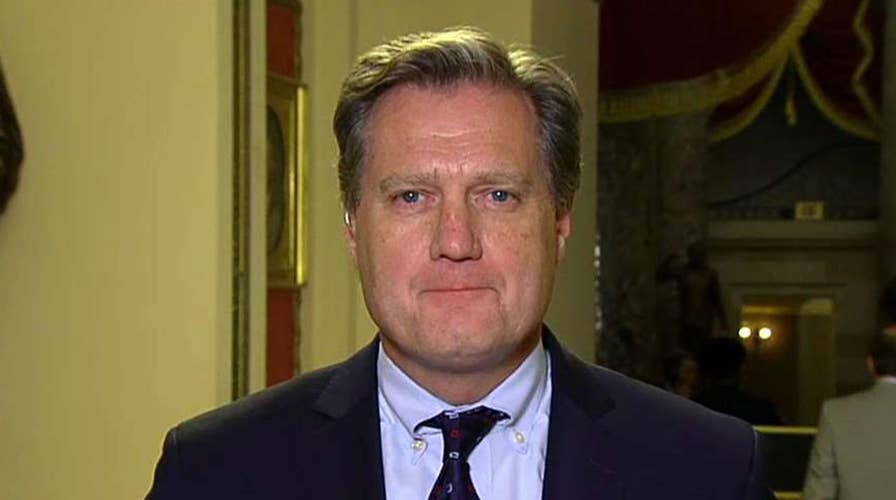
Rep. Turner questions whether or not Michael Cohen was coached by Adam Schiff’s staff before testifying
Ohio Republican Rep. Mike Turner says the American public deserves answers on what was discussed in meetings Rep. Adam Schiff’s staff and former Trump attorney Michael Cohen prior to his second Capitol Hill testimony.
This is a rush transcript from "Your World," March 8, 2019. This copy may not be in its final form and may be updated.
CHARLES PAYNE, ANCHOR: The job market suffering, a big miss ahead of tomorrow's big 10-year bull anniversary.
From politics to pocketbooks, an incredible run-up. How did we get here? And what is ahead for your money?
Welcome, everyone. I'm Charles Payne in for Neil Cavuto. This is "Your World."
Those weaker-than-expected jobs numbers raising new concern about the economy, just as the bull market for the Dow and the S&P 500 turns 10 tomorrow. So, what does it mean for your money, the 2020 election? We are going to get to in a moment.
But, first, Fox team coverage with Susan Li with the action and John Roberts at the White House with the president's reaction, what he likes about today's report.
But we begin with Susan. She's outside the New York Stock Exchange -- Susan.
SUSAN LI, CORRESPONDENT: Yes.
So, yes, we have the longest ever bull market run set to turn 10 on Saturday, forged from the destruction and the ashes of the global financial crisis. What a decade it's been.
Take a look at the performance of all the stock markets here in the U.S., the S&P and the Dow both up some 300 percent over those 10 years. The tech-heavy Nasdaq seeing gains of over 400 percent, thanks to the emergence of tech giants like Facebook, Netflix and Amazon during that period.
And it's not surprising that when we take a look at the best performing stocks over that 10-year period, Apple is at the top of the tree, up some 1300 percent. A surprising one in second place, Boeing, the plane maker, up some 1200 percent. UnitedHealth and Visa rounding out the top four.
Now, a bull market is defined as a sustained period of gains over 20 percent without a drop of 20 percent. We were very close to reaching those levels at the end of 2018. Close. Thank goodness we didn't get there. But today's jobs number, given that we saw a big miss, only 20,000 jobs in the month of February, 180,000 expected, this has investors concerned because bull markets usually don't last 10 years.
We are here in the final stages, according to a lot of investors, and these global growth concerns, whether it's slowing in China, Europe, people are concerned that it will come here to the U.S. at some point and end this bull market run that we're still in the middle of -- Charles.
PAYNE: Susan, thank you very, very much.
So, the question now is, who gets credit for this 10-year bull run, President Trump or former President Obama?
Let's ask our market pros.
Gary Kaltbaum is, Rebecca Walser and Scott Martin.
So, Gary, who gets the credit?
GARY KALTBAUM, CONTRIBUTOR: Well, under Obama, I give it to Obama and the central banks. Under Trump, I give Trump and the tax cuts and the regulatory cuts.
But I think the last two months, central banks are back in force not only here and around the globe, but, overall, I give the hard work and the ingenuity and the sweat and toil of the great American people and the great American companies that keep coming up with new inventions, new technologies, new medical breakthroughs. And I think the best is yet to come in the next 10 years.
PAYNE: Rebecca, when the market gets hammered the way it did right before President Obama came in, you do anticipate that it will rebound. And we were down 50 percent. It was ridiculously sold off.
But to the extent that it's rallied now, many people are really shocked that, 10 years later, we'd still be going like this.
REBECCA WALSER, WALSER WEALTH MANAGEMENT: Yes, absolutely, Charles.
But the thing is, I mean, let's be honest. Over Obama's full eight-year period, he had GDP at 1.5 percent. His last year in office, it was 1.6 percent and then Trump came in, in 2017 and took it to 2.3 percent. And that's what his economists had projected.
So, I give all the credit to President Trump, deregulatory policy, tax policy. And, unfortunately, I think Obama had higher wealth inequality and not real good job growth. So, GDP numbers were awful. So, no, it's unusual to have 10 years. This is the longest ever. And I do think the global slowdown is making investors nervous and it's interesting.
We're in a really interesting point.
PAYNE: You know, Scott, today, we did learn, also, what's interesting is that accompanying this rebound in the stock market is an economic recovery that's finally getting to the masses. Wages are up now big time, four months in a row over 3 percent. If you're a blue-collar worker, up seven months in a row over 3 percent.
We didn't think that could ever happen anymore. That goes part and parcel, of course, with this market, no?
SCOTT MARTIN, KINGSVIEW ASSET MANAGEMENT: Yes. And a couple of more job months or job growth months we are going to see, Charles, I think we're going to see in the next couple of months, we are going to see wages go towards 4 percent.
And you're seeing companies, too. You know, you guys talked about in kind of the previous comments about a little bit of different feel to the economy now, isn't it? It feels a little bit more self-sustaining. It feels a little more energetic vs., say, what it was in the previous administration.
So, you're seeing companies raise wages, minimum wage and things like that, because of the fact that they're confident about the regulatory environment going forward and they're confident about what's happening in D.C. now going forward.
So, that's another reason that companies, which is a good thing, are going to make their own decisions. They're going to breathe and live on their own and create job growth and create economic growth. And that, too, is going to keep this economy going in the coming years.
PAYNE: I want to go back to the New York Stock Exchange, bring Susan Li back into this.
What's interesting, Susan, is, overnight, China's stock market, their main market, the Shanghai, down more than 4 percent. It's been absolutely decimated over the last year, compared to our market, which is up significantly over the same time since President Trump has been in office.
LI: Yes.
PAYNE: As we head into the final phase of the China-U.S. trade talks, what kind of an impact does that give us? What kind of leverage does that give President Trump?
LI: Well, over the last 10 years, Charles, my favorite term has been the cleanest dirty shirts, and that's what the U.S. market and the U.S. economy has been.
And I would say actually especially true in the current environment in 2019. We do have a slowing economy taking place in China. They were down some 30 percent last year -- I would say probably the best performing stock market so far in 2019, but that all hinges on getting a U.S.-China trade deal.
Last night, we saw exports really falling off a cliff, down some 20 percent in a month. And don't forget, that is the bread and butter of the Chinese economy. That's what oils it. And if that's going down at this point, you can imagine that they are looking at a very sharp downturn and they want to sign a deal as soon as possible.
So maybe the U.S. and the Trump administration has the upper hand when it comes to signing possibly a trade truce.
PAYNE: Gary, you know, you brought up the Federal Reserve. Again, you know, Powell, let's give him credit for sinking the market in the fourth quarter of last year. Let's give him credit for maybe coming to his senses.
But now there's some concerns that the Fed is going to become even ultra- dovish and even trying to push this economy even further, and some people are concerned about that. So, where do you see interest rates?
KALTBAUM: Well, I was the first to say that they were going to stop dead in their tracks on raising rates. And I will be the first to say that the next move is going to be lowering of rates.
You know, look, we continue to be the very strong developing country. I don't -- I think China may be even in a recession. But we're not immune. I think we will slow down also. And I think Powell has already telegraphed it and I suspect we are going to see him lower rates during 2019, probably helps markets and, keep fingers crossed, keeps our economy in good stead.
And, again, let me repeat something. I give all the credit to Trump on not only lowering the taxes, but lowering the regulatory front. That was huge. Obama for eight years was the king of regulations and that needed to be undone. So good on this president.
PAYNE: There's no doubt that the business tone has taken a different tenor in the last two years, Scott.
And you have to wonder what that means for this market. We know there's an old saying on Wall Street that bull markets don't die of old age. But there's so many folks out there reluctant to get in this market, even though they see their own personal fortunes improving.
MARTIN: Yes, and, Charles, it goes across the board. It's from large multinational industrials to a small business owner like myself that, to Gary's point, sees that better regulatory environment, the better tax environment that we have seen.
And that helped kind of unleash that next level of growth that I think everybody kind of is waiting for here, even trade deal or not. So I think that's really good. And I like Susan's point, too, about kind of the cleanest dirty shirt in the basket here. And I will throw another one to her. You know, the U.S. is still kind of like the strongest guy or girl at the beach.
And so that's another reason why if you're an investor here and you see pullbacks like we have seen in the S&P 500 this year alone on, say, controversial or maybe good or bad economic data, that's why I would take that as an opportunity to get in and put some money to work.
PAYNE: Rebecca, 20,000 jobs reported for last month. Perhaps that gets revised higher. By the same token, though, the wage number was absolutely phenomenal.
And what I think people aren't talking about, the Federal Reserve is not going to get in the way. They're going to let America, Americans get a raise. What does that mean for the economy and the stock market?
WALSER: Yes, I mean, Charles, like you said, we had wage growth and we had the unemployment actually drop.
So we actually even had January revised upwards to 311,000. So, if we look at the trends, six months looks good, three months looks good. The fundamentals are still there. I don't think the market needs to overreact. It overreacted a little bit this morning. Now you it's pulled back and kind of normalized.
We expect -- the underlying fundamentals are the best in the world. Are we going to have the fact that we have an aged bull market here having some impact and some economic creep in from China and the E.U.? Obviously, it affects us. We still are, as you said, Scott, the best in the world.
PAYNE: All right, double-edged sword that there's not a lot of enthusiasm about the market. Most experts say that's one of the reasons why it's going to keep going higher.
But we have got some -- I want to thank our experts on this panel. Thank you all very much. Appreciate it.
WALSER: Thanks, Charles.
PAYNE: You know, despite today's big jobs miss, the president sounding very upbeat on the economy.
John Roberts it at the White House with more on that -- John.
JOHN ROBERTS, CHIEF WHITE HOUSE CORRESPONDENT: Charles, one of the things that's overhanging the economy, at least this month, is, as Susan Li was pointing to, is whether or not there is a trade deal between the United States and China.
We were expecting that there was going to be a meeting Mar-a-Lago at the end of this month between President Trump and Xi Jinping, the president of China. It now looks like that's not going to happen.
FOX News has learned that the Chinese had time pencilled in, blocked out for Xi Jinping to come to Mar-a-Lago at the end of March. They have removed that time from his calendar. And I'm told there is no plan on the American side for a meeting in March now.
Now, what President Trump has said, getting a trade deal with China may come down to a face-to-face meeting between he and Xi. The Chinese now want a deal in place before Xi comes to the United States.
One of the reasons why, China watched what happened in Hanoi last week, when President Trump walked away from Kim Jong-un, and there is no chance that the Chinese will let Xi come to the United States and have that happen if they can't reach a final deal.
This morning, the president didn't seem to be aware that China was reconsidering the summit. Listen here.
(BEGIN VIDEO CLIP)
DONALD TRUMP, PRESIDENT: I think they're doing well, but if it happened that way, we will do even better. We will do very well either way, with or without a deal, if you're telling me something that I have not heard.
QUESTION: (OFF-MIKE)
TRUMP: Yes, sure I'm confident. But if we don't make a very good deal for our country, I wouldn't make a deal. If this isn't a great deal, I won't make a deal.
(END VIDEO CLIP)
ROBERTS: There's still some hope, though, that that meeting could happen in April.
Also this morning, the president putting his best face on disappointing February jobs numbers, only 20,000 jobs created, just a fraction of the 180,000 that were expected. Here's how the president put it this morning:
(BEGIN VIDEO CLIP)
TRUMP: Well, it's a step. I think you will probably find out it averages out. The unemployment rate just went lower. We're down now to 3.8 percent, so we had very good news in that. I think the big news really was that wages went up.
And that's great for the American worker. That's something people, I don't know if they expected to see it.
(END VIDEO CLIP)
ROBERTS: The chief economic adviser, Larry Kudlow, said this morning that he thought the jobs number was fluky and doesn't really jibe with all of the other economic indicators out there. So we will see what happens in March -- Charles.
PAYNE: John, thank you very much.
Well, the wide-ranging impact of this bull market run will extend all the way to 2020 and that presidential race. And we're on top of that.
And, later, Republicans want to know if staffers of House Intelligence Committee Chairman Adam Schiff coached Michael Cohen ahead of his testimony last week. We will have the latest there as well.
(COMMERCIAL BREAK)
PAYNE: You're looking live at the New York Stock Exchange, investors celebrating a 10-year bull run.
But we did stumble in the last of the last year. In fact, the Federal Reserve saying American households lost around $3.7 trillion in wealth during the final three months of 2018.
So how could all of this play out in the 2020 presidential race?
Let's get reaction from The Hill's editor in chief, Bob Cusack, and The Wall Street Journal's Jillian Melchior.
Bob, let me start with you.
We have had an amazing run in household wealth, but that fourth quarter obviously impacted with that massive soon in the stock market and even some softness in housing. Obviously, those aren't the numbers that the president wants to go into in 2020. But just how important are they?
BOB CUSACK, THE HILL: Oh, very important, Charles.
I mean, that is what Trump has. He has the economy. The economy has improved. I think what you're going to hear from the president in his reelection campaign is what you have heard from prior candidates when the economy is booming, is, are you better off than you were four years ago?
And that's something the Democrats are going to have to grapple with. And, of course, it's a long way, Charles, before 2020. We don't know what's going to happen with China. And I think that's -- that China deal, if it happens, will greatly impact the market.
But, right now, it is the one thing that Trump is going to repeatedly mention, of course, going after Democrats for investigations, but the economy being something that he improved.
PAYNE: And, Jillian, and putting even a finer point on it, the job part of this, the one thing that is really blowing me away, I got to tell you, seven consecutive months of blue-collar wage growth, more than 3 percent.
We haven't seen anything like this in well over a decade. Six of those seven months, wages for blue-collar workers growing faster than their supervisors. Those are jobs in the heartland. Those are jobs that President Trump promised.
JILLIAN MELCHIOR, THE WALL STREET JOURNAL: Yes, I think we're seeing last year in October, record-breaking unemployment.
I was excited to see today that small business hiring is up. So lots of good signs here. And, you know, there's also a Fed paper that just came out today, and it's looking at the impact of such a tight labor market, and it's really showing that when the economy is booming, like it is right now, that no one is left behind.
So the theory here is that female workers, people of color, workers with a lack of skills or a lack of education, in a labor market this tight, businesses are going to give opportunities to all of them. They're competing for workers. So you're seeing wages go up, more opportunity.
So I think this is really inclusive growth. And Democrats are playing up this identity politics game. I think this in two ways -- I mean, it not only affects their narrative on the economics, but also some of the identity politics that they're playing up. It's hard to say that only the 1 percent is benefiting, when it's been bottom up.
PAYNE: Right.
And then Bob, today, Elizabeth Warren comes out with a plan to dismantle Amazon, to dismantle Google, to dismantle Facebook. Listen, we know that everybody is angry at them. They haven't been great actors, but the notion of government dismantling the hottest companies in America, do you think that will play with voters?
CUSACK: I think it's going to be a tough sell for Democrats. And that's why the Democratic Party has to worry about having a candidate that's too far left.
The Democratic Party has turned left. We should certainly see that with the progressives in Congress, Ocasio-Cortez and others. So Democrats have to make sure that they win the middle class. It's something Chuck Schumer is always focused on is winning the middle class.
That is where this is going to be decided on.
PAYNE: Right.
CUSACK: But if they have a candidate that's too progressive, then Trump is going to be -- it's a binary choice, as you know, Charles, and he can go after their policies.
PAYNE: Which is why many are saying that Joe Biden is the moderate hope for the Democratic Party, perhaps a savior.
Bob and Jillian, I will ask you both this. Bob, I will let you finish and then Jillian.
Joe Biden comes in and says, yes, we have had a 10-year run. Eight of those happened when I was part of the team that made it happen. I mean, is he ultimately the one who could come in for the Democratic side with some sort of not only economic vision, perhaps, certainly blue-collar side, but to say I have got a resume as well?
CUSACK: Listen, I think that Biden is -- would be somebody that Republicans -- and we talk to Republicans -- they're nervous about. At the same time, Trump can use his numbers against the Obama administration and say, which numbers are better for the economy?
And that is the advantage Trump. But is Biden dangerous in a general election? Absolutely.
PAYNE: Jillian?
MELCHIOR: I would agree with that.
I mean, he has going for him that he's not a New Green Deal guy. He's not somebody trying to completely from the top and bottom remake this economy that's already working.
But, at the same time, I think what we're seeing right now is that tax reform and particularly deregulation are paying off for Americans of all classes, all stripes. And I think that comparing that to the Obama record is not great.
PAYNE: Yes, it's going to be hard. He's going to be promising things that are already happening.
Bob, Jillian, thank you both very much.
MELCHIOR: Thank you.
CUSACK: Thank you.
PAYNE: Hey, did the staff of House Intelligence Committee Chair Adam Schiff coach Michael Cohen before his testimony? That's what Republicans want to know. If so, is it unusual?
The latest from Catherine Herridge on that.
Plus, meet the Republican congressman who sent letter to Cohen demanding answers next.
(COMMERCIAL BREAK)
PAYNE: Did former Trump attorney Michael Cohen get some coaching from his Capitol Hill testimony from the staff of Democratic House Intelligence Committee Chair Adam Schiff?
To Catherine Herridge with the latest on that -- Catherine.
CATHERINE HERRIDGE, CHIEF INTELLIGENCE CORRESPONDENT: Thank you, Charles, and good afternoon.
FOX News was the first to report that Democratic staff from the House Intelligence Committee traveled to New York four times and met with Cohen for more than 10 hours in advance of his seven-hour public testimony.
Two sources told Fox News that sessions with Cohen were wide-ranging, covering The National Enquirer's catch-and-kill policy, American media CEO David Pecker, as well as the alleged undervaluing or inflating of President Trump's assets.
What's key here is that, one by one, Democrats raised the exact same topics during Cohen's public testimony. Watch.
(BEGIN VIDEO CLIP)
MICHAEL COHEN, FORMER ATTORNEY/FIXER FOR DONALD TRUMP: I was involved in several of these catch-and-kill episodes. These catch-and-kill scenarios existed between David Pecker and Mr. Trump long before I started working for him in 2007.
REP. ALEXANDRIA OCASIO-CORTEZ, D-N.Y.: And, to your knowledge, did the president ever provide inflated assets to an insurance company?
COHEN: Yes.
(END VIDEO CLIP)
HERRIDGE: In a statement to Fox News, a spokesman for Chairman Schiff said -- quote -- "Despite this professed outrage by Republicans, it's completely appropriate to conduct proffer sessions and allow witnesses to review their prior testimony before the committee interviews them. Such sessions are a routine part of every serious investigation around the country, including congressional investigations."
For some context, Cohen has now testified at least five times in private and public congressional hearings. He first told the House committee over a year ago that he wasn't aware of any direct evidence showing collusion with Russia -- Charles.
PAYNE: Catherine, thank you very much.
HERRIDGE: You're welcome.
PAYNE: And, by the way, we have called Congressman Adam Schiff for an interview. We have yet to hear back from him.
But want to go now to Ohio Republican Congressman Michael Turner. He is a member of the House Intelligence Committee and wrote a letter to Michael Cohen demanding answers.
Sir, thanks for joining us.
REP. MICHAEL TURNER, R-OH: Charles, thanks for having me.
PAYNE: It feels like a bombshell for those of us not familiar with how all the -- how things proceed there.
You know, is this unusual? Has this happened before? Do you know of times, perhaps, when Republicans may have engaged in a similar kind of tactic?
TURNER: Not like this.
And my congratulations to Catherine, Charles, because what we knew before on the Government Reform testimony, that Cohen himself had admitted that he had had contact with Democrat Adam Schiff.
And what we know now from reports, Cohen's attorney, Lanny Davis, is reporting that there were four trips to New York and over 10 hours of contact with Adam Schiff's staff.
To give you some perspective, he testified in front of the government reform committee for seven hours. Let's say the Democrats were four hours of that questioning and answering. That means that they would have spent three hours behind closed doors working with Cohen preparing him for that testimony and questioning for every hour that we got to see on TV.
Now, we thought this was a congressional hearing, how they normally are, people asking questions, contemporaneously getting answers. Now, they say this is a public investigation, but it sounds like public and professional orchestration.
These types of contacts are very, very unusual. And, you know, what do you do for over 10 hours of sitting down with Cohen before he testifies publicly? You know, it absolutely rises to the level of questions of coaching and whether or not this is political theater.
PAYNE: Do you think you can get to the bottom of this? Do you think you can ultimately find out if, in fact, there was some sort of rehearsal session, some sort of coaching session?
And I think, more importantly as well, does this rise to the level of being illegal? Certainly, it sounds like it perhaps is unfair with respect to being a public hearing.
TURNER: Well, I think Democrat Adam Schiff has some answers that he owes the public, because, here, these happened behind closed doors solely with Democrat Adam Schiff's staff.
No one else was present at the time, over 10 hours of work with Michael Cohen before he came out and publicly testified. I think that the public deserves answers as to what happened during these sessions, what was discussed?
And what we certainly know was discussed were items that were of interest to the Democrats that they brought forward to the Government Reform Committee. They knew the answers he was going to give before they asked the questions, and that's what -- not what the American public expects.
They don't expect guiding and coaching of a witness. If we're going to have a congressional testimony, it should be actual testimony from the witness and questions from those who are present.
PAYNE: Right.
Adam Schiff said that it was sort of proffer -- proffer sessions and that they were routine. At the beginning of this interview, you suggested that Republicans have done something similar.
TURNER: No. Actually...
PAYNE: Tell me what the difference would be between Republicans, what they may have done in the past, compared to what you think happened in this case.
TURNER: Yes.
So, no, I wasn't suggesting at all has happened with Republicans. What I would -- what I think everybody would expect, that there could be some contact. For example, it wouldn't be shocking if the aggregate of contacts between the House Oversight Committee and the House Intelligence Committee on the Democrat side in preparation for the logistics of Cohen's testimony was an hour, you know, how it's going to go down, how it's going to work, how it's structured.
At five hours, you start to get, what are you talking about? But now we're hearing this is over 10 hours. Over 10 hours, clearly, this is trying to affect testimony. This is where coaching occurs. This is where questions of theater occur and orchestration.
You know, you hear from, you know, reports on the Democrat on the Government Reform that they were proud of their performance. Well, if it's been, you know, rehearsed, they certainly have a reason to be proud.
PAYNE: Well, apparently, Representative Turner, if indeed there were some rehearsal, maybe they -- there was some issues about the pardoning controversy now, because whether or not Michael Cohen or a representative of Cohen approached the White House, Lanny Davis coming through in successive days with more information on that, what do you make of it?
Where are we with that? I mean, do you think that Michael Cohen lied during that testimony?
TURNER: You know, the only thing I'm confident where Michael Cohen has told the truth is when he pled guilty to lying to Congress. I think, past that, you can't take much credibility in what he's saying.
You know, you have to understand that, every time he opens his mouth, as an attorney who swore to hold the confidences of his client, he's already violating his professional pledge, and that he's proven -- he's a convicted felon for having proven to have lied.
I think his guilty plea is probably the only thing that we can count on that Michael Cohen has told the truth about.
PAYNE: Representative Mike Turner, thank you very much. Appreciate it.
TURNER: Thank you.
PAYNE: We're going to drill into this later a little further with a former federal prosecutor.
And then freshman Democrat Alexandria Ocasio-Cortez sparking a brand-new controversy. Now she's claiming a pro-Israel group is coming after her and Congresswoman Ilhan Omar. And she's fund-raising off that claim. The fallout from that is next.
(COMMERCIAL BREAK)
PAYNE: President Trump has arrived just moments ago. That's on tape.
But it's just moments ago at Mar-a-Lago -- Palm Beach, rather, this, of course, after touring Alabama, where he met officials and victims.
(COMMERCIAL BREAK)
PAYNE: Republican Congressman Mike Turner slamming House Intelligence Chairman Adam Schiff for reportedly having a staff meet four times with Michael Cohen prior to his congressional testimony.
Former federal prosecutor Doug Burns joins us now.
Doug, it's just, you know, again, from the outside looking in, we're getting a civics lesson through all of this.
DOUG BURNS, FORMER FEDERAL PROSECUTOR: Yes. We are.
PAYNE: We're not liking what we're learning. Is this kosher, in your mind?
BURNS: Well, in cases, people meet with the prosecutors all the time. This is a lot different, though.
I mean, when you have a congressional hearing, and then the witness is meeting with that, you know, congressional committee...
PAYNE: These are the folks who you are going to question during the meeting, and a 10-hour meeting?
BURNS: Where I come down on all this is that people that are smarter than I am, most notably Professor Dershowitz, Ken Starr, have said, look, we're criminalizing politics, we're criminalizing political differences, we're weaponizing criminal law.
Real crime is narcotics dealing, organized crime, murder. OK? And here this one lied. It's like a schoolyard. No, he lied. He lied. And it's crazy.
PAYNE: Right.
BURNS: But, to your question, look, it is untoward, yes.
PAYNE: All right, but these sessions, you know, ostensibly, heretofore...
(CROSSTALK)
PAYNE: ... were always designed, we thought, to seek truth, to seek answers.
BURNS: Yes.
PAYNE: Instead, if it turns out it was all a coordinated rehearsal, then it makes a mockery of Congress and it makes a mockery of the system.
BURNS: Mayor Giuliani famously said the truth isn't the truth. Everybody was foaming at the mouth going crazy. How could he say that?
He's 100 percent right, OK? And what we mean by that is, you go into these meetings and there are subtle insinuations, maybe it happened that way, didn't it? You sure it wasn't this way, didn't it?
So, to your point, yes, all of this weaponization, this politics stuff is not a good process for the truth. I totally agree with you, Charles.
PAYNE: Wow.
Speaking of wow...
BURNS: Yes. Yes.
PAYNE: ... tongues are still wagging over the sentencing yesterday, Paul Manafort.
BURNS: Yes.
PAYNE: Really, a lot of people really were just caught completely off- guard, although I will say, we had a guest on last night, Gene Rossi, who said it would be a low sentence.
BURNS: I saw that.
PAYNE: And he gave some pretty interesting reasons for it. And yet, today, it's being characterized as misjustice.
(CROSSTALK)
BURNS: No, no, no, but let me clarify a couple of things.
I watched people go on television left and right saying -- quote -- "He's going to be in prison for decades. It's a life sentence."
And I was saying to myself, these people don't know what they're talking about, because what happens is, the government -- telling little tales out of school -- when you go to trial, the pre-sentence reports tend to be much, much higher than if you plead guilty, even though it's the same case.
That's a little dark secret about penalizing somebody for going to trial. Had Paul Manafort pled guilty, everybody would have said, oh, it's eight to nine years, on the same facts, OK? A little dark secret.
So, the point is I knew for sure that the judge wasn't going to give him 20 years. That was...
(CROSSTALK)
PAYNE: But 47 months?
BURNS: That was 5 percent out of 100.
Forty-seven months, but there's a follow-up point real quick, was 15 percent out of 100. The other 80 percent was six to nine years, seven to 10 years. That's what all my friends, all the experts were telling me. And I agreed with that.
Now, the point is, though, this is a little bit of a head-fake, because next Wednesday, Judge Jackson in the District of Columbia sentences him. The sentence she imposed by law is consecutive, unless she determines that that she wants to make it concurrent.
I'm still trying to handicap -- I'm not there yet -- what I think she's going to do. But the point is, if she gives him 47 months, hypothetically -- and runs it consecutive -- then he ends up with like an eight-year sentence.
PAYNE: All right, Doug, thank you very much.
BURNS: My pleasure.
PAYNE: Coming up next:
(BEGIN VIDEO CLIP)
TRUMP: I thought yesterday's vote by the House was disgraceful.
(END VIDEO CLIP)
PAYNE: President Trump blasting House Democrats over their resolution after the Ilhan Omar controversy. Now one of her fellow freshman -- fellow freshman Democrats actually fund-raising off this controversy. Really?
(COMMERCIAL BREAK)
PAYNE: President Trump arriving a short while ago in Florida. He was in Alabama earlier today visiting the victims of a tornado that killed 23 people this past Sunday.
Jonathan Serrie is in Lee County, Alabama, with the details on the president's visit -- Jonathan.
JONATHAN SERRIE, CORRESPONDENT: Hi, Charles.
The president and first lady started with the helicopter tour getting a bird's-eye view of just the scope of the massive amounts of damage here in Lee County, Alabama.
They then landed and took a walking tour of one of the neighborhoods that suffered some of the worst devastation. There, they met with families who lost loved ones in Sunday's tornado.
They include the family of Sheila Creech and Marshall Lynn Grimes, a couple that died in the storm. Mr. Grimes' 10-year-old daughter remains hospitalized. In fact, she wasn't well enough to go to the parents' funeral.
And the daughter's friend, 10-year-old Taylor Thornton, who was over for a visit at the time died in the storm. Family and friends held a funeral service for Taylor this morning.
After touring the devastation, President Trump visited a church that is serving as a staging area for relief efforts. There, he met with volunteers and first-responders and thanked them for all their hard work during the hours and days following the tornado.
He also praised Alabama Governor Kay Ivey for her handling of the disaster.
Now let's go to a live shot that we have from the town of Smiths Station. That's about 20 miles away from where I'm standing. You can see recovery efforts are well under way. The president's visit is receiving praise even from the other side of the aisle.
Alabama Senator Doug Jones, a Democrat, says such visits have a way of connecting Washington politicians with communities in need on a much more intimate and enduring level.
And now coming back to our live location here in Beauregard, Alabama, look at all of this debris on the ground and up in the trees. That's a concern as we go into the weekend, because, Charles, more severe weather is forecast for Alabama.
The worst storms are expected to pass to the north of us. But with all this debris on the ground, even moderate winds could scatter it. And the concern is that will slow down some of the recovery efforts -- Charles, back to you.
PAYNE: Thank you very much, Jonathan.
Now to an official who met with President Trump in Alabama today.
Joining us on the phone, mayor of Opelika, Alabama, Gary Fuller.
Mayor, thanks for joining us.
GARY FULLER, MAYOR OF OPELIKA, ALABAMA: Charles, my pleasure to be with you. Thank you.
PAYNE: First, before we talk about your visit today, give us an update on your town. I know you have about 30,000 folks there. How devastating was it? And where are you now?
FULLER: Well, thank goodness, Charles, it didn't touch Opelika.
We're about 13 miles from the community of Beauregard, so the storm was south of Opelika and Auburn. And, of course, because of the density of the population here or in Auburn would really have been -- it's bad enough as it is with 23 lives lost.
But it would have been really a terrible, terrible thing had it moved several miles north. But, you know, the cleanup continues. We were very grateful to have the president and first lady with us today. And I think they met some folks that are strong and will rebuild that community, not only in Beauregard, but in Smiths Station.
PAYNE: Mayor, talk to us more about the president, just how important it is, how critical is it for him and the first lady to be there and how it can lift the spirits of the folks there?
FULLER: Well, I think all of us were greatly encouraged by the fact that he would take time to come here and be with those folks that have been harmed and some of them lost everything, including family members.
But it's a great encouragement for us. And then, of course, you know, the president has many fans in the state of Alabama, and certainly here in Lee County. I think he probably carried Lee County in a big way back in the last election. So he was among friends, not all of them friends, but mostly friends.
(LAUGHTER)
PAYNE: Right. Yes.
FULLER: And, of course, Senator Jones, who is our junior U.S. senator, is a Democrat. But Senator Jones was here, and had a chance to visit with him.
And, of course, it's great to see everybody working for a common goal. And that's to get that community rebuilt and to get it cleaned up.
PAYNE: Yes, and Senator Jones is a good man.
You mentioned a common goal. I know there's been some relief efforts and there's a relief drive going on. How is that coming along?
FULLER: It's almost overwhelming, Charles, the outpouring of love and prayers and contributions.
In fact, a couple of days ago, all of the agencies said, please, don't bring any more food or bottled water or blankets or clothes. We may need those later.
PAYNE: Right. Right.
FULLER: Right now, if you want to do something, give money. And there's a number of organizations, including the Red Cross, the Lee County United Way, they're involved.
PAYNE: Right.
FULLER: And then the East Alabama Medical Center Foundation is involved with the Poarch Band of Creek Indians to pay for the burial of all of those deceased.
PAYNE: We have got less than 30 seconds, but I have to give you a shout- out.
In the midst of all of this, you secured a pretty good deal for your town, an almost $6 million deal with an Indian automobile manufacturer. Just quickly, you know, talk to us because we have been -- there's a theme in this country about businesses coming to America.
FULLER: Charles, we think everything starts with good-paying jobs.
My friend Al Cook taught me that. And these folks, Yongsan Automotive, that made the great decision to locate here, going to employ 150 people within three years, good jobs, good pay, that's good for everybody.
PAYNE: It is.
Be safe. And we really appreciate you taking the time out, Mayor Gary Fuller.
FULLER: Thank you so much, Charles.
PAYNE: More right after this.
(COMMERCIAL BREAK)
PAYNE: President Trump slamming House Democrats and their anti-hate resolution, this coming after Minnesota freshman Ilhan Omar was accused of anti-Semitic remarks.
But Congresswoman Omar wasn't named in the resolution. So is this an issue that's going to stay with Democrats for a while?
Let's talk to The Washington Examiner's Kelly Jane Torrance.
Kelly Jane, what are your thoughts there?
KELLY JANE TORRANCE, THE WASHINGTON EXAMINER: I do think it's going to stay with Democrats for a while, Charles.
This resolution, I think, was just completely pointless. It's not even that it didn't name Ilhan Omar, which is bad enough. But they actually completely changed the resolution. The original resolution condemned anti- Semitism, and it actually had a little bit about the history of anti- Semitism and why it is such a problem.
Well, they totally watered it down. As James Clyburn of South Carolina said, we need to have an anti-Semitism, Islamophobia, racism, all that stuff. It's mind-boggling.
And, you know, Ilhan Omar was saying she thinks people are tagging her because she is Muslim. Now, they're not. They're worried about her because she's made anti-Semitic remarks.
PAYNE: Right.
TORRANCE: But by putting Islamophobia and other things in there, Democrats are making it look like they think she is right.
PAYNE: Well, to your point, President Trump saying Democrats are now the anti-Israel, anti-Jewish party, to which Senator Schumer just releasing a tweet.
And I want to share it with the audience. "For the president who when neo- Nazis marched in Charlottesville in front of a synagogue and said burn it down, and he said both sides are to blame, this is a new divisive low. His comments show the president is only interested in playing politics of division and not in fighting anti-Semitism. Mr. President, you have redefined chutzpah."
Your thoughts?
TORRANCE: Well, yes, it's -- if I were President Trump, I might not decide to comment on this and call another party the party of anti-Semitism.
We have had a few Republicans who have had some issues. But I don't really like this whataboutism. I think the Democrats also have a problem. Let's address it. And I don't think the Democrats are addressing it.
And if they're not brave enough to address it, it is going to continue to be a problem for them.
PAYNE: That's the operative word there, Kelly Jane, brave. That was a bad move yesterday.
But, real quickly, maybe this is a bad move, too, because New York freshman Democrat AOC, Alexandria Ocasio-Cortez, now fund-raising over a controversy. She's claiming that the pro-Israeli group AIPAC is coming after her and she's raising money on this. Your thoughts?
TORRANCE: Again, exactly. This is divisive politics. This is not the way to go.
You know, AOC has been one of the people who has been really defending Omar on this. We would have been moving on from this if Ilhan Omar had just apologized and moved on and quit making the remarks.
But she just keeps doing it. She can't stop. And the Democrats -- at first Nancy Pelosi and Steny Hoyer, the Democratic leadership in the House, had a statement when Omar first made some comments. They have wimped out since then. And that's why people are still talking about it, because it looks like the Democrats are trying to cover up for some other Democrats.
PAYNE: And you have got to believe it's going to happen again.
Thank you very, very much, Kelly Jane Torrance.
In the meantime, Elizabeth Warren vs. Wall Street all over again. And this time, the Democratic senator and 2020 hopeful, well, she's targeting big tech. That's next.
(COMMERCIAL BREAK)
PAYNE: Democratic senator and 2020 presidential candidate Elizabeth Warren wants to break up big tech companies, claiming companies like Facebook, Google and Amazon hurt small businesses and innovation.
We invited Senator Warren to come on the show, but her schedule today didn't allow her to join in.
Here now to discuss is Stanford University School of Business Professor David Dodson and former Republican senator -- Senate candidate for Wyoming.
David, thanks for joining us.
This isn't your typical, hey, let's break up a company or two because they're big. She wants to dismantle prior mergers and just completely take it all apart. Your thoughts?
DAVID DODSON, STANFORD UNIVERSITY SCHOOL OF BUSINESS: Oh, it's naively mind-boggling, what she is suggesting.
I don't know if this is just a continuation of this kind of Democratic economic nanny state that is being promoted increasingly by the fringes of the Democratic Party, or it's just a political stunt where she's seen three big juicy targets, and she could take sort of a populist stand against these three companies.
Look, these companies only have two things in common. The first is that they have been successful. And the second is that they sell things over the Internet.
That doesn't mean that the government should take their regulatory chain saw and arbitrarily decide, if you get to be a certain size, that must be bad, and so we're going to cut you in half.
Now, we all know that there are issues with Facebook and Google in terms of privacy issues, and how ads are sold and hacking and so forth.
PAYNE: Right.
DODSON: But you don't solve those things by taking a chain saw and cutting the companies in half and expecting that's going to be fixed.
PAYNE: What about consumers?
DODSON: Consumers are not harmed because Amazon has figured out that people like me like the stuff brought to our house at a really low price.
That's why Amazon has done so well, not because they're doing anything illegal. And, in fact, she literally said this morning that their purchase of Whole Foods was illegal.
On what basis is that illegal?
PAYNE: Real quick, we only have 30 seconds, but what about the idea that it's not hurting the customer, but it's hurting small businesses?
DODSON: Well, I think that's absurd, because if you look at how many -- for example, how many books have been published, self-published books on Amazon, it reached a million this year. Never before.
More things are sold by regular people over the Internet now as a result of the democratization of the Internet, whether it's all the way from eBay back in the day, to Amazon, to Facebook and so forth.
PAYNE: Right.
DODSON: So these are places where people have an opportunity to sell products.
PAYNE: David, thank you very much.
Really appreciate it.
DODSON: Not at all.
PAYNE: Well, big tech played a big role in keeping this bull market running, so be sure to tune in to "Cavuto Live" tomorrow at 10:00 a.m. Eastern for special coverage on the bull market's 10-year anniversary.
In the meantime, I will be back on Monday at 2:00 p.m. Eastern for "Making Money" on the Fox Business Network. We will see you then, again, tomorrow, 10 years, bull market, big deal.
So is "The Five." It starts right now.
Content and Programming Copyright 2019 Fox News Network, LLC. ALL RIGHTS RESERVED. Copyright 2019 ASC Services II Media, LLC. All materials herein are protected by United States copyright law and may not be reproduced, distributed, transmitted, displayed, published or broadcast without the prior written permission of ASC Services II Media, LLC. You may not alter or remove any trademark, copyright or other notice from copies of the content.
