


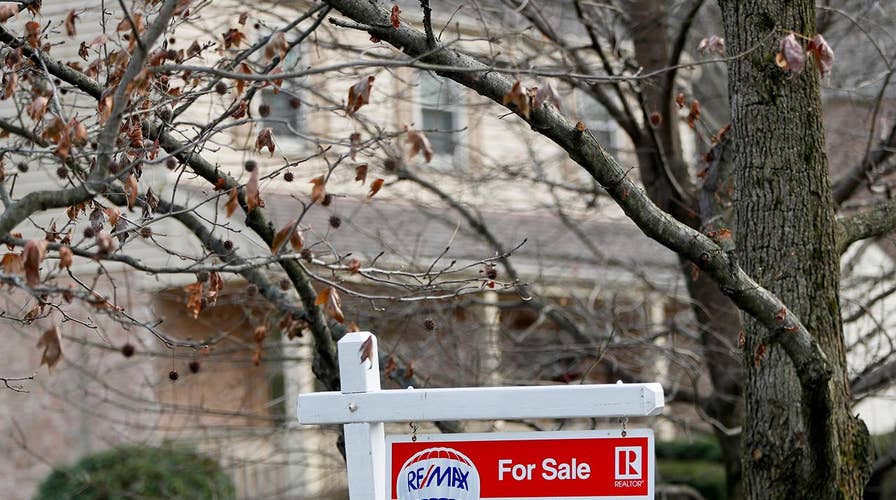
Partial government shutdown causes delays in home loans
Quicken Loans CEO Jay Farner says that it is getting harder for lenders to issue and refinance loans for their customers because of the partial government shutdown.
This is a rush transcript from "Your World," January 24, 2019. This copy may not be in its final form and may be updated.
NEIL CAVUTO, HOST: Votes in, still shut down.
Welcome, everybody. I'm Neil Cavuto, and this is "Your World."
It is 34 days and counting, and something that could have interrupted that process didn't. Two different measures, one a Republican plan, one a Democratic plan, couldn't garner the 60 votes necessary to at least move the ball forward on a shutdown that seems to know no end.
Let's go to Peter Doocy on Capitol Hill, where all this is standing right now -- Peter.
PETER DOOCY, CORRESPONDENT: Neil, in the Republican-controlled U.S. Senate, the Republican plan to reopen the government was less popular than the Democratic plan, two votes less popular.
So now it is back to the drawing boards.
(BEGIN VIDEO CLIP)
SEN. CHRIS COONS, D-DEL.: I think it was important that both caucuses, both sides see that there aren't the votes for the president's proposal in its current form. And there aren't the votes to simply reopen the government in its current form. And, frankly, I think we all knew that.
But by returning to Washington to see those two bills taken up and fail now puts us in a place where our leaders need to talk directly.
(END VIDEO CLIP)
DOOCY: The president's plan didn't have the support of Republicans Mike Lee or Tom Cotton. And, separately, six other Republicans broke with their party leaders to support the Democratic plan, which doesn't have any new border wall money or protections for dreamers brought to the country illegally.
Lamar Alexander, Johnny Isakson, Lisa Murkowski, Susan Collins and Mitt Romney all voted to fund the government at current levels for two weeks. But that Democratic plan was seen as pointless by the rest of the Republicans because they know President Trump will not sign it.
(BEGIN VIDEO CLIP)
SEN. JOHN KENNEDY, R-LA: You can try to teach a goat how to climb a tree. But you're better off hiring a squirrel in the first place.
And the Trump proposal will both secure the border and get government open. And the Schumer proposal will do neither.
(END VIDEO CLIP)
DOOCY: We have no idea what comes next. There has been a real lack of leadership-level negotiations as this vote was put on the calendar, but just in the last few minutes, Chuck Schumer, the minority leader in the Senate, said on the floor that Mitch McConnell has requested to meet with him in his office sometime soon.
So if there is going to be a different kind of compromise, we might know in a little bit -- Neil.
CAVUTO: Fingers crossed.
Thank you, my friend, Peter Doocy.
Let's go to the other end of Pennsylvania Avenue, Kevin Corke at the White House.
Kevin, what are you hearing there?
KEVIN CORKE, WHITE HOUSE CORRESPONDENT: Well, listen, a lot of people are talking about this possibility that this shutdown, Neil, could last for quite a long time.
As you have heard the old expression, prudent management means preparing for events without a known end date. And that is the warning for the White House and its chief of staff, Mick Mulvaney. Why? Well, he's been talking to agency heads, Neil, about a possible protracted shutdown, as they shutdown now moves into month number two, with no apparent end in sight.
Get this. He's actually asked agency leaders to give him a list of the highest-impact programs that would be jeopardized if the shutdown were to continue into, say, March or April. And while White House officials insist that's not what they want, the lack of movement with respect to negotiations has a lot of people at 1600 Pennsylvania Avenue and beyond making contingency plans.
The president tweeting this. It reads in part: "Our country has a chance to greatly reduce crime, human trafficking, gangs and drugs. Should have been done for decades. We will not cave," as in, we will not cave on our demand, our desire to fund border security, including a barrier or a wall.
That's a sentiment, by the way, Neil, shared and echoed by Democrats on Capitol Hill, even though they do say they're still open to talking.
(BEGIN VIDEO CLIP)
REP. NANCY PELOSI, D-CALIF., SPEAKER OF THE HOUSE: This is the president of the United States. We will meet with them any time he wants to meet. And I have never discouraged anybody from meeting with the president.
SEN. LINDSEY GRAHAM, R-S.C.: Nancy Pelosi has become a nightmare for the Democratic Party. She seems unreasonable. She seems to have a dislike for the president that is hurting the country. And this idea of not letting the press to speak is really overplaying her hands.
(END VIDEO CLIP)
CORKE: Day 34, no end in sight for the shutdown, which is not only impacting federal paychecks. It could have a major impact on the political fortunes of a number of people in this town, if they don't figure it out soon, Neil.
CAVUTO: Kevin, I'm curious about the State of the Union decision.
The president seemed to be toying with alternative venues, if he wasn't allowed on the floor of the House, and then decided, no, no, no, scrap it, we will wait until the shutdown is over.
What happened?
CORKE: I think a couple things.
First of all, you do want the magisterium, right, of being in the House chamber. But I also think what he probably figured out with good counsel is, this is not the way to go. What you really want to do is get Democrats, frankly, on the record and bide your time, Neil.
There are a number ways they can go with this thing, and it doesn't make you look good if you simply do every end-around. Sometimes, you have to face your troubles head on. He feels like he's in the right here. And so he will wait. And we will get a State of the Union where it should be. And that's the Capitol
CAVUTO: Kevin, thank you very, very much.
Before I go to my next guest, I do want a peek at the corner of Wall and Broad today. We were down all of 22 points. That's it. We were down worse. It has nothing to do with the shutdown, no fears of this escalating, even though the legitimate concerns that this could spread to our economy, and this notion that this does weigh on the American psyche.
However, there were more back and forths on the prospect of those China trade talks and a lot of friction back and forth. In the end, we kind of ended the day as we started the day. We are up throughout this shutdown, 34 days we have been doing this, and all the major averages are up double digits.
So that's the market's view of this, so far shrugging its shoulders,
Democratic strategist Jessica Tarlov, American Majority CEO Ned Ryun, Washington Examiner's Tiana Lowe.
So, that's their view. They could be very, very wrong and naive about the impact of this.
But, Tiana, is there a middle ground for both parties that could save face for both parties? What do you think?
TIANA LOWE, THE WASHINGTON EXAMINER: So what Trump actually proposed could be seen as a victory for both parties.
I think the Democrats, they need to name their price. He's effectively issued a blank check for them, because all Trump cares about is the $5.7 billion for physical border security.
So if Nancy Pelosi wants to say, six years of protections for DACA recipients and TPS holders, instead of three, or she could even start touting actual amnesty, I think that Trump is so desperate at this point.
But the fact that she won't even come to the bargaining table, that's the thing that makes the Democrats M.O. on this a lot more questionable.
CAVUTO: All right, Jessica, what do you think of that offer, that, if it came to, that all of a sudden the president is open to anything, if they're open to this wall thing?
And part of the Democratic plan that was shot down in the Senate, even it garnered more votes -- votes than the Republican one, did include more than $5 billion worth of security funding, just not distinctly wall funding.
JESSICA TARLOV, CONTRIBUTOR: Right.
CAVUTO: So, what do you make of that?
TARLOV: Well, I'm actually hopeful to see what the House puts out there. Jim Clyburn was on TV yesterday talking about a compromise bill that would give him more than the 5.7 for a smart technology barriers system, which would include physical barriers being expanded at certain points across the border, but more patrol units and addressing our asylum system.
I think that we need to see where that goes. There's no doubt, if you look at the recent FOX News poll, that pressure is mounting on Democrats. Now 34 percent of Americans are placing the blame on them, and then 51 percent on the president, and congressional Republicans are actually taking only 3 percent of the heat.
So now it's really Democrats vs. Trump, whereas congressional Republicans had a higher price to pay just last week for all of this. So I want to see where the compromise bill goes here, and hopefully we can get somewhere with that.
CAVUTO: You know what worries me about all of this, Ned, no matter what side you're on the political fence, I have often seen Washington propelled into action based on an unexpected development, even a tragedy, a horrific event; 9/11 comes to mind.
Now, that wasn't ending shutdown. It was prompting a dramatic response. But it took a big almost 800 point-hit in the Dow at the time they were debating government help for banks, TARP, as it was called at the time that got Congress back together to get approval of such a thing, whether you like that or not.
NED RYUN, PRESIDENT, AMERICAN MAJORITY: Right.
CAVUTO: And I'm not -- I'm not justifying that.
But would it take a tragedy or compromised air travel, which has come out of a number of airlines, Southwest among those said they're worried, that that would prompt something like that?
RYUN: Yes.
No, I think, Neil, that there's something that has to shake and wake people up. Right now, I don't think either Republicans or Democrats -- they're pretty dug in, as we know. They don't really feel compelled. They don't feel -- I mean, most politicians are experts in self-preservation. They don't feel any need to actually move on this, because they don't feel like there's enough pressure from the American people to actually solve this.
But I think Jessica has a really interesting point. Democrats are coming under a little more pressure. And I would actually argue Nancy Pelosi is on a little bit shakier ground than people would like to think.
Again, Republicans have now put up two motions to recommit that federal employees be paid. The first time, only six Democrats voted with them. Now 13 Democrats have voted. Again, I think they're going to put it up again. And I think you will see more Democrats starts to come over to the Republican side that the federal employees should be paid.
The other thing is Steny Hoyer himself said to you, there's not a problem, physical barriers do actually work. And now you have Jim Clyburn actually wanting to negotiate on some level with Trump.
And I think, if Nancy Pelosi continues to hold this hard line, she's going to find yourself locked out of these negotiations at some point. If she doesn't -- if she refuses to negotiate, I think you start to call into question how long she actually lasts as speaker.
CAVUTO: I get the sense of that, behind the scenes, despite all the bellicose talk, that some progress might be made. But that could be me, naively.
Guys, I want to thank you very much.
We're following these breaking news developments, including a number of key players on Capitol Hill speaking in both the House and the Senate. We're going to monitor that.
This is day 34 of this partial government shutdown. And there was some economic fallout from this, including a back and forth about the safety of our air, with one out of 10 TSA workers taking sick-outs and the like.
Whether that did, fairly or not, raise concerns about just the safety of traveling, period, it was enough to get Southwest Airlines to clarify an earlier report from its CEO that they're worried, but things are OK for now.
That's what happens when something drags on. These kind of things just seem to pop up.
More after this.
(COMMERCIAL BREAK)
(BEGIN VIDEO CLIP)
PELOSI: This is the president of the United States. We will meet with them any time he wants to meet. And I have never discouraged anybody from meeting with the president.
LARRY KUDLOW, DIRECTOR, NATIONAL ECONOMIC COUNCIL: The trick here is to get moving and get this commonsense bipartisan negotiation completed. I mean, that's the trick.
SEN. TIM KAINE, D-VA: There is dialogue, but, as of yet, nothing to report, but there is dialogue. And there's going to continue to be.
KENNEDY: I feel badly for the folks that are being hurt by the shutdown. They just got caught in the middle of this. And we need to fix it. But we also need to fix the border.
SEN. JOE MANCHIN, D-W.V.: I want to move this forward. This is ridiculous. This is all manmade. And this is turning not only into a catastrophe. It's turning into emergency.
(END VIDEO CLIP)
CAVUTO: All right, a lot of back and forth on this.
Just to update you, two different measures, one a Republican one, a Democratic one, both failing in the Senate to garner the 60 votes necessary to sort of move the debate forward. But they are moving it forward.
Lindsey Graham, speaking on the floor of the Senate, we will be monitoring what he has to say.
With us now is Georgia Republican Congressman Doug Collins.
Congressman, thank you.
Where do you think this goes now, sir?
REP. DOUG COLLINS, R-GA: Well, ask Ms. Pelosi.
She's the one that's absolutely just -- we have heard nothing from her. Some of her own leadership team is starting to talk about the fact that a wall actually works. Mr. Clyburn has talked about putting money together and at least putting a proposal on the table.
The question has become is, not where's Waldo? It's where's Nancy?
She's not available to talk. She won't let it -- she won't have any negotiations. She just simply says, no, not going to do it.
CAVUTO: All right, so when she says that a wall is immoral -- and you're quite right -- Steny Hoyer and others have said, well, it's not really immoral. It might not be what we envision as the key part of this.
But even the Democratic measure, Congressman, that was brought up in the Senate called for a little bit more than $5 billion for security funding along the border, without outlining a structure, per se, so it just seems, for want of a better term, to be about semantics now.
Am I right?
COLLINS: Well, it's become an issue that gets political, Neil.
And I think this is the thing we have to talk about. You can't -- this immoral argument is to me the most -- it drips in hypocrisy. Many of these same members who are now claiming, because it's fashionable on the left to call ICE agents terrible, to call the border wall immoral -- I don't see any of those same folks actually going, saying, let's go take down the walls that currently exist.
Immoral is immoral. Abortion is immoral. Abortion is murder. There's no doubt about that. We will call it what it is. If you call the border wall immoral, then you want to take it down. You want to get rid of it.
You can't have it both ways.
CAVUTO: Well, fair enough.
Then, would Republicans, then, go back on some things that they -- that Democrats would charge you haven't gotten far enough? For example, many of you were in agreement in doing something about the children of illegals who got here, DACA, as they're known, and through no fault of their own are in this legal limbo.
The president looked at a way to give them protections for a couple of years, maybe three years.
Are you open to that? Democrats have then countered, and just said, well, maybe a longer period, maybe six years and all.
But, in other words, is the blueprint there for a deal?
COLLINS: It can be.
The president has made it very clear. The president took forward and lifted a -- put out a deal that said, we will extend it for three years.
Here's the interesting thing. Ms. Pelosi...
CAVUTO: Well, he went back to his old -- his old stance.
(CROSSTALK)
CAVUTO: So, Democrats charge -- and I know it goes both ways, sir. You're right.
COLLINS: Yes.
CAVUTO: But Democrats charge, wait a minute, you're going back to the stance you had before you reversed that stance, and we're supposed to be grateful that you have returned to your old stance.
You say?
COLLINS: Well, it's not returning the old stance.
This is -- this is the same speaker who spent eight hours on the floor last year using her magic minute to talk about how great DACA was, but yet she won't use this opportunity to actually help them.
She uses DACA as political pawns. We're trying to actually solve the problem. I voted last year for both of the plans we put forward in the House that would have actually solved the DACA issue.
(CROSSTALK)
CAVUTO: But you're quite comfortable, and a lot of your colleagues are, sir, doing both, that, as long as you have funding for the wall, you're more than open to a three-year protection, maybe more than that, for -- for those who are here illegally, the children of those here illegally?
COLLINS: Why should we take border wall off the table here, Neil?
The president has been talking about this forever. We have actually been putting border wall money in that many Democrats who now claim it to be immoral have voted for.
CAVUTO: No, I understand that. But you're open to do -- you want to do both?
COLLINS: I'm open to anything.
CAVUTO: And if it means maybe stretching the number or the years on protections for DACA, you would be open to that?
COLLINS: I think you got to show -- you got to find a solution here.
CAVUTO: OK.
COLLINS: And those are the things that we will be looking at.
CAVUTO: All right, Congressman, thank you very much, sir. Good having you.
COLLINS: No problem, Neil. It's good to see you.
CAVUTO: All right.
I don't know if you noticed this, but Venezuela now technically has two presidents, one who won't go, the other telling him, don't let the screen door hit you on the way out. What do we do?
After this.
(COMMERCIAL BREAK)
(BEGIN VIDEO CLIP)
MIKE PENCE, VICE PRESIDENT: The Maduro regime has oppressed its people. It's become a haven for criminals and narco- terrorists.
And President Trump has taken decisive action over the last two years. And the United States is going to continue to bring the full weight of our economic and diplomatic pressure, until freedom and democracy and fair elections are restored for the people of Venezuela.
(END VIDEO CLIP)
CAVUTO: All right, that was Vice President Pence telling our Trish Regan, it's time to say bye-bye to Nicolas Maduro.
The time has come. You're a dictator. You're not doing anything that is helping your people, and you have got, what, 10 million percent inflation going on in your country, so we much prefer this Juan Guaido interim president, more moderate, to be the duly elected and ultimately soon officially elected alternative to you.
Trouble is Maduro won't go, and a lot of people are wondering whether this could represent a security threat, when indeed Maduro has now threatened all U.S. personnel in the country to get the heck out.
The president and the vice president have said they're not going anywhere, he's in no position to do that.
But in this limbo stands a crisis that is international in scope.
Center for Security Policy president Fred Fleitz on this.
Fred, what do make of this? Right now, for Maduro, he's got Russia and China and Cuba behind him. In the case of Guaido, the guy who we recognize, he's got ourselves, most of the Western Hemisphere leaders, save the newly elected president of Mexico, and Canada. What happens now?
FRED FLEITZ, CENTER FOR SECURITY POLICY: Well, Neil, it's good to be here.
Well, this was a gutsy move by President Trump. Maduro is no longer legally president, under Venezuelan law. The Venezuelan Assembly, which is controlled by the opposition, declared the office vacant, which makes Guaido president.
Now, with the backing of major international countries, and with the dire humanitarian situation...
CAVUTO: How did Guaido get to that point? Just to be clear, he's the opposition leader, right?
FLEITZ: He was the opposition leader.
CAVUTO: Understood. OK.
FLEITZ: And when the presidency is declared vacant, he becomes the acting president.
So, basically, President Trump is gambling that, with the endorsement of Guaido by the assembly and by the United States and Canada and by other nations, and how dire the humanitarian situation is, that the Venezuelan people and hopefully security forces will turn against Maduro.
It's a big gamble. But I think it's a gamble worth taking.
CAVUTO: I -- it's a little apples and oranges. So, if you will forgive me, Fred, as you do when I ask you some dumb question.
(LAUGHTER)
CAVUTO: I think of the Ayatollah Khomeini, right?
And, you know, we couldn't fathom that a religious leader would go ahead and allow American representatives to be taken hostage, and for over a year. And we didn't know how to respond to that, outside of saying, we don't recognize you, this is ridiculous.
Does this risk something that could escalate like that?
FLEITZ: It definitely does.
And I think we have to keep an eye on that. I think U.S. citizens in Venezuela, U.S. diplomats are definitely at risk. The key here -- some experts around town are saying that we will know if this succeeds if senior military officials turn against the president.
CAVUTO: Right.
FLEITZ: I don't think that's necessarily the case.
I think mid-level officers, rank-and-file policemen and soldiers, their families are starving. Their families are in misery. And I think we may come to the point where they simply refuse to follow orders, they refuse to fire on the people. And that's when there could be a change in government.
CAVUTO: But I can remember, in the waning days of Hugo Chavez, when things were all deteriorating, and all this money Venezuela had would just evaporate into socialist and crime-ridden programs that just -- it all went, that even the poor who had looked up to him and espoused him were getting antsy.
But a lot of soldiers in the middle of night were coming and just people were disappearing. Who's to say that Maduro won't pull the same act?
FLEITZ: The situation is so much worse now than it was.
And Chavez was able to pull that off because he had huge amounts of funding from China and Russia. Now Venezuela owes huge, huge amounts to both countries. Basically, the country has sold its oil reserves for years to come to the Chinese.
And you mentioned Russia and China earlier. Russia and China have to evaluate, are they going to stick with Maduro, given the situation? And I imagine that they may be thinking of not backing him.
CAVUTO: All right, so there's been no effect on the oil markets here, because Venezuela isn't nearly the player it was. So, I understand all of that.
But the reverberation of this and what it could mean for Latin America still sticks. Do you buy that?
FLEITZ: I think that's right.
But, frankly, Venezuela is incredibly destabilizing to the region right now. About three million out of its 35 million population have left the country. That's just astounding, Neil. And this is destabilizing all the countries in the region.
CAVUTO: All right, we will watch it closely.
Fred, good seeing you again, even under these circumstances, my friend.
FLEITZ: Good to be here.
CAVUTO: Fred Fleitz and a read on that.
Again, both presidents -- and that's how they're being deemed now -- are saying they have the right to stay right where they are. So the mess continues.
We will have more after this.
(COMMERCIAL BREAK)
CAVUTO: You know, it's not just these guys you're watching. It's affecting the rest of us guys in the country, those trying to close on a loan.
Yes, Jay Farner, the Quicken Loans CEO, on the news you're not hearing that you should, and you will with him -- next.
(COMMERCIAL BREAK)
(BEGIN VIDEO CLIP)
LAUREN SIMONETTI, CORRESPONDENT: Is this affecting you?
UNIDENTIFIED MALE: No, it doesn't affect me directly, but I just think it's disgraceful.
UNIDENTIFIED FEMALE: I'm a government contractor, so I am not on furlough. I am just not allowed to work. We are not guaranteed back pay, like full- time employees.
UNIDENTIFIED MALE: Well, if it's paralyzing the country, it's not a good thing. And we need to find a bipartisan way to solve the problem.
UNIDENTIFIED MALE: I'm a former Naval officer. I'm a veteran. And you have the Coast Guard going without pay right now. It just doesn't make much sense to me at all.
UNIDENTIFIED FEMALE: Put the government back to work and just take care of the wall another time.
UNIDENTIFIED FEMALE: I would like to go back to work and do my job.
(END VIDEO CLIP)
CAVUTO: Great wisdom on all of that, our Lauren Simonetti talking to average folks about how they feel about this, Republican, Democrat, whatever.
It's -- they're just sick of it. And it drags on and on and on.
Now, so far, for the markets, it's not been a big hit one way or the other, but it's noise. And if it drags on, it could be significant noise.
John Layfield with us, Scott Martin with us.
Scott, since the markets have ignored this and focused on bigger issues, I guess, like China trade and the prospect there, earnings, which have been, by and large, pretty good, that's the wind at their back. They don't really see this as having an effect. But it is getting -- seeping in to closing on home loans and the like.
What do you think about the fallout from this, the more it drags on?
SCOTT MARTIN, KINGSVIEW ASSET MANAGEMENT: Yes, I liked your description.
It seems like consumers, Americans are getting sick of it, were your words. And I agree. I mean, I think that's really the danger here. We have seen so many shutdowns in the past, right? Even recent past, we have seen several.
And I think that Americans were, not say used to that, but able to stomach it. But speaking of the sickness that's out there, given how long this is dragging on, as one of the interviewees said, there's maybe not a guarantee of back pay coming back, as it is for some of the other government workers that she mentioned.
So this whole kind of angst or anxiety over who's going to get the back pay who's not, and then also the effects, Neil, on the companies, let's say, that are maybe seeing lost revenue from less spending, that's really that spillover effect that, as this drags on, really starts to take hold.
CAVUTO: Leaving the shutdown aside for a moment, there is the other issue too about these China talks.
And I think Wilbur Ross, the commerce secretary, John Layfield, kind of agitated the markets when he said, "We are miles and miles from a trade deal with China."
And all of a sudden, something that looked like a given or at least something close to a given or imminent wasn't. What did you think?
JOHN LAYFIELD, CONTRIBUTOR: I think a lot of people in the market have thought that all along.
I think the market in general was hoping and optimistic that we would get some type of trade deal. But China feels like they are winning this trade war. They look at what's going on in America, and, right or wrong, they see a House that was lost to the Democrats. They see a government shut down. They see the favorability ratings of the president, they are dipping
They think they're winning this trade war, and they can last longer than we can. There's no point of negotiation here, when you have two sides both think they're winning, that you get a deal out of this. And I think it's going to hurt us significantly.
If they go up to 25 percent on these tariffs, what is killed in this is global supply chains like Apple. And I think this could do a lot of damage to our economy.
CAVUTO: You talk about consumer confidence. That's a fickle beast to try to get a handle on. I understand that, Scott.
But between that and the tariffs that a lot of Americans pay -- it's not governments -- and we're not paying as many the Chinese are -- but it is it a retail concern? Is it is it something you worry about?
The Southwest Airlines CEO came out to talk about the safety of the skies, but more to the point about what it could do to business, sanguine on both, but what do you think?
MARTIN: Well, you said it.
It's consumer confidence, right? And so maybe it's not so bad just yet, but, my goodness, going forward, if you're a business, if you're a consumer, and you're not dealing with this very well, just the anxiety alone. I mean, forget about the X's and O's. You're not going to spend money going forward.
You're going to maybe scrap those R&D plans that you had as a business, just because you're worried about what your government is or is not going to do for you going forward.
And so that really, to me, to your question, Neil, is the concern here, is just that not maybe so much what's happening very today, but the prospects of this dragging on, with Trump even asking, I think recently, yesterday afternoon, about what agencies, what departments would be most affected by shutdown into, say, March and April, assuming that that's maybe how long this thing could go, to what John was initiating there.
CAVUTO: Right.
MARTIN: That's scary to a lot of people.
CAVUTO: What do you think, John? We're in April, and we're still seeing this drag on?
LAYFIELD: I think it's going to be an absolute disaster to the economy.
And it's all self-sabotage. This is all arguing over nomenclature. But you're losing 0.13 percent of GDP per week. And this isn't like a natural disaster, where you're going to get that -- those -- that economic boom after the natural disaster, because, in a natural disaster, you have insurance money, you have federal funds that come in that rebuild an area.
That money that is lost for these mom-and-pop businesses that have to do with -- deal with the government, those business could actually go out of business during this time.
This is -- these people are being held hostage by these political leaders, who are acting like petulant children.
CAVUTO: All right, John, Scott, thank you both very, very much.
Again, no end in sight to this, but a lot of people are worrying about, what would it take to get these guys to do something? Would it take a tragedy, God forbid? Why a lot of people are worried about what's happening for air travel -- after this.
(COMMERCIAL BREAK)
(BEGIN VIDEO CLIP)
SEN. TED CRUZ, R-TX: If you're a TSA agent -- so, I saw TSA agents last night when I flew back to Washington to vote.
Those TSA agents have been ordered by their bosses to come into work, because they have been deemed essential. I think, if someone is forced to work, they ought to be paid. That's a principle of fairness.
(END VIDEO CLIP)
CAVUTO: All right, there is some light at the end of this tunnel, potentially.
Sarah Sanders, the White House press spokeswoman, has talked to our John Roberts, saying that the president would consider a C.R., a continuing resolution, if it includes a down payment on the wall.
We're also separately hearing there's a possibility of a White House briefing coming up. We will keep you tuned to that.
But, again, this TSA worker situation, where one in 10 are not showing up for the job, and the longer lines you have heard about, it depends at what airport you're seeing this, but it is raising concerns from some of the big airlines CEOs, concerned not about timing issues and not just that, but even down to the safety of the skies.
Alicia Acuna at Denver International Airport with more.
How are things there, Alicia?
ALICIA ACUNA, CORRESPONDENT: Hi, Neil.
Well, here at Denver International Airport, they aren't feeling it so much. A couple of TSA workers were talking to us earlier, saying that right now they're doing OK. Two more weeks, morale is going to go way down, they're expecting.
But I'm also going to take you to Hawaii, because the Hawaii News Now agency is reporting that some TSA workers are now resigning due to financial hardships. And the TSA says it has found money to help workers with parking and transit, because you know some of them can't even drive because they can't put gas in their car.
The agency says the number of callouts today, compared to this day last year, is up 250 percent, from 3 percent this day last year to 7.5 today. Federal workers protested the shutdown during their lunch breaks at Raleigh, Durham, International Airport.
They are among the tens of thousands now living in part on donated food.
(BEGIN VIDEO CLIP)
TANGELA CAMPBELL, TSA WORKER: It's not normal.
We appreciate the donations. (INAUDIBLE) authority is helping us out a lot, but we need our checks to live. That's it. We appreciate all the help and support, but we need -- we need our money.
(END VIDEO CLIP)
ACUNA: The air traffic controllers, pilots and flight attendant unions are now issuing a dire warning, in a joint statement saying they have growing concern for safety and security for everyone involved.
In part, it reads: "In our risk-averse industry, we cannot even calculate the level of risk currently at play, nor predict the point at which the entire system will break. It is unprecedented."
In response, a Federal Aviation Administration spokesperson wrote to FOX News, in part saying: "Overall the traveling public can be assured that our nation's airspace system is safe. Air traffic controllers and the technicians who maintain the nation's airspace system continue working, as they fill a critical mission to ensure the public safety."
Add to all of this, Neil, some airlines now are concerned about their bottom line. Southwest Airlines just saying that this is going to cost them -- or, rather, it has already cost them $10 million to $15 million.
And Delta estimates it could lose around $25 million a month if this shutdown continues -- Neil.
CAVUTO: Alicia Acuna, thank you very, very much.
Let's go to aviation expert Michael Boyd.
Michael, do you feel the skies are safe right now?
MICHAEL BOYD, AVIATION SECURITY EXPERT: As safe as they were before? Yes.
The call put out by those unions makes sense in the long term. But keep in mind, if they're worried about security, let's worry about the border, get that done, and everything's fixed.
CAVUTO: So this talk then with one out of 10 TSA workers -- we don't know what the exact numbers are on air traffic controllers and the like -- that obviously they're distracted. If you're not getting paid, you're worried and all that.
And many aren't coming to work or just quitting work, if those early reports are true. What do you think?
BOYD: Well, in terms of the TSA, they have never been short-staffed.
So if 7.5 are calling in or not coming to work, that is probably not going to put a big hit on anybody. Air traffic controllers are another whole smoke. They -- they're very professional people, but they have always been understaffed.
But the TSA -- I took a trip the other day, no problem at all. They're fine people. They're working hard. But the reality of it is, we do have to fix this fairly soon.
And if you're worried about security, there's a bigger issue than just security at the gate at La Guardia.
CAVUTO: I'm curious. We have had a number of drone incidents lately, Michael.
Now, some have tried to attach that to, we're not as watchful on some of these things because of this ongoing shutdown. I think that's a bit of a stretch. But we have seen more drone incidents. Apart from the shutdown, including the drone incident at New York's Liberty Airport in New Jersey or New York -- New Jersey Liberty Airport -- I apologize.
But this continues something we have been seeing a lot more of. What do you think?
BOYD: Well, first of all, drone technology, looking at the long term, is going to be every bit as important as what the Internet has been in terms of logistics and communication.
The problem is, we do not have the system to control it. Forget about just detecting a drone. Who's operating it? And I will tell you this. Until we have systems that will tell you who is operating that machine, big or small, we need to ground drones, because they are now a safety hazard.
CAVUTO: All right, they're supposed to be quite far from any commercial or even private airport, aren't they?
BOYD: Well, that's just it. It's five miles. And the FAA says, oh, we have guidelines.
CAVUTO: Yes.
BOYD: Well, we had guidelines about blowing up buildings before 9/11.
A guideline isn't it. We need to be able to track who is using those things. And until we can do that, they need to be grounded. It's just as simple as that.
CAVUTO: Yes, I know. You have been warning about this for years, Michael, before they were the hot item they are.
Michael Boyd, the aviation expert, the Boyd Group president, thank you, sir.
In the meantime, we are following this government shutdown. And it goes way beyond just federal workers affected. If you have an FHA loan or something that requires sort of a federal write-off on it, you're not closing on that loan, not anytime soon.
Quicken Loans CEO Jay Farner is here.
(COMMERCIAL BREAK)
CAVUTO: All right, Joni Ernst right now speaking on the floor of the Senate, the body that rejected two different measures to end this 34-day- old government shutdown, a Democratic proposal and a Republican proposal.
So we're kind of back to square one. But this has had impact way beyond just Washington and way beyond just the better than 800,000 federal workers involved.
If you're trying to close, let's say, a loan on a home or you're trying to sell a home that requires it from your potential buyer, the federal home administration, FHA, you're in a tight spot, because that's not big processed by the FHA right now.
Quicken Loans CEO Jay Farner on the fallout from all.
Jay, very good to have you.
JAY FARNER, CEO, QUICKEN LOANS: Yes, thanks for having me, Neil.
CAVUTO: How big an issue is this in the lending industry right now?
FARNER: We're watching it very closely.
And, as you probably know, we originate -- the largest home loan originator in the country. We also service about 1.6, 1.7 million home loans. So we're keeping a close eye.
So far, things have been going OK. There have been a few hiccups, but we're getting to a point now where things will become more complicated in the coming weeks if we don't get some resolution.
CAVUTO: Explain that, then. You obviously need the FHA to write off on some of these loans, if they're FHA-backed loans. And they can't do that, right?
FARNER: Yes.
Well, it really goes across more than just FHA. Income verification is really one of the things that are required on almost all mortgages. And that's where the complications come in. Sometimes, we're reaching out to the government directly for tax transcripts.
CAVUTO: Ah.
FARNER: Those are becoming more challenging to get.
And then, depending on Fannie, Freddie, or FHA, you have got to be able to verify your employment. And if you're a government worker, that can be more complicated.
Now, if you have cash in the bank, we're still able to help folks, but that is not something that everyone has. And with rates dropping recently, it's a shame, because we see some people thinking they can't refinance, and with rates going down, it's a great time to do it.
So we certainly want people to take advantage of it. And we hope this doesn't get in the way.
CAVUTO: In a weird way, then, this could be -- believe me, I don't look at it this way -- but a benefit, if it means through this whole cycle, we have seen rates come down. So closings that are delayed or mortgages that are delayed might be reworked in the buyer's favor, right?
FARNER: Well, it's interesting.
I mean, from a purchase perspective, we have seen that house prices are softening a little bit, which means it's a good time to buy a home.
Now, what we have done is, we have offered a rate shield product, so people can lock an interest rate for 90 days before they find a home. We're hopeful that that might help folks who can't close right now.
For clients or government clients that are in the pipeline, we're also extending rates for free for 30 days to try to assist them as well. So, so far things are working out. But it would be nice to get some resolution to this.
CAVUTO: You mentioned in 90 days, and it used to be unfathomable to think that it could drag on that long, but the administration is already making contingency plans for April. What do you think?
FARNER: Yes, yes.
Well, I think the biggest message is, if you're a consumer and you're concerned, pick up the phone and call. We're talking to thousands of clients over the last few weeks who have questions. We're happy to help them. We have been able to come up with the solutions for clients.
So that's the thing. Reach out to your lender. Ask questions. Don't sit and wait.
(CROSSTALK)
CAVUTO: Have any lenders that you know of, Jay -- I didn't want to jump on you there -- but said, look, we're going to have to hold off on this, or -- or you -- this would seem extreme -- you work for the federal government, you're now looking risky?
FARNER: Well, I haven't heard that.
There is one loan in particular called a USDA loan that we offer that helps clients, lower-income clients in some cases in rural areas. And with the government shutdown, we can't do those loans at all.
So those folks have been affected. But that's really the only area where it's been a direct impact. We're working through all the others, but you're right. It's slowing closings. And everybody's -- everyone's obviously wanting to help people who are affected. And I think we will continue to work through it.
But it is getting more challenging.
CAVUTO: Even before this government shutdown, partial shutdown, I had noticed some of the housing data was slowing a little bit.
In other words, there was a longer stretch time between selling points for homes. And they were getting a little less than was the case prior. Some looked at that and said there's a definite slowdown going on, not a meltdown like we had a decade ago. But are you worried about that?
FARNER: Right.
I don't think we're concerned about any sort of a meltdown. I think it is slowing a bit, which actually creates, like I mentioned before, a good opportunity. We have seen rates dip quite a bit in the last three or four weeks. So payments are lower. Housing prices have leveled and are dipping in a few areas.
That's why it would be a shame, if someone was thinking about buying a home, and now thinks they can't do so because of this government shutdown. We hate to have to miss out, because it's still -- we're still able to help people. And it is a good time to buy right now.
CAVUTO: All right.
So have you run across that, people who wouldn't be affected by this, but they're -- they're reading or following the media and saying, I better not?
FARNER: Yes, that's probably the biggest thing that we're educating clients on.
People are just unsure. And so they're asking the right questions. And we're dealing with it. In some cases, someone's got to reach out to their accountant and gather some tax returns. We can't get the returns that we need. Or, in other cases, maybe we have to delay the closing a few days, as it's taking longer to process paperwork.
But, for the most part, things are operating fine right now. Now, as we get through this next cycle, I think the verification of employment will become more complicated, and it may even slow the process a bit more.
So, we have got contingency plans. Like I mentioned, we're extending rate locks for people free of charge, so they can -- they can lock in that interest rate. So you should still call. You should still take advantage. And we will just have to watch closely and see what happens.
CAVUTO: Jay Farner, Quicken Loans CEO, thank you very much.
FARNER: Thank you.
CAVUTO: All right, that puts in perspective some of the things that go beyond just federal workers, per se, but how the tentacles of all this spreads into society, in American society, even the housing industry.
You're seeing it with small business loans, because the SBA, the Small Business Administration, their lending activity would be frozen as a result, the Securities and Exchange Commission on writing off on big financial transactions. And, also, those nifty IPOs that you have been hearing about, a lot of them are parked like planes at La Guardia right now. They can't get off to launch, because the government isn't around the check off on them.
So, it does spread. Just how far, how wide and for how long?
After this.
(COMMERCIAL BREAK)
CAVUTO: All right, let's go to our Capitol Hill producer, Chad Pergram, with the latest.
That looks like Senator Cardin talking on the floor of the Senate.
Where are we right now on this thing, Chad?
CHAD PERGRAM, CORRESPONDENT: Well, that's a bipartisan colloquy between Republican and Democratic senators who want to figure out a way to jump-start talks on reopening the government.
Just a couple of moments ago, there was a gaggle of reporters who went by here chasing House minority leader -- excuse me -- House Speaker Nancy Pelosi onto the floor. She's going to speak on the floor shortly.
In the past hour or so, we have heard talk about they might try -- and might, I underscore -- try to move a three-week C.R., continuing resolution, to try to keep the government open
Now, the White House immediately said, we would only do that if it has a down payment for the wall. Now, Chuck Schumer, the Democratic leader, went to meet with the Senate majority leader, Mitch McConnell. He walked out of his office back over to the Democratic leader's office.
And all he would say 13 times is -- quote -- "We're talking, we're talking, we're talking."
So the wheels are starting to move here a little bit, simply because there's desperation. You had these two procedural votes earlier today. Neither got anything close to 60 votes, which -- which is what you need to cut something off.
And, in fact, Neil, I should point out that the Democratic plan got more Republican defections. There were more people overall who voted to end debate on that, 52. And there were six Republican defections. That is significant.
Now, that was just an interim plan to reopen the government through the 28th of February. So, whether or not they can actually get something done here to reopen the government, and then work on these immigration and border security issues down the road is unclear.
Lindsey Graham, the Republican senator from South Carolina, said that if the president would just give them three weeks, he thought they could reach an agreement -- Neil.
CAVUTO: We know -- I know you're at the other end of Pennsylvania Avenue - - what the president might be considering on this. We know there's a briefing that could happen pretty soon. It might have to do with trade, by the way, none of this.
But what do you think?
PERGRAM: Well, just the fact that they're now talking a little more in earnest is a signal.
But, again, at the end of the day, the math has to work. They have to be able to figure out something that gets 60 votes in the Senate. The math also has to work in the House. And then the key linchpin of the whole thing is whether or not the president would sign it.
And if the president doesn't come off a push for that border wall or a down payment in an interim spending bill for a border wall, then the government is going to remain closed. It's that simple. The math just doesn't work.
CAVUTO: And we already got word that the administration is planning to see what it could do going out into March and April.
PERGRAM: Right.
That's something that came out yesterday, that the White House chief of staff was looking into that. OMB was asking questions about keeping things closed for weeks.
Again, you might hit a tipping point here. The federal workers, they miss their second paycheck on Friday.
CAVUTO: That's right.
PERGRAM: And a lot of people are looking at that, if Congress is going to go home here without having resolved this.
I mean, they were nowhere close on either of these votes here in the Senate today. One was 10 short. The other one was eight short.
CAVUTO: Chad, thank you very, very much.
So much we don't know. This much, we do. The shutdown is still on.
Here's "The Five."
Content and Programming Copyright 2019 Fox News Network, LLC. ALL RIGHTS RESERVED. Copyright 2019 ASC Services II Media, LLC. All materials herein are protected by United States copyright law and may not be reproduced, distributed, transmitted, displayed, published or broadcast without the prior written permission of ASC Services II Media, LLC. You may not alter or remove any trademark, copyright or other notice from copies of the content.
