











During a closed-door White House meeting Tuesday, President Obama urged House Speaker Nancy Pelosi and Senate Majority Leader Harry Reid to move rapidly on health care legislation as means to regain political momentum and demonstrate the party's ability to govern.
According to senior congressional sources, Democratic leaders are working on a rough calendar that envisions House floor action by the end of September or the first week of October. In the Senate, Democrats hope to pass a health care bill by no later than the second week of October.
These deadlines are not binding, but they outline the general pace of legislative activity Democratic leaders intend to follow. White House advisers and senior Democrats calculate that once bills move to the floor and actually pass, momentum will build among Democratic constituencies and more room will be found for eventual compromises. There is also some hope -- and it's not much more than that at this stage -- that legislative movement could leave Republicans discouraged and, possibly, win back independents attracted by the possibility of reform.
Senate Democratic leaders have a two-path strategy: one envisions some GOP support and a 60-vote filibuster-proof majority; the other anticipates near-universal Republican opposition and a parliamentary maneuver to move parts of the bill through reconciliation, whereby only a 51-vote majority would be required.
"We have Plan A and Plan B," one Democratic congressional source said. "We can go either direction. But, either way, we will get something done."
The emphasis on moving legislation is designed, for now, to set aside the thorny issue of the public option, the government-financed move into private insurance markets. The current theory is the House will pass a bill with the public option while the Senate, in all likelihood, will not.
Merging those bills together and obtaining a durable Democratic compromise on the public option, White House and congressional Democratic sources say, is not on any calendar. Similarly, the path to that avidly sought goal is not at all clear.
"I believe that a public option will be essential to our passing a bill in the House of Representatives because, as the president has said, and I listen to him very carefully, he believes that the public option is the best way to keep the insurance companies honest," Pelosi said after her meeting with Obama and Reid.
Reid said a majority of Senate Democrats support the public option and did not rule out its inclusion in the final bill.
"We're going to do our very best to have a public option or something like a public option before we finish this work," Reid said.
But the Chairman of the Senate Finance Committee, Montana Democrat Max Baucus said he can't even move the public option out of his committee. Baucus met with the so-called Gang of Six (3 Democrats and 3 Republicans on his committee) in hopes of hammering out a bill this week. That session produced no concrete results and it appears sessions will drag into next week.
"Over the next week or so, the Finance Committee will move forward with health care reform," Baucus said. "We very much want a bipartisan agreement. To get a proposal out of the Finance Committee, it cannot have a public option."
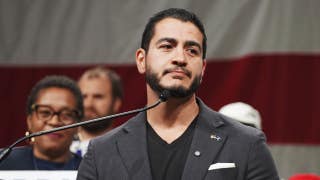
Meanwhile, just outside the White House, dozens of Obama campaign field workers and volunteers marched in favor of the public option. The protest, they said, was to remind the president of his campaign promises and to stiffen his spine in favor of declining poll numbers and a long, hot August of intense public debate over his health care initiatives.
"The president spoke at a staff party, the day he was elected and he made a promise," said Obama field organizer Mike Elk, recalling a private meeting Obama had on election night with volunteers in Chicago. "He said to all his staff gathered in this hall, over six thousand of us. He said: 'What made this campaign special was you, I'm optimistic about America because of you, If I make a mistake, you'll set me right,' Well, Mister President, we're here to set you right."
As for the stakes involved, one Democratic strategist said they could hardly be higher.
"The (Obama) speech is going to be essential to whether or not health care reform succeeds, in his presidency, " said Kathleen Strand, a key operative in Hillary Clinton's presidential campaign, now based in Chicago with the Dover Strategy Group. "Secondarily, its going to be pivotal in the outcome of the mid-term elections."
