






















Chris Stirewalt examines America's populist tradition
Fox News political editor Chris Stirewalt's new book 'Every Man a King' is a lively account of America's populist history from Presidents Andrew Jackson and Teddy Roosevelt to political powerhouses Ross Perot and Pat Buchanan.
It is a long-running game amongst armchair historians to debate which era in American history was most dangerous to our national unity since the Civil War. Certainly the span between the assassination of John F. Kennedy in Dealey Plaza on November 22, 1963, and the final helicopter taking off from the roof of the American embassy in Saigon on April 30, 1975 deserves special mention. It was certainly far worse than our current period's disheartening blend of government incapacity and authoritarianism.
But trust me when I say that what was happening in the country when Huey Long was executing his designs on the republic was far more disturbing than our current period's disheartening blend of government incapacity and authoritarianism. The period between the start of the Great Depression and the turning of the tide in World War II in 1942 was the moment of greatest danger to our system since Fort Sumter.
For three generations we have been playing with house money, enjoying the dividends of the Pax Americana. But eighty-three years ago, rebelling against the establishment meant something different. Americans today are having a pretty vigorous discussion about whether capitalism and republicanism are still working. But in the mid-1930s, there was a far better argument to say that they were not.
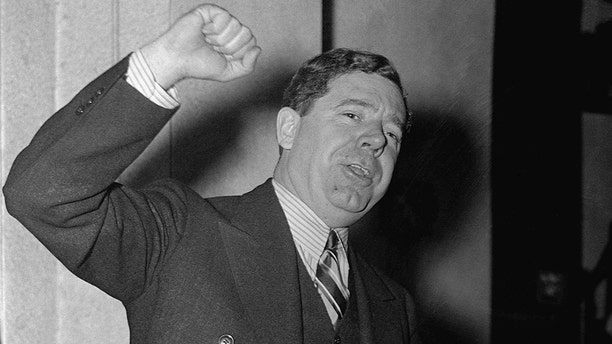
Louisiana Senator Huey Long criticizes former head of the National Recover Administration, Hugh S. Johnson, and the New Deal during a nationally broadcasted speech. (This content is subject to copyright.)
The Depression was heading into a painful second dip and Long was hardly the only voice calling for a radical departure from American norms.
Progressives had been arguing since before Woodrow Wilson ran in 1912 that a government of constitutionally limited powers was too slow, too antiquated, and too weak to meet the needs of modernity. As the dark decade of the 1930s trudged on, more Americans on the political right were starting to agree.
There could hardly be anything more blunt or simple than the idea that powerful elites were denying desperate Americans access to a simple, permanent solution to their many woes. If populism was a church, Long would have been its greatest ever preacher of the prosperity gospel.
The Nazi enthusiasts of the German American Bund claimed two hundred thousand members; and luminaries like Henry Ford, Charles Lindbergh, and Joseph Kennedy expressed admiration for the pseudoscientific pragmatism of European fascism.
Many of the same folks who admired MacArthur for rolling tanks on a shanty village by the banks of the Potomac thought that maybe we needed a generalissimo here—that liberty was simply not suited to either the chaos or the efficiency of the modern era.
A consensus between voices on the right and left was starting to emerge that a system arranged around protecting individual liberties was no longer sustainable. The disagreement was over what to replace it with.
It was not quite clear to anyone, Long included, exactly what his alternative system was. Step one was to install Long as ruler, step two was to confiscate all fortunes of more than $8 million for redistribution among the poor, and step three ... well, we'd just have to sort that out later.
"Every man a king," Long said, "so there would be no such thing as a man or woman who did not have the necessities of life who would not be dependent upon the whims and caprices and ipse dixit of the financial barons for a living."
Long surely knew he was mostly ipse dixit-assertions made but not proved-himself. But he also understood the awesome power of the new mass medium of radio, especially for blunt, simple ideas.
And there could hardly be anything more blunt or simple than the idea that powerful elites were denying desperate Americans access to a simple, permanent solution to their many woes. If populism was a church, Long would have been its greatest ever preacher of the prosperity gospel.
Free money, it turns out, has always been pretty popular.
And as an expert at grabbing attention, Long would know. Since the moment he arrived in the Senate in 1932, the gentleman from Louisiana was an instant hit with the Washington press corps. Long had actually won the seat in 1930, but he left it vacant for more than a year so he could remain governor long enough to smite the last of his political enemies back home.
In fact, the 1930 campaign had been an improvisation. Long was stymied by a state legislature that was growing less afraid of his political power. So the governor used his smashing victory in the Senate run as a show of political strength.
And while he surely was popular, Long wasn’t taking any chances on how smashing his victory would be. Long historian Richard White wrote that in one parish “the official record indicated that voters marched to the polls in alphabetical order.”
When Huey Pierce Long smote you, he expected you to stay smote.
But now Long had a problem. Unlike Lyndon Johnson, who had the foresight to ram through a law in Texas letting him seek two federal offices simultaneously ahead of his 1960 vice presidential run, Long was going to have to choose. The Senate win had proven his clout, yes, but it meant that he was going to have to give up the governorship that made him “the Kingfish.”
From the tips of his gangster-chic two-tone spectator shoes to the straw boater hat perched atop his well-oiled locks, Long was a thirty-nine-year-old walking, talking outrage generation machine.
The fight was a wild one. At one point Long even dispatched the state's National Guard to cordon off the capitol and governor's mansion from his own lieutenant governor to keep him from taking power. Eventually, though, Long got a more obedient crony set up as the new lieutenant governor and had another devotee ready to run with the backing of the Long machine when the term ended in 1932.
Satisfied that he would retain power of the governorship if not the title of governor, Long finally was ready to head to Washington.
He made up for lost time and quickly figured out his new national audience. Reporters stuck in Senate hearings and debates, then as now, always gobble up good copy. And the man they dubbed, in a groaner among all groaners, the "Terror of the Bayous" dished it out.
From the tips of his gangster-chic two-tone spectator shoes to the straw boater hat perched atop his well-oiled locks, Long was a thirty-nine-year-old walking, talking outrage generation machine.
Long insulted his enemies with deadly accuracy and unusual coarseness. A Louisiana politician who opposed his agenda and who was known to have gastrointestinal troubles was dubbed "Whistle Britches." Long called the Constitutional League that was formed to oppose his many, many usurpations "the Constipational League." Whatever else Long was, he was funny as hell.
He also knew one of the first rules for getting coverage in Washington: Bash your own team. Long savagely attacked his own party, blocking Democratic measures with his famous filibusters. If Americans knew well enough what a filibuster was for one to be the centerpiece of "Mr. Smith Goes to Washington" in 1939, Frank Capra could thank Long.
Long eventually resigned all his committee appointments in protest of Majority Leader Joe Robinson, who Long said was a crook in the employ of his former corporate clients. Robinson’s real mistake was trying to outdo Long. The Democratic leader quickly found himself out-demagogued by maybe the best in American history.
[…]
We have fallen for many silly fads over the generations. Americans love a good salesman, and our devotion to get-rich- quick schemes and miracle cures is evidence of gullibility, yes, but also of optimism. We may get suckered into shortcuts to El Dorado, but we still think there’s a city of gold out there somewhere. Things generally do not end well for those who prey on such hopes, though. And so it was for Long.
He returned to Baton Rouge at the end of the long, hot summer of 1935 to reimpose himself on his subjects. He stayed late at the skyscraper statehouse he had built as a monument to himself. He was bossing through a legislative package designed, of course, to tighten his machine's grip on power by removing anti-Longite judge Benjamin Pavy from his post.
Walking out with his goon squad around him, Long was confronted by Pavy's son-in-law, twenty-eight-year-old Dr. Carl Weiss. Long had already discharged Weiss's in-laws from teaching jobs in public schools and even suggested that Weiss's wife was the illegitimate product of the judge's consorting with a mixed-race woman.
Weiss fired four shots at Long, whose bodyguards responded with a hail of bullets. When they picked up the dead doctor's body and the slugs fell out, one observer said that it sounded like someone had dropped a handful of gravel on the smooth marble floor.
Long held on for two days but, in a most fitting turn, died at the hands of an unqualified quack whom he had installed for patronage purposes as the official state physician.
[…]
It would be unfair to say that Long was insincere in his beliefs, but there’s no doubt that both he and his audience were aware to a degree that there was a con going on.
Consider the nickname he embraced. The Kingfish was a character on the most popular program of the day, the radio minstrel show "Amos ’n’ Andy."
Amos and Andy were unwitting country boys from Georgia who were trying to navigate life in the big city of Chicago. And George Stevens was “the Kingfish” at the Mystic Knights of the Sea lodge. He used his position to trick and bully the unwitting protagonists into all sorts of trouble.
That Long would embrace a comparison to such a character is striking, but more striking was that his supporters would, too. They knew that Long was corrupt, dishonest, and in possession of a wide authoritarian streak. But they believed that he was one of them and was using his powers, at least sometimes, to get for them.
Did the women who bought patent medicine from Long as a young man believe that Wine of Cardui was a miracle cure? How many of them knew the racket and understood that it was a legal, societally acceptable way to buy booze? How many of them took very lightly the claims of the maker and its young salesman? How many enjoyed the medicine show or the sales pitch more than they liked the product?
America might have elected president a man who embraced his conman status well enough to take the nickname of a hustler from a comedy series. If the Depression had gotten even deeper, if Roosevelt faltered, if the world hadn't been looking so ominous, anything might have been possible for a politician of Long's gifts. But to allow him to become a dictator?
Germany and Italy had weak institutions, little history of self-governance, and they had been ravaged by war in profoundly damaging ways. America, on the other hand, could afford a little foolishness.
The above is an excerpt from Every Man A King: A Short, Colorful History of American Populists by Chris Stirewalt, reprinted by permission of Twelve/Hachette Book Group. All rights reserved.
