
Artemis II astronauts begin journey home amid historic lunar mission
The Artemis II astronauts completed their lunar mission late Monday, traveling deeper into space than any human in history ad revealing views of the far side of the moon never seen with human eyes until now. President Donald Trump spoke with the crew as they continued their spaceflight, telling them, "Your mission paves the way for America's return to the lunar surface very soon."
Coverage for this event has ended.
NASA kicks off Artemis III timeline, begins early prep as crawler heads to launchpad
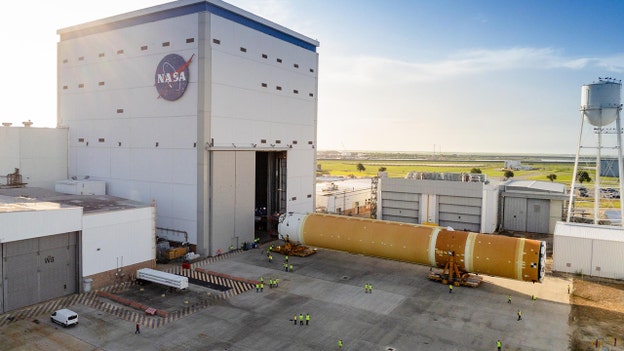
While the historic Artemis II mission enters its final days returning to Earth, NASA announced Tuesday that the agency is already accelerating the timeline for its next mission, signaling a shift away from its traditional, linear approach to spaceflight.
NASA Administrator Jared Isaacman confirmed that the agency’s crawler — the massive track-laying vehicle used to transport rockets — is already rolling to launchpad 39B at the Kennedy Space Center to retrieve the mobile launcher used for Artemis II.
“We've got other things to get done, including thinking about Artemis III,” he said. “It's why I was very happy that the crawler is making its way out to 39 B right now.”
By starting logistical preparations for Artemis III early, NASA expects to reduce turnaround time between missions by roughly three months, marking a significant improvement over the typical gap between launches.
“We've got a timeline to get it back in the VAB, ideally in a week,” he said, referring to the Vehicle Assembly Building, where the launcher is refurbished and prepared for future missions.
“That would cut down on the turnaround, I think, by three months compared to Artemis II. So, we can undertake, again, world-changing missions like Artemis II right now and get ready for the next ones at the same time.”
Artemis III is currently targeted for 2027 and is expected to test rendezvous and docking operations between Orion and commercial lunar landers, including those being developed by SpaceX and Blue Origin, capabilities essential for safely landing astronauts on the Moon.
Artemis II crew fires up critical burn to fine-tune path home toward Earth

The Artemis II crew on Tuesday successfully initiated its Return Trajectory Correction Burn (RTCB), a key maneuver used to fine-tune Orion’s path back to Earth during the mission’s return leg.
Orion’s thrusters ignited at approximately 8:03 p.m. ET, marking the first of three planned trajectory correction burns.
Artemis II crew confirmed that “they also saw a good Return Trajectory Correction 1 burn," mission control said.
RTCB is a simple but critical engine adjustment that ensures the spacecraft reenters Earth’s atmosphere at the precise angle required for a safe splashdown. The crew is expected to land in the Pacific Ocean near San Diego on Friday.
Artemis II data to be released in detailed reports 6 months after splashdown

NASA said Tuesday that the agency will compile all the data collected during the Artemis II lunar flyby into comprehensive reports, expected to be released within six months after the mission.
Two reports — prepared with the collected audio, images, and annotation — will be released, with one describing preliminary lunar science findings, and another detailing how the team was structured to integrate with flight operations.
“We will be getting all mission data relevant to lunar science archived and made publicly available within six months post splashdown,” NASA lead Dr. Kelsey Young said, referring to the four astronauts’ expected return to the Pacific Ocean near San Diego on April 10.
She emphasized that the mission was designed to maximize scientific value for future lunar missions and expressed eagerness to see how the public and scientific community will use the reports.
“We are going to be going objective by objective with those ten lunar science objectives,” she said about the lunar observation tasks. “Looking across this entire, really rich, robust, but very large data set and really trying to understand what data we got relevant to each objective, but set up the community for success so that they can access those data and help us answer these fundamental driving science questions.”
“We're really eager to see what the community is able to do with these data,” she said.
Wiseman’s late wife and Artemis II vehicle being submitted as moon crater namesakes

NASA said Tuesday that the Artemis II crew will be submitting names for two previously unnamed craters in the Moon’s eastern hemisphere, including proposals honoring Mission Commander Reid Wiseman’s late wife, Carroll, and the crew’s spacecraft, Integrity.
The names will be submitted to the International Astronomical Union, the sole authority that assigns designations to celestial bodies.
“The Artemis II crew, in a very poignant moment, offered proposed names for two unnamed craters,” NASA lead Dr. Kelsey Young said during a press conference. “Crater Integrity for their vehicle and Crater Carroll for Commander Wiseman's late wife.”
“Upon return, the crew does plan to submit these to the International Astronomical Union as consideration for official names.”
Carroll, who died in 2020 following a five-year battle with cancer, was previously described as a beloved member of the “close-knit astronaut family.”
Artemis II crew continues limiting toilet use aboard Orion spacecraft

NASA said that the toilets on the Orion spacecraft remain operational, although the Artemis II crew must limit their use to keep the system running smoothly.
Flight Director Rick Henfling provided the update Tuesday after the toilet previously experienced major vent issues, when suspected ice and frozen urine blocked the wastewater vent line, prompting the crew to use heaters and other methods to melt and clear the blockage.
“The toilet remains operational,” Henfling said during a press conference. “The challenge that we're working through is evacuating the wastewater tank. The vent is a lot less than we were expecting."
“So, we're having to fall back to some other alternate means other than the toilet,” he said, referring to backup urine collection devices.
He added that by using the system less frequently, the crew does not need to maintain the internal holding tank on a daily basis.
“With a lower use rate, since we're not able to to vent the the waste water products, we don't need to do the maintenance as often.”
Artemis II crew says spacecraft still well packed with food as mission nears final days
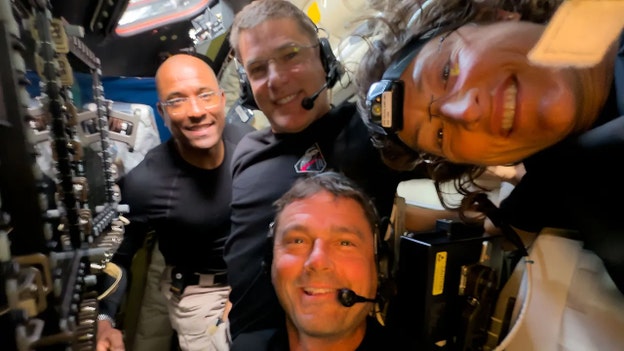
The Artemis II crew indicated Tuesday that the spacecraft’s pantry remains well-stocked, with crewmembers having used only about 40% of their total Bulk Overwrap Bags (BOBs) as they entered Day 7 of the 10-day mission.
“We are working our way through BOBs but we are nowhere near completing all the food onboard,” Canadian Space Agency astronaut and Artemis Mission Specialist Jeremy Hansen said during a call with Mission Control.
“For instance, I went through an inventory of my food today, and I have about, I expect to have one and a half BOBs remaining at the end of the flight.”
“We will go and do a pretty good inventory,” he added. “Overall, I'd say we're probably 40% through the total food allotment right now.”
BOBs, which are bundles of individual food packets, typically provide two to three days’ worth of meals for a single crewmember, according to NASA.
Artemis II astronaut Christina Koch says Earth suspended in deep space reveals ‘how alike we are’

Artemis II Mission Specialist Christina Koch said one of the most striking realizations of her Moon mission was seeing Earth suspended in the vast darkness of space, uniting billions of people at a single point in the universe, and underscoring just “how alike we are.”
She shared the reflection during Tuesday’s historic call between the Artemis II crew and the International Space Station.
“The thing that changed for me, looking back at Earth, was that I found myself noticing not only the beauty of the Earth, but how much blackness there was around it and how it just made it even more special,” Koch said to ISS.
“It truly emphasized how alike we are, how the same thing keeps every single person on planet Earth alive. We evolved on the same planet. We have some shared things about how we love and live that are just universal, and the specialness and preciousness of that really is emphasized when you notice how much else there is around it.”
NASA Administrator Jared Isaacman describes Artemis II-ISS exchange ‘touching’ in historic moment
NASA Administrator Jared Isaacman described Tuesday’s historic ship-to-ship call between Artemis II and the International Space Station as filled with “touching moments.”
The milestone exchange came during a 15-minute, audio-only call between the Artemis II crew — Reid Wiseman, Victor Glover, Christina Koch and Canadian crewmember Jeremy Hansen — and the orbiting ISS crew, including NASA astronauts Jessica Meir, Jack Hathaway and Chris Williams, along with Sophie Adenot of the European Space Agency.
During the call, the crews shared insights and experiences from their respective missions, offering a rare, real-time connection between astronauts in deep space.
“Just listening to that phone call covering that ship-to-ship communication, covering everything from technical conversations between astronaut professionals to some very human things, like what they're eating together and their friendship that obviously existed together in training and bringing up to space,” Isaacman said on Fox News. “They all had some really touching moments as it relates to this mission.”
He also commended the astronauts for undertaking the mission, saying he personally saw them during the walkout as they said goodbye to their families, praising their willingness to accept the risks in pursuit of something bigger than themselves.
“They certainly understand the risks that they’re taking on in a mission like this,” Isaacman said. “But they know, it's for something bigger, bigger than themselves and bigger than this mission. It’s about American leadership in space. It's about humanity’s goals to explore out amongst the very last frontier.”
Crew says ‘every single thing’ learned on ISS proved useful for Moon mission

The Artemis II crew said that virtually everything they learned during their time aboard the International Space Station (ISS) was carried forward to the Moon mission.
In a historic linkup, the Artemis II crew spoke to their colleagues aboard the ISS on Tuesday.
“Basically every single thing that we learned on ISS is up here,” Artemis Mission Specialist Christina Koch said.
She added that witnessing previous high-stakes events — such as spacewalks performed by other astronauts — also reinforced the flight operations principles necessary for Artemis II.
Beyond technical skills, she highlighted the importance of the "funny and practical" side of microgravity.
“There's the funny and practical, how to eat, how to do silly things with water, how to flip around,” Koch said. “We're bringing that with us to.”
Artemis II leaves lunar sphere of influence, returns to Earth's gravitational pull
The Artemis II crew is leaving the lunar sphere of influence as the astronauts continue their journey back toward Earth, NASA announced on Tuesday afternoon.
“We anticipate that the Orion spacecraft has now departed the lunar sphere of influence — this is when the gravitational pull of the Moon is stronger than the gravitational pull of Earth,” the space agency said.
The crew is expected to splashdown in the Pacific Ocean near San Diego on April 10, nine days after launching into space from Florida.
Photo highlights ‘complexity’ of moon’s rugged surface on far side, NASA says

A new photo from Artemis II captured the far side of the moon in a new light, highlighting its rugged topography in ways that are rarely visible, NASA said Tuesday.
In the photo taken Monday, part of the moon is captured as it comes into view along the terminator, which NASA described as “the boundary between lunar day and night — where low-angle sunlight casts long, dramatic shadows across the surface.”
“This grazing light accentuates the Moon’s rugged topography, revealing craters, ridges, and basin structures in striking detail,” the space agency said.
The photo shows features such as Jule Crater, Birkhoff Crater, Stebbins Crater and surrounding highlands, according to NASA.
“From this perspective, the interplay of light and shadow highlights the complexity of the lunar surface in ways not visible under full illumination,” it said.
New photo shows Earth setting behind moon minutes before Artemis II fully passes to its dark side

NASA has shared a close-up view from the Orion spacecraft during the Artemis II crew’s lunar flyby, capturing a total solar eclipse from a new vantage point.
In the photo taken Monday, only part of the moon visible in the frame as it fully blocks out the sun.
“Although the full lunar disk extends beyond the image, the Sun’s faint corona remains visible as a soft halo of light around the Moon’s edge,” NASA said.
“From this deep-space vantage point, the Moon appeared large enough to sustain nearly 54 minutes of totality, far longer than total solar eclipses typically seen from Earth,” the space agency continued.
The cropped perspective of the photo emphasizes the scale of the alignment and reveals subtle structure in the corona that the crew observed, according to NASA.
“The bright silver glint on the left edge of the image is the planet Venus,” NASA said. “The round, dark gray feature visible along the Moon’s horizon between the 9 and 10 o’clock positions is Mare Crisium, a feature visible from Earth. We see faint lunar features because light reflected off of Earth provides a source of illumination.”
NASA shares new photo of total solar eclipse, planet Venus during Artemis II lunar flyby

NASA has shared a close-up view from the Orion spacecraft during the Artemis II crew’s lunar flyby, capturing a total solar eclipse from a new vantage point.
In the photo taken Monday, only part of the moon visible in the frame as it fully blocks out the sun.
“Although the full lunar disk extends beyond the image, the Sun’s faint corona remains visible as a soft halo of light around the Moon’s edge,” NASA said.
“From this deep-space vantage point, the Moon appeared large enough to sustain nearly 54 minutes of totality, far longer than total solar eclipses typically seen from Earth,” the space agency continued.
The cropped perspective of the photo emphasizes the scale of the alignment and reveals subtle structure in the corona that the crew observed, according to NASA.
“The bright silver glint on the left edge of the image is the planet Venus,” NASA said. “The round, dark gray feature visible along the Moon’s horizon between the 9 and 10 o’clock positions is Mare Crisium, a feature visible from Earth. We see faint lunar features because light reflected off of Earth provides a source of illumination.”
Retired astronaut highlights how the Artemis II crew will return to Earth
A retired NASA astronaut gave expert insight into how the Artemis II crew will make its return to Earth after completing their lunar loop around the moon.
Butch Wilmore, also a Fox News contributor, told “America’s Newsroom” on Tuesday that reentry into the Earth’s atmosphere must be “very precise” and the crew will reach tremendous speeds as the Earth’s gravity begins to pull them toward home.
“As they start to trek back towards Earth, the gravitational pull of the Earth is going to pull them in and they’re going to come faster, and faster and faster,” Wilmore said.
Wilmore, who has logged more than 464 days in space across three missions, said the crew will be traveling at about 25,000 miles per hour, a speed faster than seven miles a second, when they start reentering Earth’s atmosphere.
“I’m not sure if they’ll break the record for the fastest humans ever, but there’s a good chance they will,” he said. “Time will tell.”
Wilmore said that the crew will have a “very narrow window to reenter the atmosphere,” which they’ll have to hit at a precise angle, “firing those thrusters to get them on that exact trajectory.”
“If you’re too shallow, way too shallow,” Wilmore warned, “then you skip off the atmosphere … and you just keep going.”
The Artemis II capsule is aiming for a splashdown in the Pacific Ocean near San Diego on April 10, nine days after the crew launched the mission from Florida.
Artemis II astronauts requested moon crater to be named after late wife of commander Reid Wiseman
Before embarking on the historic lunar flyby on Monday, the Artemis II crew spoke to Mission Control and asked to name a crater on the moon after the late wife of the mission’s commander, Reid Wiseman.
The crew had requested permission to name two bright, freshly carved craters.
One crater was suggested to be called Integrity, the name the crew gave their Orion capsule. The other was Carroll, after commander Wiseman’s wife who died of cancer in 2020.
Wiseman wept as Canadian astronaut Jeremy Hansen put in the request to Mission Control, and all four astronauts embraced in tears.
“Such a majestic view out here,” Wiseman radioed once he regained his composure and started picture-taking.
The astronauts called down that they managed to capture the moon and Earth in the same shot, and they provided a running commentary to scientists back in Houston on what they were seeing.
The Associated Press contributed to this report.
Solar eclipse from far side of moon revealed in first images from Artemis II
A total solar eclipse from the far side of the moon is seen in a first-of-its-kind photo taken during the Artemis II lunar mission.
The White House shared the photo from NASA, which was taken Monday, in a post on X.
“Totality, beyond Earth,” the post read. “From lunar orbit, the Moon eclipses the Sun, revealing a view few in human history have ever witnessed.”
The astronauts ensured themselves the cosmic view from behind the moon by launching the mission last Wednesday.
The Artemis II crew began studying solar eclipses in the few weeks before their space journey after already spending years learning lunar geography to prepare for the mission.
White House shares first Artemis II photo of Earth from far side of the moon
The first Artemis II photo of the Earth seen with human eyes from the far side of the moon was revealed on Tuesday morning.
The image, taken by NASA’s Artemis II crew on Monday, was shared by the White House in a post on X.
“Humanity, from the other side,” the post read. “First photo from the far side of the Moon. Captured from Orion as Earth dips beyond the lunar horizon.”
NASA said the photo is "reminiscent of the iconic Earthrise image taken by astronaut Bill Anders 58 years earlier as the Apollo 8 crew flew around the Moon."
The crew’s loop around the dark side of the moon came with a 45-minute communications blackout with Mission Control. The blackout, which was expected, happened as the spacecraft slipped behind the moon, losing line of sight to Earth, with the moon blocking satellite communications entirely.
The Artemis II crew went on to complete their record-breaking trip around the moon Monday, recording many scientific observations that will be shared with teams back on Earth.
The Artemis II crew is expected to discuss their observations with the lunar science team on Tuesday in a live broadcast from NASA.
Former NASA astronaut weighs in on Artemis II report that moon appeared very brown with green hues
A former NASA astronaut weighed in on the Artemis II mission to the moon and what the astronauts discovered during their lunar observations.
Jose Hernandez said it was “surreal” to witness the history-making lunar mission on Monday, recalling his own mission to space where he orbited the Earth 214 times during an appearance on “FOX & Friends First” Tuesday morning.
When asked about the astronauts’ observations of the moon appearing brown with unusual greenish hues, Hernandez said the unexpected colors are likely from light bouncing from the Earth.
“What happens is you’ve go the Earth’s shine hitting the [moon] and light bouncing out and creating these interesting hues,” he said. “You also got to see the corona of the sun as the moon blocked the entire sun and they were able to study the ages of the sun itself.”
Hernandez highlighted the mission a “new era” of space exploration that will pave the way for the establishment of a long-duration lunar base on the surface of the moon.
Trump speaks with Artemis II crew as they continue spaceflight: 'You've made history'
President Donald Trump spoke to the Artemis II crew on Monday after they completed their loop around the moon, telling them they made history as "modern-day pioneers."
"Today you’ve made history and made all of America really proud. Incredibly proud," Trump told the crew.
The president praised the four astronauts — Reid Wiseman, Victor Glover, Christina Koch and Jeremy Hansen — as "brave" and "modern-day pioneers".
"America will be second to none in space and everything else that we’re doing, and we will continue to lead the whole thing, into the stars," Trump said.
The president added that more lunar traveling is coming and ultimately "the whole big trip to Mars.”
"Your mission paves the way for America's return to the lunar surface very soon," Trump said.
The successful mission sets the stage for next year’s Artemis III, which will see another Orion crew practice docking with lunar landers in orbit around Earth. The culminating moon landing by two astronauts near the moon’s south pole will follow on Artemis IV in 2028.
Fox News Digital's Stephen Sorace and The Associated Press contributed to this report.
Artemis II astronauts report Moon appearing very brown with unusual green hues
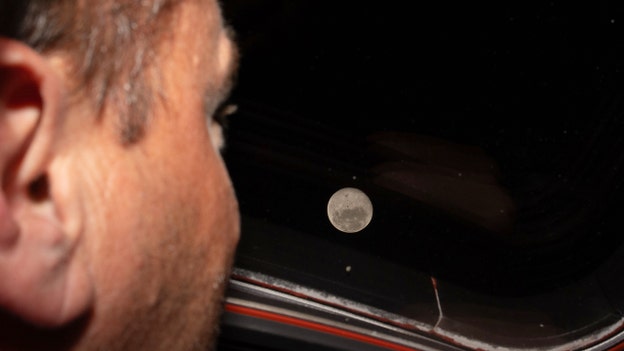
During their lunar observations, the Artemis II crew spotted unexpected colors on the Moon’s surface.
Much of the terrain appeared brown, while distinct greenish tones showed up in isolated areas.
“Something I just heard from the window team is the more I look at the moon and the browner and browner it looks, I thought that was an interesting observation,” Mission Specialist Christina Koch said during a NASA transmission.
Canadian astronaut Jeremy Hansen noted the greenish hues near the Aristarchus Plateau, a large, relatively young crater. The crew added that this coloration was unique and not seen elsewhere on that side of the Moon.
Live Coverage begins here