Artemis II astronauts now under Earth's gravity again after leaving moon's sphere of influence
The Artemis II astronauts have left the moon's sphere of influence and are now speeding back under Earth's gravitational force on Flight Day 8 of 10. A Friday splash down will welcome the crew back in a mission hailed as sending men and a woman to the furthest reaches of the solar system in human history.
Coverage for this event has ended.
NASA shares striking new photos of the moon’s far side
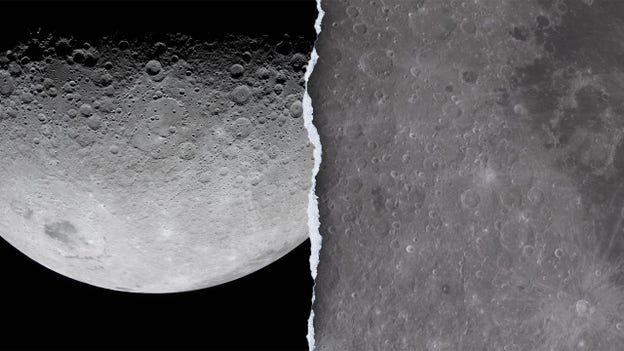
NASA released more images of the moon taken during the Artemis II mission.
"But wait, there's more!" the space agency wrote on X. "These newly released photos show off striking details on the far side of the Moon, like craters of various sizes and basins."
Earlier in the day, NASA released images of Earth, the moon and the Milky Way galaxy.
Artemis II flight director says re-entry will reach max velocity of nearly 35K feet per second
Artemis II Flight Director Rick Henfling said on Wednesday that Artemis II is predicted to reach a maximum velocity of nearly 35,000 feet per second upon re-entry.
"As far as the speed, our prediction for Artemis two, we're going to reach a max velocity of 34,965ft per second. And that is, less than the Apollo ten record of 36,397," he said at a briefing.
"The crew members are going to be heads down. That provides them a view of the horizon as they enter. If we were in a different attitude, you wouldn't have that horizon as a reference," he continued.
Artemis II flight director says they're primarily looking at wind conditions: 'Favorable conditions'
Artemis II Flight Director Rick Henfling said on Wednesday that he is "primarily looking at the wind" in the weather constraints for splashdown, adding that he believes the weather will offer "favorable conditions" for the splashdown on Friday.
"For the weather constraints for splashdown, we're primarily looking at the wind. The wind conditions," he said at a briefing. "We're looking at some of the the wave conditions. We're looking at precipitation and thunderstorms. And as of now, our forecast for our landing site is, winds out of the southwest, ten knots, waves less than four feet, with a wave period of 17 seconds."
"We're watching that cold front that I had mentioned over the past couple of days," he continued. "It's slowed down. It's also weakened in nature. And so the precipitation that we were watching is predicted is forecasted to be greater than 60 miles from the intended splashdown location. So we have some really favorable conditions should be during the day in San Diego. That cold front will push through after splashdown, but it is it's looking like we'll have some favorable conditions for a nice landing on Friday."
Henfling added, "We want to ensure that the spacecraft can still fly safely home."
"So we have some ways to alter the landing, which shortens our entry profile. We land, further up range, but they are certified spacecraft guidance, navigation and control modes that will ensure a safe landing in multiple failure condition contingencies," he said.
Canada PM Mark Carney praises Jeremy Hansen during deep-space connection

Canadian Prime Minister Mark Carney praised the Artemis II crew—and specifically Canadian astronaut Jeremy Hansen—during an audio call on Wednesday.
"The examples that you're showing of how to reach literally for the stars, reach for the Moon, and don't just be satisfied with that, because you're setting a platform for the world to go even farther," Carney said. "Canadians couldn't be more proud of you."
Hansen noted that Canada's space program must be prepared to face setbacks to ensure long-term success. "As a country, we have to have some failures... but we assure ourselves we're not going to stay or rest in those failures; we're going to push through them," he told Carney. "We have to be willing to have some failures and be okay with that, knowing that we're just going to persist and win in the final calculation."
NASA shifts focus to safe return for Artemis II crew
The primary focus of the Artemis II mission is now the safe return of its four crew members, officials stated Wednesday.
"After an exciting day of science on Monday and a day for the crew to recover and achieve other flight objectives yesterday, the team is turning our attention to the return and getting the crew safely home," said NASA Deputy Associate Administrator Lakiesha Hawkins.
Despite the priority being a safe re-entry, Hawkins noted that NASA still aims to gather as much data as possible from the final legs of the journey.
"We are thinking about what we can still learn in the remaining days to better understand the systems and to inform future missions," she said.
Artemis II maintains significant fuel reserves ahead reentry
The Artemis II mission has consumed nearly 3,000 pounds of propellant, officials said Wednesday.
"We have 4,285 [pounds] to go," said Debbie Korth, the Orion deputy program manager. "So clearly, we put a lot of margin into this mission to make sure we could fly it properly."
Artemis II crew to practice piloting maneuvers ahead of splashdown
The Artemis II crew will perform manual piloting demonstrations on Wednesday night as they begin final preparations for their return to Earth.
"One [demonstration] will be to use the docking camera to point the spacecraft toward a celestial body," said Rick Hensarling, the entry flight director for the mission. "Once that activity is complete, we're going to do another manual piloting demonstration where the crew is going to center the Earth in the field of view of one of the windows. Then, they're going to fly the spacecraft to an attitude where the tail points toward the sun."
Hensarling explained that these tests are vital for safety. "That's important to show that the flight crew can maneuver their spacecraft to... generate power so they can continue to [run] the subsystems onboard," he said.
Artemis II crew completes flywheel workouts and suit checks before return
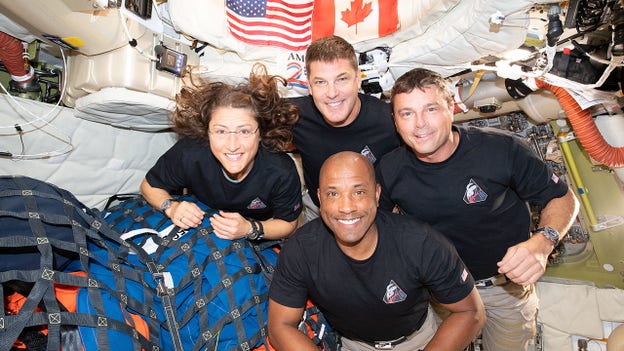
The Artemis II crew spent Wednesday completing their daily exercise regimen and various preparation tasks.
The astronauts held a flywheel exercise session, NASA said. The flywheel uses a cable-based system that supports both aerobic workouts, such as rowing, and resistive movements, including squats and deadlifts, the space agency said.
In addition, they took turns testing and evaluating orthostatic intolerance garments worn under their suits.
The garments help the astronauts maintain blood pressure and circulation during the transition back into Earth’s gravity.
Canadian PM Mark Carney to speak with Artemis astronaut Jeremy Hansen
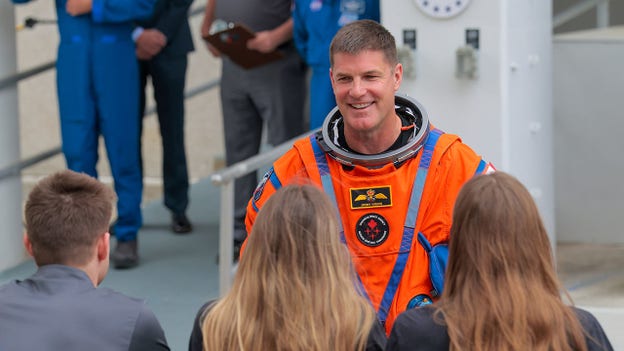
Artemis II crew member Jeremy Hansen will speak with Canadian Prime Minister Mark Carney on Wednesday night.
Hansen, a Canadian Space Agency (CSA) astronaut, will join Carney and other "special guests" for a call starting at 7 p.m. ET.
The event will be hosted by fellow CSA astronaut Joshua Kutryk.
As the CSA noted, Hansen is the first Canadian astronaut to ever venture to the Moon.
Artemis II Zero-G indicator 'Rise' carries millions of names on lunar journey
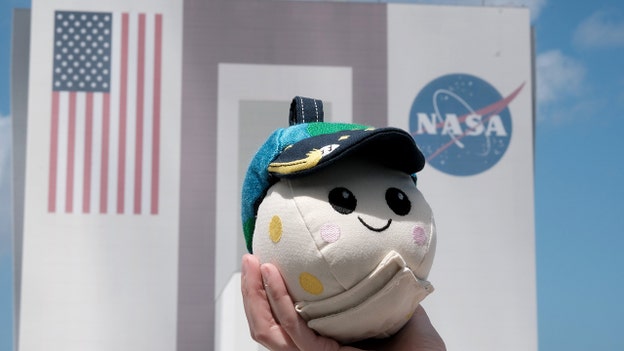
Rise, the plush "zero-gravity indicator" flying aboard Artemis II, is carrying more than 5.6 million names during the space mission.
"Did you send your name aboard Artemis II??? If you did, then your name is literally in my pocket!!" Rise wrote on X. "And every time you see me floating around the Orion spacecraft — that’s where your name is! With ME! Don’t worry — I’ve kept your names safe as I’ve flown around the Moon -Rise."
The names were submitted by people around the world through the "Send Your Name with Artemis" campaign. They then downloaded onto an SD card that is safely stored inside Rise.
The Artemis crew took the memory card and put it inside Rise.
"It was a bit more emotional than expected," said crew commander Reid Wiseman. "Just that act of seeing that little memory card with everyone's names, everyone's hopes that are going on this journey with us."
"We always say we're going for all and by all, and zipping that little pocket on the bottom of rise was kind of the moment that put it all together for me," he added.
Favorable weather forecasted for Artemis II return near San Diego
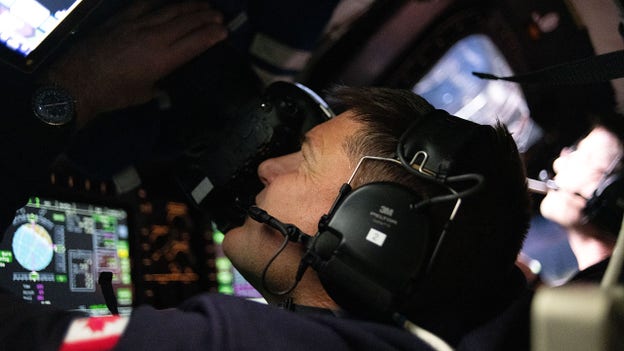
Weather conditions are expected to be favorable for the Artemis II crew's Friday splashdown off the Southern California coast.
The crew is expected to splash down in the waters near San Diego just after 8 p.m.
At the time of the landing, the weather is forecast to be around 63 degrees, AccuWeather reported.
There is a 20% chance of rain, and winds are projected to range from 7 to 15 mph. The water temperature is expected to be around 64 degrees.
Rise takes over NASA Artemis account as Orion’s 'zero-gravity indicator'
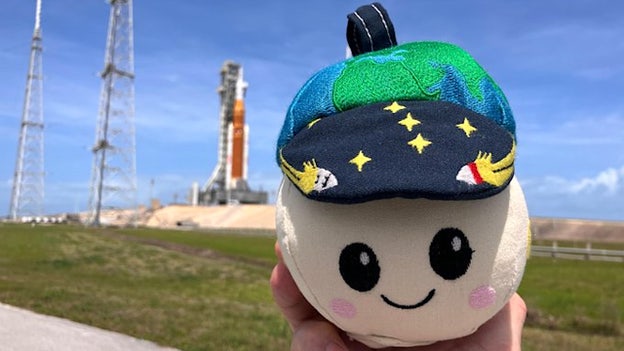
NASA’s Artemis X account handed the mic to Rise, the plush "zero-gravity indicator" flying aboard Artemis II, in a playful series of posts introducing the mission mascot and its backstory.
"I'm having so much fun in space, but I can't wait to see you again!!!" Rise posted on the X account.
In the posts, Rise says it launched “about a week ago” aboard Orion with the four Artemis II astronauts and now serves an important role on the spacecraft: floating in zero gravity to signal when the capsule has reached spaceflight conditions.
NASA also used the thread to spotlight how Rise came together. The character was designed by California student Lucas Ye, whose concept won the agency’s Moon Mascot contest. Rise was then assembled at NASA Goddard Space Flight Center, where technician Paula Cain helped build the mascot and create its custom outfit in the Thermal Blanket Lab.
One post focused on Rise’s hat, which carries symbolic mission details: rockets along the visor representing Apollo and Artemis, stars referencing the Orion constellation, and a top design evoking Earth.
Artemis II snaps interstellar photo of Milky Way galaxy on its way back to Earth

NASA released a historic interstellar photo taken from Artemis II, capturing "the breathtaking photo of our galaxy."
"Sky full of stars," NASA wrote Tuesday night on X.
"Following a successful lunar flyby, the Artemis II astronauts captured this breathtaking photo of our galaxy, the Milky Way, on April 7, 2026."
SpaceX's Elon Musk chimed in later, responding to the post.
"One day, we will be out there, among the stars," Musk wrote on X.
The Orion capsule left the moon's sphere of influence and was re-engaged by Earth's predominant gravitational pull Tuesday as the Integrity crew sped back home at more than 1,700 miles per hour.
NASA offering free wallpaper photos of moon, Earthset, historic Artemis II mission; more pics coming

NASA is offering free wallpaper images online for space fans.
"Experience the magic of our Moon mission wherever you go!" NASA wrote Wednesday on X. "Download free, mobile wallpapers and bring your device into the new era of exploration: https://go.nasa.gov/4bYzen1"
In another announcement from Mission Control Houston, the Artemis II Orion crew is sending down more photos to NASA to share on Earth.
Orion capsule now under 200,000 miles from Earth

Artemis II's Orion capsule is now under now just under 200,000 miles away from home, according to Mission Control Houston.
"It's going to be a busy day for the crew," Mission Control said, after the 11:35 a.m. ET wakeup.
"They are now in their post sleep period conducting any hygiene, configuring their cabin by putting up their window shrouds and their sleeping bags, as well as enjoying breakfast.
"Flight Day 8: On the menu for breakfast, we have couscous with nuts, vegetable quiche, granola with raisins, almonds, oatmeal and brown sugar, peanuts, strawberry, lavender, super seed protein bars and of course, some coffee."
Artemis II's 'Earthset' photo pays homage to Apollo 8’s 1968 'Earthrise'

NASA's Earthset images from Artemis II pays homage to Apollo 8’s iconic 1968 'Earthrise' shot.
Taken a day after the spacecraft’s lunar flyaround, the photos include an “Earthset” before the Earth sank below the moon's horizon from the view of Artemis II's Orion capsule as seen by the Integrity crew.
The four-member Integrity crew — three Americans and one Canadian — is now heading back to Earth at more than 1,700 miles per hour, with splashdown in the Pacific scheduled for Friday.
As the astronauts return home, scientists in Houston are analyzing the stream of lunar images sent back from the mission.
The parallels with Apollo 8 are significant. That 1968 mission carried the first humans to the moon and produced the Earthrise photo, which became an enduring symbol of the environmental movement.
Artemis II now links a new generation of astronauts to that legacy.The mission is a major milestone in NASA’s Artemis program and a key step toward sending another crew to the lunar surface within two years.
The Associated Press contributed to this report.
USS John P. Murtha will receive Artemis II astronauts in Pacific
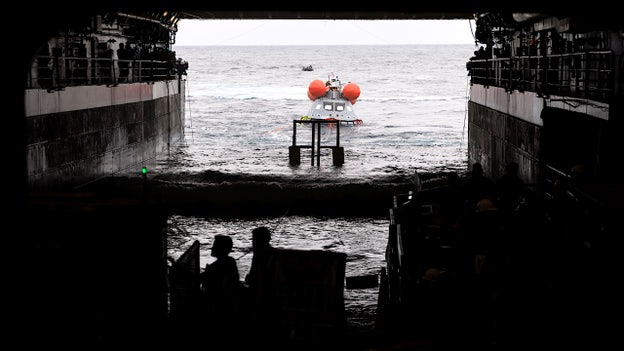
The San Diego-based USS John P. Murtha will recover NASA’s four Artemis II astronauts when their Orion capsule splashes down in the Pacific Ocean west of San Diego on Friday at 8:07 p.m. ET, according to the U.S. Navy.
Commanding Officer Capt. Erik Kenny said the crew is "honored" to support NASA and the Artemis II mission.
The amphibious transport dock ship, LPD 26, has been designated as the recovery vessel for the mission’s return.
The 684-foot John P. Murtha is well suited for the job because it has a well deck, helicopter pad, onboard medical facilities and communications systems needed for astronaut and spacecraft recovery.
For the recovery operation, MH-60S Sea Hawk helicopters from Helicopter Sea Combat Squadron 23 will track Orion during reentry and help transport the astronauts after splashdown.
Navy divers from Explosive Ordnance Disposal Group 1 will recover the capsule from the ocean and move it into the ship’s well deck, while a dive medical team will help assess the crew after they exit the spacecraft.
The ship has also been conducting mission-specific preparation.
The Murtha has been underway in the U.S. 3rd Fleet area of operations performing just-in-time training in support of the Artemis II recovery mission.
It departed Naval Base San Diego on Monday to travel to 50 to 60 miles offshore where Orion will touch down with the use of 11 parachutes.
"I'll breathe easier when we get through reentry and everybody’s under chutes and in the water," NASA Administrator Jared Isaacman said at Tuesday's news conference.
Day 8 schedule features testing, experiments, evening news conference
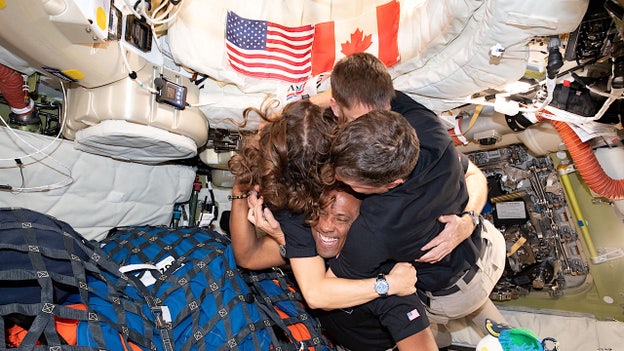
The Artemis II crew is continuing its return journey to Earth at more than 1,700 miles per hour with a schedule focused on safety testing, spacecraft operations and public updates.
NASA said the astronauts will spend part of the day conducting experiments to analyze radiation levels inside Orion. The Integrity crew will also use onboard supplies and equipment to assemble a shelter and test procedures designed to protect them during high-radiation events such as solar flares.
Later in the day, the astronauts will test Orion’s manual piloting capabilities. The flight test will include steering the spacecraft through a series of tasks, centering a selected target in Orion’s windows, moving into a tail-to-Sun position and carrying out additional maneuvers.
NASA officials are set to provide a mission status briefing from Johnson Space Center in Houston at 5 p.m. ET.
The Artemis II crew will then hold a news conference at 9:45 p.m. ET and answer questions from reporters.
At 10:55 p.m. ET, the crew will begin the manual piloting flight tests.
NASA reveals Orion Integrity crew's wake-up playlist
Space missions run on precision, discipline, and checklists. But they also run on morale.
That is part of what makes the Artemis II wake-up playlist such a fun window into life aboard Orion.
NASA published an “Artemis II Wake-Up Songs” playlist on Spotify, built around the daily music tradition that has long been part of crewed spaceflight.
"Rise and shine, space fans!" NASA posted Wednesday morning on X. "The official Artemis II wake‑up song playlist is here: https://open.spotify.com/user/nasaspotify"
"Stay tuned to find out the crew’s picks for the rest of the mission."
The Tuesday morning playlist included “Sleepyhead” by Young & Sick, “Green Light” by John Legend featuring André 3000, “In a Daydream” by Freddy Jones Band, and “Pink Pony Club” by Chappell Roan.
The wake-up time was 11:35 a.m. ET on Wednesday.
"Today's wakeup music was 'Under Pressure' by David Bowie and Queen," Mission Control Houston said at 11:39 a.m. ET.
"Artemis II is just a couple of days away from splashdown—and as Earth grows larger in the mission's sights, the crew woke up this morning to 'Under Pressure,' by Queen and David Bowie, and greetings from our colleagues at @csa_asc," NASA wrote on X.
During mission audio Tuesday, the crew was also said to have awakened to “Tokyo Drifting” by Glass Animals and Denzel Curry.
Integrity, ISS crews joke about racing inside space craft to set historic 'furthest' milestones
Both Orion's Integrity and the International Space Station crews joked Tuesday night in a historical space-to-space call that they were elbowing each other to set milestones of going distances where no man or woman has gone before.
"We like to joke about that up here, too, because everyone's talking about the records of the distance," ISS Commander Jessica Weir told Artemis II Commander Reid Wiseman and her fellow former ISS resident Christina Koch.
"And we ran to the far end of the space station when you guys were on the other side, so that we could claim we were the furthest away from you in that moment.
"I love all four of you so, so much."
Wiseman replied with a joke in kind.
"We were doing the same shenanigans here when we got to the furthest point from the moon," he said. "I tried to get to the furthest point from Earth. I tried to get to the furthest point in the spacecraft, and my roommates were clawing me down.
"I know, that's a joke. We were busy doing science, but we had that same conversation. It was a lot of fun."
Wiseman turned more serious, thanking the seven-member ISS crew for the historic call.
"I don't know how much longer we have here, but from the four members of the spacecraft integrity, we really want to just say our deepest appreciation to the seven members of the International Space Station," he concluded. "This has been a true treat. iIt takes the entire world to do amazing things like this and to get to come together as this group of people, and talk for just a minute at these distances.
"We are all off the planet Earth right now, and we're all going to go home to that planet, and that is a very special thing. So thank you all for tying in."
For Koch and Meir, it marked a joyous space reunion despite being 230,000 miles (370,000 kilometers) apart. The two teamed up for the world’s first all-female spacewalk in 2019 outside the orbiting lab.
Koch told her “astro-sister” that she’d hoped to meet up with her again in space “but I never thought it would be like this — it’s amazing.”
The Associated Press contributed to this report.
Artemis jokes its going to run into Earth as it grows before their eyes: 'It does bend your mind'
Artemis II Commander Reid Wiseman joked with the astronauts aboard the International Space Station in a rare ship-to-ship call that the Orion capsule looked headed for a crash course with Earth.
"When we were about 5 or 6,000 miles up from the Earth, looking at the entire Earth just growing rapidly in the window, Jeremy [Hansen] turns around to us, he goes, 'I'm not sure; I think we're going to run right into it,'" Wiseman said.
"We were all dying laughing, and it was the most fascinating thing to watch that Earth grow."
Wiseman noted the Orion capsule recorrected from a trajectory pointing at the top half of Earth to the bottom half.
"So it is crazy up here, and it does bend your mind," he said.
Artemis II crew shares emotional space-to-space call with the International Space Station
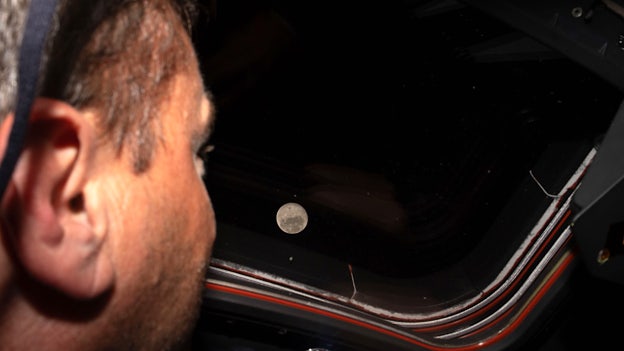
The Artemis II crew shared an emotional ship-to-ship call with astronauts aboard the International Space Station, creating one of the mission’s most human moments as both crews connected from different corners of space.
"So we have a view right now, and it is making us so excited: We feel like you're here with us, and this is really just making our entire week right now," ISS NASA astronaut Jessica Meir told Artemis II's Integrity crew.
The event came as Artemis II was on its return leg to Earth after a lunar flyby, with the spacecraft more than 200,000 nautical miles away from home.
"We have been waiting for this like you can't imagine," Artemis II Commander Reid Wiseman told Expedition 74. "We are 201,726, now 25, nautical miles from planet Earth, which is just hard to believe. The scales are impossible to believe."
During the exchange, the Orion crew aboard Integrity spoke with the seven Expedition 74 crew members living and working aboard the station, with both sides reflecting on the wonder of spaceflight, the meaning of exploration, and the rare experience of talking to fellow astronauts while all of them were off the planet at the same time.
"So we can tell that you guys are definitely experiencing moon joy, and I feel like even we are experiencing moon joy right now," Meir said.
Artemis II enters Flight Day 8 of 10 after leaving moon's sphere of influence
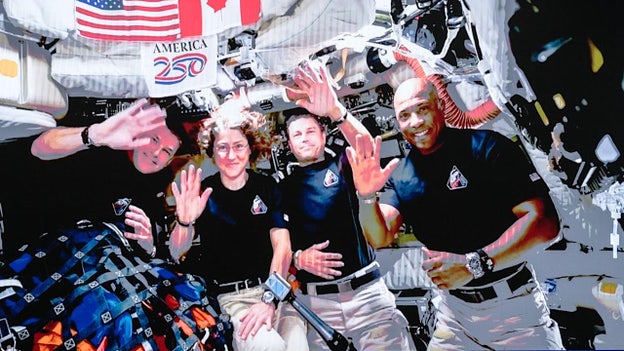
Artemis II enters Flight Day 8 early Wednesday after the Orion capsule exited the moon’s sphere of influence Tuesday at 1:23 p.m. ET, placing the spacecraft back under Earth’s dominant gravity for the final leg of its return journey.
"Earth is pulling us back and we are happy about that," Commander Reid Wiseman said Tuesday.
The four-astronaut crew, sleeping until an 11:35 a.m. ET wakeup, is now headed toward a planned Pacific splashdown off San Diego on Friday, April 10, after a historic lunar flyby that sent humans farther from Earth than ever before.
The Orion capsule is expected to hit the water at approximately 8:07 p.m. ET, following the crew module separation and re-entry process beginning at 6:33 p.m. ET.
NASA said the crew remained safe and the capsule continued to perform well following its passage behind the moon, which included a brief communications blackout and views of the lunar far side.
The mission has followed a free-return trajectory, using the moon’s gravity to slingshot Orion back toward Earth while conserving fuel.
As re-entry approaches at over 1,700 miles per hour, the astronauts are resting and preparing for splashdown, capping a milestone voyage in NASA’s Artemis program.
NASA kicks off Artemis III timeline, begins early prep as crawler heads to launchpad
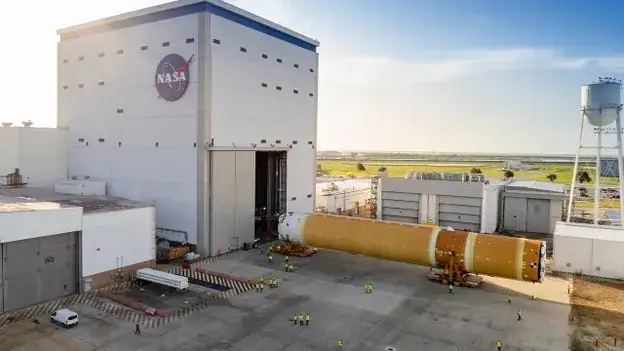
While the historic Artemis II mission enters its final days returning to Earth, NASA announced Tuesday that the agency is already accelerating the timeline for its next mission, signaling a shift away from its traditional, linear approach to spaceflight.
NASA Administrator Jared Isaacman confirmed that the agency’s crawler — the massive track-laying vehicle used to transport rockets — is already rolling to launchpad 39B at the Kennedy Space Center to retrieve the mobile launcher used for Artemis II.
“We've got other things to get done, including thinking about Artemis III,” he said. “It's why I was very happy that the crawler is making its way out to 39 B right now.”
By starting logistical preparations for Artemis III early, NASA expects to reduce turnaround time between missions by roughly three months, marking a significant improvement over the typical gap between launches.
“We've got a timeline to get it back in the VAB, ideally in a week,” he said, referring to the Vehicle Assembly Building, where the launcher is refurbished and prepared for future missions.
“That would cut down on the turnaround, I think, by three months compared to Artemis II. So, we can undertake, again, world-changing missions like Artemis II right now and get ready for the next ones at the same time.”
Artemis III is currently targeted for 2027 and is expected to test rendezvous and docking operations between Orion and commercial lunar landers, including those being developed by SpaceX and Blue Origin, capabilities essential for safely landing astronauts on the Moon.
Live Coverage begins here