
Artemis II astronauts describe 'unbelievable' lunar eclipse ahead of re-entry, splashdown
Artemis II's journey back to Earth continues on Flight Day 9 of 10. Never seen before images from the dark side of the moon continue to be downlinked from Orion by the Integrity crew, which held a news conference with reporters Wednesday night.
Coverage for this event has ended.
Jaw-dropping video shows solar eclipse from space during Artemis II mission
NASA shared stunning video Thursday of a solar eclipse from space, which was captured during the ongoing Artemis II mission.
The agency stitched together views from Orion's solar array wing cameras throughout the eclipse.
Video showed the sun as it disappeared behind the moon, revealing a glowing halo around the lunar disk.
Astronaut’s daughter goes viral celebrating dad’s moon mission: 'Biggest flex ever’

As Artemis II races toward a historic return from the moon, it’s a daughter’s joyful, offbeat tribute to astronaut Victor Glover that’s capturing the internet’s heart.
Glover's daughter went viral on social media this week after posting a video playfully dancing while wearing a shirt donning a picture of her father in a space suit.
"When your dad successfully pilots Artemis II halfway to the moon ... & u forget the dance," Glover's daughter, Maya, wrote in an Instagram post.
The video amassed a staggering 21.9 million views on TikTok and Instagram as of Thursday afternoon, with companies including Walmart and Spotify weighing in on her parent's impressive feat.
"This quite literally makes you generationally iconic," Instagram's official account commented on the post.
Walmart added, "'yeah my dad is out of this world.'"
"He's an icon," Coach replied.
Victor Glover is the first Black astronaut to travel beyond low Earth orbit and journey to the vicinity of the moon.
Click here to read the full story.
Historic American flag from scrapped Apollo mission heads to space on Artemis II
NASA’s Artemis II astronauts recently showed off some of their historic cargo aboard the Orion spacecraft, including the American flag prepared for the canceled Apollo 18 mission.
Apollo 18 and 19 were canceled in the early 1970s as NASA shifted focus to Skylab — America’s first space station — and development of the Space Shuttle.
At the time, the U.S. had already achieved its primary goal of landing astronauts on the Moon with Apollo 11, and Congress decided to reduce NASA’s funding — redirecting resources toward new programs.
‘NASA Is Back’: GOP Rep. Mike Haridopolos hails Artemis II as America’s space comeback
Rep. Mike Haridopolos, R-Fla., who chairs House Space and Aeronautics Subcommittee, hailed Artemis II as proof that “NASA is back” as the agency’s first crewed moon mission of the Artemis era nears splashdown.
"I'll be speaking live to the astronauts [8 p.m. ET tonight]: I'm actually taking questions from my local district to ask them," Haridopolos, whose district includes Kennedy Space Center, told Fox Business' "Mornings With Maria" on Thursday.
"It's been amazing. It's been an amazing week here in Florida. This proves that NASA is back."
Haridopolos hailed "spectacular mission" of Artemis II, President Donald Trump's creating Space Force, and Trump's NASA Administrator Jared Isaacman "hitting the ground running."
"What a spectacular mission," Haridopolos told host Maria Bartiromo. "We're all Americans, we are coming back together and recognizing the power of our space industry and how it's fueling not just that goes back to the moon, but our economy is growing.
"SpaceX is doing incredible things in space that will reduce the cost of things like AI and energy," he added.
Haridopolos also spoke about the broader push to restore American leadership in space, pointing to future lunar missions, Mars ambitions and competition with China.
"It's vital not just my community, but for the entire world," he said. "Remember, America needs to dominate the moon.
"We're going to be launching rockets from the moon, going to Mars in our lifetime. It is going to be incredible. And that will lead to incredible technological changes, not just reducing energy costs, but of course, changing the way we live every day for the better.
"It's a great investment and we all get to celebrate. America can do anything."
The comments come as Artemis II closes out its historic voyage around the moon and heads for a planned splashdown off the coast of San Diego.
Dem Sen. Mark Kelly: Artemis 'really good thing for our country right now'
Sen. Mark Kelly, D-Ariz., notoriously a President Donald Trump critic and often at odds with Republicans in Congress, found a way to share some love for bipartisanship.
"I think this is a really good thing for our country right now when we are very divided politically, a lot of partisanship, it's nice to see something that's positive that we can do, coming together, that, by the way, other countries can't do," Kelly told reporters in Arizona after he participated in a roundtable discussion with business owners.
"You know, even the Chinese, even though they're trying to get to the surface of the moon and they would probably like to do it before we get back to the surface of the moon, they haven't done that yet."
The good feelings and bipartisan vibes did not last through the totality of his remarks, though. He did take a veiled shot at Trump's administration.
"This moment reminded me a little bit about what I know about 1968," Kelly continued. "I was 4 years old at the time, but when Apollo 10 went to the moon; 1968 was the year that Martin Luther King and Robert Kennedy were assassinated, and I think the Tet Offensive was going on.
"It was a bad year all around. And Frank Borman, who was an Arizonan, went to Tucson High School. He was the commander of the mission. And he got a telegram from just a regular old citizen that said, I'm paraphrasing, said, 'Thank you, you saved 1968.'
"So I think of that like this mission."
Artemis II's Orion capsule speeding up, nearly closer to Earth than the moon again
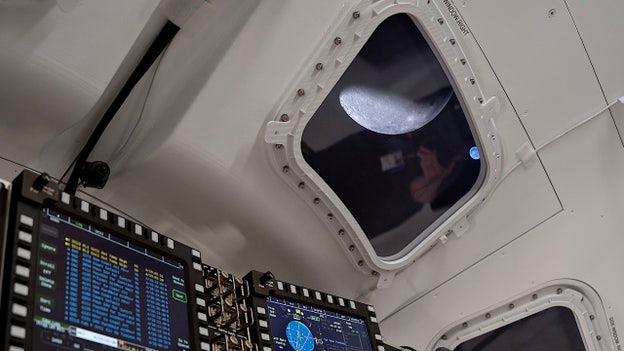
NASA’s Orion spacecraft is picking up speed on its return to Earth, moving at 2,808 mph as of 12:50 p.m. ET as the planet’s gravitational pull continues to build.
The Artemis II capsule was just under 145,000 miles from Earth and more than 132,000 miles from the moon at that time, a sign the spacecraft is steadily leaving lunar space behind and closing in on home after its historic crewed trip around the moon.
The capsule and Integrity crew should officially return to being closer to Earth than the moon in a few hours, a milestone on a mission full of milestones.
Orion’s rising speed comes as NASA and the four-person Artemis II crew prepare for the mission’s most critical phase: re-entry and splashdown. The spacecraft is expected to continue accelerating as Earth’s gravity draws it in ahead of a planned splashdown at 8:07 p.m. ET Friday night.
NASA astronauts Reid Wiseman, Victor Glover and Christina Koch, along with Canadian Space Agency astronaut Jeremy Hansen, are wrapping up final return preparations inside the capsule, including re-entry reviews, cabin stowage and splashdown procedures.
The mission marks NASA’s first crewed lunar-return flight of the Artemis era and a major test of Orion ahead of future moon-landing missions.
Apollo 16 pilot Charles Duke talks re-entry dangers: Can ‘skip out,’ be ‘lost in space’
Retired Apollo astronaut Charles Duke said the most dangerous moment for the Artemis II crew remains to come on dangerous re-entry, warning in a Fox News "America’s Newsroom" appearance that Orion Pilot Victor Glover must not “skip out of the atmosphere” during the 25,000 mph high-speed return to Earth.
“The vehicle has lift and it wants to skip out,” Duke told host Bill Hemmer. “You have to roll it over inverted to pull it back in.”
“You didn’t want to skip out," he concluded. "And if you skipped out, there was no recovery: You were lost in space."
Duke’s remarks put the spotlight on the razor-thin margins of re-entry as the Artemis II crew heads back toward Earth under the pull of the planet’s gravity.
With splashdown approaching Friday evening at 8:07 p.m. ET, Duke said re-entry remains “the last big hurdle they have.”
“They’ll hit the atmosphere like we did about 25,000 miles an hour,” he said. “The vehicle wants to skip out of the atmosphere, but you do roll over at the right point and then pulls you back into the atmosphere, start maneuvering to hit your landing point.”
The former astronaut, speaking from Greenville, South Carolina, said the maneuver is largely automated but can also be flown manually if necessary.
“So it’s all autopilot mostly, but you can take over and manually fly,” Duke said. “And so I’m sure they practice both kinds and they’ll be great.”
Even so, Duke made clear that the key moment to watch during splashdown coverage is the point at which the spacecraft must be rolled properly to keep it from rebounding out of Earth’s atmosphere.
“A critical moment in re-entry is the speed you hit,” he said. “The vehicle has lift and it wants to skip out and you have to roll it over inverted to pull it back in and then from there on you just maneuver to hit your landing spot in the Pacific Ocean.”
Notably, Artemis I had heat shield issues that led to a May 2024 NASA Office of the Inspector General report that warned about the dangerous re-entry.
Duke is one of the few men to have walked on the moon, serving as lunar module pilot on Apollo 16. He was also the youngest person to walk on the lunar surface, part of the astronaut class selected by NASA in 1966, and previously served as spacecraft communicator during Apollo 11’s historic first moon landing.
Asked why it has taken more than 50 years to send astronauts back toward the moon, Duke said NASA’s priorities shifted after Apollo.
“They wanted to spend the money on a space shuttle and then the space station,” he said. “And so it’s taken that long to get back up to speed with Artemis again.”
Still, Duke said interest in lunar exploration is returning and pointed to the long-term goal of landing astronauts near the moon’s south pole, which he called “a very challenging mission for the Artemis crews.”
For now, though, Duke’s message was centered on the immediate danger ahead: getting home safely. For a spacecraft returning from lunar distance, he suggested, the difference between a triumphant splashdown and disaster can come down to one correctly timed roll.
"Looking forward to splashdown," Duke said, hopefully.
Artemis II crew begins final push home as Orion readies for fiery re-entry
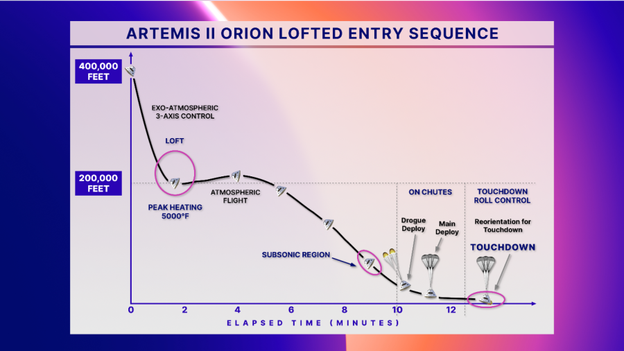
The Artemis II crew is spending its last full day in space Thursday preparing for the most dangerous phase of the mission: the high-speed return to Earth aboard NASA’s Orion spacecraft.
The four astronauts aboard Orion began Flight Day 9 by reviewing re-entry and splashdown procedures, securing the cabin for landing and preparing for a key trajectory-correction burn as the capsule heads back from the moon for a planned Friday evening splashdown in the Pacific Ocean off the coast of San Diego, according to NASA's latest blog.
The Orion capsule Integrity crew — NASA astronauts Reid Wiseman, Victor Glover and Christina Koch, along with Canadian Space Agency astronaut Jeremy Hansen — was around 145,000 miles from Earth as the astronauts started their day.
With Earth's gravity getting stronger, the Orion capsule has sped up from 1,700 mph from Wednesday to around 2,800 mph Thursday.
NASA said Orion’s thrusters were scheduled to fire again at 9:53 p.m. ET for the second return trajectory correction burn, a maneuver designed to fine-tune the spacecraft’s path and keep it properly aligned for atmospheric re-entry.
During the burn, Hansen was set to review procedure steps and monitor Orion’s guidance, navigation and propulsion systems.
Inside the capsule, Koch and Hansen were tasked with stowing equipment, removing cargo and locker netting, and adjusting the crew seats to make sure the spacecraft is locked down for entry. The astronauts were also scheduled to review the latest weather briefing, recovery-force status and entry timeline while working through post-landing procedures.
NASA says the critical re-entry sequence will begin about 20 minutes before Orion reaches the upper atmosphere southeast of Hawaii, when the spacecraft’s service module separates. If needed, a final trajectory-adjustment burn will further refine the flight path before Orion begins a series of roll maneuvers to safely distance itself from departing hardware.
Orion is expected to hit its maximum speed of about 23,864 miles per hour just before entry interface. As the spacecraft descends through roughly 400,000 feet, plasma is expected to build around the capsule, triggering a planned six-minute communications blackout during peak heating.
NASA said the crew could experience as much as 3.9 Gs in a nominal landing profile.
Once Orion emerges from blackout, the spacecraft will jettison its forward bay cover, deploy drogue parachutes near 22,000 feet and then unfurl its three main parachutes at about 6,000 feet to slow the capsule for splashdown.
The landing is scheduled for about 8:07 p.m. EDT Friday, or 5:07 p.m. local time, off the Southern California coast.
Recovery teams from NASA, the U.S. military and the Navy are already in position. Within two hours of splashdown, the astronauts are expected to be extracted from Orion and flown by helicopter to the USS John P. Murtha. Once aboard, the crew will undergo post-mission medical evaluations before returning to shore and then flying back to NASA’s Johnson Space Center in Houston.
NASA watchdog warned in May 2024 that Artemis II crew faces serious Orion re-entry risks
Artemis II Pilot Victor Glover talked about "riding a fireball" and saying he will not fully reflect on the Integrity crew's experience until the mission is accomplished.
And that brings us back to the May 1, 2024, NASA Office of the Inspector General report that warned the astronauts aboard Artemis II could face serious danger during Orion’s return.
The OIG’s warning was blunt.
“In our judgment, the unexpected behavior of the heat shield poses a significant risk to the safety of future crewed missions,” the report read, adding if the same problem occurs again, “it could lead to the loss of the vehicle or crew.”
Friday’s descent will be the first real crewed test of those fixes.
Because of a break the heat shield system, the space shuttle Columbia fatally broke apart during its 2003 reentry, killing seven astronauts.
The watchdog report in 2024 noted problems uncovered on the uncrewed Artemis I mission, especially with the capsule’s heat shield and separation bolts.
Anomalies with Orion’s heat shield, separation bolts and power system “pose significant risks to the safety of the crew,” with re-entry issues standing out as among the most consequential hazards for the first crewed lunar-orbit mission in more than 50 years.
The sharpest concern centers on Orion’s heat shield, which is supposed to protect the crew module during a plunge through Earth’s atmosphere at nearly 25,000 mph and temperatures approaching 5,000 degrees Fahrenheit.
After Artemis I, inspectors said NASA identified “more than 100 locations” where ablative material on the shield chipped away unexpectedly during re-entry.
The report said portions of the shield’s char layer wore away differently than engineers predicted, “cracking and breaking off the spacecraft in fragments that created a trail of debris rather than melting away as designed.”
That unexpected behavior, the watchdog said, “creates a risk that the heat shield may not sufficiently protect the capsule’s systems and crew from the extreme heat of reentry on future missions.”
The danger is not limited to the heat shield itself. Inspectors also found that post-flight inspections of Orion’s crew-module separation bolts revealed unexpected melting and erosion during re-entry. Those bolts are critical because they help connect the crew module to the service module and must perform properly as Orion sheds hardware and descends under parachutes.
"Separation bolt melt beyond the thermal barrier during reentry can expose the vehicle to hot gas ingestion behind the heat shield, exceeding Orion’s structural limits and resulting in the breakup of the vehicle and loss of crew,” according to the report.
The watchdog further said that “current predictions using the correct information suggest the bolt melt exceeds the design capability of Orion.”
NASA was studying whether to mitigate the problems by changing Orion’s design, altering its re-entry trajectory, or both. But the OIG cautioned that those fixes carry their own uncertainty.
“Without understanding the residual effects of introducing design and operational changes, it will be difficult for the Agency to ensure that the mitigations or hardware changes adopted will effectively reduce the risks to astronaut safety,” the report said.
The watchdog said the re-entry findings were among the biggest factors affecting NASA’s readiness for Artemis II.
"Identifying and mitigating the root cause of the Orion heat shield and separation bolt melting and erosion issues will be crucial for the Agency moving forward,” the report concluded.
NASA management concurred with the watchdog’s recommendations.
In comments included in the report, the agency said testing the heat shield was a major goal of Artemis I and that evaluation of the char-loss problem had already begun before the audit.
NASA said it was making “significant progress” in understanding the issue and expected to complete key work in 2024.
Still, the OIG urged caution as NASA presses toward its first crewed deep-space mission of the Artemis era.
“Human space flight by its very nature is inherently risky, and the Artemis campaign is no exception,” the report said.
NASA video cuts out Pilot Victor Glover's 'fireball' quip talking about re-entry
A closer look at NASA's video posted early Thursday morning catches a noticeable edit, cutting out the words "riding a fireball through" from an iconic quotable from Artemis II Pilot Victor Glover.
"I haven't even begun to process what we've been through, and we've still got two more days, and riding a fireball through the atmosphere is profound as well," Glover famously told reporters Wednesday night in a rare space-to-Earth news conference from the Integrity crew aboard the Orion capsule.
The clip posted hours later to X conspicuously cut the words "riding a fireball through" with a smooth transition to make the words appear to have been delivered as presented.
It is unclear why NASA's video cut those words, but Fox News reached out to NASA via email for comment.
"There's a lot to process on Day 8 of the @NASAArtemis II mission," NASA posted to X, sharing the video. "With Earth in view from Orion's windows, the astronauts are packing up and reflecting on their lunar journey."
The edited video shows Glover saying, "I haven't even begun to process what we've been through, and we've still got two more days, and the atmosphere is profound as well."
Notably, the Orion capsule, with Integrity crew head first (or head down), will be speeding through the friction of the Earth's atmosphere at speeds up to 23,839 mph.
The full quote of Glover's remarks:
"The entry thing, I'll be honest and say I've actually been thinking about entry since April 3, 2023, when we got assigned to this mission and one of the first press conferences, we were asked, what are we looking forward to? And I said, splashdown.
"And it's kind of humorous, but it's literal, as well, that we have to get back.
"There's so much data that you've seen already, but all the good stuff is coming back with us. There's so many more pictures, so many more stories.
"And, gosh, I haven't even begun to process what we've been through. And we've still got two more days. And riding a fireball through the atmosphere is profound as well. So I have to answer that question later.
"I'm not sure, but I can tell you it's a lot, and lifelong memories I'm going to be thinking about and talking about all of these things for the rest of my life, for sure."
NASA has not yet responded to Fox News' request for comment.
With scenes like it's from a sci-fi movie, Earth becomes 'mesmerized' by Artemis II
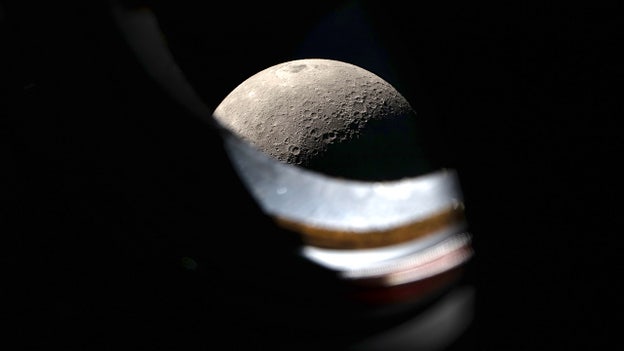
NASA’s Artemis II mission has sparked awe far beyond the space community, drawing Americans of all ages into a rare shared experience of wonder as four astronauts made humanity’s first voyage around the moon in more than 50 years.
From rocket-launch watch parties and classroom lessons to crowded planetariums and a rush of Artemis-themed merchandise, the 10-day mission has stirred fascination with the crew’s journey to the far side of the moon and back.
The flight is a major test run for NASA’s plan to return astronauts to the lunar surface later this decade, and it is set to end Friday with a Pacific splashdown off the California coast.
Public attention is expected to follow the return almost as closely as the April 1 launch, when Orion lifted off from Cape Canaveral atop NASA’s Space Launch System rocket.
“Everyone can be excited about humans extending their capabilities, learning new things, and doing so in a positive, peaceful way,” said Gaza Gyuk, senior astronomer at Chicago’s Adler Planetarium, where he said hundreds of visitors gathered to watch the launch and learn more about the mission.
That excitement has shown up in polling as well. A Reuters/Ipsos survey conducted during the mission found that 69% of Americans said space exploration excites them, while about 80% said they viewed NASA favorably. The same poll found that 69% said it was important to send astronauts back to the moon.
For many Americans, Artemis has offered a moment of inspiration amid an often grim and fractured news cycle, serving both as an escape and as a reminder of scientific ambition and human possibility.
In Elkins Park, Pennsylvania, astronomy enthusiast Hector Ybe hosted an Artemis launch party for about 225 people, including many families with children.
“For two hours, everybody forgot what was happening outside in the world, everybody was talking about space,” he said, adding that attendees came from a range of ethnic, religious and racial backgrounds.
The sense of shared wonder has also been fueled by images returned from deep space. Gyuk pointed to photographs of Earth taken by the Artemis crew that show oceans and continents without borders, emphasizing humanity’s common home.
“That helps people sort of realize that we’re all in this together,” he said.
Teachers across the country have folded the mission into classroom activities. At STEM Lab public school in Northglenn, Colorado, engineering teacher Erin Brabant decorated a hallway with posters of the SLS rocket, astronauts and a mission timeline, while assigning students to design their own lunar landers.
“When we talk about Artemis, it’s like every kid stops what they’re doing,” Brabant said. “Their little side conversations stop, and they have questions."
Brabant said the makeup of the Artemis II crew has also helped students see themselves in the mission. Pilot Victor Glover is the first Black astronaut assigned to a lunar voyage, and mission specialist Christina Koch is the first woman ever sent to the moon.
Last week in Pilot Mountain, North Carolina, 15 Girl Scouts between the ages of 5 and 11 watched the launch live during a troop meeting.
Their attention was especially drawn to Koch, a former Girl Scout, as they worked on Women’s History Month presentations, troop leader Heather Willard said.
“All of the girls were mesmerized,” Willard said.
Reuters contributed to this report.
Commander Wiseman gets emotional tribute of Carroll Crater to honor his late wife

As NASA’s Artemis II crew heads back to Earth from the moon, the astronauts have marked the mission with a deeply personal tribute, asking to name two lunar craters — one for their Orion capsule, Integrity, and another for Commander Reid Wiseman’s late wife, Carroll.
The request came earlier this week during the crew’s lunar flyby, when Canadian astronaut Jeremy Hansen, the first Canadian to the moon, asked mission controllers for permission to use the names. Wiseman, who said he was too emotional to make the request himself, later described the moment as one of the defining experiences of the mission.
“Just for me personally, that was kind of the pinnacle moment of the mission for me,” Wiseman said from space Wednesday night in a rare space-to-Earth news conference with the media.
Carroll Wiseman, a neonatal nurse, died of cancer in 2020.
The gesture echoed an earlier moment from the Apollo era. During Apollo 8’s historic 1968 mission around the moon, astronaut Jim Lovell named a lunar peak Mount Marilyn after his wife. That mission was humanity’s first journey to the moon, and Marilyn Lovell was waiting for him back in Houston.
Artemis II’s four-person crew — three Americans and one Canadian — are the first astronauts to travel to the moon since Apollo 17 in 1972. Their crater-naming request stunned scientists and flight controllers on the ground.
“It was definitely a very emotional moment. I don’t think most of us knew it was coming,” NASA lunar scientist Ryan Watkins told The Associated Press on Wednesday from Johnson Space Center in Houston. “There was not a single dry eye.”
Before launch, Mission Control lead scientist Kelsey Young quietly worked with the Artemis II crew to identify two bright, relatively young craters. Once the astronauts neared the moon, they were able to spot them using zoom lenses and with the naked eye.
Wiseman said the idea originated with his crewmates while the team was in quarantine just days before liftoff.
“Absolutely, I would love that, I think that’s just the best. And I said, ‘But I can’t give the speech, I can’t give the talk,’” he recalled during a crew news conference.
The proposed Carroll Crater sits near the moon’s left limb, along the boundary between the near side and far side, and can occasionally be seen from Earth. According to Watkins, it is about 3 miles, or 5 kilometers, across and relatively shallow. Integrity crater is slightly larger and lies fully on the far side of the moon.
The naming request came shortly after the crew surpassed Apollo 13’s long-standing distance record for human spaceflight. All four astronauts cried and embraced after the moment.
“We lost a loved one. Her name was Carroll, the spouse of Reid, the mother of Katie and Ellie,” Hansen radioed, his voice breaking. “It’s a bright spot on the moon and we would like to call it Carroll.”
Mission Control was silent for nearly a minute before answering.
“Integrity and Carroll crater, loud and clear.”
For NASA officials, the exchange stood apart from the more stoic tone often associated with the Apollo moon missions, whose all-male test pilot crews were generally less outwardly emotional.
“This is no fault of Apollo,” Watkins said. “I think we’re seeing just a more human aspect.”
After returning to Earth later this week, the Artemis II crew is expected to formally submit the proposed names to the International Astronomical Union, which oversees official naming of planetary features.
It took nearly 50 years for the IAU to formally approve Mount Marilyn, which it did in 2017.
The union’s Ramasamy Venugopal said a decision on Carroll and Integrity could come in about a month, which he described as typical “for straightforward requests.”
The IAU has already approved 81 astronaut-given lunar feature names, including Apollo 16’s Baby Ray and Gator, as well as Apollo 17’s Lara, named for the lead female character in the 1965 film “Doctor Zhivago.”
Not every Apollo nickname made it into the official record. Apollo 17 commander Gene Cernan informally called a split boulder “Tracy’s Rock” after his daughter in 1972, while Apollo 12 commander Pete Conrad dubbed his 1969 landing area “Pete’s Parking Lot.”
The Associated Press contributed to this report.
Integrity crew will start final full day in space on 10-day Artemis II mission: Today's schedule
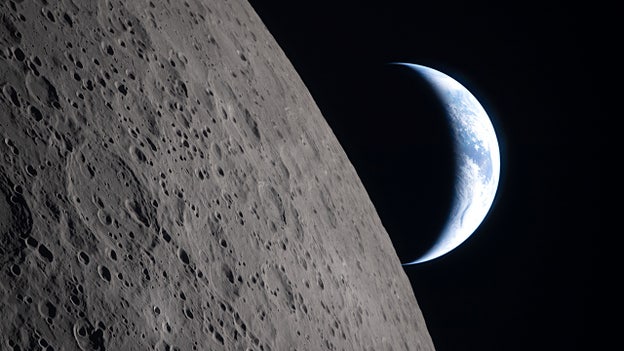
NASA’s Artemis II crew will begin Flight Day 9 of 10 on a lighter public schedule Thursday, with the astronauts waking up at 11:35 a.m. ET ahead of a pair of afternoon public events and a key overnight engine burn.
A mission status briefing from NASA Johnson Space Center is scheduled for 3:30 p.m. ET, followed by a NASA Public Affairs Office event at 7:35 p.m. ET.
Later in the evening, Orion is set to conduct its RTC-2 burn at 10:53 p.m. ET, an important maneuver on the trip back to Earth.
The crew’s sleep period is scheduled to begin at 3:05 a.m. ET Friday.
Artemis II Flight Day 9 schedule (ET):
11:35 a.m. ET – Crew wake-up / Flight Day 9 begins
3:30 p.m. ET – Mission status briefing
7:35 p.m. ET – NASA Public Affairs Office event
10:53 p.m. ET – RTC-2 burn
3:05 a.m. ET Friday – Crew sleep begins
Artemis II pilot gears up for 'riding a fireball' on re-entry, saying he just wants to 'get back'
Talking about space travel and "unbelievable" sights of the dark side of the moon are all fun and games -- until you remember you're going to be "riding in a fireball" and falling into Earth at speeds of up to 23,839 mph.
"Riding a fireball through the atmosphere is profound," Artemis II Pilot Victor Glover told reporters aboard the Orion capsule in a rare space-to-Earth news conference late Wednesday night.
"We have to get back," he said, noting the end goal of the mission in contrast to pontification on the experience.
Glover said he has been thinking about splashdown since the day the astronauts were assigned to the mission in April 2023.
"The entry thing, I'll be honest and say I've actually been thinking about entry since April 3rd, 2023, when we got assigned to this mission," Glover said. "And one of the first press conferences, we were asked what are we looking forward to?
"And I said, 'splashdown.' And it's kind of humorous, but it's literal, as well, that we have to get back."
While NASA’s Artemis II crew has already delivered dramatic views and historic milestones from deep space, Glover said the journey is not complete until Orion survives the high-speed plunge back through the atmosphere and lands off the Southern California coast.
“You know this, it started off sounding like an easy question for me to answer. Then it got really big,” Glover said when asked about re-entry and what moments he would carry with him for the rest of his life.
"There's so much data that you've seen already, but all the good stuff is coming back with us. There's so many more pictures, so many more stories.”
He added that the mission’s significance will stay with him for life.
“And lifelong memories I'm going to be thinking about and talking about all of these things for the rest of my life, for sure,” Glover said.
The Artemis II crew is scheduled to splash down off the coast of San Diego on Friday evening at 8:07 p.m. ET, capping a mission that NASA sees as a key step toward future lunar flights.
Reuters contributed to this report.
First woman to the moon, Christina Koch, says she wouldn't trade this experience for the world
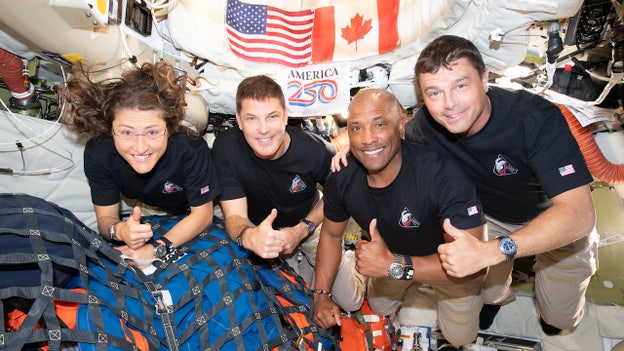
The Artemis II crew is not getting sick of each other in cramped quarters, in fact, Mission Specialist Christina Koch is going to miss the bonding time.
"We have loved living in Orion, and in fact, we've all said that sometimes you can forget where you really are because we're in this small, the small space that just gives us everything we need," Koch told reporters in a rare space-to-Earth news conference late Wednesday night.
Koch noted the capsule seems "bigger in microgravity," but she does not mind bumping into each other.
"We are bumping into each other 100% of the time," she said. "A phrase that you often hear in the cabin is, 'Don't move your foot; I'm just going to reach for something right under it.' Or, you know, 'Can I get there?' And my goal is to get over there."
Koch calls it not only "fun" but she is going to miss the "comraderie"
"Everything we do in here is a four person activity, but it's also really fun," she said.
"I will miss this camaraderie," she continued. "I will miss being this close with this many people and having a common purpose, a common mission, getting to work on it hard and hard every day across hundreds of thousands of miles with the team on the ground.
"This sense of teamwork is something that you don't usually get like as an adult. I mean, we are close like brothers and sisters, and that is a privilege we will never have again. I have to say, I don't think there's anything I would say I won't miss, or that I'm just ready to be over, because this whole thing is a package.
"We can't explore deeper unless we are doing a few things that are inconvenient, unless we're making a few sacrifices, unless we're taking a few risks, and those things are all worth it."
Canadian Mission Specialist Jeremy Hansen: We're 'seeing living proof of' humanity's fragility
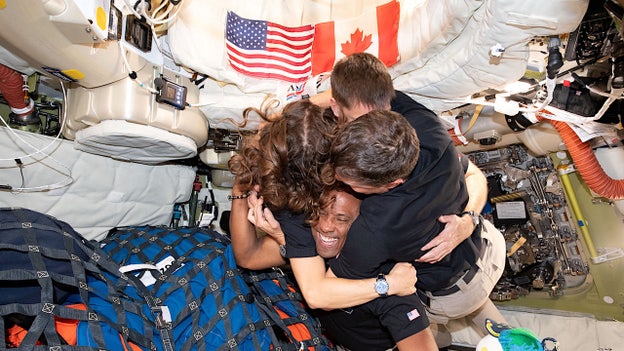
Canadian Mission Specialist Jeremy Hansen said Artemis II has not changed his worldview so much as confirmed it, telling reporters that the mission reinforced his belief in both Earth’s fragility and humanity’s responsibility to work together.
Speaking during Wednesday night’s rare space-to-Earth news conference, Hansen said the crew had witnessed extraordinary scenes during the flight, including sights that went beyond what he had imagined before launch.
“We have seen just some extraordinary things, things that I thought we might see; they looked similar to what I thought they might look like; and other things that I just had never even imagined,” Hansen said. “And those were different perspectives that we saw these things from.
"But, I have to say, it hasn't changed my perspective or the perspective that I launched with.”
Hansen said that perspective began with an appreciation for Earth’s vulnerability in space and has only been strengthened by the mission.
“The perspective I launched with was that we live on a fragile planet, in the vacuum and the void of space,” Hansen said. “We know this from science. We're very fortunate to live on planet Earth.”
He added that the experience also reaffirmed a broader belief about human purpose.
“And the other perspective that I've sort of learned from others through life is that, you know, our purpose on the planet as humans is to find joy, to find the joy and lifting each other up by creating solutions together instead of destroying,” Hansen said. “And when you see it from out here, it doesn't change it.
"It just absolutely reaffirms that. It's almost like seeing living proof of it."
Artemis II Commander Wiseman: Lunar eclipse from dark side of the moon 'an unbelievable sight'
Artemis II Commander Reid Wiseman admits he is prone to "embellishment" on his storytelling, but describing the "unbelievable sight" views of the lunar eclipse did not require stretching the "truth."
"When we watched that Earth eclipse behind the moon, wow," Wiseman told reporters in a rare space-to-Earth news conference late Wednesday night. "I'm actually getting chills right now just thinking about it. My palms are sweating.
"But it is amazing to watch your home planet disappear behind the moon. You could see the atmosphere. You could actually see the terrain in the moon projected across the Earth, as the Earth was eclipsing behind the moon.
"It was just an unbelievable sight. And then it was gone. It was out of sight."
After taking a few minutes to reflect together and share maple cookies brought by crewmate Jeremy Hansen, the four astronauts returned to work. The eclipse coincided with some of the mission’s most important lunar observations for the geology team, underscoring the balance between awe and scientific focus.
"The four of us took a moment," Wiseman said, "to really reflect on where we were.
"And then it was right back into the science. And it is a surreal feeling. But we had a lot of work to do too, and I think that kept our focus. "
Mission specialist Christina Koch: Artemis is 'a relay race,' we're just passing the 'batons'

The Artemis II mission might have broken records and made all-time human achievement for being the furthest travel away from Earth, but it is merely a floor and not a ceiling, according to mission specialist Christina Koch.
"Part of our ethos as a crew and our values from the very beginning were that this is a relay race," said Koch, the first woman to the moon, who already holds the record for the longest single spaceflight by a woman (328 days) and was part of the first all-female spacewalk.
"In fact, we have batons that we bought to symbolize physically that we plan to hand them to the next crew. And every single thing that we do is with them in mind."
Speaking during the Orion news conference with media on Earth late Wednesday night, Koch said she is helping test everything from Orion’s manual piloting and procedures to evaluating food, provisions and other human-system details inside the spacecraft.
"Oftentimes it's actually easier in human spaceflight, especially on a first mission, to accept some of the things that aren't working quite right or the operational workarounds, and we have actually been diligent to try to fix everything," she continued. "And we're always thinking from the perspective is: What is the next crew going to think about this? How will this help them to succeed?"
It is ultimately about furthering the space program, getting back on the moon as soon as 2028, and potentially using the moon to slingshot to Mars.
"So both in the vehicle and all in the last three years, we've really just worked to make sure that they are set up for success, and that's the all of the teams, not just the crew, but the flight control teams, the mission, engineering rooms, the launch teams, everyone," she concluded.
"Hopefully we've done our best to bring folks together and to make sure that we can be the best that can be. Obviously, just testing, putting humans in this vehicle is the easy thing to see, and we hope that we've capitalized on that and made it as much as it can be for our time here."
Pilot Victor Glover: Lunar eclipse 'blew us all away,' was 'one of the greatest gifts' of mission
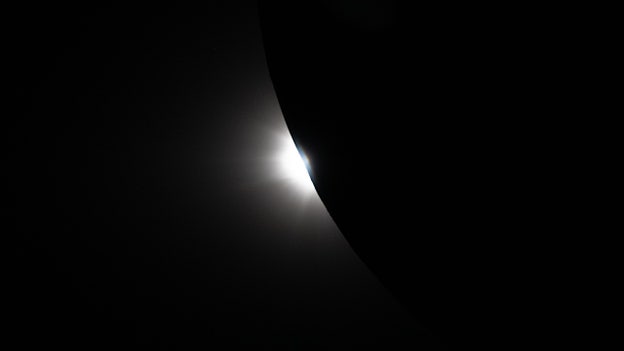
Artemis II pilot Victor Glover said there was no amount of training that could have prepared the crew for the never-seen-before sights aboard the Orion capsule.
"We trained to view the eclipse from the far side of the moon, or after going beyond the far side of the moon," he told the media in the rare Earth-to-space news conference with the media late Wednesday night.
"We saw great simulations made by our lunar science team, but when that actually happened, it just blew us all away.
"I mean, you heard the reaction in real time."
There was slight "disappointment" in the lack of light, due to the delayed launch date, but that faded into darkness, too, he said.
"I don't want to say unhappy about," the later launch, he said, "but launching on April 1 meant the far side wasn't as illuminated as we were hoping.
"And so, you know, that thing seemed to be a consolation, and it was one of the greatest gifts of that part of the mission."
USS John P. Murtha will receive Artemis II astronauts in Pacific
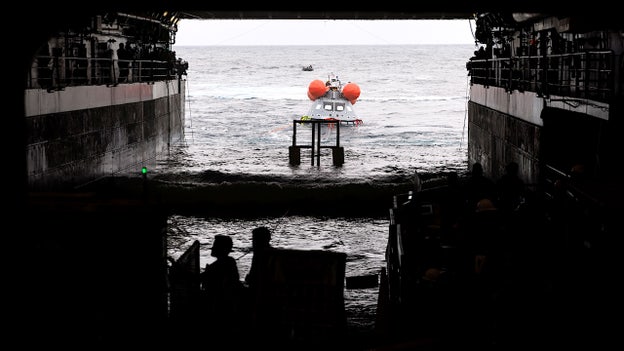
The San Diego-based USS John P. Murtha will recover NASA’s four Artemis II astronauts when their Orion capsule splashes down in the Pacific Ocean west of San Diego on Friday at 8:07 p.m. ET, according to the U.S. Navy.
Commanding Officer Capt. Erik Kenny said the crew is "honored" to support NASA and the Artemis II mission.
The amphibious transport dock ship, LPD 26, has been designated as the recovery vessel for the mission’s return.
The 684-foot John P. Murtha is well suited for the job because it has a well deck, helicopter pad, onboard medical facilities and communications systems needed for astronaut and spacecraft recovery.
For the recovery operation, MH-60S Sea Hawk helicopters from Helicopter Sea Combat Squadron 23 will track Orion during reentry and help transport the astronauts after splashdown. Navy divers from Explosive Ordnance Disposal Group 1 will recover the capsule from the ocean and move it into the ship’s well deck, while a dive medical team will help assess the crew after they exit the spacecraft.
The ship has also been conducting mission-specific preparation.
The Murtha has been underway in the U.S. 3rd Fleet area of operations performing just-in-time training in support of the Artemis II recovery mission. It departed Naval Base San Diego on Monday to travel to 50 to 60 miles offshore where Orion will touch down with the use of 11 parachutes.
"I'll breathe easier when we get through reentry and everybody’s under chutes and in the water," NASA Administrator Jared Isaacman said at Tuesday's news conference.
Live Coverage begins here