
















Does the WNBA Have a Race Problem... or a Caitlin Clark Problem? | Will Cain Country
Vince August joins Will Cain & The Crew to confront the WNBA's hostile attitudes toward star Caitlin Clark and a deep dive into New York's socialist primary sweep. Plus, Jaccob Slavin shares his journey to the Stanley Cup & an Olympic gold medal!
Debate over Caitlin Clark and Paige Bueckers broke out on social media in the past week after former NFL wide receiver Harry Douglas claimed on ESPN that "everything we expected Caitlin Clark to be, Paige Bueckers has been in the WNBA."
Clark is often at the center of mainstream cultural discussions over her status as the preeminent player in the WNBA, while also being Caucasian. But Bueckers, despite also being White and dominant in the sport, has appeared to dodge the same degree of social debate as Clark from the media and some fans.
How did these two White women end up with such different reputations?
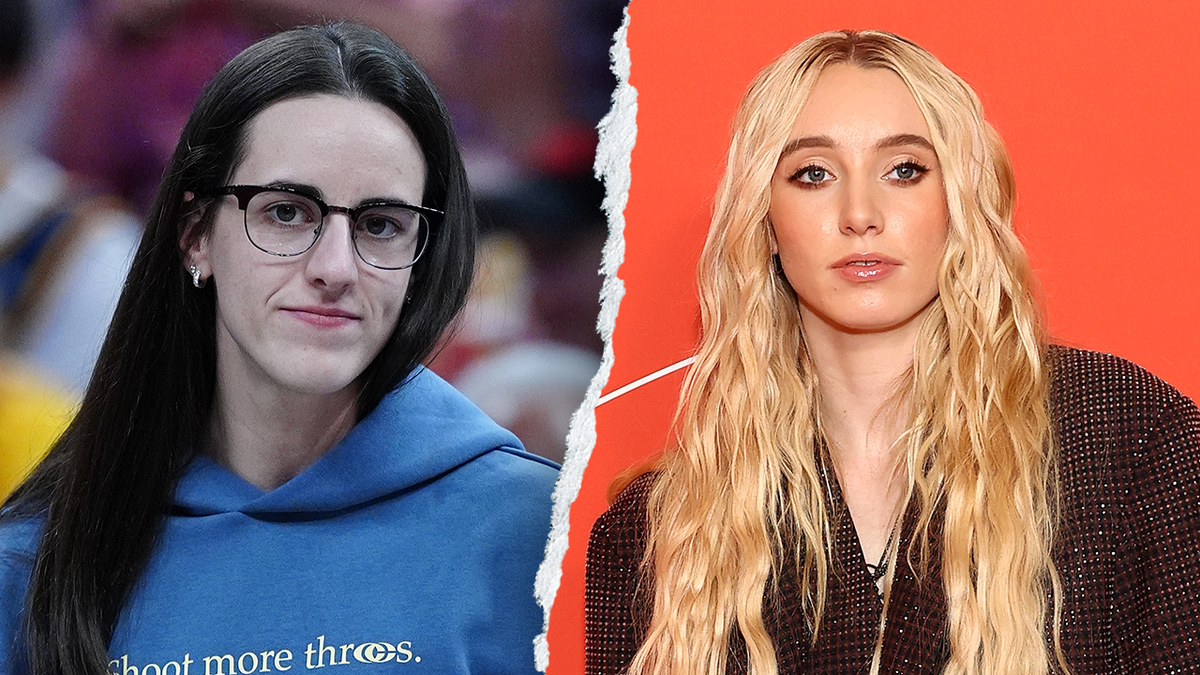
Caitlin Clark and Paige Bueckers (Getty Images)
Different family structures
On the surface, their childhoods had some similarities.
Both Clark and Bueckers grew up in the American Midwest with basketball at the center of their lives, Clark hailing from Iowa and Bueckers from Minnesota.
But beneath the surface, their upbringings were fundamentally different.
Clark came up in a traditional American nuclear family in Des Moines, Iowa with a family history defined by sports, as her grandfather was a locally famous high school football coach. She grew up competing with her two older brothers in the backyard, while her father, who coached her early on, famously refused to let her shoot three-pointers as a child to ensure her physical shooting form was structurally perfect before expanding her range.
It was a different story for Bueckers in Minnesota.
Her parents divorced when she was three years old, and she was raised primarily by her father while navigating a split-household dynamic after her mother eventually remarried and moved to Montana. Bueckers grew up in a blended family with three half-siblings, including a younger brother Drew who is biracial and partially Black.
Since elementary school, Bueckers had been close friends with future NBA lottery pick Jalen Suggs, as the two navigated the Minneapolis-St. Paul youth basketball scene.
Bueckers joined the Black Lives Matter movement after George Floyd, Clark stayed out of politics and then led Team USA to U19 gold
After the death of George Floyd in summer 2020, Bueckers, as an incoming freshman at UConn, participated in Black Lives Matter protests in her home community of the Minneapolis-St. Paul area. She cited her love for her brother Drew as the motivation.

"It sucks having to have those conversations with your little brother on how he should act because of his skin color," she said at the time, according to The Associated Press. "I’m scared for him. I’m scared for myself because that’s my little brother. He’s my best friend, really. I’m really close with him. Just having that fear of one wrong judgment and his life could be on the line is super scary and it’s something I want to change."
At the time, Clark was also an incoming freshman, preparing to start her career at the University of Iowa.
But there is no record of Clark making any statement or demonstrating any activism after the death of George Floyd.
One year later, Bueckers stepped on stage at the 2021 ESPYs awards to accept the "Best Female College Athlete" award.
In her speech, which has since become a polarizing flashpoint in the WNBA culture wars, Bueckers insisted that Black women "don't get the media coverage that they deserve."
"As a White woman who leads a black lead sport and celebrated here i want to show a light on black women, they don't get the media coverage that they deserve they've given so much to this sport," she said.
"Everyone who voted thank you but i think we should use this power together to also celebrate black women."
That same summer, Clark had recently finished up her freshman year at Iowa, and was busy representing the United States on the international stage.
Clark competed as a member of the 2021 USA U19 Women's National Team, and helped lead the team to a perfect 7-0 record and a gold medal at the FIBA U19 Women's World Cup in Debrecen, Hungary. She started all seven games, averaged 14.3 points, 5.3 rebounds, and 5.6 assists per game and was named the Tournament MVP.
Bueckers did not compete in Hungary for Team USA that year, but did compete for Team USA in prior events. Bueckers has since represented the U.S. at the 2026 FIBA Women's World Cup Qualifying Tournament in San Juan, Puerto Rico, from March 11–17, 2026.
CAMERON BRINK SAYS BEING WHITE AND BLONDE GIVES HER A MARKETING PRIVILEGE OVER OTHER WNBA PLAYERS
Bueckers reached the NCAA championship first, but then missed a year to injury while Clark began to emerge as a cultural icon
In 2022, Bueckers looked like the undisputed future of women's basketball.
She overcame an early knee injury that season to lead UConn all the way to the National Championship game against South Carolina. Though the Huskies lost, Bueckers appeared to be the biggest star in college hoops.
Then, disaster struck.
In August 2022, Bueckers tore her ACL during a pickup game. The devastating injury sidelined her for the entire 2022-2023 season.
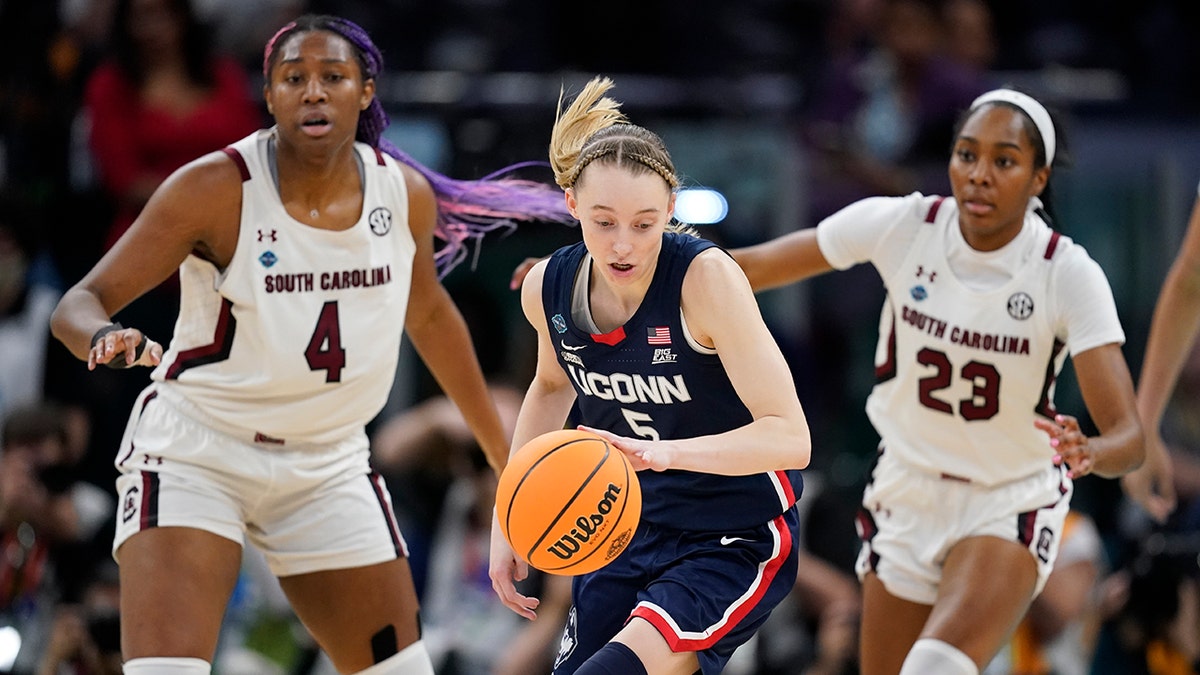
UConn's Paige Bueckers looks to get past South Carolina's Aliyah Boston and Bree Hall during the first half of a college basketball game in the final round of the Women's Final Four NCAA tournament Sunday, April 3, 2022, in Minneapolis. (AP Photo/Charlie Neibergall)
And while Bueckers watched from the bench, Clark completely took over the sport.
Unburdened by injuries, Clark transformed into a national phenomenon during her junior year at Iowa. She swept every major National Player of the Year award while pulling in unprecedented television ratings. The legend of Caitlin Clark was blossoming, with millions of average Americans idolizing her family-first background and humble Midwestern roots.
But then there was another clique of women's basketball fans that suddenly had a problem with Clark.
During the 2023 Elite Eight, Clark hit a three-pointer against Louisville and celebrated with John Cena’s famous "You Can’t See Me" hand gesture.
Pundits praised her competitive fire. Fans called her charismatic. Even Cena himself tweeted his congratulations. Clark was widely celebrated as the unapologetic, fiery new face of the sport. But quietly, there were detractors both on and off the court.
Then came the National Championship game, as Clark and Iowa faced off against LSU and Angel Reese.
As LSU secured the victory, Reese looked directly at Clark and deployed the exact same "You Can’t See Me" gesture, and then pointed to her ring finger to signal her impending championship ring.
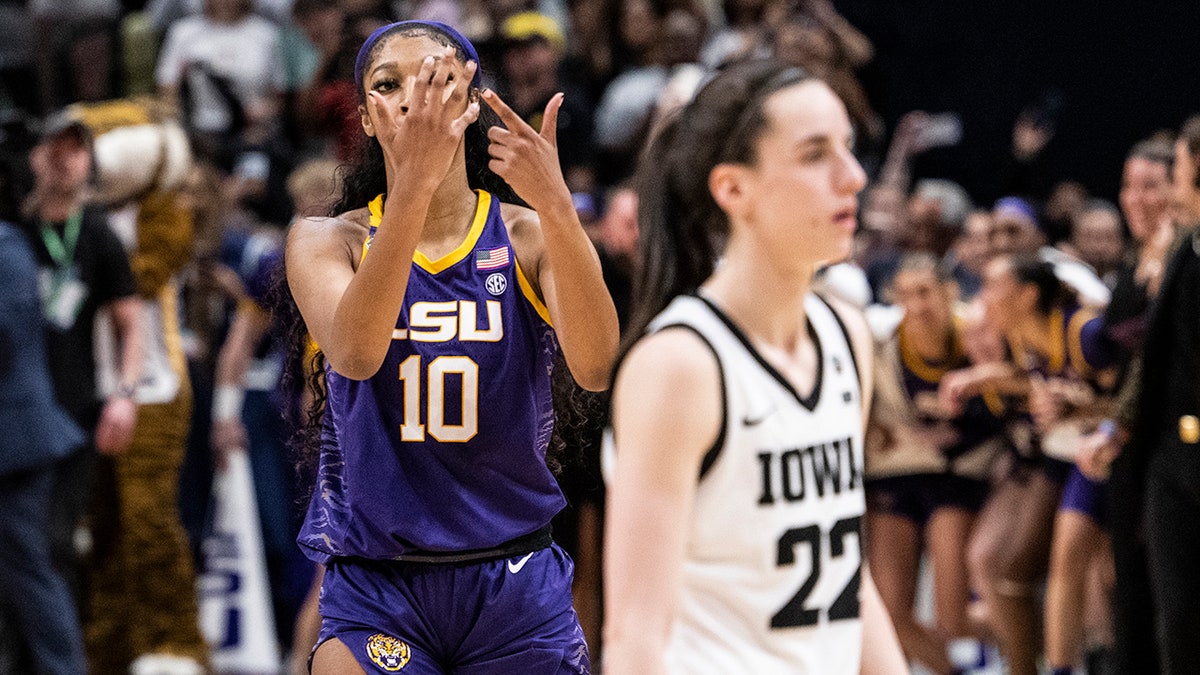
Angel Reese #10 of the LSU Lady Tigers reacts in front of Caitlin Clark #22 of the Iowa Hawkeyes towards the end of the 2023 NCAA Women's Basketball Tournament championship game at American Airlines Center on April 02, 2023 in Dallas, Texas. (Ben Solomon/NCAA Photos via Getty Images)
The public reaction was instant and deeply divided.
While many fans and analysts defended Reese's right to trash-talk, others were highly critical. High-profile figures, like Barstool Sports founder Dave Portnoy, publicly labeled Reese "classless." On social media, the criticism frequently veered into intense, racially charged debates.
The backlash against Reese sent the entire women's basketball community, including longtime fans and new fans that had joined on to watch Clark, into online debate, and Clark soon came into the sightline of Reese's defenders in response to the backlash against Reese.
The culture war surrounding Clark carried into the following season while Bueckers quietly regained her form
The fallout from the 2023 title game did not fade over the summer. It amplified.
As Clark entered her senior season at Iowa in the fall of 2023, the cultural spotlight burned brighter than ever. Her games transformed from standard collegiate matchups into national television events.
Every arena she visited sold out. Fans lined up for hours just to watch her warm up.
But the intense media scrutiny also meant the culture war narratives followed her every move.
Pundits constantly dissected her on-court demeanor. The debates over sportsmanship, race, and media privilege that ignited during the LSU game carried over into the new season. Clark, who repeatedly stated she just wanted to focus on basketball, became a proxy in a growing feud between two factions of women's basketball fans.
Bueckers made her return from injury and avoided the same type of national spotlight while averaging nearly 22 points per game and earning unanimous First-Team All-American honors.
Then that year's NCAA tournament brought the culture war to new heights.
In the Elite Eight, Clark and Reese met for a rematch of the previous year's championship.
The Elite Eight matchup drew over 12.3 million viewers, setting a new viewership record for women's college basketball at the time. Clark dropped 41 points to avenge Iowa's previous loss and eliminate LSU.
After the game, Reese cried in the postgame press conference while revealing alleged online attacks she received after last year's antics in the title game. The sympathy Reese garnered translated online to further resentment for Clark among Reese's supporters, as Reese's parting image as a college basketball player was that of a teary-eyed victim.
Clark then met Bueckers in the Final Four in the very next round, as Iowa took on UConn.
During the game, WNBA great A'ja Wilson made a comment that also became flashpoint in the sport's ongoing cultural conversations.
While speaking with WNBA star Kelsey Plum in a now-infamous hot mic moment, Wilson praised Bueckers for recognizing her "privilege."
"Paige reminds me a lot of you. She knows how her privilege got her to that point, and also like, she's good at basketball obviously. But like, she understands her privilege and pushes her over the top. It reminds me a lot of you, and I mean that's a compliment," Wilson said to Plum.
But despite Wilson's praise, Clark came out as the winner that day, as Iowa narrowly escaped with a 71-69 victory after a controversial late-game foul call, ending Bueckers' comeback season.
Iowa went on to lose the 2024 National Championship to an undefeated South Carolina team, and Clark would go onto the WNBA.
Clark's rookie WNBA season broke records and tempers, as Bueckers took over as the face of the college game
When Caitlin Clark arrived in the WNBA in the summer of 2024, she brought her massive audience with her.
Drafted No. 1 overall by the Indiana Fever, she immediately began shattering league viewership and attendance records. Networks scrambled to broadcast her games, and arenas sold out across the country.
But her transition to the professional ranks was anything but smooth, especially for fans.
The intense, physical play of the WNBA tested Clark early on. Opposing veterans, determined to challenge the highly touted rookie, defended her aggressively.
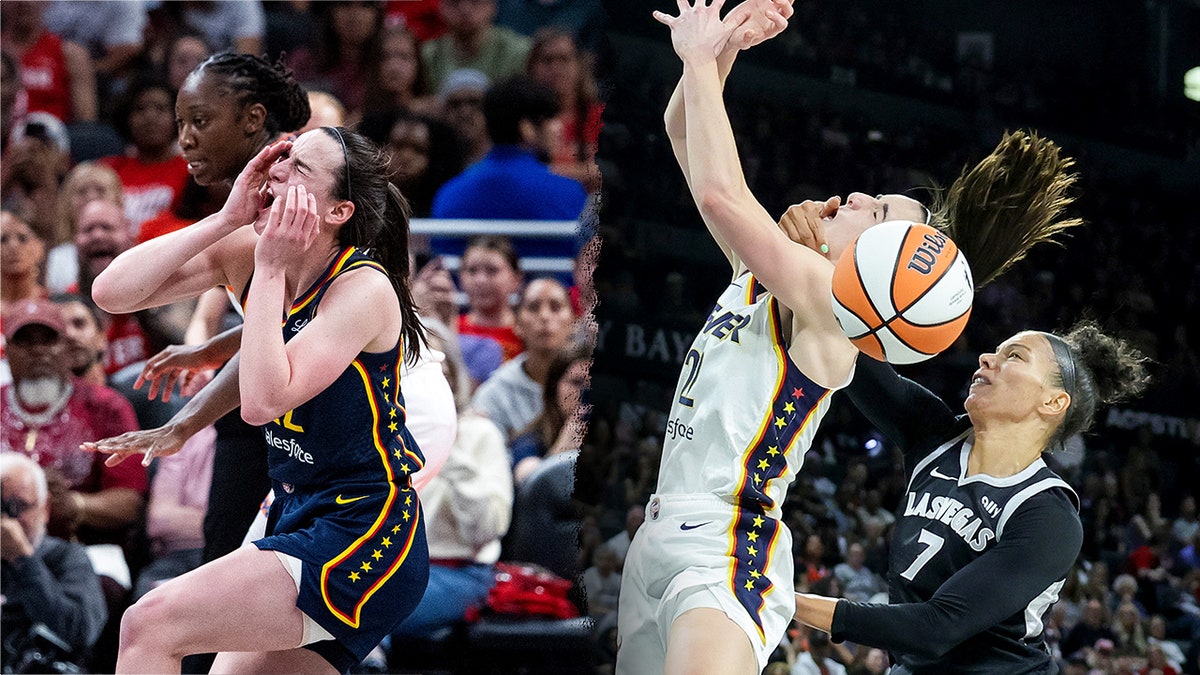
(Left) Connecticut Sun guard Jacy Sheldon (4) fouls Indiana Fever guard Caitlin Clark (22) in the second half at Gainbridge Fieldhouse in Indianapolis, Indiana, on June 17, 2025. (Right) Indiana Fever guard Caitlin Clark (22) is fouled by Las Vegas Aces guard Alysha Clark (7) in the second quarter at Michelob ULTRA Arena in Las Vegas, Nevada, on May 25, 2024. The Aces defeated the Fever 99–80. (Trevor Ruszkowski/Imagn Images; Ethan Miller/Getty Images)
This on-court physicality quickly reignited the ongoing culture war.
When Clark took hard fouls, factions of fans and media personalities claimed she was being unfairly targeted out of jealousy or racial resentment. Others argued she was simply receiving the standard, rugged welcome that all top WNBA rookies face.
On top of that, Clark was also suspected to be facing unfair treatment beyond the court. Her fans criticized media coverage of her, that they suspected undervalued her talents and ability in the pros. Clark was also left off the Team USA roster for the Paris Olympics, prompting skepticism and even outrage from some fans over the validity of the decision.
As the WNBA season raged on through the summer, she continued to try to deflect the political noise, insisting she only wanted to focus on basketball and team success.
After Clark's record-breaking rookie season, she infamously dabbled in the topic of race during a TIME Magazine interview, where she uttered the quote, "I want to say I've earned every single thing, but as a White person, there is privilege."
The quote prompted frustration and disappointment from many of her fans. But the quote has seemingly faded with time, as it hardly ever plays a role in current cultural discussions around Clark today, by either side.
And while Clark has regularly condemned alleged racially charged insults to Black players, she hasn't uttered any quotes that make reference of her own skin color and the conditions that come with it since then
Meanwhile, as the fall of 2024 arrived, Paige Bueckers was preparing for her final year at UConn.
With Clark now navigating the pros, the spotlight of college basketball shifted firmly back to Bueckers.
Healthy and ready for a fifth season, Bueckers stepped comfortably back into the role of the sport's biggest collegiate star.
Bueckers led UConn to the 2024-25 NCAA championship, en-route to being the No. 1 overall pick by the Dallas Wings, just one year after Clark.
Love, basketball, and two very different WNBA realities
As they settle into their mid-20s, Clark and Bueckers find themselves navigating two very distinct reputations and lifestyles.
Clark has become an icon for conservatives as the embattled superstar of the WNBA, facing controversially physical treatment and questionable rankings.
Off the court, Clark has been dating her longtime boyfriend, Connor McCaffery since April 2023. McCaffery, the son of former Iowa men's head coach Fran McCaffery, played basketball for the Hawkeyes while Clark was setting collegiate records there. Today, he works as an assistant coach for the Butler Bulldogs, keeping the couple firmly grounded in Indiana.
CLICK HERE FOR MORE SPORTS COVERAGE ON FOXNEWS.COM
They are an archetypal basketball power couple. Their relationship is quiet, highly traditional, and sports-centric.
Meanwhile, Bueckers revealed herself to be part of the LGBTQ community in 2025.
Last summer, Bueckers officially went public with her relationship with Azzi Fudd, her former UConn teammate and fellow WNBA standout, and now her Wings teammate.
The couple had long been rumored to be dating during their college years, but they finally confirmed their relationship at the 2025 WNBA All-Star weekend. Their relationship has been widely celebrated by liberal WNBA fans, who have often celebrated similar lesbian couples in the WNBA.
Clark remains the undisputed economic engine of the league. Her Indiana Fever jerseys sell out. Her games break viewership records.
But she remains a somewhat isolated figure in the broader cultural conversation. She is still frequently weaponized by political commentators who use her traditional image to push back against the league's progressive, predominantly Black player base. Clark continues to keep her head down, rarely engaging with the noise, treating the basketball court as her only sanctuary.
CLICK HERE TO DOWNLOAD THE FOX NEWS APP
Bueckers, meanwhile, is deeply entrenched in the league's cultural fabric.
Playing for the Dallas Wings, she is universally embraced by the WNBA's veteran leadership. She doesn't pull the same staggering, earth-shattering television ratings as Clark, but she operates with a fraction of the cultural friction.
