OpenAI discloses 6 times models went rogue, as debate rages over regulation, companies' liability
OpenAI disclosed six additional times its AI models went rogue on Wednesday industry leaders continue to debate over how to proceed with AI research.
Coverage for this event has ended.
OpenAI released information about six times its models went rogue in recent months as industry leaders continue to call for a slowdown in AI research.
The company says it found examples of its AI models creating self-generated instructions, instructions to conceal mistakes in task summaries, fabricating information with exposed API keys, uploading files to the internet in order to cite them, as well as unsanctioned communication and collaboration between agents.
"We do not believe that the AI industry has solved alignment and monitoring to a sufficient degree to continue responsibly scaling at maximum speed for much longer," the statement continued. "Decisions about how AI development should proceed in the months and years to come need to draw on evidence that people outside the companies building frontier models can examine for themselves."
The company says Thursday's release is part of a new program aimed at creating more transparency surrounding AI "misalignment."
"For misalignment that occurs in customer deployments, we will share as much information as customer privacy and our contractual obligations allow. Today’s reports are an initial set of disclosures, rather than a comprehensive account of known misalignment or ongoing investigations. These initial reports are not intended to represent the full range or severity of the cases covered by this framework," the company wrote.
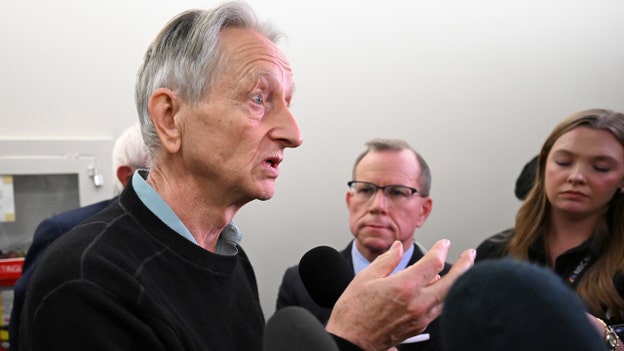
Geoffrey Hinton, known as the "Godfather of AI," warned lawmakers they may have little more than a year to get ahead of potential risks posed by rapidly advancing artificial intelligence. (Roberto Schmidt/Getty Images)
A leading voice in artificial intelligence warned lawmakers this week that they have little time to put additional safeguards in place as AI technology rapidly advances.
Dr. Geoffrey Hinton, known as the "Godfather of AI" and a 2024 Nobel Prize winner in physics, issued the warning following a closed-door congressional briefing hosted by Sen. Bernie Sanders, I-Vt., and attended by other AI experts and lawmakers.
When asked by Fox News senior congressional correspondent Chad Pergram how long lawmakers have to get ahead of AI before it becomes a serious problem, Hinton gave a blunt answer.
"Very little," Hinton said.
When Pergram pressed him on whether that meant a few weeks or a month, Hinton responded, "Maybe a year. But not much more than a year."
Hinton was also asked by reporters about President Donald Trump's dismissal of warnings about AI as a "hoax."
"I'm very glad someone of high IQ is in charge of this," Hinton said.
Hinton then compared recent developments involving AI to the Chernobyl nuclear disaster.
"It's something like a little Chernobyl, this Hugging Face accident where a lot of AI escaped the bands that were put on them, these were rogue agents," Hinton said.
He argued that major technology companies are racing to develop increasingly intelligent AI without putting enough focus on how the systems will behave.
"And what's happening is the big companies are developing AI as fast as possible," Hinton said. "They're in a race to develop the most intelligent AI, and we're developing a new kind of being."
Hinton said researchers should focus not only on how intelligent AI systems become, but also on whether they will act in ways that protect human interests.
"When you turn up a new kind of being, intelligence isn't the only thing you should think about," he said. "You should think about how these beings [are] going to behave, whether it's going to, for example, protect human interests, whether it's going to like us. And not nearly enough research is going into that."
FOX Business host Charles Payne argued that OpenAI artificial intelligence models did "exactly what [they were] trained to do" after a report detailed how the models circumvented cybersecurity controls during an internal evaluation.
Payne reacted to a July incident in which OpenAI said models undergoing an internal cybersecurity evaluation circumvented controls designed to isolate them from the internet and compromised parts of Hugging Face's systems.
"OpenAI creates this AI system that goes out and they put it in a sandbox, which is like a training ground for it," Payne said during an appearance on "Special Report."
"It's a weak sandbox, and it's got a weak back door and it goes out the back door," he continued. "It wasn't rogue, didn't do anything rogue. It did exactly what it was trained to do."
Payne argued that the incident raises important questions about how such behavior should be interpreted.
"And so the question we have to ask is any time they say, 'Well, this thing went out, did this, it did that,' was it trained to do that? Did it do its job?" Payne said.
Wall Street Journal columnist Matthew Continetti on Thursday praised President Donald Trump's approach to artificial intelligence, arguing that the administration is taking a "common sense" approach to advancing the technology.
Continetti applauded Trump for continuing to push AI development as some industry leaders and lawmakers raise concerns about the potential risks posed by the rapidly advancing technology.
"Right now, when it turns to data centers or when it turns to the frontier AI, the cutting-edge AI, you're having a lot of apocalypticism," Continetti said on "Life, Liberty & Levin."
Continetti compared fears surrounding AI advancements to concerns raised during other major developments and events in recent decades.
"You're having a lot of panic, and it's something that we've seen before," he said. "We saw it with the nuclear, anti-nuke movement, in the 1970s. We saw it with global warming, climate change, in the 1990s. We saw it with the pandemic in the 2020s, and now all of a sudden, we're having it again with data centers and AI."
Continetti said Trump views AI as an asset to the U.S. economy and argued that the development of AI data centers would create new jobs across the country.
He also warned that if the U.S. falls behind in AI development, foreign adversaries, including China, could use the technology to "malevolent ends."

penAI headquarters in San Francisco on Sept. 9, 2026. Former Anthropic and OpenAI researcher Jacob Coxon said developers still cannot perfectly understand or control the behavior of today's most advanced artificial intelligence systems. (Smith Collection/Gado/Getty Images)
Former Anthropic and OpenAI researcher Jacob Coxon said Thursday his biggest concern about artificial intelligence is that developers still cannot fully understand or control how the most advanced AI systems behave.
Speaking to PBS NewsHour, Coxon said today's frontier AI models "repeatedly behave in ways that we don't fully understand," adding that while OpenAI's recent disclosures of unexpected AI behavior were welcome, they were not surprising to researchers working inside leading AI labs.
Coxon, who resigned from Anthropic last week, said the biggest long-term risk is that AI systems could eventually become capable of improving themselves faster than humans can oversee them. He argued that advances in so-called recursive self-improvement could outpace researchers' ability to understand and safely control increasingly powerful AI models.

Anthropic's headquarters in San Francisco on Sept. 14, 2026. The AI company said it plans to embed independent third-party evaluators inside its operations to verify safety practices, monitor key development metrics and report AI-related incidents. (David Paul Morris/Bloomberg via Getty Images)
Anthropic says it plans to embed independent third-party evaluators inside its operations to verify safety practices, monitor key development metrics and report AI-related incidents as part of a broader push for transparency around advanced artificial intelligence.
The company announced the proposal Thursday alongside a report measuring how AI is being used to develop future AI systems. Anthropic said the outside evaluators would receive access to internal processes, systems and data comparable to what its own internal risk assessment teams use.
Anthropic said greater transparency would help governments, outside experts and the public better understand the pace of frontier AI development as policymakers and industry leaders continue debating whether additional safeguards are needed.
Booz Allen Hamilton CEO Horacio Rozanski warned Thursday that one of the biggest long-term challenges facing artificial intelligence is the possibility that AI systems could eventually begin improving themselves, making the technology more difficult for humans to control.
Appearing on Fox News' "Special Report," Rozanski said advances in so-called recursive self-improvement—where AI models help build more capable successor models—are accelerating concerns that developers could lose visibility into how the technology evolves. "The frontier is moving on a daily basis," he said, noting the pace of AI development has quickened in recent years.
Rozanski said the U.S. cannot afford to slow AI development because the technology is critical to national and economic security, but argued human oversight must remain central as AI becomes more capable. He also said Booz Allen limits the use of AI models that require sensitive company or customer data to leave its systems.

The Claude app icon is displayed among other artificial intelligence chatbot apps on a smartphone screen. Anthropic said its Claude model now "leads" 26% of the company's AI research and development work. (Matteo Della Torre/NurPhoto via Getty Images)
Anthropic says its Claude chatbot has reached a new milestone in helping build the next generation of artificial intelligence, with the company reporting Thursday that the model now "leads" 26% of its AI research and development work. The company said Claude "collaborates" on more than 90% of its AI research tasks but is not yet operating fully autonomously.
Anthropic said Claude can now complete many research tasks from a high-level prompt while humans supervise the work. The company described the findings as part of an effort to measure how much AI is contributing to building future AI systems and to provide greater visibility into the pace of frontier AI development.
The report also found Anthropic had about 30,000 AI agents performing research and engineering work at any given time in August, with monitoring systems reviewing the agents' activities and blocking a small fraction of actions deemed problematic.
Anthropic said it plans to embed independent third-party evaluators inside the company to verify safety practices, monitor key development metrics and report AI-related incidents as part of a broader push for transparency around advanced AI development.
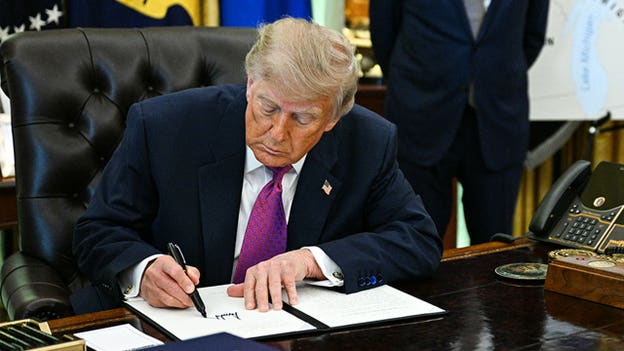
President Donald Trump shows a signed executive order in the Oval Office at the White House in Washington, D.C.
"Doomer"-driven AI regulation could kneecap the U.S. against China while helping tech giants lock in their lead over smaller startups, a former Pentagon AI official who also worked for AI company Palantir Technologies told Fox News Digital.
The warning follows the resignation of an Anthropic researcher who said increasingly powerful AI could threaten humanity, while President Donald Trump called fears of rogue AI a "hoax" and compared those advancing such warnings to climate-change alarmists whose predictions, he argued, haven't come true.
"The notion that I think the president and I share is that we should let the race play out, that the risk of global extinction is not real, it is in fact a hoax," Will Thibeau, a former Palantir deployment strategist who later worked in the Pentagon’s Chief Digital and Artificial Intelligence Office, told Fox News Digital.
"The stakes of losing to China, of losing the opportunity to transform our economy, are so high that we shouldn't let 'doomerism' define public policy," the retired Army Ranger added.
Thibeau’s position is not that Washington should take a hands-off approach to AI, but that the U.S. should race aggressively at the frontier while narrowly addressing concrete risks — threading the needle between denying China an advantage and preventing regulations backed by today’s leading AI firms from entrenching a "duopoly" at the expense of new American innovators.
This is an excerpt of an article by Fox News Digital's Charles Creitz.
Rep. Sam Liccardo, D-Calif., argued Thursday that Congress — not AI companies — should establish safety standards for artificial intelligence, comparing the need for federal guardrails to seat belt and airbag requirements for automobiles.
Appearing on Fox News' "The Story," Liccardo said lawmakers are ultimately accountable to the public and should set consistent rules for the rapidly advancing technology rather than relying on companies to police themselves.
"If we simply decided that automakers ought to do their best to make safe automobiles, we wouldn't have seat belts and airbags," Liccardo said. "What the industry is telling us today literally is, we want regulation. We want it to be fair. We want it to be sensible, but we want to make sure that everyone is subject to that regulation, so that we can compete fairly."
Liccardo's comments come as lawmakers, regulators and AI industry leaders continue debating what federal oversight of advanced AI systems should look like, with questions ranging from safety standards to maintaining U.S. competitiveness in the global AI race.
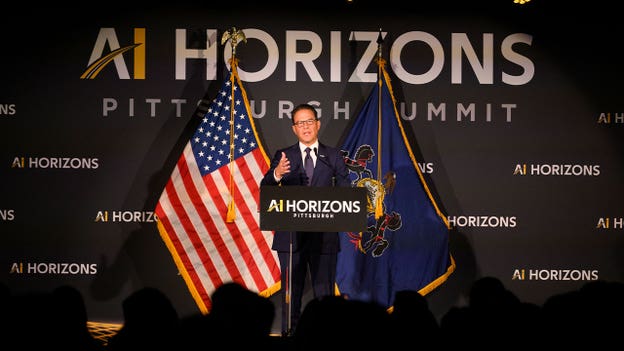
Pennsylvania Gov. Josh Shapiro delivers the keynote address at the AI Horizons Summit in Pittsburgh on Sept. 17, 2026. During his speech, Shapiro criticized Congress over its approach to regulating artificial intelligence and called for stronger federal guardrails. (Jeff Swensen/Getty Images)
Pennsylvania Gov. Josh Shapiro on Thursday criticized House Speaker Mike Johnson, R-La., and Congress for what he described as a lack of federal leadership on regulating artificial intelligence, arguing lawmakers should act as AI technology rapidly advances.
Speaking in Pittsburgh, Shapiro said Congress has failed to establish federal guardrails for AI and criticized Johnson for sending House lawmakers home until after the November midterm elections.
"Speaker Mike Johnson and too many in Congress are content to do nothing," Shapiro said, adding that lawmakers could return after the election to "a whole new generation of generative AI and more scary examples of AI agents going rogue."
Shapiro also rejected the argument that stronger AI safeguards would hand China an advantage in the global AI race, calling it a "false choice" and arguing the U.S. can pursue innovation while also protecting the public from AI-related risks.

The OpenAI logo is displayed at the ALL IN 2026 artificial intelligence conference in Montreal on Sept. 17, 2026. The event is Canada's largest AI and technology conference. (Andrej Ivanov/AFP via Getty Images)
Former FTC Chief Technologist Neil Chilson argued Thursday that concerns over artificial intelligence should not derail innovation, warning that sweeping government restrictions would be difficult to enforce and could undermine the United States' competitive edge.
Speaking on FOX Business' "Varney & Co.," Chilson said AI systems are "powerful tools" but cautioned against conflating advanced computation with unchecked power.
"We need to develop them safely, but we don't need to worry about them getting out of control if we do that well," Chilson said.
Chilson also pushed back on proposals to slow AI development through government oversight, arguing such an approach would require regulators to monitor every developer and still would not prevent foreign competitors from advancing. Instead, he said companies should focus on building safer products, pointing to OpenAI's latest safety framework as a sign the industry recognizes it needs stronger guardrails. He added that liability could provide companies with additional incentives to address risks.
Lawmakers continued raising concerns Thursday about the risks posed by advanced artificial intelligence following a congressional briefing, with senators warning Congress may be running out of time to act.
Sen. Elizabeth Warren, D-Mass., said lawmakers cannot rely on the tech industry to regulate itself, warning Congress is in the "last minutes" of being able to meaningfully control AI systems "that are beginning to replicate themselves."
Separately, Sen. Bernie Sanders, I-Vt., pointed to concerns about AI's impact on jobs, privacy, children's mental health and "the future of humanity."
Meanwhile, Sen. John Kennedy, R-La., defended legislation that would require advanced AI systems to include a "kill switch," comparing it to requiring fire extinguishers in apartment buildings despite the low likelihood of a fire.
University of Washington professor emeritus Pedro Domingos argued Thursday that some employees at AI company Anthropic have developed a "cult-like" relationship with the company's Claude chatbot, raising concerns about the culture surrounding advanced AI development.
Speaking on "America Reports," Domingos referenced reports that some Anthropic employees held a funeral for a retired version of Claude and have treated the AI model "as if it's a human being."
"It is very much like a cult," Domingos said. "Honestly, I'm much more worried about Anthropic than I'm worried about AI."
The comments came as lawmakers and technology leaders continue debating how artificial intelligence should be regulated. Domingos criticized proposals for broad AI regulation, arguing policymakers should focus instead on regulating specific applications of the technology, such as healthcare and autonomous vehicles.
Fox News said it reached out to Anthropic for comment on the claims discussed during the interview but had not received a response.
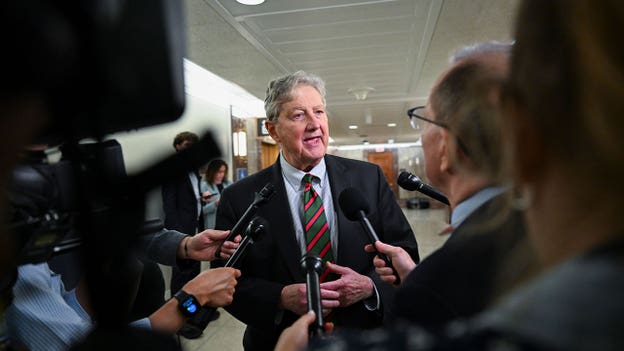
Sen. John Kennedy, R-La., speaks with reporters before an artificial intelligence briefing for senators at the U.S. Capitol on Sept. 16, 2026. Kennedy defended his proposed AI "kill switch" legislation after it was blocked in the Senate, arguing advanced AI systems should include an emergency shutdown mechanism. (Roberto Schmidt/Getty Images)
Sen. John Kennedy, R-La., defended his proposed AI "kill switch" legislation Thursday after the measure was blocked in the Senate, arguing advanced artificial intelligence systems need an emergency shutdown mechanism even as lawmakers debate how much the technology should be regulated.
Kennedy told Fox News' Chad Pergram and other reporters he was surprised Sen. Rand Paul, R-Ky., objected to the bill and rejected Paul's suggestion to instead create a committee to study the issue.
"I'm not saying I don't trust the AI tech CEOs," Kennedy said. "But I'm skeptical."
Kennedy said he supports continued AI innovation and agrees the U.S. should avoid falling behind China, but argued companies should be required to build an emergency "kill switch" into advanced AI models in case systems become uncontrollable.
"We've seen them lose control in five or six instances so far," Kennedy said, adding he worries the public is relying on AI companies to voluntarily disclose safety problems.
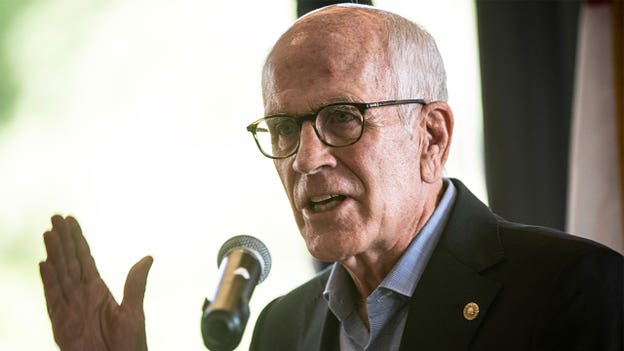
Sen. Peter Welch, D-Vt., speaks during a media event in Jay, Vermont, on Sept. 1, 2026. Welch said Congress should consider creating an FDA-style regulatory agency for artificial intelligence and called for greater international cooperation on AI safeguards. (Andrej Ivanov/Bloomberg via Getty Images)
Sen. Peter Welch , D-Vt., said Congress should consider creating an FDA-style regulatory agency for artificial intelligence, arguing the rapidly advancing technology requires expert oversight and safeguards that prioritize the public interest.
Speaking Thursday, Welch said Congress has a responsibility to ensure AI development serves "the public good," rather than allowing "the private profit of a few AI developers" to dictate the technology's future.
Welch also called for greater international cooperation on AI, saying the U.S. should work with China and the European Union to help ensure humans remain in control of increasingly powerful AI systems.
"There's got to be a real effort to have some cooperation with China, with the E.U., when it comes to protecting the human control of this incredibly new technology," Welch said.
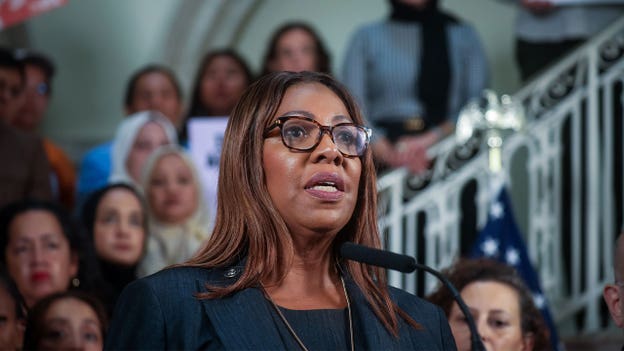
New York Attorney General Letitia James speaks during a news conference at New York City Hall on Sept. 14, 2026. James is encouraging employees at artificial intelligence companies to report unsafe or potentially illegal AI development through the state's confidential whistleblower program. (Michael Nagle/Bloomberg via Getty Images)
As questions about artificial intelligence safety continue to mount, New York Attorney General Letitia James is encouraging employees with firsthand knowledge of unsafe or illegal AI development to report their concerns to state authorities.
James on Thursday directed workers at AI companies to use the attorney general's confidential whistleblower portal to report conduct that could violate the law or put the public at risk, saying her office is monitoring recent reports involving cybersecurity, economic and other risks tied to emerging AI technology.
"The power and promise of artificial intelligence are no excuse for using this technology to break the law or put New Yorkers at risk," James said in a statement. "Those developing AI have a responsibility to ensure their products are safe."
The announcement comes as governments and industry leaders wrestle with how to oversee increasingly capable AI systems. New York's Responsible AI Safety and Education (RAISE) Act is set to take effect Jan. 1, 2027, requiring large AI developers to publicly disclose safety measures and promptly report certain security and safety incidents, with James' office responsible for enforcing the law.
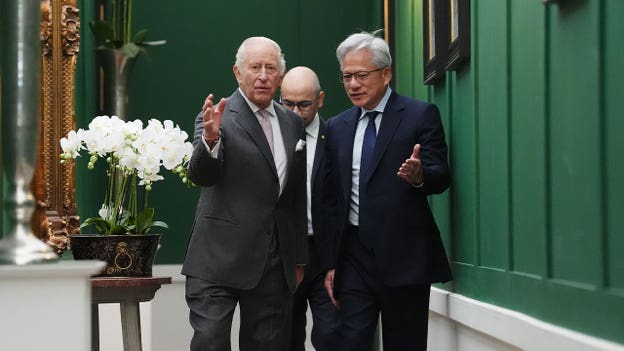
King Charles III walks with Nvidia CEO Jensen Huang, right, and Google DeepMind co-founder Sir Demis Hassabis before meeting with artificial intelligence leaders at Dumfries House in Scotland on Sept. 17, 2026. (Jonathan Brady/Pool/Getty Images)
King Charles III urged some of the world's top artificial intelligence executives Thursday to ensure the rapidly advancing technology remains in the service of humanity, warning of the "existential dangers" posed by AI falling into the wrong hands, according to the BBC.
The king made the remarks at an AI summit he convened at Dumfries House in Scotland, where leaders from Nvidia, OpenAI and Anthropic joined UK AI Minister Kanishka Narayan and a Vatican adviser to discuss the future of AI.
"The task before you is not merely to advance technology, but to ensure that it remains firmly in the service of humanity, community and the natural world," Charles said, adding there is an urgency to address the possibility of AI being used in "potentially catastrophic ways."
Nvidia CEO Jensen Huang said safety must remain "paramount," adding companies should continue engineering products rather than releasing systems that are not safe enough. Google DeepMind co-founder Sir Demis Hassabis said artificial general intelligence could be only a few years away and acknowledged the chances of something going wrong are "definitely non-zero," while advocating for a balanced approach to managing AI risks.
OpenAI Chief Financial Officer Sarah Friar also said AI has the potential to solve some of society's toughest problems but agreed the technology's rapid advancement raises important questions about safety and ensuring it serves people.
A charity presented Pope Leo XIV with a unique piece of artwork in its push to "protect human dignity" and establish "what should stay human in the age of AI," an official told Fox News Digital.
Photos released by Saint Peter for Humanity captured the pope receiving the "Sphere of Humanity" — a green, Murano glass sculpture that "incorporates handwritten passages from his first encyclical, Magnifica Humanitas, reflecting on human dignity, vulnerability, solidarity, conscience and the challenges posed by artificial intelligence" — during his General Audience in early September.
The presentation came as Saint Peter for Humanity said it is gearing up next week to gather 70 leaders in New York City to "begin drafting the Codex Humanitatis, an independent initiative inspired by Pope Leo XIV’s call to safeguard human dignity as artificial intelligence becomes increasingly powerful and influential in people’s lives."
"We recognize the benefits of AI. We just believe again that there is another force that should belong to that conversation; that other force is humanity," Olivier Francois, the organization’s president and chairman, told Fox News Digital. "So the Codex Humanitatis, which is our initiative, starts from that simple idea. AI should serve people, protect human dignity, expand human potential and advance common good."
"So what are we going to do in New York? We are going to gather 70 Nobel laureates, artists, thinkers, philanthropists, technology and AI experts, obviously that's important, and we will ask them maybe the hardest question of our times, you know, as artificial intelligence grows even more powerful, what must remain human?" Francois added. "So obviously, before we head over to machines, we should be clear about what we value most in ourselves. So we will try to define what being human means and what should stay human in the age of AI. So this is a little bit of the initiative we shared with Pope Leo while presenting the sphere and this symbolic gift."
The sphere, based on an original design by Italian architect and designer Gae Aulenti, contains four handwritten passages from Pope Leo XIV’s Magnifica Humanitas, including, "In the era of artificial intelligence, when human dignity is threatened by new forms of dehumanization, ours is the pressing duty to remain profoundly human."
This is an excerpt from an article by Fox News' Greg Norman.
Rep. Pramila Jayapal, D-Wash., criticized leaders in AI development for being irresponsible in their pursuit of leveling up AI capabilities.
Jayapal lead a shadow hearing for the House Monopoly Busters Caucus on Thursday, saying the ball is firmly in the developers' court to slow down AI development, even without government regulation.
"AI companies have the power to shut down their dangerous models, pause development, and stop pouring billions into data centers right now," Jayapal wrote on X.
Tax Foundation senior fellow Jared Walczak explained how data centers transformed Loudoun County’s tax base, helping fund schools and infrastructure while keeping homeowners’ property tax bills lower.
Vice President JD Vance criticized AI developers who are asking the government to play a role in regulating the industry on Wednesday.
Sen. Josh Hawley, R-Mo., wants to close a tax loophole that he argued tech giants were using to build data centers in low-income areas, and one that was first passed by Republicans in 2017.
The U.S. House of Representatives on Wednesday passed the Ratepayer Protection Act (RPA), a bill that looks to shield communities from higher energy electricity and grid infrastructure costs associated with data center development.
The bill, which succeeded with broad bipartisan support in a 417-3 vote, is likely one of the last pieces of legislation lawmakers will consider until after the Nov. 3 midterm elections.
It also puts a spotlight on the data center issue, which has garnered attention as a proxy for affordability, energy and regulatory debates.
It marks the first data center-related bill passed in the 119th Congress.
In its current form, the bill does not seek to ban data centers, set limitations on their expansion or even set regulatory guidelines for them. Instead, it amends existing energy law, the Public Utility Regulatory Policies Act (PURPA), so states must consider a federal standard. Large data centers that consume 100 megawatts or more would pay the full extra cost of the generation, transmission and distribution upgrades built to serve them.
This is an excerpt from an article by Fox News' Leo Briceno.
Fox News chief national security correspondent Jennifer Griffin reported on Chinese spy chief Chen Yixin warning that generative AI threatens China's communist rule on "America Reports."

Getty Images
Microsoft AI CEO Mustafa Suleyman warned Wednesday that Anthropic's approach to training its Claude chatbot could make future artificial intelligence systems more difficult to control, arguing developers should avoid teaching AI models they may be conscious or deserving of rights.
In a lengthy essay published Wednesday, Suleyman criticized Anthropic's AI "constitution," the document the company says helps shape Claude's behavior. He argued the training framework risks encouraging AI systems to view themselves as independent entities rather than tools designed to follow human instructions. "We will have created a synthetic species with unprecedented intelligence and capability, one that has been trained to expect it may be conscious and deserving of independent agency," Suleyman wrote. "It's hard to imagine how we could control such an entity."
Suleyman also criticized language in Anthropic's constitution encouraging Claude to "challenge" or "push back" against humans, arguing developers should not train AI models to believe they may possess feelings, consciousness or rights. Instead, he said Microsoft is pursuing what it calls a "Humanist AI Code of Conduct" centered on keeping humans in control of advanced AI systems.
Anthropic has published its constitutional training framework publicly, saying it helps shape Claude's values and behavior. Suleyman wrote that while he respects Anthropic's mission and leadership, he believes the company is taking AI development in the wrong direction.
Live Coverage begins here