













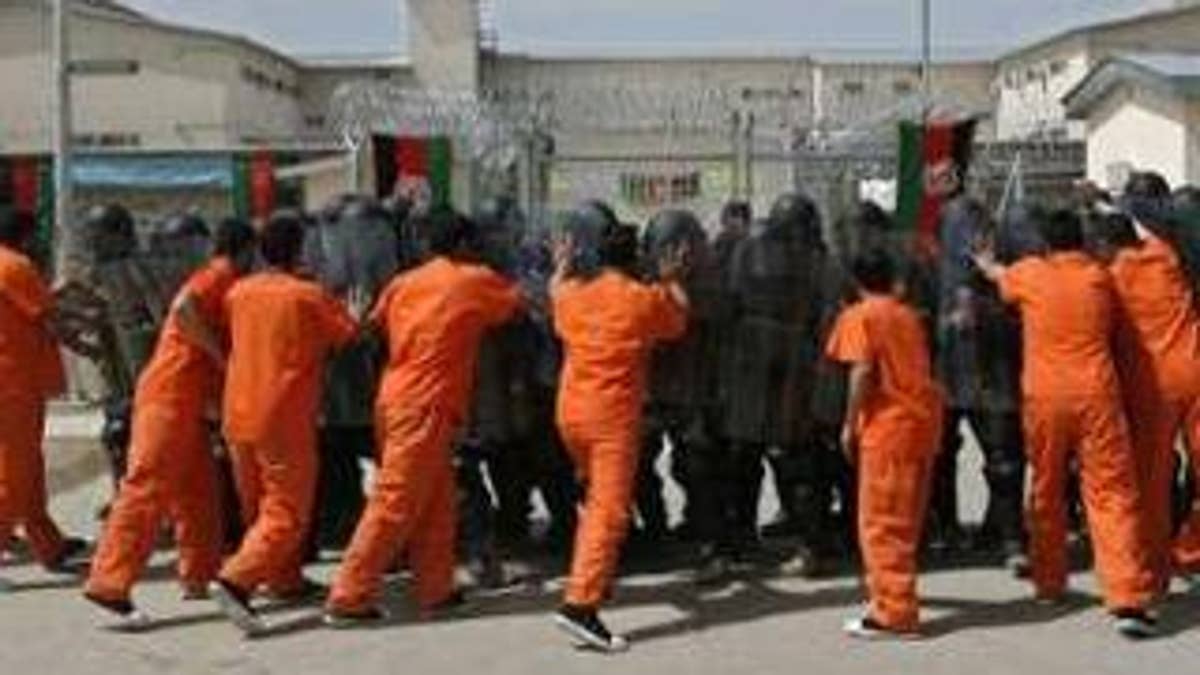
Detainees at Guantanamo Bay prison who are brought to the United States to stand trial in U.S. criminal courts, they are expected to enjoy the same rights afforded others who pass through the federal criminal court system, and that worries some.
The contentious debate over bringing terrorist suspects at Guantanamo Bay, Cuba, prison to the United States to be tried in federal courts raises thorny questions about rights such as bail hearings, plea negotiations and jury selections -- and of course, what happens if a suspect is acquitted.
"That's the issue that drove the whole system in the first place," said Anthony Barkow, a former U.S. attorney and executive director of the Center on the Administration of Criminal Law at New York University.
"I think some if not all pose a risk to national security and I think the administration is going to be put in a tough spot if anyone is acquitted and faced with a difficult decision about whether to employ some other mechanism to detain these people," Barkow told FOXNews.com.
Dean Boyd, a spokesman for the Justice Department, told FOXNews.com that these suspects get the same rights as any other criminal defendant.
"Those that are prosecuted in the criminal justice system will be treated as any other criminal defendant," he said, adding that those who pose grave dangers can be segregated from other inmates.
Click here to read raw data on how the criminal cases proceed in U.S. federal courts.
If they're acquitted, Boyd said the defendants are typically deported if they are not citizens of the United States.
Boyd added that not all terror detainees will be tried in U.S. courts; some will be tried in the military commissions that President Obama announced last month would be revived.
Obama's spokesman said Friday that the administration hasn't decided whether or not to release Guantanamo Bay detainees in the United States. Asked if that meant he was ruling out releasing any detainees in the United States, Robert Gibbs said, "I'm not ruling it in or ruling it out."
Gibbs said the Obama administration is not going to make any detainee decisions that threaten U.S. security. He did not address whether any decision would apply to detainees acquitted in U.S. courts.
Ahmed Ghailani became the first Guantanamo detainee brought to the United States this week to face charges in deadly strikes in 1998 against the U.S. embassies in Tanzania and Kenya, and relating to his ties to Al Qaeda. He had been indicted by a federal grand jury for the embassy bombings more than a decade ago.
In theory, Ghailani will now have broader access to the evidence against him and more avenues to challenge it by emphasizing the circumstances of his capture, detention and treatment over the years. He'll also have regular access to his lawyers as he awaits trial in a jail that holds disgraced financier Bernie Madoff and a captured Somali pirate.
His military lawyers, frustrated by the failings of tribunals, said this week that the government's decision to bring him to the U.S. was a victory in itself.
"The rule of law is established here," said Air Force Maj. Richard Reiter. "We're not dealing with the due process issues that exist in Guantanamo. ... A fair prosecution that protects his rights is all we could ask for."
Guantanamo detainees are not the only terrorist suspects who may end up in U.S. courthouses.
The Justice Department acknowledged Wednesday that FBI agents have read terrorist suspects their rights overseas, at Bagram Air Base in Afghanistan and other places, to "preserve the quality of evidence obtained."
The FBI's role in Mirandizing suspects is an apparent product of reported plans for the agency to expand its role in counter-terrorism operations under what's called the "global justice" initiative. According to reports, FBI agents would take over some CIA responsibilities under the assumption that most of these suspects would end up in a court of law.
Boyd said "the vast majority of terrorism detainees captured abroad are and continue to be interviewed without Miranda warnings for intelligence collection purposes."
But the warnings may be used when "it appears that national security may be best served by prosecuting that detainee, or at least preserving the prosecution option," he said, explaining that the warnings ensure that detainee statements are admissible at trial.
He added that several of the Mirandized interviews in Afghanistan took place under the previous administration.
Congressional Republicans argue that transferring terrorist suspects to U.S. soil will jeopardize national safety. But President Obama has said keeping suspects such as Ghailani from coming to the United States "would prevent his trial and conviction" for terrible crimes.
Prosecutors achieved a conviction rate of more than 90 percent in terror-related cases from Sept 11, 2001, to the end of 2007.
Boyd also noted that of the 216 inmates imprisoned in the United States for a connection to international terrorism, 67 were extradited for prosecution, including Wadih el-Hage, convicted of the 1998 U.S. Embassy bombings in Africa, and Zacarias Moussaoui, convicted of conspiring with Al Qaeda in the Sept. 11 terrorist attacks.
The Associated Press contributed to this report.
