



















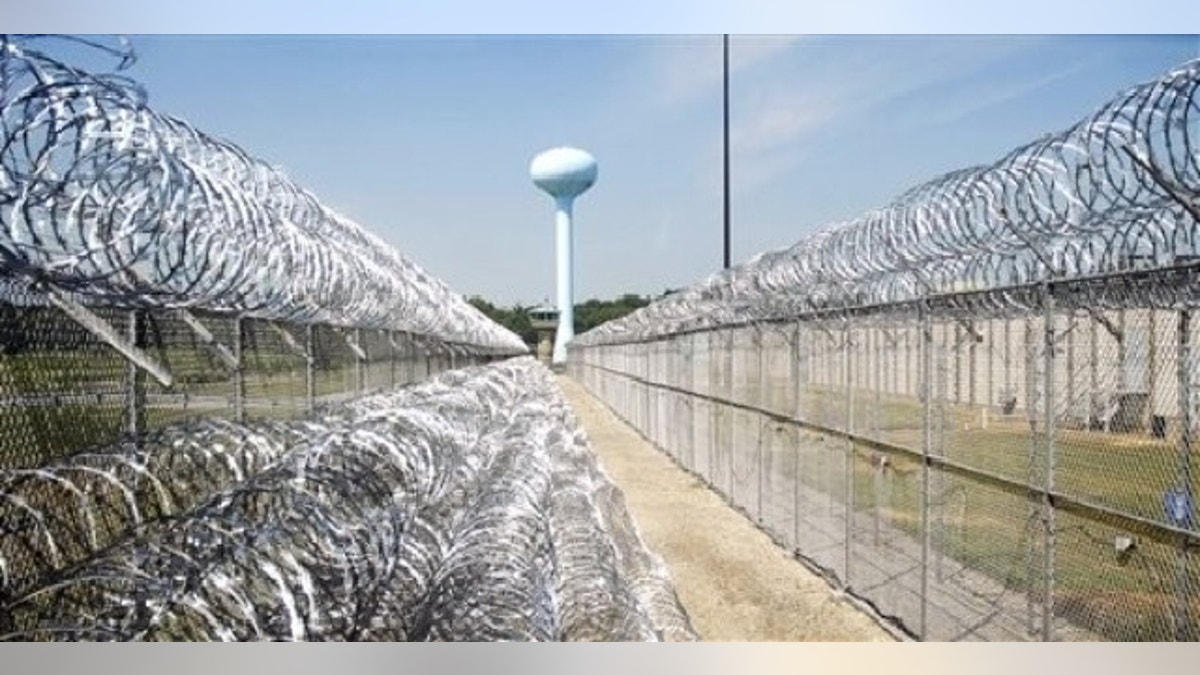
This Aug. 19, 2008, photo shows the inner and outer security fence surrounding the medium security federal prison in Marion, Ill. Once the nation's securest prison, the federal lockup near this southern Illinois town has housed everyone from spies to a Columbian druglord to dapper mob boss John Gotti. (AP Photo/The Southern, Steve Jahnke) (AP)
With all the attention that's been paid lately to long federal sentences for drug offenders, it's surprising that a far more troubling phenomenon has barely hit the media's radar screen. Every year, thousands of upstanding, responsible Americans run afoul of some incomprehensible federal law or regulation and end up serving time in federal prison.
What is especially disturbing is that it could happen to anyone at all -- and it has.
We should applaud Reps. Bobby Scott (D-Va.) and Louie Gohmert (R-Texas), then, for holding a bipartisan hearing today to examine how federal law can make a criminal out of anyone, for even the most mundane conduct.
Federal law in particular now criminalizes entire categories of activities that the average person would never dream would land him in prison. This is an inevitable result of the fact that the criminal law is no longer restricted to punishing inherently wrongful conduct -- such as murder, rape, robbery, and the like.
Moreover, under these new laws, the government can often secure a conviction without having to prove that the person accused even intended to commit a bad act, historically a protection against wrongful conviction.
Laws like this are dangerous in the hands of social engineers and ambitious lawmakers -- not to mention overzealous prosecutors -- bent on using government's greatest civilian power to punish any activity they dislike. So many thousands of criminal offenses are now in federal law that a prominent federal appeals court judge titled his recent essay on this overcriminalization problem, "You're (Probably) a Federal Criminal."
Consider small-time inventor and entrepreneur Krister Evertson, who will testify at today's hearing. Krister never had so much as a traffic ticket before he was run off the road near his mother's home in Wasilla, Alaska, by SWAT-armored federal agents in large black SUVs training automatic weapons on him.
Evertson, who had been working on clean-energy fuel cells since he was in high school, had no idea what he'd done wrong. It turned out that when he legally sold some sodium (part of his fuel-cell materials) to raise cash, he forgot to put a federally mandated safety sticker on the UPS package he sent to the lawful purchaser.
Krister's lack of a criminal record did nothing to prevent federal agents from ransacking his mother's home in their search for evidence on this oh-so-dangerous criminal.
The good news is that a federal jury in Alaska acquitted Krister of all charges. The jurors saw through the charges and realized that Krister had done nothing wrong.
The bad news, however, is that the feds apparently had it in for Krister. Federal criminal law is so broad that it gave prosecutors a convenient vehicle to use to get their man.
Two years after arresting him, the feds brought an entirely new criminal prosecution against Krister on entirely new grounds. They used the fact that before Krister moved back to Wasilla to care for his 80-year-old mother, he had safely and securely stored all of his fuel-cell materials in Salmon, Idaho.
According to the government, when Krister was in jail in Alaska due to the first unjust charges, he had "abandoned" his fuel-cell materials in Idaho. Unfortunately for Krister, federal lawmakers had included in the Resource Recovery and Conservation Act a provision making it a crime to abandon "hazardous waste." According to the trial judge, the law didn't require prosecutors to prove that Krister had intended to abandon the materials (he hadn't) or that they were waste at all -- in reality, they were quite valuable and properly stored away for future use.
With such a broad law, the second jury didn't have much of a choice, and it convicted him. He spent almost two years locked up with real criminals in a federal prison. After he testifies today, he will have to return to his halfway house in Idaho and serve another week before he is released.
The other hardened criminal whose story members of Congress will hear today is retiree George Norris. A longtime resident of Spring, Texas, Norris made the mistake of not knowing and keeping track of all of the details of federal and international law on endangered species -- mostly paperwork requirements -- before he decided to turn his orchid hobby into a small business. What was Norris's goal? To earn a little investment income while his wife neared retirement.
The Lacey Act is an example of the dangerous overbreadth of federal criminal law. Incredibly, Congress has made it a federal crime to violate any fish or wildlife law or regulation of any nation on earth.
Facing 10 years in federal prison, Norris pled guilty and served almost two. His wife, Kathy, describes the pain of losing their life savings to pay for attorneys and trying to explain to grandchildren why for so long Poppa George couldn't see them.
Federal criminal law did not get so badly broken overnight, and it will take hard work to get it fixed. It is encouraging that members of Congress such as Reps. Scott and Gohmert are now paying attention to the toll overcriminalization takes on ordinary Americans. Congress needs to begin fixing the damage it has done by starting to restore a more reasonable, limited and just federal criminal law. Today's hearing is an excellent first step.
Brian W. Walsh is Senior Legal Research Fellow in the Center for Legal and Judicial Studies at The Heritage Foundation (heritage.org).
