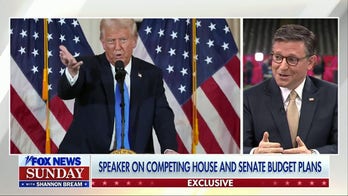



• Special Guests: David Plouffe, Rep. Eric Cantor

    The following is a rush transcript of the April 10, 2011 edition of "Fox News Sunday With Chris Wallace." This copy may not be in its final form and may be updated.


    CHRIS WALLACE, ANCHOR: I'm Chris Wallace. The latest on the battle of the budget, next on "Fox News Sunday."


    (BEGIN VIDEOTAPE)

    (MUSIC)

    PRESIDENT BARACK OBAMA: This agreement between Democrats and Republicans --

    SPEAKER OF THE HOUSE JOHN A. BOEHNER, R-OHIO: -- will, in fact, cut spending and keep our government open.

    WALLACE (voice-over): Uncle Sam stays in business. But, now, a tough battle over the federal debt and the 2012 campaign year budget. We'll look at the policy and politics with White House senior adviser David Plouffe and House Majority Leader, Republican Eric Cantor.

    Plouffe and Cantor live only on "Fox News Sunday."

    Plus, the fall-out from the budget battle for President Obama and Speaker Boehner. Our Sunday regulars tell us who won and who lost.

    All right now on "Fox News Sunday."

    (END VIDEOTAPE)

    WALLACE: And hello, again, from Fox News in Washington.

    Well, by now, you've seen the headline. House Republicans, Senate Democrats and the White House reached a deal late Friday night to avoid a government shutdown and cut $38.5 billion from the budget. It's the biggest spending cut ever.

    But what's s in the deal? And what was taken out? And what does this showdown mean for battles later this year over government spending?

    Fox News chief political correspondent Carl Cameron is live on Capitol Hill with the answers -- Carl.

    CARL CAMERON, FOX NEWS CHIEF POLITICAL CORRESPONDENT: Good morning, Chris.

    Lawmakers have until Friday to pass the final agreement. President Obama signed the extension yesterday and then went to the Lincoln Memorial to welcome sightseers.

    (BEGIN VIDEO CLIP)

    OBAMA: Because Congress was able to settle its differences, that's why this place is open today and everybody has been able to enjoy their visits. And that's what kind of future cooperation I hope we have going forward.

    (END VIDEO CLIP)

    CAMERON: The $1 trillion budget through September cuts spending a record $38.5 billion. It includes a $1 billion across-the-board cut. Another $2.5 billion comes out of transportation. And more than $5 billion from programs the president planned cut next year.

    The Pentagon gets $2 billion less than it requested.

    The deal halts additional funds for the IRS sought by the White House. It bans abortion funding in D.C. and re-establishes a D.C. school voucher program the president let lapse.

    Democrats got GOP provisions stripped out that would have defunded the health care law and Planned Parenthood but feature votes on both in the Senate.

    Most Republican policy riders to defund things like EPA and National Public Radio were dropped.

    The deal shows that president Obama can do business with the new House Speaker John Boehner, but Republicans wanted to cut more spending and Democrats wanted to cut less -- differences that are only likely to deepen as Congress gets ready to deal with next year's budget and raising the debt limit in the next several weeks -- Chris.

    WALLACE: Carl Cameron reporting from Capitol Hill -- Carl, thanks for that.

    Joining us now is David Plouffe, President Obama's senior adviser.

    Mr. Plouffe, welcome back to "Fox News Sunday."

    DAVID PLOUFFE, WHITE HOUSE SENIOR ADVISER: Good to be with you, Chris.

    WALLACE: Let's peel back a little of the process. You have gone out today; pre-taped a few of the other Sunday shows and you're live here on "Fox News Sunday." And you are apparently saying that the president is going to lay out this week new plans to cut the deficit. Tell us about it.

    PLOUFFE: Well, he'll lay out his approach this week in terms of the scale of debt reduction he thinks the country needs so we can grow economically and win the future, a balanced approach. Obviously, we need to look at all corners of government. As he said previously, his health care law is $1 trillion in deficit reduction over the next two decades, but we have to do more there.

    We have to look at more spending here, carefully. As he said, we have to use a scalpel not a machete. And, obviously, this is a distinction with the congressional Republican plan that was announced this week.

    That plan would give the average millionaire $200,000 in tax cuts, but ask a lot more of senior citizens. It would double their health care cost, $6,000 a year down the road. Cut education, cut energy investment at a time of record gas prices.

    So, we're going to have a big debate. But what's clear on deficit reduction, like anything in Washington, if we're going to make any progress together, whether it's in education reform, job creation, deficit reduction, the parties are going to have to come together to find common ground. And that's what happened this week -- just as it did in December when the parties came together with the president's leadership to cut taxes for everybody in America.

    WALLACE: Let me ask you a couple of specifics. Will the president address entitlements which he did not do in his 2012 budget, specifically what to do about Medicare and Medicaid?

    PLOUFFE: Well, first, on the 2012 budget, that would be $1 trillion of deficit reduction over the next decade and lowest level of domestic spending since Dwight Eisenhower. And he said it in the State of the Union, that was just a start. We're going to have to do more.

    So, as I said, we've already -- on health care, over $1 trillion. Actually, the congressional Republican plan actually preserves the Medicare spending. So, the president says we have to do more. He's going to lay out his cuts about that (ph).