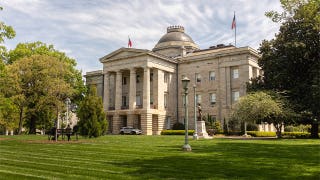








The 1,900-page House health care bill, shown here, is expected to come to the floor for debate in a matter of days. (AP Photo)
The health care reform bill awaiting debate in the House assumes millions of workers and employers would rather pay $167 billion in fines than purchase or provide adequate coverage, according to a recent analysis, raising questions about whether the plan does enough to make insurance affordable.
Though the bill is estimated to expand coverage from the current 83 percent to 96 percent of legal U.S. residents, the windfall of projected penalty payments also exposes a potential contradiction in reform. A significant part of the plan to expand coverage relies financially on fines from the uninsured.
The nonpartisan Congressional Budget Office estimated in its study last week that the House bill would bring in $167 billion over 10 years -- $33 billion from fines paid by individuals who decline to buy insurance, and the rest from employers who don't offer insurance to workers or contribute enough toward premiums.
Ernest Istook, a former Republican congressman from Oklahoma who is now a fellow at the conservative Heritage Foundation, calculated that anywhere between 8 million and 14 million people would end up paying the fines.
This raises a few problems, he said. First, if those millions somehow get covered and don't pay the fine, then the health program is faced with a budget hole.
Second, he said, it speaks to a flaw with the insurance packages that are being offered. "If you say people would rather pay $167 billion in penalties rather than buy insurance under your new plan, what's wrong with your new plan?" he asked.
The answer, Istook said: "It's expensive."
The House plan would create a government-run insurance program intended to help extend coverage. But the plan would allow the government to negotiate rates with providers rather than set artificially low Medicare-style rates -- as House Speaker Nancy Pelosi and other liberal Democrats were hoping to do.
While the negotiated rate structure somewhat assuages the concerns of moderate Democrats and others who projected that a system based on Medicare rates would create an irresistibly cheap public plan that would draw millions away from private coverage and hurt doctors, it also does much less to address cost concerns.
In fact, the CBO report said such a public plan "would typically have premiums that are somewhat higher than the average premiums" for private plans in the newly created insurance marketplace. This is partly because the public plan would likely attract less healthy, and more expensive, enrollees.
In addition, many analysts and lawmakers have warned that private premiums will go up as well as a result of new requirements.
Though the government is offering a bevy of subsidies to make coverage more affordable under the plan, it apparently would not be enough to lure everyone into the system.
Suggestions for reducing the number of people who are insurance-averse are wide-ranging.
Some don't want any fines, emphasizing incentives over penalties. But political momentum in Washington has long since shifted in favor of a requirement to get coverage. President Obama, who opposed such a mandate during the presidential campaign, reversed and supported it during his September address on health care reform to Congress.
Others, especially the health insurance industry, want the fines to be increased.
"If you don't get everybody in, the market reforms don't work and premiums skyrocket for everybody," said Robert Zirkelbach, spokesman with America's Health Insurance Plans, which opposes the House Democratic plan.
Zirkelbach warned that those who choose to pay the penalty will just wait until they get sick to get covered, driving up premiums across the board. "More needs to be done to make coverage affordable."
Zirkelbach dismissed the claim that less penalty revenue would leave the federal government with a budget hole. He said getting more people covered would help bring down health care costs overall and balance out in the end for the government's books.
He doubted, though, that the government plan would have higher premiums. He said the so called public-option would ultimately negotiate rates down to Medicare levels.
Third Way, a think tank that describes itself as part of the "moderate wing of the progressive movement," also released a study saying the mandate cannot be weakened. But it said several changes can be made to expand coverage. The group suggested, among other things, allowing young people to pay lower premiums and allowing people to meet the coverage requirement with even leaner insurance plans.
Democrats are standing by the mandate provisions, though, arguing that some relatively small group of uninsured people is inevitable.
"There's just going to be some people who choose rather to pay (the fine) than to pay for health care," said Stephanie Lundberg, spokeswoman for House Majority Leader Steny Hoyer, D-Md. "There's going to be some people that just philosophically don't want to buy health care."
She said individual responsibility has to be a part of the plan, but that 96 percent coverage is still pretty admirable.
"It expands coverage substantially," Lundberg said.
