 Print
Print
 Close
Close

Key takeaways from House impeachment debate
Published December 18, 2019
This is a rush transcript from "Special Report with Bret Baier," December 18, 2019. This copy may not be in its final form and may be updated.
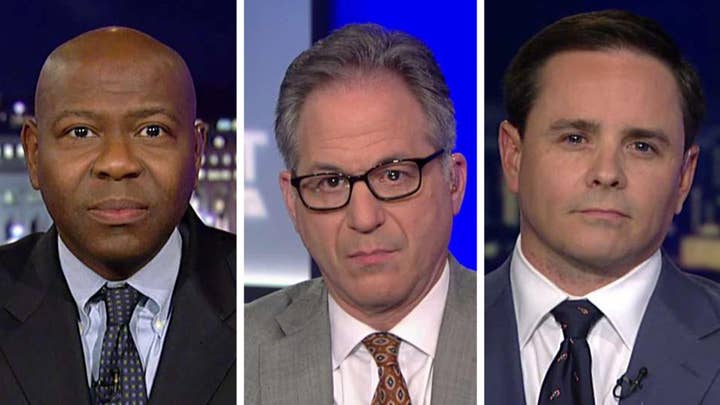
Bret Baier, anchor: Let's bring in our panel a little early tonight: Josh Holmes, former top adviser to Mitch McConnell, now president of Calvary Consultants; Charles Lane, opinion writer for The Washington Post; and Jason Riley, Wall Street Journal columnist and senior fellow at the Manhattan Institute.
Okay, Josh, you've seen the back and forth. And really, we said today these are the same arguments being made by different members, a lot of them, more than 166 at this hour, that we saw in the House Judiciary, the House Intel, and the House Rules Committee.
Josh Holmes, Calvary Consultants: Yeah. No, I -- look, other than a declaration of war, this is, perhaps -- you know, it's supposed to be amongst the most significant things that a Congress can do. And I was really struck today at how vapid and sort of insignificant all of the discussion was. It was, as you had suggested, Bret, it was a trading of talking points, largely poll-tested, that sort of worked on both sides with no real significance. And there was almost this comedic effort on behalf of congressional Democrats to insert this level of gravity that just didn't exist in terms of the facts. And you know, the quoting of Thomas Paine, and the introducing of our founding fathers, and this effort to sort of like raise the historic value of really what amounted to an extraordinarily partisan process.
Bret Baier: This is the only partisan impeachment we've had in the country's history and what's going to come down to, probably, a bipartisan effort with a couple of Democrats voting against impeachment. Speaking about the atmospherics, somebody in the press gallery in the House today said this, "I've seen bigger crowds for an omnibus." As far as people showing up to look at what's happening, this is this historic day, but it is what it is.
Charles Lane, The Washington Post: Slight correction. I would say the Andrew Johnson impeachment in 1868 was pretty partisan. But, yes, there is not as much --
Bret Baier: But people in his own party voted against.
Charles Lane: Well, what party really was --
Bret Baier: -- voted for impeachment.
Charles Lane: -- [inaudible]?
Bret Baier: Not true. But I'm just saying, for numbers.
Charles Lane: We digress, Bret.
[LAUGHTER]
Charles Lane: The numbers are clear. This is more partisan than Bill Clinton, which was more partisan than Richard Nixon. And I do think there's a kind of anticlimax feeling about it, whether you support this or not. I think there is a sense that we all kind of know where it's headed, that it's going to the Senate, and that the very high bar, 67 votes just isn't going to be met. And so, in a funny way, you really have to almost admire the Democrats for persisting in it, both in the face of the inevitable fact that it's not going to result conviction, and in the face of these negative poll results, which, admittedly, have gone back and forth a little bit, although the trend is not favorable to it. I think that what this shows is that that, I guess, the only explanation for it is twofold: one, that they really believe in it; and, two, that within the Democratic Party, it has become almost as much of a loyalty test to the party as in the Republican Party unconditional defense of Trump has become.
Bret Baier: Tonight's vote is a foregone conclusion. What's not is the Senate plan ahead. They will get this trial. Take a listen to this argument about witnesses.
[BEGIN VIDEO CLIPS]
Rep. Adam Schiff: He'd have more credibility if he said, "Let's bring in Bolton. Let's bring in Mulvaney. Let's bring in Pompeo. Let's –
Secretary Mike Pompeo: I'm happy to do document productions. I'm happy to testify if that's appropriate and required by law.
Sen. Chuck Schumer: They're the appointees of President Donald J. Trump. They are hardly biased.
Sen. Lindsey Graham: I am not going to support witnesses being called for by the president. I'm not going to support witnesses being called for by Senator Schumer.
[END VIDEO CLIPS]
Bret Baier: What about this, Jason?
Jason Riley, Wall Street Journal: I think the Democrats are being very disingenuous on this witness requests, Bret. Mulvaney and Bolton weren't called in the House. If their testimony was so important to this process, why didn't the Democrats in the House of Representatives let this play out in the courts? Why were they so eager to move ahead with impeachment without that testimony if it is so key to these proceedings?
Bret Baier: Their answer to that –
Jason Riley: To then turn —
Bret Baier: -- let me just answer -- what their answer to it is, it's urgent because the because the president is currently obstructing the 2020 election. That's what Jerry Nadler said today.
Jason Riley: Well, they [laughs] -- well, it's interesting. Both Nadler and Schiff have now made the argument that we must remove this president because he's going to cheat in the next election. I know they are eager to expand the scope of impeachable behavior. But since when do we impeach presidents based on what they might do in the future? I mean, I think that is that is a bridge too far. But there is an urgency here on the part of the Democrats. And it is anticlimactic, as Trump was saying. I think it's because they over- promised. We -- they had these bombshells, we were told: bribery, and collusion with Russia, and extortion, and all the rest. And we have some very weak tea here. It has been overly partisan. And, more importantly, it has not moved the polls in the way that they thought.
Bret Baier: Speaking of polls, Josh, the president's approval in Gallup went up six points. You've seen, in swing states, the impeachment go upside down, against. Meantime, stuff is getting done. In the Senate today, 11 more federal judges being confirmed. And, also, just breaking tonight, the Fifth Circuit Court of Appeals upholding a lower court's ruling, saying Obamacare individual mandate is unconstitutional. Now, that's one part of it, but it leads to a whole bunch of questions about what that means, legislatively, and in the courts, and if this is going back to the U.S. Supreme Court.
Josh Holmes: Yeah. I mean, well, look, if you're concerned with policymaking whatsoever, you've got to hate what's happening in the House of Representatives over the last couple of months. Now, they've had some wins here and a omnibus in the end that is, you know, largely, a lot of conservative priorities, like repealing medical device taxes and all the various Republican priorities of repealing Obamacare. But, look, I think ultimately the bet that they made is that they had to produce some kind of leverage with the base between now and primary season, with Democrats, in order to protect that 2018 class from all being wiped out by a bunch of young, unelectable Democrats that walk into the 2020 election and promptly lose their majority for them. That's fine for the time being. Over time, you see the error of that judgment. And I think what you're seeing in the poll movement is the center of this country saying, "Well, first, you told us that there was a Russian collusion episode. And we found out Mueller didn't agree with that. Now, you told us that there's this Ukrainian issue. We're looking at obstruction charges and this sort of amorphous problem that you've surfaced. None of it looks that serious to us. What are you wasting all of our time for?"
Bret Baier: But we don't know, Chuck, is how much or little the albatross of impeachment by the House will hang on a president seeking reelection in 2020. And we don't know the political fortunes of the 31 Democrats. Most of them will vote for impeachment in those Trump districts. And the political fallout of that, I think, is yet to be even seen.
Charles Lane: Yes, but I don't want to let the discussion go by without pointing out that President Trump did something vis-à-vis Ukraine, many things that were really inappropriate: leveraging the opportunity to meet in the White House; leveraging the military aid for the sake of this, you know, demand or request that Joe Biden be investigated, on the one hand, and that the Ukrainians pursue this ludicrous -- excuse me -- this ludicrous theory about Ukrainian intervention. And I think one of the very unfortunate consequences, among all the others we're discussing here, is that a lot of Republicans, who privately know better, have been, in a way, forced to adhere to that narrative as the price. They're loyal to the president.
Bret Baier: There is a Republican line on some of these speeches today on the floor that the president did nothing wrong. There is another Republican line by some moderates who say, "The call wasn't perfect, but it's not impeachable."
Josh Holmes: What a lot of Republicans are also saying, though, is you can't point to an underlying statute that was violated. You can't point to an underlying crime. And that is what we have had in past impeachment efforts. Everyone knows Clinton violated the law. He committed perjury. That's something people can understand. We don't have a similar infraction here on the part of Trump, and that bothers a lot of Republicans.
Bret Baier: Okay, panel, thank you very much.
Content and Programming Copyright 2019 Fox News Network, LLC. ALL RIGHTS RESERVED. All materials herein are protected by United States copyright law and may not be reproduced, distributed, transmitted, displayed, published or broadcast without the prior written permission of Fox News Network, LLC. You may not alter or remove any trademark, copyright or other notice from copies of the content.
https://www.foxnews.com/transcript/key-takeaways-from-house-impeachment-debate