 Print
Print
 Close
Close

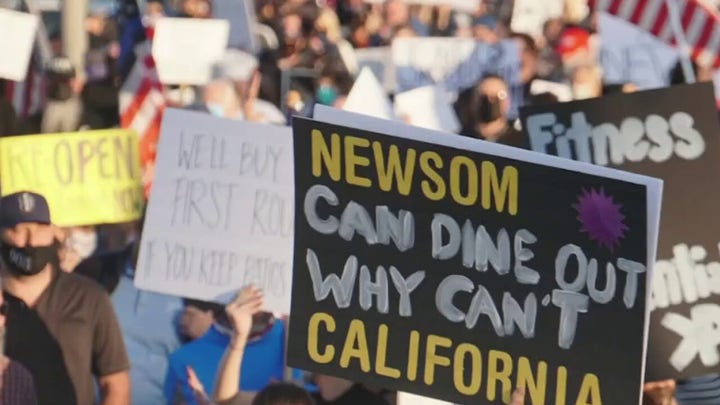
California businessman organizes march to protest COVID lockdowns
Published December 16, 2020
This is a rush transcript from “Your World with Neil Cavuto” December 4, 2020. This copy may not be in its final form and may be updated.
NEIL CAVUTO, FOX NEWS ANCHOR: All right, Billy, thank you very, very much.
At the corner of Wall and Broad, optimism right now that not only is one
vaccine on the way, but available doses into the millions, and by the end
of next year, over one billion are on the way as well. And it won't be just
one company participating, possibly a few, good enough for the corner of
Wall and Broad to see record after record.
Welcome, everybody. I'm Neil Cavuto, and this is "Your World."
And that, what you were peeking at the Dow, is the highest it has ever
been, the S&P 500 the highest it has ever been, the Nasdaq the highest it
has ever been, and all buoyed by optimism that, even with a potentially
bumpy start, the rollout in states for getting doses of vaccine to deal
with COVID-19, the plans are being made, the layout is already being
detailed.
We heard it from Ohio's governor yesterday. We're going to hear it from
Arkansas' governor today.
But first to Aishah Hasnie on the rollout and the deadline for those
distribution plans -- Aishah.
AISHAH HASNIE, FOX NEWS CORRESPONDENT: Hi, Neil. Yes, that's right.
Right now, states across the country are working on their last-minute
updates or last-minute changes to come into compliance with the latest CDC
guidelines, basically prioritizing two different groups, those health care
workers and nursing home patients.
Want to show you a list right now, not a complete list, though, of the
states that have already submitted their plans. Many, like California,
Washington, New York had already placed those two priority groups at the
front of the line. Other states, though, are now revising their plans and
also trying to balance the new guidelines with their own dire economic
needs.
So, in Nevada, for example, Neil, nursing home patients were previously
included in phase three. They were actually behind retail workers there.
The tourism hot spot is now, of course, moving them to the top of the list.
In Arkansas, where poultry is a huge part of the economy, poultry workers
will be among the second group of essential workers to get the vaccines.
Colorado is placing ski resort workers in phase two to try to revive its $6
billion industry.
Now, choosing where these vaccines go just got harder for these states, as
Pfizer is expected to ship only half the predicted number of doses.
Here's the latest from the FDA commissioner, Stephen Hahn, who is now
really trying to defend the agency's vetting process of that Pfizer
vaccine. Listen.
(BEGIN VIDEO CLIP)
DR. STEPHEN HAHN, COMMISSIONER, FOOD AND DRUG ADMINISTRATION: I'm feeling
pressure from the urgency of the situation and the thought that we have a
significant pandemic in this country. The American people do depend upon us
to do this job right.
And that is our promise we will do this right. We will get it right for the
American people. And we will look at the data very carefully so that they
can have confidence.
(END VIDEO CLIP)
HASNIE: And, Neil, it's one thing to roll out the vaccine. It's another
thing to get folks to take it.
We have been talking about these possible mandates out there. Will people
take the vaccine?
Here's an interesting note from Texas. Governor Greg Abbott has said the
vaccine there will only be given to folks who voluntarily choose to be
immunized. Very interesting -- Neil.
CAVUTO: Very interesting, Indeed.
Aishah, thank you. Great reporting on this, Aishah -- Aishah in New York
City on all of that.
Now, yesterday, we talked to Ohio's governor about how he was very much
eagerly anticipating thousands of doses of that Pfizer vaccine if and when
it becomes available via a checkoff from the FDA. That is said to be
happening in a matter of days.
Asa Hutchinson also with us right now, the Arkansas governor, who is very
eagerly awaiting that and getting it all distributed.
I guess, first, Governor, to health care workers.
GOV. ASA HUTCHINSON (R-AR): That's correct.
We, hopefully, with the FDA approval on the 10th, which is next week, we
expect our first shipment to arrive within 24 hours. It will go as we
direct to hospitals around the state, as well as pharmacies, so that our
health care workers can be immunized.
As has been pointed out, there's not enough in the anticipated volume that
comes with the first shipment to cover all the health care workers. And so
there's going to have to be some decisions made within the health care
community as to the priority.
Obviously, it would be -- go first to those that are having direct roles in
taking care of COVID patients and direct care with patients as well.
But those are going to be some refining points to our plan that has been
submitted. But we're ready to go. Obviously, it takes performance and
execution. And while the federal government has a very good plan, they have
worked on it, they have table topped it, we are anxious to actually see the
wheels roll and having that vaccine distributed, because it does give
everyone hope.
CAVUTO: Do you need, Governor, to wait until formal FDA approval?
It's been granted, certainly, in the United Kingdom by their counterpart to
the FDA here. But, without that, can, even on an emergency basis, it be
given to your residents?
HUTCHINSON: No, we cannot give it to our residents until we have emergency
youth -- use authorization, if I'm getting your question right.
(CROSSTALK)
HUTCHINSON: And so, we're awaiting the 10th.
We hope that that approval comes, that it goes to the medical care doctors.
In terms of the broad population, it's more a -- we're ready to give it to
them whenever the volume is here and we have the FDA approval, but the
emergency use authorization will be adequate.
Now, in terms of whether we're going to -- we're not mandating everyone to
take the vaccine either. That's why it's a public relations campaign. It is
confidence-building, so that the citizens will have confidence. I want to
set the right example.
If the FDA approves it, I have confidence in it. And we have to have that
large amount of participation. But I don't expect the mandates to follow
that.
CAVUTO: You know, president-elect Biden has said that the vaccine, that it
needn't be mandatory. What did you think of that?
HUTCHINSON: Well, I don't think it'd be appropriate.
Generally, we have some mandates for immunization of schoolchildren. But
that is somewhat controversial, in and of itself. This is a vaccine that is
really the product of one of the greatest research and operations in
American history with the development of this. The FDA is going through the
right process to approve it.
And so it's not a matter of mandate. It's a matter of confidence, and that
-- and selling it and making sure people feel comfortable with it. And
whenever you start with our health care workers, and then it will go to our
nursing home residents and staff, we're going to see the results of it as
you go along.
And they're going to continue to be able to evaluate it. I expect and hope
that the confidence will continue to build, so by the time that it gets to
our essential workers, the broader population, that there will be a huge
acceptance of this, because it takes that kind of acceptance for it to be
effective.
And so we need to have that. And it's for sure that we want to get beyond
where we are right now and have a brighter next summer, a brighter 2021.
CAVUTO: There's a concept.
Governor Hutchinson, thank you very much, sir. Very good catching up with
you on this, Asa Hutchinson of the beautiful state of Arkansas.
Let's go to Susan Li on what was a beautiful hat trick for the markets
today, the Dow, the Nasdaq, S&P 500 all just easily jumping into record
territory.
What was going on?
SUSAN LI, FOX NEWS CORRESPONDENT: Well, let's talk about jobs, because we
saw a seventh consecutive month of gains, but the jobs recovery obviously
is slowly, as COVID cases spike and new restrictions are put in place.
We saw November with 245,000 new jobs created, much less than economists'
forecasts, who were calling for 469,000. The jobless rate came down,
though, to 6.7 percent, and a bright spot, where wages accelerating from
October.
Now, close to half the new jobs in the month were in transport and
warehousing, as we head into the holiday shipping period, professional and
business services, including tech, also hiring, as is health care. And the
housing boom means demand in construction. Manufacturing had a strong
month, and jobs still coming back in leisure and hospitality.
So that means that the U.S. economy has now recovered 12 million out of the
22 million jobs that were lost at the onset of COVID. But, with rising
cases and more business restrictions being put in place, we do have workers
dropping out of the work force in order to care for children or just
discouraged from looking, the participation rate now near 50-year lows.
And this latest report card makes it even more urgent to pass a new
stimulus bill using a $900 billion bipartisan Senate package as a starting
point, which is a far smaller amount than Democratic leaders said -- say
that they might -- will accept.
Now, at her weekly press conference, we had House Speaker Nancy Pelosi
asked if it was maybe a mistake to turn down the previous White House offer
of $1.8 trillion.
(BEGIN VIDEO CLIP)
REP. NANCY PELOSI (D-CA): I'm going to tell you something.
Don't characterize what we did before as a mistake as a preface to your
question, if you want an answer. That was not a mistake. It was a decision.
And it's taken us to a place where we can do the right thing without other,
shall we say, considerations in the legislation that we don't want.
(END VIDEO CLIP)
LI: But, Neil, as you heard from Joe Biden earlier, he said that whatever
might be agreed to now is just a down payment for something even bigger in
the new year.
CAVUTO: Susan Li, thank you very much for that.
I want to go to Peter Doocy, because he's been following team Biden in
reaction to the jobs report and all this stimulus and how much and how soon
-- Peter.
PETER DOOCY, FOX NEWS CORRESPONDENT: And, Neil, as the president-elect was
exiting the stage, I managed to get a question in. I shouted out to him.
Does he think the COVID vaccine should be mandatory for all Americans?
And he said, no, he does not think it should be mandatory when it is
available, but that, like masks, he would do whatever it -- whatever he can
with the power that he has, once he is president, to convince people to, in
his words, do the right thing.
He also says he thinks it will go a long way in getting people to get the
vaccine if they see him, along with Barack Obama, Bill Clinton and George
Bush, getting the shot, so that people in certain communities -- he
specifically singled out the black community here in Wilmington -- don't
feel like they are being given the shot first.
And the word that he used to describe the concerns he is hearing is people
don't want to be guinea pigs. So, he is going to go to the front of the
line to try to ensure confidence.
Something that he said, though, about the briefings that they have been
getting about Operation Warp Speed, he says that they still haven't heard
from the Trump administration how exactly the U.S. government and
pharmaceutical companies are going to take the raw vaccine, the actual
liquid, and get it into a syringe that can then be given to somebody as a
shot.
That is something Biden said he is still waiting to do, and it is going to
be very expensive. He is also calling on Congress to act very quickly to
help people who are hurting right now by no fault of their own. Listen to
this.
(BEGIN VIDEO CLIP)
JOE BIDEN (D), PRESIDENT-ELECT: If Congress and President Trump fail to act
by the end of December, 12 million Americans will lose their unemployment
benefits they rely on.
Merry Christmas.
(END VIDEO CLIP)
DOOCY: Biden was asked multiple times during a Q&A session after his
remarks about the jobs report, which he called dire, whether or not he's
actually spoken to Mitch McConnell yet, and he did not give a direct answer
with any of the chances that he had -- Neil.
CAVUTO: Peter Doocy, thank you very, very much.
Well, as Peter intimated, tomorrow is going to be a big day in Georgia,
where the president of the United States will be campaigning on behalf of
those two Republican senatorial candidates who are in very tight races,
according to the latest polls.
There is the distinct possibility the Democrats, both of them, could pull
this off. Then what?
We're on it -- after this.
(COMMERCIAL BREAK)
CAVUTO: All right, President Trump will be in Georgia tomorrow arguing on
behalf and campaigning on behalf, as his vice president, Mike Pence, was
earlier today, for the two Republican senators in that January 5 run-off in
the Peach State.
But let's say there's a lot of intramural problems within the Republican
Party that could make this, I don't know, maybe a little problematic.
Steve Harrigan in Atlanta with much more.
Hey, Steve.
STEVE HARRIGAN, FOX NEWS CORRESPONDENT: You're right, Neil, a lot of
questions about how this is going to play out.
It is the president in Georgia tomorrow, but, today, it's the vice
president. He's in Savannah, campaigning with David Perdue and Kelly
Loeffler. Here's the vice president.
(BEGIN VIDEO CLIP)
MIKE PENCE, VICE PRESIDENT OF THE UNITED STATES: We need the Peach State to
defend the majority, because the road to the Senate Republican majority
runs right through the state of Georgia.
(END VIDEO CLIP)
HARRIGAN: President Obama also conducting a virtual rally for the two
Democrats.
There's been a lot of accusations and a lot of debate about potential fraud
in the general election, especially some video that's gotten a lot of
attention, security video from Fulton County, prompting the election
systems manager of Georgia to respond on Twitter: "The 90-second video of
election workers at State Farm Arena purporting to show fraud was watched
in its entirety, hours, by Georgia secretary of state investigators. Shows
normal processing."
Of course, the president going to Valdosta, Georgia, tomorrow. The thing to
watch will be how much of his focus will be on presidential claims of fraud
in the general election and how much will be focused on these two Senate
candidates, really the battle for control of the U.S. Senate -- Neil.
CAVUTO: Steve, thank you very much, my friend.
To Charlie Gasparino.
It's not just only Georgians watching this and political types. So are
investors and big honchos in the financial community, who are getting
increasingly concerned, I guess, huh, Charlie?
CHARLIE GASPARINO, FOX NEWS SENIOR CORRESPONDENT: Yes, I mean, they are
obsessed with this race.
I mean, never before have I heard so many Wall Streeters, C level types, C
suite level types, Neil, talk about two Senate seats in Georgia.
But the -- there's obvious reasons, and there's policy implications here.
If the Senate stays Republican majority, it puts a cap on a lot of the tax
increases, including maybe that corporate tax increase, that Biden -- that
president-elect Biden wants to enact when he gets in office.
So, if there's Republicans controlling the Senate by one or maybe two
votes, raising the corporate tax to -- from its current level of about 20
percent to 28 or 30 percent, is probably a nonstarter. Same with a lot of
the other tax increases that Joe Biden has pushed for during the election,
during the campaign, and same with some other measures involving Green New
Deals and lots of spending plans.
I mean, it's going to be -- it's a different fiscal policy ball game, as it
applies to investors, who may not face capital gains tax increases,
corporations, who may be able to keep their current corporate tax rate
where it is now, and in terms -- and even in terms of some regulations,
which need to go through the Congress, if the Republicans maintain that
seat, those two seats, or at least one of those seats.
But corporations, as they are -- at least they're telling me, based on what
their lobbyists are telling them, are getting scared. And the reason why
they're getting nervous, Neil, is because they believe that Donald Trump --
President Trump, in his continuing to attack the voter system down in --
particularly in Georgia, calling into question the Republican secretary of
state and governor, that he's going to request voter turnout, that people
are just not going to turn up.
They're going to think it's -- the election is rigged. And some of the
things that he said and some of the things Rudy Giuliani said and some
other lawyers that were associated with this effort have said is really
scaring corporate executives to think that there's a chance that the
Republicans, even though they should win these seats -- we should point out
that Jon Ossoff, the Democrat that's running against David Perdue, Reverend
Warnock, the Democrat running against Kelly Loeffler, they're pretty far
left.
Georgia is not quite a right-wing state anymore because of demographic
changes, influx of people from the North. But it's not -- it's clearly not
a far left state. And these are two candidates that would be very
comfortable with AOC and Bernie Sanders in leadership roles in the Biden
administration.
So -- but Georgia voters generally are out there. That's why they split the
ticket in this -- in this election. Remember, Perdue won, didn't get 50
percent, but won more votes than Ossoff.
So that's what they're worried about, depressing GOP voter turnout. Maybe
President Trump could turn around this Saturday -- back to you, Neil.
CAVUTO: All right, thank you, my friend, very, very much.
We will be looking at that, by the way, in Georgia. We will be speaking
with the secretary of state there, who has had his differences with the
president of the United States. He will be joining me tomorrow on my
Saturday show at 10:00 a.m. Eastern time on FOX.
In the meantime, I should also let you know and explain something that
Charlie mentioned. Republicans would have to lose both these seats for
Democrats to take control of the Senate. Democrats can't rest with winning
just one of them. They have to take both of them. It's an uphill battle.
But some polls show that both races are close enough that it could happen.
So, don't take anything for granted. And that's why the president of the
United States will be there.
In the meantime, I should let you know about overall concerns about
lockdowns and all of that in California, which you have heard a good deal
about. Now we're hearing that health officers in most of the San Francisco
Bay Area are issuing their own stay-at-home orders, because hospital
capacity is running to a bare minimum.
ICU beds continue to fill. And capacity there at hospitals in and around
the San Francisco area is such that they didn't want to take any chances.
And the better part of valor is to issue these stay-at-home orders for
hospitals.
Now, how many people adhere to that? We shall see.
Stay with us.
(COMMERCIAL BREAK)
CAVUTO: We just might have COVID-19 stimulus coming our way.
A top Republican senator who says it looks more likely now than it did
little more than 24 hours ago. What changed? Who changed? And what's in
store for you?
After this.
(COMMERCIAL BREAK)
CAVUTO: Can a governor go ahead and shut down private schools as well to
ward off the COVID-19 spread in his state?
That's the issue before the governor of Kentucky, and no less then, well,
Associate Justice Kavanaugh was demanding an answer by the end of today to
a lawsuit filed by the attorney general of Kentucky as to the double
standard there.
I had a chance to speak to Daniel Cameron, the Kentucky attorney general,
about this, and the premise of the case that says you can't treat two
school systems differently.
Take a look.
(BEGIN VIDEOTAPE)
DANIEL CAMERON (R), KENTUCKY ATTORNEY GENERAL: The fact of the matter is,
is that he's infringing upon the First Amendment rights of parents all
across the commonwealth who simply want to send their children to
religiously affiliated schools.
Meanwhile, gambling parlors, retail shops, movie theaters all continue to
stay open. But he has found it necessary to close down religiously
affiliated schools. That is a direct infringement upon the First Amendment
rights we all hold so dear.
As the attorney general, it's my responsibility to stand up for those
rights.
CAVUTO: So, when the governor is saying that this is not tilted toward just
private schools, that this crackdown that favors more virtual than in-
person learning applies to everybody, you said that's not the case?
CAMERON: Well, look, the larger context here is the fact that he has closed
down schools, specifically religiously affiliated schools, but opened up
the other things that I just mentioned.
What I have advocated and what parents all across the commonwealth in
Kentucky have advocated is the simple fact that the schools need to be able
to apply with the CDC guidelines.
You take Danville Christian that spent nearly $30,000, Lexington Christian
that spent nearly $400,000, all in an effort to keep people safe during the
midst of this pandemic.
CAVUTO: Now, what's happened, as you know better than many, Attorney
General, is that where there have been cases where public schools have been
shut down, parents have been just shipping their kids to private schools
and registering them there.
I would suspect the same phenomenon was going on in Kentucky. And that
could have something to do with all of this. What do you think?
CAMERON: Well, I think that's certainly a part of it.
Look, we just want our religiously affiliated schools, again, to have the
same opportunity that we have given retail shops, that we have given movie
theaters, that we have given gambling parlors. They should have the same
opportunity.
And, Neil, you know this. Dr. Fauci just this past weekend was on
television talking about the importance of getting our kids back in school.
The CDC has even put forth statements to that very same point, that very
same fact that schools have not been the super-spreaders that a lot had
feared.
It's important that our children get back to school. It's important that
parents in the commonwealth have the right and the opportunity to send
their children to these religiously affiliated schools, because not only is
the curriculum important, but it's also learning the story of the Bible,
learning the story of faith, again, that is protected by the First
Amendment.
We're going to stand up for that here in the commonwealth. And that is my
responsibility, as the attorney general.
CAVUTO: Now, Brett Kavanaugh has asked the governor to respond to this, to
respond essentially to your lawsuit by the end of today.
I'm no lawyer. You're very good one. What if the governor does not? Then
what?
CAMERON: Well, it's still left up to Justice Kavanaugh what the next steps
are. He can either consider this by himself, or he can consult with the
other eight justices on the bench.
This is a really important case. I hope they will take careful
consideration of it. Obviously, the diocese case came out last week in New
York that basically said there can't be specific limits placed on the free
exercise of religion on in-person worship services.
I think this case is very consistent with that. And I'm hopeful that we
will get a favorable decision that allows our parents to send their
students, their children back into the classroom in our religiously
affiliated schools.
(END VIDEOTAPE)
CAVUTO: All right, Kentucky's attorney general.
We have reached out to Kentucky Governor Beshear. He has not responded to
our calls. And, as far as we know, he did not meet Justice Kavanaugh's
deadline to respond by this afternoon to the charges in the lawsuit filed
by the attorney general.
We will keep you posted.
Also keeping you posted on these crackdowns in California, including
revisiting what amount to the toughest shutdown requirements we have had
that date back to the height of the pandemic. Some business owners are
saying, enough is enough.
Meet one -- after this.
(COMMERCIAL BREAK)
CAVUTO: All right, well, they're not quite lockdowns yet in the Golden
State, but, increasingly, better than 40 percent of counties in California
are experiencing some tough restrictions that will limit public activity
and exposure to businesses, even restaurants or outdoor dining and a host
of other things, lives on the vine.
For businesses protesting all of this, it's just more insults along the
way, and something that could tip them into outright bankruptcy.
Ryan Choura joins us right now. He is the -- organized March for Small
Businesses behind that in California today, has had to make some tough
decisions and lay off folks himself in the face of all of this.
Ryan, good to have you.
Where does this stand right now in your state? It looks like things are
going from bad to worse.
RYAN CHOURA, CEO, CHOURA EVENTS: They're getting so terrible.
You -- in Long Beach specifically, you walk around to the different
restaurants and retail shops, and you see so many of them boarding them up
and having to close down. And it's just -- it's just a terrible sight to
see.
CAVUTO: Now, I have heard as well about the latest crackdown in San
Francisco, given the fact that hospital capacity is down to next to
nothing. I don't know how accurate that is. But that obviously will spur
still more restrictions.
Are you worried that this is going to get even worse, if that's possible?
CHOURA: Well, I think so many people just feel helpless. And it feels like
the goalpost continues to move.
And we -- everyone thinks they do this, and then something else happens.
And when I -- when you look at cities like San Francisco, who would ever
want their city to look like San Francisco? And that's how we feel on Long
Beach.
We're one of the three cities in California to have their own health
department. And our city, instead of utilizing their own health department,
continues to utilize L.A. County. And L.A. doesn't look much different than
San Francisco, which both are looking very sad.
CAVUTO: I'm just wondering, what do you do, Ryan? I mean, you're a business
owner yourself. You could face this reality.
You hear across the other side of the country what's going on in Washington
about a possible stimulus measure. Maybe that could help small business.
Maybe that could help guys like you, maybe not.
What do you think?
CHOURA: You know, the thing that I think politicians, until they get a pay
cut, they don't get it.
I had to lay off 180 people in my business. And I'm just one of thousands
of small businesses that have had to do that. And I think of the many
workers, the servers and the people that work in the kitchen, the busboys.
And what do you do? I mean, the only thing I could do in my community was
to organize a really positive march. Instead of burning down businesses,
we're about building businesses back up. But it feels like politicians,
specifically in my city, are just so out of touch with reality.
CAVUTO: Obviously, your governor has come under criticism number, a number
of your mayors have, that preach one thing and do quite the opposite for
themselves.
Their hypocrisy notwithstanding, is it frustrating for you asking for and
not getting help?
CHOURA: Yes, it's interesting.
When we did our march, the city came out, and they said they would give
$250,000 or something like this to fund the employees of restaurants. And I
just said, $250,000? Why do you need to do that, when you could open
restaurants up today?
Maybe you limit the capacity. Maybe you drop outdoor capacity to 50
percent. But a complete shutdown cannot be our only answer. And why I think
that is, is, they're just so interested in optics vs. science.
And when you -- when you're driving through political optics, you don't
care who you hurt. You're just concerned with your next position or where
you're going.
And so I see, specifically in our city and surrounding cities, small
businesses will continue to go out of business until the politics change.
CAVUTO: I wouldn't hold my breath for that, Ryan, but I -- hope springs
eternal.
Thank you. Hang in there, my friend.
CHOURA: You got it.
CAVUTO: We will be watching it very closely.
If you don't mind, we'd love to check back with you and see how things are
going.
CHOURA: Thank you.
CAVUTO: No, thank you, Ryan Choura, on all of that.
Well, help is on the way, maybe not in California, for California, but in
Washington for the rest of the country, as Republicans and Democrats see
eye to eye on a pretty big stimulus package.
But what's in it, and can it pass?
We will talk to Republican Senator Bill Cassidy of Louisiana -- after this.
(COMMERCIAL BREAK)
(BEGIN VIDEO CLIP)
BIDEN: I think it would be better if they had the $1,200. And I understand
that may be still in play. But I'm not going to comment on the specific
details.
(END VIDEO CLIP)
CAVUTO: All right, Joe Biden responding to some positive developments in
Washington that Republicans and Democrats, in a bipartisan fashion, are
inching closer to what could be about a $908 billion relief bill in light
of COVID-19.
The president-elect was asked directly about those $1,200 stimulus checks,
whether we'd have something akin to what we had in the beginning of this as
part of this.
He did sort of hedge on that, saying that, whatever they come up with now,
he would come up with something later, when he takes office.
Bill Cassidy joins us, the Louisiana Republican senator.
First off, on progress here, Senator, on a measure, how likely is it, you
think?
SEN. BILL CASSIDY (R-LA): Well, Neil, actually, I have another call that I
have to decide right now, in which we're negotiating different aspects of
it.
We're working over the weekend to build out our framework to come up with
more specific language in proposals. But I'd like to -- I'm hopefully
optimistic. I say that because there's a lot of Republicans who have been
against previous proposals who are for this one, and similarly for
Democrats. If they had looked at our proposal, they were against it.
They're for this one.
Nothing passes unless it's bipartisan. This is bipartisan. Again, I'm
cautiously optimistic.
CAVUTO: Do you have an understanding from the president as well that, as
things stand now, Senator, he supports this, as it stands?
CASSIDY: He said he would sign a $908 billion package. He pulled back a
little bit and said he meant Mitch's. But Mitch's is not $908 billion. Ours
is.
CAVUTO: Right.
CASSIDY: And ours is the only one with the chance to get to his desk.
So, I, again, am cautiously optimistic. And I do see his comments as
contributing to the momentum that we can get something done.
CAVUTO: The $1,200 checks that a lot of folks got in the beginning of the
pandemic, extension of unemployment benefits beyond just what seem to be a
limited number of weeks right now, can you enlighten us? What's happening
on those fronts?
CASSIDY: Yes, this is not a stimulus package. That was part of a stimulus
package.
This is a relief package. Now, it may be a stimulus package comes later. I
will say, though, if someone's unemployed, and you have given them a $300
supplemental payment a week, that money is going to be spent. So, of course
it stimulates the economy.
But what we're attempting to do is bring relief to those who are in
greatest need.
CAVUTO: Senator, the president's going to be in Georgia tomorrow. He is
shoring up support for the Republican candidates, who are in pretty tight
races themselves for that run-off election January 5.
I had your colleague Chuck Grassley here from Iowa the other day, and he
was saying he hopes the president kind of sticks to script, doesn't mention
about the voting irregularities, some of the other stuff. He understands
the president's upset, but this is about getting those two senators back in
Washington.
Do you agree with that?
CASSIDY: I totally agree with that.
And whether he's the president or Joe Biden's the president, you want a
Republican Senate. And that is common ground for all Republicans right now.
And so I want Perdue. I want Loeffler.
If you're in Georgia, go vote. Hey, vote by mail, vote on the day,
whatever. Make sure that you vote for Loeffler and for Perdue.
CAVUTO: Senator, as you know, the president's been very critical of
Republican leadership in the state, going so far as to say he's
disappointed in the governor and the secretary of state.
Do you think that is helping these Republican senatorial candidates?
CASSIDY: It's hard for me to say. I'm not looking at polls. I don't know if
that's top of mind.
I just went through a reelection, and most voters right now are focused on
the economy. How do you get coronavirus under control? Delta is
headquartered in Atlanta. Our bill has $17 billion to help airlines keep
kind of going. And so that may be an issue.
So I just find voters are focused on coronavirus and the economy and, if
they're unemployed, on how they pay their bills, if they're a small
businesswoman, small businessman, how do they keep their doors open and
keep their people employed.
I think that's probably more top of mind than other things.
CAVUTO: Senator, do you think Joe Biden is the president-elect?
CASSIDY: You know, Joe Biden -- I have spoken to this.
When Michigan certified their results, he has 270 -- 270 Electoral College
votes. The 12th Amendment of the Constitution says that whoever has the
majority of Electoral College votes is either reelected or president-elect.
So, by that criteria, he would be.
CAVUTO: So, when the president presses his case -- and the president-elect
was asked whether the president should appear at his inauguration.
He seemed to say in a CNN interview last night, that, well, it's not,
personally, a matter for him. He thinks it would be good for the country.
I'm really paraphrasing it, Senator, but that the president should be there
to show a peaceful change of power, a peaceful transition by being there
and for the American people to see that he's there. What do you think?
CASSIDY: Yes, I agree with that.
This is about our country. And we -- I voted for Donald Trump. I worked for
Donald Trump. I wish he had won. And if there's evidence of widespread
fraud, and courts are convinced by it, by golly, bring it forward.
On the other hand, at the end of the day, it is about our country and about
peaceful transition. That's what separates us from other countries. I wish
to continue to be separated from those other countries.
CAVUTO: Senator Bill Cassidy, very good catching up with you, the Louisiana
senator, pushing for this bipartisan COVID-19 measure that could be more
likely than not, which is a big change over the last 24 to 48 hours.
Thank you, Senator, very much.
CASSIDY: Thanks, Neil.
This has just come into our newsroom, by the way. I want to pass it along,
because it does concern big pharma and all of that. Right now, the industry
is filing lawsuits against the Trump administration over a drug pricing
rule.
The lawsuits claim that the rule would tie government drug payments to
lower prices abroad. In other words, the lowest the prices are abroad, you
have to sell the drugs at the same price here. Well, the drug industry is
saying that goes beyond the White House's authority, and they're suing.
We will have more after this.
(COMMERCIAL BREAK)
CAVUTO: Well, remember when, during the presidential campaign, Donald Trump
would constantly mention how he was going to slash drug prices and require
the drug industry that oftentimes sells the exact same medications abroad
for a fraction of the price, that U.S. consumers should take advantage of
the same price allowances, given them, that, in other words, no one could
buy their drugs for less anywhere else but the United States.
It sounded like a good plan but the industry coming up with a one-two power
response. Big pharma, some biotech industry groups are filing two separate
lawsuits against the Trump administration over this drug pricing rule.
They claim that would tie government drug payments to lower prices, and
what they argue should be the same for everybody, that it's not realistic,
in fact, that it's illegal, and that it exceeds the White House's authority
to do so essentially by executive order.
I think I got the gist of it.
But Andy McCarthy knows far more about the legal matters than I ever will.
He joins us right now, the former assistant U.S. attorney, FOX News
contributor.
Andy, they're saying the president went too far. Legally, did he?
ANDY MCCARTHY, FOX NEWS CONTRIBUTOR: You would have -- what you would have
to do, Neil, is take a hard look at what the congressional statutes are
here and how much authority they give the president.
My sense of this is that this does go far -- too far on the part of the
administration. This is an issue that is, as you know, constantly debated.
And on the one hand, the president has sounded almost like a Democrat at
times talking about this, using this leverage to bring the prices down.
On the other hand, the big pharma guys say, if we're going to innovate and
get all the advantages that we have from our system, they have to be able
to price accordingly. And, usually, this is the kind of thing that needs to
be worked out by legislation.
We're at the point, in the end of the administration, where I imagine that
a lot of things the president hasn't been able to get through
legislatively, he may take a shot at doing by executive order, which will
at least make it a little bit difficult to roll back in the coming months.
But I don't know if this will hold up.
CAVUTO: He did bring -- that is, the president -- of this startling
reality, and it was a startling rally for a lot of Americans, that the same
drugs they're taking here, you can get them a lot more cheaply abroad. And
that did put the focus on the industry as to why it does so.
Now, I talk to a lot of big pharma CEOs and the like. They say, well, it's
a different market and a different beast here, and we have to amortize
these costs out, yadda, yadda, yadda. I get that.
But it did call into question whether they're fair in this. I guess you
could extend it to, why are iPhones more expensive in Japan than they are
in the United States? I understand that argument as well. But is there a
point to be made about examining how companies price their products, charge
Americans more, presumably because we're wealthier, than others because
they're not?
MCCARTHY: I think it's important, Neil, not to look at price in a vacuum,
because there's a lot more that goes into it.
So, for example, we may pay more, but the drugs are also more readily
available and more widely available in the United States. If we paid less,
we might have the same restrictions on availability that you see in Europe
and other parts of the world.
So, I always think that, when you have something that's got a lot of moving
parts to it, it's really a mistake to look at one as if it existed
artificially in a vacuum. And, here, that one would be pricing. I think
there's more to it than that.
CAVUTO: So, you're a fair and balanced attorney, besides, so that's a neat
concept.
(LAUGHTER)
CAVUTO: Let me ask you this while I have you, my friend.
MCCARTHY: You haven't gotten my bill yet.
CAVUTO: Oh, I know. Man, oh, man, I can't afford it.
(LAUGHTER)
CAVUTO: But let me ask you a little bit about this legal battle the Trump
campaign continues to wage to change the election results.
It's legally been smacked down in state after state. Where do you think
this is going right now?
MCCARTHY: Well, Neil, we're only four days away from the federal safe
harbor day, which is December 8. And what that means, as a matter of
federal law, is, if the states have certified under law that existed before
the election took place, then that's the end of the matter as far as the
federal system is concerned.
And that's in there for a reason. The idea is, we need to get all of the
state disputes, whatever they are, wrapped up in an early point, so you can
get whoever is going to be the president January 20 up to speed and ready
to go to defend the interests of the United States beginning on January 20.
So, the election is very important. But to repeat what I just said in a
different context. It's not the only thing that's important. It doesn't
exist in a vacuum.
CAVUTO: Got it.
And it's got to compete with the other interests we have of getting a new
president up and running and ready to go.
CAVUTO: Andy, you ought to stick with this law thing. You seem to know
quite a bit about it.
(LAUGHTER)
CAVUTO: So, thank you very much, my friend, in guiding me through these
twin developments.
Andy McCarthy, no matter what you throw at him, no matter when you throw
it, he's ready to catch it and throw it right back at you.
All right, we are live tomorrow, remember, with the secretary of state of
Georgia, as the president prepares for a big arrival there, presumably to
help those two Senate candidates. Not everyone is so sure.
Here comes "The Five."
END
Content and Programming Copyright 2020 Fox News Network, LLC. ALL
RIGHTS RESERVED. Copyright 2020 ASC Services II Media, LLC. All materials
herein are protected by United States copyright law and may not be
reproduced, distributed, transmitted, displayed, published or broadcast
without the prior written permission of ASC Services II Media, LLC. You may
not alter or remove any trademark, copyright or other notice from copies of
the content.
https://www.foxnews.com/transcript/california-businessman-organizes-march-to-protest-covid-lockdowns