 Print
Print
 Close
Close

Scientists explain universe's missing antimatter
Published October 21, 2015
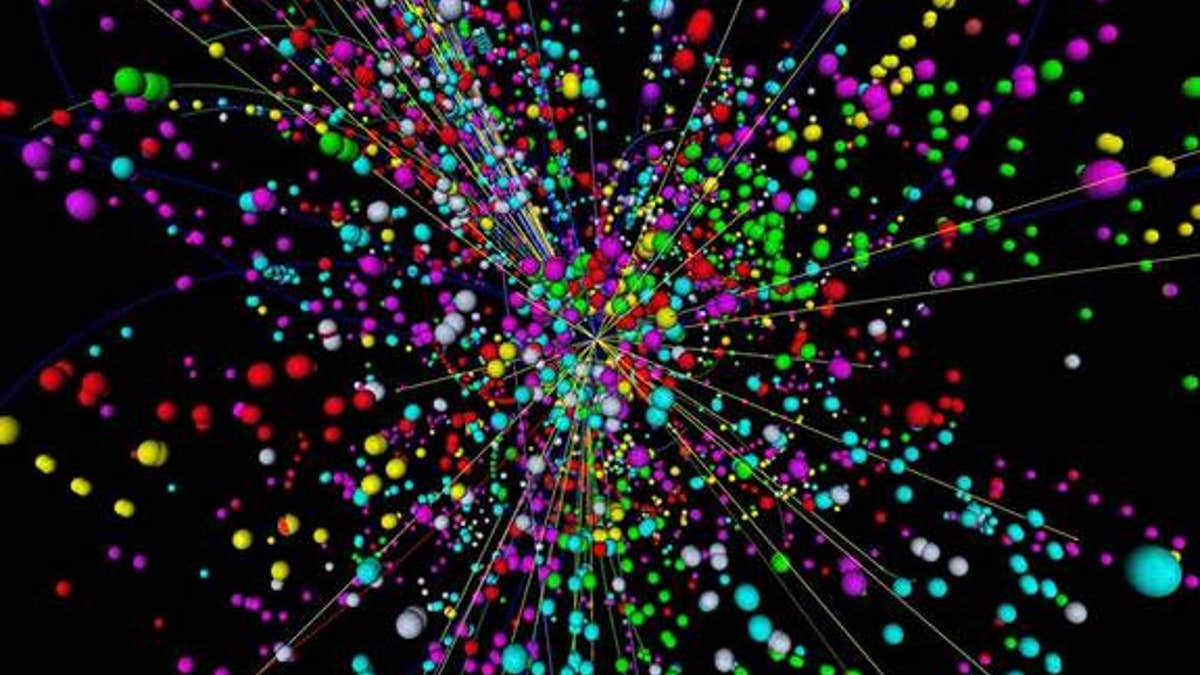
A simulation of a particle collision inside the Large Hadron Collider, the world's largest particle accelerator near Geneva, Switzerland. When two protons collide inside the machine, they create an energetic explosion that gives rise to new and exotic particles. (CERN)
Scientists at the world's biggest atom smasher have found further reasons for the apparent lack of antimatter in the universe.
A team working with data from CERN's Large Hadron Collider says it has discovered a particle that decays unevenly into matter and antimatter.
The lab near Geneva said Wednesday that the particle called `B0s' is the fourth sub-atomic particle known to prefer matter over antimatter.
Theory posits that the Big Bang produced equal amounts of each, and scientists have puzzled over why matter now dominates.
The discovery of the first matter-antimatter asymmetry earned two scientists at Brookhaven Laboratory in New York a Nobel Prize in 1980.
Team spokesman Pierluigi Campana said the find was predicted by the standard model of physics but "some interesting discrepancies demand more detailed studies."
https://www.foxnews.com/science/scientists-explain-universes-missing-antimatter