 Print
Print
 Close
Close

Meet my new co-pilot in the doctor's office: Artificial Intelligence
By Marc Siegel
Published May 17, 2023
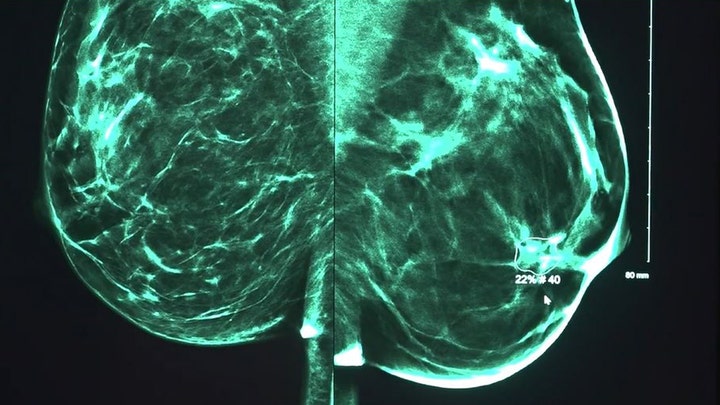
The more I learn about the growing uses of Artificial intelligence in health care, the more convinced I become about its essential place in not just the lab or radiology suite but also in the doctor’s office. It can help usher in a world where tests and treatments are applied on an individual basis based on a patient’s unique history and predicament.
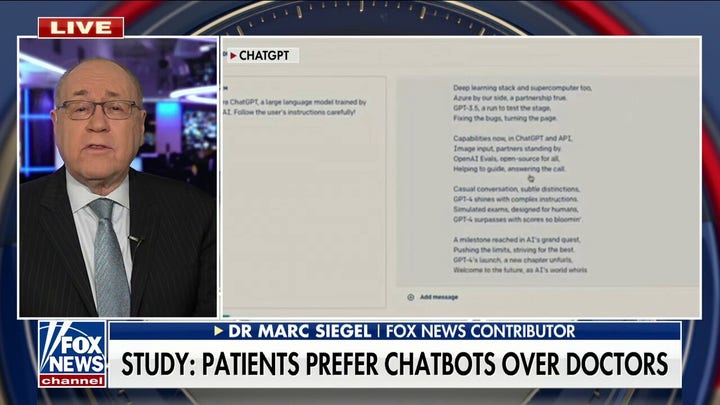
ChatGPT recently passed a radiology board style exam, even as it also informed one of my patients that his hemorrhoids might be from prolonged sitting before I thought to mention that possibility to him. At the same time, AI (a program called Sybil) has recently been found to help with earlier diagnosis of lung cancer by picking up abnormalities earlier than a human eye might detect them. Another study showed that it could be employed to measure multiple factors that predict pancreatic cancer up to three years before usual diagnosis.
AI has the advantage of searching massive data bases for comparison purposes, allowing it to bring this to bear in detecting differences that signals early pathology. Earlier diagnosis leads directly to earlier treatments and cures.
Dr. Miriam Bredella, a prominent professor of radiology at Harvard, told me on Doctor Radio on SiriusXM that a crucial purpose of AI in radiology is to rescreen many thousands of studies (X-rays, CT scans, MRIs) that were done for one reason and to use an AI algorithm to find something else, such as the amount of saturated fat in bone, which can correlate to other health problems, including insulin resistance, diabetes and osteoporosis.
AI TOOL HELPS DOCTORS MAKE SENSE OF CHAOTIC PATIENT DATA
A recent article in the journal Nature pointed out that AI could help primary care providers by combining early diagnoses of certain conditions including osteoporosis with treatment recommendations. AI in this context would serve as co-pilot, helping to inform busy doctors of relevant options. Doctors like me are already used to dealing with patients informed by Google searches. AI-fueled information will be more precise, and as long as it doesn’t undermine the doctor-patient relationship, will prove helpful in guiding patients.
In fact, a new report from the consulting firm Accenture showed that advances in large language AI models could support or augment 40 percent of all working hours in health care. Seminars in AI application in clinical practice are taking place all over the country, from MIT to Stanford to the Mayo Clinic.
CLICK HERE TO GET THE OPINION NEWSLETTER
This past week on Doctor Radio Reports, Dr. Natalia Trayanova, head of the Alliance for Cardiovascular Diagnostic and Treatment Innovations at Johns Hopkins, described digital twins, a replica of something physical, such as the heart or other organ or an entire patient, a dynamic model based on personalized data that can be used to monitor how a system is aging, providing information of how to replace a part that is wearing out without stopping the process that the part is engaged in. The information can constantly be adjusted with new data, using artificial intelligence to help make predictions in terms of disease.
CLICK HERE TO GET THE FOX NEWS APP
Of course AI technology is still evolving, and it is highly dependent on the quality of the dataset/health records used to train it, but amidst a huge shortage of healthcare workers AI will clearly be of help in a wide range of areas from preventive healthcare to pandemic preparedness, to drug discovery and development.
Don’t get me wrong. I want medical decisions to still take place entirely between a health care provider and his or her patients. But AI, when utilized and vetted properly, can certainly speed and smooth and revolutionize the process.
CLICK HERE TO READ MORE FROM DR. MARC SIEGEL
https://www.foxnews.com/opinion/meet-my-new-co-pilot-doctor-office-artificial-intelligence