 Print
Print
 Close
Close

Lab-grown mini brains mimic Parkinson’s disease, researchers say
By Kayla Rivas
Published September 07, 2021

Researchers have grown miniature brains in laboratory dishes to mirror Parkinson’s disease, learn how it progresses and study new treatments, Duke-NUS Medical School announced Tuesday, in what was reported as a first-time feat.
Parkinson’s disease is a neurodegenerative disorder without a cure, and which gradually causes movement-related issues, like tremors and rigidity, per the Parkinson’s Foundation.
CLICK HERE FOR FULL CORONAVIRUS COVERAGE
"Recreating models of Parkinson’s disease in animal models is hard as these do not show the progressive and selective loss of neurons that produce the neurotransmitter dopamine, a major feature of Parkinson’s disease," Professor Ng Huck Hui, senior group leader at the Agency for Science, Technology and Research’s Genome Institute of Singapore, and senior co-author of the study, said in a statement posted Tuesday. "Another limitation is that experimental mouse models of Parkinson’s disease do not develop characteristic clumps of proteins called Lewy bodies, which are often seen in the brain cells of people with Parkinson’s disease and a type of progressive dementia known as Lewy body dementia."
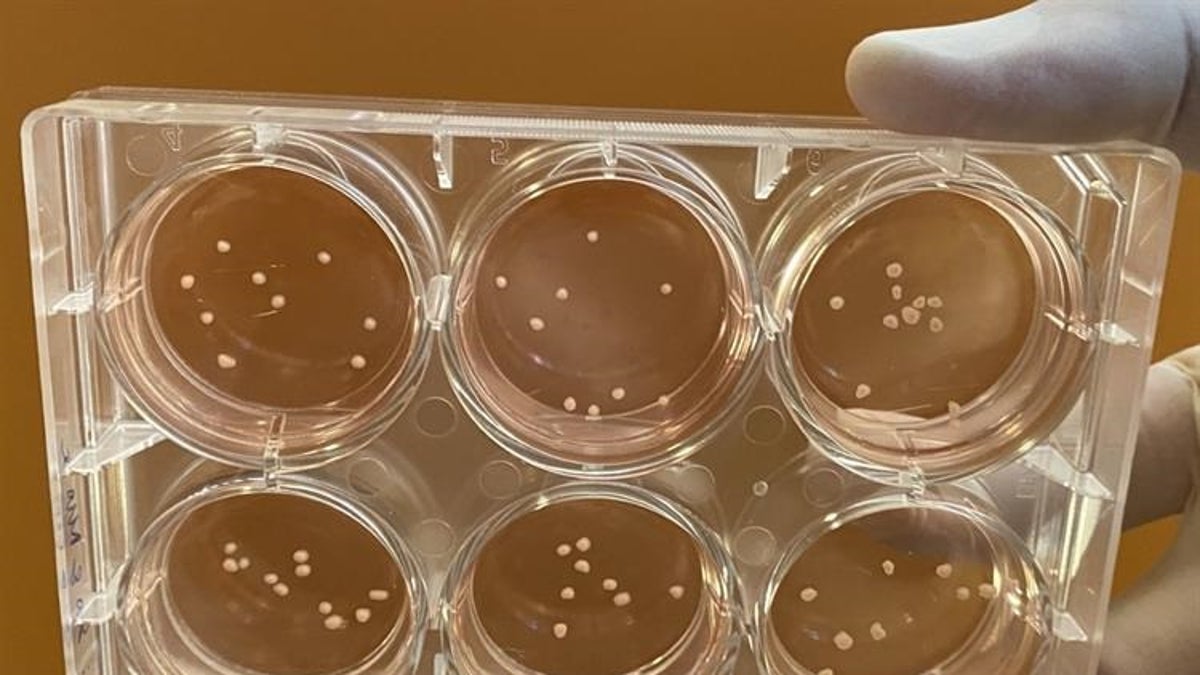
Small pea-sized human midbrain-like organoids – or three-dimensional, multicellular, in vitro tissue constructs that mimic the human midbrain – are grown from human stem cells to enable scientists to study how the human brain develops and communicates. (Credit: Associate Professor Hyunsoo Shawn Je, Duke-NUS Medical School)
ANTIBODY DRUG CUTS MODERATE ALZHEIMER'S DECLINE, SWISS BIOTECH CAUTIONS OVER RESULTS
The so-called "human midbrain-like organoids" were described as "three-dimensional, multicellular, in vitro tissue constructs that mimic the human midbrain." The organoids, approximately the size of a pea, "are grown from human stem cells into a bundle of neurons and other cells found in the brain," per the release.
"These experiments are the first to recreate the distinctive features of Parkinson’s disease that we see only in human patients," said Hyunsoo Shawn Je, associate professor and senior co-author from the Neuroscience and Behavioural Disorders Programme at Duke-NUS. "We have created a new model of the pathology involved, which will allow us to track how the disease develops and how it might be slowed down or stopped."
https://www.foxnews.com/health/lab-grown-mini-brains-mimic-parkinsons-disease-research